
Diboron trioxide; boric oxide
Diboron trioxide; boric oxide figure à l’annexe II en tant que substance interdite dans les produits cosmétiques mis sur le marché de l’UE.
Détails de la fiche
Nom chimique
Diboron trioxide; boric oxide
Nom chimique / IUPAC
Diboron trioxide; boric oxide
Informations réglementaires
CMR
| Catégorie | Carcinogenic | Mutagenic | Reprotoxic |
|---|---|---|---|
| Cat. 1B | — | — | ✓ |
Données clés
Identité et propriétés chimiques
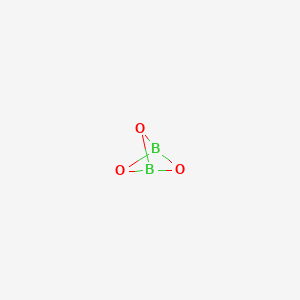
Boron oxide (B2O3)
Boron oxide appears as colorless, semi-transparent glassy lumps or hard white odorless crystals. Mp 450 °C; bp: 1860 °C. Density: 2.46 g cm-3. Moderately soluble in water. Used as an insecticide; as the starting material for the synthesis of other boron compounds; as a fluxing agent in enamels and glasses; and in mixture with 2-6% boron nitride, as a bonding agent in the hot isostatic pressing of boron nitride ceramics. — CAMEO Chemicals
- Nom IUPAC
- 2,4,5-trioxa-1,3-diborabicyclo[1.1.1]pentane
- Formule moléculaire
- B2O3
- Masse moléculaire
- 69.63 g/mol
- Masse exacte
- 70.0033542 Da
- Surface polaire topologique
- 27,7 Ų
- Donneurs de liaisons hydrogène
- 0
- Accepteurs de liaisons hydrogène
- 3
- Unités covalentes
- 1
- Stéréocentres définis
- 0
Également connu sous le nom de
16 autres noms signalés
Preuves issues de bases de données scientifiques complémentaires
NIH PubChem PUG-View
Attributed physical-property, hazard, environmental and use annotations.
- Boiling Point: 3380 °F at 760 mmHg (NIOSH, 2024) Source: CAMEO Chemicals
- Boiling Point: 1500 °C (crystal) Source: Hazardous Substances Data Bank (HSDB)
- Boiling Point: ~1860 °C Source: ILO-WHO International Chemical Safety Cards (ICSCs)
- Boiling Point: 3380 °F Source: Occupational Safety and Health Administration (OSHA)
- Boiling Point: 1500 °C @760 [mm Hg] Source: PAC Chemical Database, U.S. Department of Energy
- Boiling Point: 3380 °F Source: The National Institute for Occupational Safety and Health (NIOSH)
- Color/Form: Colorless, brittle, vitreous, semitransparent lumps or hard, white crystals Source: Hazardous Substances Data Bank (HSDB)
- Color/Form: Colorless, glassy or hexagonal crystals, hygroscopic Source: Hazardous Substances Data Bank (HSDB)
- Color/Form: Colorless powder or vitreous crystals Source: Hazardous Substances Data Bank (HSDB)
- Density: 2.46 (NIOSH, 2024) - Denser than water; will sink Source: CAMEO Chemicals
- Density: 1.8 g/cu cm (amorphous); 2.46 g/cu cm (crystal) Source: Hazardous Substances Data Bank (HSDB)
- Density: Relative density (water = 1): 2.46 (cryst) Source: ILO-WHO International Chemical Safety Cards (ICSCs)
- Density: 2.46 Source: Occupational Safety and Health Administration (OSHA)
- Density: 2.46 @25 °C Source: PAC Chemical Database, U.S. Department of Energy
- Density: 2.46 Source: The National Institute for Occupational Safety and Health (NIOSH)
- Melting Point: 842 °F (NIOSH, 2024) Source: CAMEO Chemicals
- Melting Point: 450 °C (crystal) Source: Hazardous Substances Data Bank (HSDB)
- Melting Point: 450 °C Source: ILO-WHO International Chemical Safety Cards (ICSCs)
- Melting Point: 842 °F Source: Occupational Safety and Health Administration (OSHA)
- Melting Point: 450 °C Source: PAC Chemical Database, U.S. Department of Energy
- Melting Point: 842 °F Source: The National Institute for Occupational Safety and Health (NIOSH)
- Odor: Odorless Source: Hazardous Substances Data Bank (HSDB)
- Physical Description: Boron oxide appears as colorless, semi-transparent glassy lumps or hard white odorless crystals. Mp 450 °C; bp: 1860 °C. Density: 2.46 g cm-3. Moderately soluble in water. Used as an insecticide; as the starting material for the synthesis of other boron compounds; as a fluxing agent in enamels and glasses; and in mixture with 2-6% boron nitride, as a bonding agent in the hot isostatic pressing of boron nitride ceramics. Source: CAMEO Chemicals
- Physical Description: Other Solid; Dry Powder; CBI; Large Crystals; Liquid; Other Solid Source: EPA Chemical Data Reporting (CDR)
- Physical Description: Colorless, semitransparent lumps or hard, white, odorless crystals; [NIOSH] Source: Haz-Map, Information on Hazardous Chemicals and Occupational Diseases
- Physical Description: WHITE HYGROSCOPIC POWDER OR GRANULES Source: ILO-WHO International Chemical Safety Cards (ICSCs)
- Physical Description: Colorless, semitransparent lumps or hard, white, odorless crystals. Source: Occupational Safety and Health Administration (OSHA)
- Physical Description: Colorless, semitransparent lumps or hard, white, odorless crystals. Source: The National Institute for Occupational Safety and Health (NIOSH)
- Refractive Index: INDEX OF REFRACTION: 1.61 Source: Hazardous Substances Data Bank (HSDB)
- Solubility: 3 % (NIOSH, 2024) Source: CAMEO Chemicals
- Solubility: Slowly soluble in 30 parts cold water; slowly soluble in 5 parts boiling water; soluble in alcohol, glycerol Source: Hazardous Substances Data Bank (HSDB)
- Solubility: Water solubility: 4.0% at 20 °C Source: Hazardous Substances Data Bank (HSDB)
- Solubility: 2.77 g/100 g water at 20 °C. Source: Hazardous Substances Data Bank (HSDB)
- Solubility: Solubility in water, g/l at 25 °C: 36 (moderate) Source: ILO-WHO International Chemical Safety Cards (ICSCs)
- Solubility: 3% Source: The National Institute for Occupational Safety and Health (NIOSH)
- Vapor Pressure: 0 mmHg (approx) (NIOSH, 2024) Source: CAMEO Chemicals
- Vapor Pressure: Negligible at 20 °C Source: Hazardous Substances Data Bank (HSDB)
- Vapor Pressure: 0 mmHg (approx) Source: Occupational Safety and Health Administration (OSHA)
- Vapor Pressure: 0 mmHg (approx) Source: The National Institute for Occupational Safety and Health (NIOSH)
- pH: pH = 5.1 at 20 °C 1.0% solution Source: Hazardous Substances Data Bank (HSDB)
- Exposure Routes: The substance can be absorbed into the body by inhalation of its aerosol and by ingestion. Source: ILO-WHO International Chemical Safety Cards (ICSCs)
- Exposure Routes: inhalation, ingestion, skin and/or eye contact Source: The National Institute for Occupational Safety and Health (NIOSH)
- First Aid: Excerpt from NIOSH Pocket Guide for Boron oxide:; Eye: IRRIGATE IMMEDIATELY - If this chemical contacts the eyes, immediately wash (irrigate) the eyes with large amounts of water, occasionally lifting the lower and upper lids. Get medical attention immediately.; Skin: WATER FLUSH PROMPTLY - If this chemical contacts the skin, flush the contaminated skin with water promptly. If this chemical penetrates the clothing, immediately remove the clothing and flush the skin with water promptly. If irritation persists after washing, get medical attention.; Breathing: FRESH AIR - If a person breathes large amounts of this chemical, move the exposed person to fresh air at once. Other measures are usually unnecessary.; Swallow: MEDICAL ATTENTION IMMEDIATELY - If this chemical has been swallowed, get medical attention immediately. (NIOSH, 2024) Source: CAMEO Chemicals
- First Aid: (General first aid procedures); Eye: Irrigate immediately - If this chemical contacts the eyes, immediately wash (irrigate) the eyes with large amounts of water, occasionally lifting the lower and upper lids. Get medical attention immediately.; Skin: Water flush promptly - If this chemical contacts the skin, flush the contaminated skin with water promptly. If this chemical penetrates the clothing, immediately remove the clothing and flush the skin with water promptly. If irritation persists after washing, get medical attention.; Breathing: Fresh air; Swallow: Medical attention immediately - If this chemical has been swallowed, get medical attention immediately. Source: The National Institute for Occupational Safety and Health (NIOSH)
- Signal: Danger Source: Regulation (EC) No 1272/2008 of the European Parliament and of the Council
- GHS Hazard Statements: H360FD: May damage fertility; May damage the unborn child [Danger Reproductive toxicity] Source: Regulation (EC) No 1272/2008 of the European Parliament and of the Council
- Precautionary Statement Codes: P203, P280, P318, P405, and P501 (click each P-code to see the statement) Source: Regulation (EC) No 1272/2008 of the European Parliament and of the Council
- Signal: Danger Source: European Chemicals Agency (ECHA)
- GHS Hazard Statements: H360 (95.1%): May damage fertility or the unborn child [Danger Reproductive toxicity]; H360FD (13.1%): May damage fertility; May damage the unborn child [Danger Reproductive toxicity] Source: European Chemicals Agency (ECHA)
- Precautionary Statement Codes: P203, P280, P318, P405, and P501 (click each P-code to see the statement) Source: European Chemicals Agency (ECHA)
- ECHA C&L Notifications Summary: Aggregated GHS information provided per 588 reports by companies from 17 notifications to the ECHA C&L Inventory. Each notification may be associated with multiple companies.; Information may vary between notifications depending on impurities, additives, and other factors. The percentage value in parenthesis indicates the notified classification ratio from companies that provide hazard codes. Only hazard codes with percentage values above 10% are shown. For more detailed information, please visit ECHA C&L website. Source: European Chemicals Agency (ECHA)
- Signal: Danger Source: NITE-CMC
- GHS Hazard Statements: H319: Causes serious eye irritation [Warning Serious eye damage/eye irritation]; H335: May cause respiratory irritation [Warning Specific target organ toxicity, single exposure; Respiratory tract irritation]; H360: May damage fertility or the unborn child [Danger Reproductive toxicity] Source: NITE-CMC
- Precautionary Statement Codes: P203, P261, P264+P265, P271, P280, P304+P340, P305+P351+P338, P318, P319, P337+P317, P403+P233, P405, and P501 (click each P-code to see the statement) Source: NITE-CMC
- Signal: Warning Source: NITE-CMC
- GHS Hazard Statements: H303: May be harmful if swallowed [Warning Acute toxicity, oral]; H316: Causes mild skin irritation [Warning Skin corrosion/irritation]; H319: Causes serious eye irritation [Warning Serious eye damage/eye irritation]; H335: May cause respiratory irritation [Warning Specific target organ toxicity, single exposure; Respiratory tract irritation] Source: NITE-CMC
- Target Organs: Eyes, skin, respiratory system Source: The National Institute for Occupational Safety and Health (NIOSH)
- Consumer Uses: Other; Adhesion/cohesion promoter; Flame retardant; Not Known or Reasonably Ascertainable; Catalyst Source: EPA Chemical Data Reporting (CDR)
- Industry Uses: Not Known or Reasonably Ascertainable; Catalyst; Flux agent; Flame retardant; Hardener; Other; Processing aids not otherwise specified Source: EPA Chemical Data Reporting (CDR)
- Sources/Uses: Used to produce elemental boron, heat-resistant glass, fire-resistant paint, electronics, and herbicides; Derived by heating boric acid; [Hawley] Source: Haz-Map, Information on Hazardous Chemicals and Occupational Diseases
- Industrial Processes with risk of exposure: Semiconductor Manufacturing [Category: Industry]; Glass Manufacturing [Category: Industry] Source: Haz-Map, Information on Hazardous Chemicals and Occupational Diseases
- Uses: For boron oxide (USEPA/OPP Pesticide Code: 011002) there are 0 labels match. /SRP: Not registered for current use in the U.S., but approved pesticide uses may change periodically and so federal, state and local authorities must be consulted for currently approved uses./ Source: Hazardous Substances Data Bank (HSDB)
- Uses: Used in herbicides; fire resistant additive for paints, electronics; liquid encapsulation techniques Source: Hazardous Substances Data Bank (HSDB)
- Uses: In metallurgy; in analysis of silicates to determine silicon dioxide and alkalies; in blowpipe analysis. Source: Hazardous Substances Data Bank (HSDB)
- Uses: Flux for enamels and glazes; additive for glass fibers; chemical intermediate for elemental boron, boron master alloys, borides, boron carbide, nitrides and halides Source: Hazardous Substances Data Bank (HSDB)
- Uses: As catalyst Source: Hazardous Substances Data Bank (HSDB)
Mis en correspondance par: Existing checksum-valid CAS to unique PubChem CID match. Récupéré le: 2026-08-31. Ouvrir la fiche source
Les classifications scientifiques et les annotations de danger apportent du contexte et ne remplacent pas la décision réglementaire propre au marché indiquée ci-dessus.
Couverture des sources complémentaires et état des correspondances
| Source | Résultat | Vérifié |
|---|---|---|
| NIH PubChem PUG-View | Correspondance exacte | 2026-08-31 |
Une absence de correspondance enregistrée est une preuve utile que la source a été vérifiée ; ce n’est pas l’affirmation que la substance n’existe pas ailleurs.
Récupéré depuis NIH PubChem le 2026-09-02 par correspondance CAS à somme de contrôle valide. Les propriétés chimiques ne remplacent pas la décision réglementaire de cette page.
Fiches associées pour Diboron trioxide; boric oxide
Les correspondances directes sont limitées pour cette fiche ; des entrées voisines de l’annexe II sont donc également affichées.
N-Methyl-2-pyrrolidone; 1-methyl-2-pyrrolidone
Boric acid [1]; Boric acid [2]
1-Cyclopropyl-6,7-difluoro-1,4-dihydro-4-oxoquinoline-3-carboxylic acid
Borates, tetraborates, octaborates and boric acid salts and esters, including: Disodium octaborate …
Perboric acid (H3BO2(O2)), monosodium salt trihydrate [1] Perboric acid, sodium salt, tetrahydrate …
2,2'-((3,3',5,5'-Tetramethyl-(1,1'-biphenyl)-4,4'-diyl)-bis(oxymethylene))-bis-oxirane
Dibutyltin hydrogen borate
Dichloromethane; methylene chloride
Nickel bis(tetrafluoroborate)
Octamethylcyclotetrasiloxane; D4
Mancozeb (ISO); manganese ethylenebis(dithiocarbamate) (polymeric) complex with zinc salt
Ce que signifie l’annexe II pour Diboron trioxide; boric oxide
Diboron trioxide; boric oxide figure comme substance interdite à l’annexe II du règlement (CE) n° 1223/2009 relatif aux produits cosmétiques et ne doit pas être ajouté intentionnellement. L’article 17 traite séparément des traces involontaires, techniquement inévitables dans le respect des bonnes pratiques de fabrication et compatibles avec l’exigence de sécurité de l’article 3.
Les formulateurs doivent contrôler leurs ingrédients et matières premières afin de s’assurer qu’aucun ne contient cette substance. Les fournisseurs doivent fournir, sur demande, une documentation confirmant son absence.
La page fait également apparaître 12 fiches d’annexe associées présentant des identifiants, une logique d’annexe ou des schémas de dénomination qui se recoupent.
Liste de contrôle de conformité
- Vérifiez que cette substance est absente de toutes les matières premières et formulations finies.
- Demandez aux fournisseurs de matières premières une attestation d’absence ou un certificat d’analyse.
- Consignez le résultat du contrôle dans le dossier d’information produit (DIP).
- Cette substance a une classification CMR. Examinez le tableau CMR ci-dessus et vérifiez le statut actuel dans les annexes II/III avant toute utilisation.
Questions fréquentes
Note de source pour la fiche Diboron trioxide; boric oxide de l’annexe II
Cette page résume une fiche de l’annexe II pour Diboron trioxide; boric oxide à partir de documents publics de la Commission européenne sur les cosmétiques et ajoute les correspondances d’inventaire ou d’identifiants associées lorsqu’elles sont disponibles.
Utilisez cette page de fiche pour examiner les conditions de l’annexe II pour Diboron trioxide; boric oxide, mais confirmez toute décision réglementaire finale auprès du libellé officiel en vigueur de l’annexe et des fichiers sources.
Outils et étapes suivantes
Vérifiez votre formule
Collez une liste INCI complète pour détecter Diboron trioxide; boric oxide et d’autres fiches d’annexe de l’UE signalées en une seule passe.
Vérificateur INCIComparer des entrées
Comparez Diboron trioxide; boric oxide côte à côte avec une autre fiche d’annexe pour examiner les différences de restrictions, de concentrations et d’annexe.
ComparerParcourir l’annexe
Consultez toutes les fiches de l’annexe II et comparez les conditions réglementaires entre les substances de cette annexe.
Ouvrir l’annexe II