
Diboron trioxide; boric oxide
Diboron trioxide; boric oxide은(는) EU 시장에 출시되는 화장품에 사용이 금지된 물질로 부속서 II에 등재되어 있습니다.
기록 세부 정보
화학명
Diboron trioxide; boric oxide
화학명 / IUPAC 명칭
Diboron trioxide; boric oxide
규제 정보
CMR
| 카테고리 | Carcinogenic | Mutagenic | Reprotoxic |
|---|---|---|---|
| Cat. 1B | — | — | ✓ |
주요 데이터
화학적 정체 및 특성
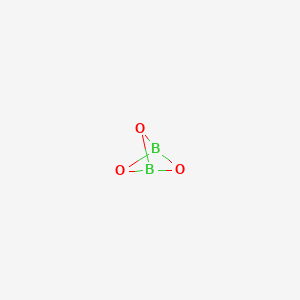
Boron oxide (B2O3)
Boron oxide appears as colorless, semi-transparent glassy lumps or hard white odorless crystals. Mp 450 °C; bp: 1860 °C. Density: 2.46 g cm-3. Moderately soluble in water. Used as an insecticide; as the starting material for the synthesis of other boron compounds; as a fluxing agent in enamels and glasses; and in mixture with 2-6% boron nitride, as a bonding agent in the hot isostatic pressing of boron nitride ceramics. — CAMEO Chemicals
- IUPAC 명칭
- 2,4,5-trioxa-1,3-diborabicyclo[1.1.1]pentane
- 분자식
- B2O3
- 분자량
- 69.63 g/mol
- 정확한 질량
- 70.0033542 Da
- 위상 극성 표면적
- 27.7 Ų
- 수소 결합 공여체
- 0
- 수소 결합 수용체
- 3
- 공유결합 단위
- 1
- 정의된 입체중심
- 0
다른 이름
보고된 명칭 16개 더 보기
추가 과학 데이터베이스의 근거
NIH PubChem PUG-View
Attributed physical-property, hazard, environmental and use annotations.
- Boiling Point: 3380 °F at 760 mmHg (NIOSH, 2024) 출처: CAMEO Chemicals
- Boiling Point: 1500 °C (crystal) 출처: Hazardous Substances Data Bank (HSDB)
- Boiling Point: ~1860 °C 출처: ILO-WHO International Chemical Safety Cards (ICSCs)
- Boiling Point: 3380 °F 출처: Occupational Safety and Health Administration (OSHA)
- Boiling Point: 1500 °C @760 [mm Hg] 출처: PAC Chemical Database, U.S. Department of Energy
- Boiling Point: 3380 °F 출처: The National Institute for Occupational Safety and Health (NIOSH)
- Color/Form: Colorless, brittle, vitreous, semitransparent lumps or hard, white crystals 출처: Hazardous Substances Data Bank (HSDB)
- Color/Form: Colorless, glassy or hexagonal crystals, hygroscopic 출처: Hazardous Substances Data Bank (HSDB)
- Color/Form: Colorless powder or vitreous crystals 출처: Hazardous Substances Data Bank (HSDB)
- Density: 2.46 (NIOSH, 2024) - Denser than water; will sink 출처: CAMEO Chemicals
- Density: 1.8 g/cu cm (amorphous); 2.46 g/cu cm (crystal) 출처: Hazardous Substances Data Bank (HSDB)
- Density: Relative density (water = 1): 2.46 (cryst) 출처: ILO-WHO International Chemical Safety Cards (ICSCs)
- Density: 2.46 출처: Occupational Safety and Health Administration (OSHA)
- Density: 2.46 @25 °C 출처: PAC Chemical Database, U.S. Department of Energy
- Density: 2.46 출처: The National Institute for Occupational Safety and Health (NIOSH)
- Melting Point: 842 °F (NIOSH, 2024) 출처: CAMEO Chemicals
- Melting Point: 450 °C (crystal) 출처: Hazardous Substances Data Bank (HSDB)
- Melting Point: 450 °C 출처: ILO-WHO International Chemical Safety Cards (ICSCs)
- Melting Point: 842 °F 출처: Occupational Safety and Health Administration (OSHA)
- Melting Point: 450 °C 출처: PAC Chemical Database, U.S. Department of Energy
- Melting Point: 842 °F 출처: The National Institute for Occupational Safety and Health (NIOSH)
- Odor: Odorless 출처: Hazardous Substances Data Bank (HSDB)
- Physical Description: Boron oxide appears as colorless, semi-transparent glassy lumps or hard white odorless crystals. Mp 450 °C; bp: 1860 °C. Density: 2.46 g cm-3. Moderately soluble in water. Used as an insecticide; as the starting material for the synthesis of other boron compounds; as a fluxing agent in enamels and glasses; and in mixture with 2-6% boron nitride, as a bonding agent in the hot isostatic pressing of boron nitride ceramics. 출처: CAMEO Chemicals
- Physical Description: Other Solid; Dry Powder; CBI; Large Crystals; Liquid; Other Solid 출처: EPA Chemical Data Reporting (CDR)
- Physical Description: Colorless, semitransparent lumps or hard, white, odorless crystals; [NIOSH] 출처: Haz-Map, Information on Hazardous Chemicals and Occupational Diseases
- Physical Description: WHITE HYGROSCOPIC POWDER OR GRANULES 출처: ILO-WHO International Chemical Safety Cards (ICSCs)
- Physical Description: Colorless, semitransparent lumps or hard, white, odorless crystals. 출처: Occupational Safety and Health Administration (OSHA)
- Physical Description: Colorless, semitransparent lumps or hard, white, odorless crystals. 출처: The National Institute for Occupational Safety and Health (NIOSH)
- Refractive Index: INDEX OF REFRACTION: 1.61 출처: Hazardous Substances Data Bank (HSDB)
- Solubility: 3 % (NIOSH, 2024) 출처: CAMEO Chemicals
- Solubility: Slowly soluble in 30 parts cold water; slowly soluble in 5 parts boiling water; soluble in alcohol, glycerol 출처: Hazardous Substances Data Bank (HSDB)
- Solubility: Water solubility: 4.0% at 20 °C 출처: Hazardous Substances Data Bank (HSDB)
- Solubility: 2.77 g/100 g water at 20 °C. 출처: Hazardous Substances Data Bank (HSDB)
- Solubility: Solubility in water, g/l at 25 °C: 36 (moderate) 출처: ILO-WHO International Chemical Safety Cards (ICSCs)
- Solubility: 3% 출처: The National Institute for Occupational Safety and Health (NIOSH)
- Vapor Pressure: 0 mmHg (approx) (NIOSH, 2024) 출처: CAMEO Chemicals
- Vapor Pressure: Negligible at 20 °C 출처: Hazardous Substances Data Bank (HSDB)
- Vapor Pressure: 0 mmHg (approx) 출처: Occupational Safety and Health Administration (OSHA)
- Vapor Pressure: 0 mmHg (approx) 출처: The National Institute for Occupational Safety and Health (NIOSH)
- pH: pH = 5.1 at 20 °C 1.0% solution 출처: Hazardous Substances Data Bank (HSDB)
- Exposure Routes: The substance can be absorbed into the body by inhalation of its aerosol and by ingestion. 출처: ILO-WHO International Chemical Safety Cards (ICSCs)
- Exposure Routes: inhalation, ingestion, skin and/or eye contact 출처: The National Institute for Occupational Safety and Health (NIOSH)
- First Aid: Excerpt from NIOSH Pocket Guide for Boron oxide:; Eye: IRRIGATE IMMEDIATELY - If this chemical contacts the eyes, immediately wash (irrigate) the eyes with large amounts of water, occasionally lifting the lower and upper lids. Get medical attention immediately.; Skin: WATER FLUSH PROMPTLY - If this chemical contacts the skin, flush the contaminated skin with water promptly. If this chemical penetrates the clothing, immediately remove the clothing and flush the skin with water promptly. If irritation persists after washing, get medical attention.; Breathing: FRESH AIR - If a person breathes large amounts of this chemical, move the exposed person to fresh air at once. Other measures are usually unnecessary.; Swallow: MEDICAL ATTENTION IMMEDIATELY - If this chemical has been swallowed, get medical attention immediately. (NIOSH, 2024) 출처: CAMEO Chemicals
- First Aid: (General first aid procedures); Eye: Irrigate immediately - If this chemical contacts the eyes, immediately wash (irrigate) the eyes with large amounts of water, occasionally lifting the lower and upper lids. Get medical attention immediately.; Skin: Water flush promptly - If this chemical contacts the skin, flush the contaminated skin with water promptly. If this chemical penetrates the clothing, immediately remove the clothing and flush the skin with water promptly. If irritation persists after washing, get medical attention.; Breathing: Fresh air; Swallow: Medical attention immediately - If this chemical has been swallowed, get medical attention immediately. 출처: The National Institute for Occupational Safety and Health (NIOSH)
- Signal: Danger 출처: Regulation (EC) No 1272/2008 of the European Parliament and of the Council
- GHS Hazard Statements: H360FD: May damage fertility; May damage the unborn child [Danger Reproductive toxicity] 출처: Regulation (EC) No 1272/2008 of the European Parliament and of the Council
- Precautionary Statement Codes: P203, P280, P318, P405, and P501 (click each P-code to see the statement) 출처: Regulation (EC) No 1272/2008 of the European Parliament and of the Council
- Signal: Danger 출처: European Chemicals Agency (ECHA)
- GHS Hazard Statements: H360 (95.1%): May damage fertility or the unborn child [Danger Reproductive toxicity]; H360FD (13.1%): May damage fertility; May damage the unborn child [Danger Reproductive toxicity] 출처: European Chemicals Agency (ECHA)
- Precautionary Statement Codes: P203, P280, P318, P405, and P501 (click each P-code to see the statement) 출처: European Chemicals Agency (ECHA)
- ECHA C&L Notifications Summary: Aggregated GHS information provided per 588 reports by companies from 17 notifications to the ECHA C&L Inventory. Each notification may be associated with multiple companies.; Information may vary between notifications depending on impurities, additives, and other factors. The percentage value in parenthesis indicates the notified classification ratio from companies that provide hazard codes. Only hazard codes with percentage values above 10% are shown. For more detailed information, please visit ECHA C&L website. 출처: European Chemicals Agency (ECHA)
- Signal: Danger 출처: NITE-CMC
- GHS Hazard Statements: H319: Causes serious eye irritation [Warning Serious eye damage/eye irritation]; H335: May cause respiratory irritation [Warning Specific target organ toxicity, single exposure; Respiratory tract irritation]; H360: May damage fertility or the unborn child [Danger Reproductive toxicity] 출처: NITE-CMC
- Precautionary Statement Codes: P203, P261, P264+P265, P271, P280, P304+P340, P305+P351+P338, P318, P319, P337+P317, P403+P233, P405, and P501 (click each P-code to see the statement) 출처: NITE-CMC
- Signal: Warning 출처: NITE-CMC
- GHS Hazard Statements: H303: May be harmful if swallowed [Warning Acute toxicity, oral]; H316: Causes mild skin irritation [Warning Skin corrosion/irritation]; H319: Causes serious eye irritation [Warning Serious eye damage/eye irritation]; H335: May cause respiratory irritation [Warning Specific target organ toxicity, single exposure; Respiratory tract irritation] 출처: NITE-CMC
- Target Organs: Eyes, skin, respiratory system 출처: The National Institute for Occupational Safety and Health (NIOSH)
- Consumer Uses: Other; Adhesion/cohesion promoter; Flame retardant; Not Known or Reasonably Ascertainable; Catalyst 출처: EPA Chemical Data Reporting (CDR)
- Industry Uses: Not Known or Reasonably Ascertainable; Catalyst; Flux agent; Flame retardant; Hardener; Other; Processing aids not otherwise specified 출처: EPA Chemical Data Reporting (CDR)
- Sources/Uses: Used to produce elemental boron, heat-resistant glass, fire-resistant paint, electronics, and herbicides; Derived by heating boric acid; [Hawley] 출처: Haz-Map, Information on Hazardous Chemicals and Occupational Diseases
- Industrial Processes with risk of exposure: Semiconductor Manufacturing [Category: Industry]; Glass Manufacturing [Category: Industry] 출처: Haz-Map, Information on Hazardous Chemicals and Occupational Diseases
- Uses: For boron oxide (USEPA/OPP Pesticide Code: 011002) there are 0 labels match. /SRP: Not registered for current use in the U.S., but approved pesticide uses may change periodically and so federal, state and local authorities must be consulted for currently approved uses./ 출처: Hazardous Substances Data Bank (HSDB)
- Uses: Used in herbicides; fire resistant additive for paints, electronics; liquid encapsulation techniques 출처: Hazardous Substances Data Bank (HSDB)
- Uses: In metallurgy; in analysis of silicates to determine silicon dioxide and alkalies; in blowpipe analysis. 출처: Hazardous Substances Data Bank (HSDB)
- Uses: Flux for enamels and glazes; additive for glass fibers; chemical intermediate for elemental boron, boron master alloys, borides, boron carbide, nitrides and halides 출처: Hazardous Substances Data Bank (HSDB)
- Uses: As catalyst 출처: Hazardous Substances Data Bank (HSDB)
매핑 기준: Existing checksum-valid CAS to unique PubChem CID match. 가져온 시각: 2026-08-31. 출처 기록 열기
과학적 분류와 유해성 주석은 맥락을 제공할 뿐이며, 위에 표시된 시장별 규제 판단을 대체하지 않습니다.
추가 출처 적용 범위 및 일치 상태
| 출처 | 결과 | 확인됨 |
|---|---|---|
| NIH PubChem PUG-View | 정확히 일치 | 2026-08-31 |
기록된 불일치는 출처를 확인했다는 유용한 근거이며, 해당 물질이 다른 곳에 존재하지 않는다는 주장이 아닙니다.
체크섬이 유효한 CAS 일치를 통해 2026-09-02에 NIH PubChem에서 가져왔습니다. 화학적 특성은 이 페이지의 규제 판단을 대체하지 않습니다.
Diboron trioxide; boric oxide의 관련 기록
이 기록에 직접 일치하는 항목이 제한적이어서, 부속서 II의 인접 항목도 함께 표시합니다.
Boric acid [1]; Boric acid [2]
1-Cyclopropyl-6,7-difluoro-1,4-dihydro-4-oxoquinoline-3-carboxylic acid
Borates, tetraborates, octaborates and boric acid salts and esters, including: Disodium octaborate …
Perboric acid (H3BO2(O2)), monosodium salt trihydrate [1] Perboric acid, sodium salt, tetrahydrate …
2,2'-((3,3',5,5'-Tetramethyl-(1,1'-biphenyl)-4,4'-diyl)-bis(oxymethylene))-bis-oxirane
Mancozeb (ISO); manganese ethylenebis(dithiocarbamate) (polymeric) complex with zinc salt
Diboron trioxide; boric oxide에 대한 부속서 II의 의미
Diboron trioxide; boric oxide은(는) EU 화장품 규정 1223/2009 부속서 II에 따라 사용금지 물질로 등재되어 있으며 의도적으로 첨가해서는 안 됩니다. 제17조는 별도로, 우수화장품제조관리기준(GMP)에 따라 기술적으로 피할 수 없고 제3조의 안전 요건에 부합하는 비의도적 미량에 대해 다룹니다.
처방 개발자는 원료와 원재료를 선별하여 이 물질이 들어 있지 않은지 확인해야 합니다. 공급업체는 요청 시 부재를 확인하는 문서를 제공해야 합니다.
또한 이 페이지에는 식별자, 부속서 논리 또는 명칭 패턴이 겹치는 관련 부속서 기록 12건이 표시됩니다.
규제 준수 체크리스트
- 이 물질이 모든 원료와 완제품 처방에 없는지 확인하세요.
- 원료 공급업체에 부재 확인서 또는 CoA를 요청하세요.
- 선별 결과를 제품정보파일(PIF)에 기록하세요.
- 이 물질은 CMR로 분류되어 있습니다. 사용 전에 위의 CMR 표를 검토하고 현재 부속서 II/III 상태를 확인하세요.