
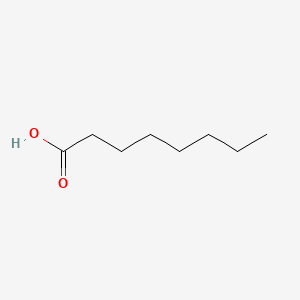
Octanoic Acid
Octanoic acid is a straight-chain saturated fatty acid that is heptane in which one of the hydrogens of a terminal methyl group has been replaced by a carboxy group. Octanoic acid is also known as caprylic acid. It has a role as an antibacterial agent, an Escherichia coli metabolite and a human metabolite. It is a straight-chain saturated fatty acid and a medium-chain fatty acid. It is a conjugate acid of an octanoate. — ChEBI
- IUPAC name
- octanoic acid
- Molecular formula
- C8H16O2
- Molecular weight
- 144.21 g/mol
- Exact mass
- 144.115029749 Da
- XLogP3
- 3.0
- Topological polar surface area
- 37.3 Ų
- Hydrogen-bond donors
- 1
- Hydrogen-bond acceptors
- 2
- Covalent units
- 1
- Defined stereocentres
- 0
Also known as
16 more reported names
External database identifiers
- ChEBI:CHEBI:28837
- ChEMBL:CHEMBL324846
- EPA DTXSID:DTXSID3021645
- PubMed:23110149
- PubMed:23109878
- PubMed:23049343
- PubMed:23028854
- PubMed:23027775
- PubMed:23026261
- PubMed:22975500
- PubMed:22975065
- PubMed:22975052
- PubMed:22975047
- PubMed:22975045
- PubMed:22947450
Evidence from additional scientific databases
NIH PubChem PUG-View
Attributed physical-property, hazard, environmental and use annotations.
- Boiling Point: 463.5 °F at 760 mmHg (NTP, 1992) Source: CAMEO Chemicals
- Boiling Point: 239 °C Source: DrugBank
- Boiling Point: 239 °C Source: Hazardous Substances Data Bank (HSDB)
- Boiling Point: 240 °C Source: Joint FAO/WHO Expert Committee on Food Additives (JECFA)
- Boiling Point: 240 °C @760 [mm Hg] Source: PAC Chemical Database, U.S. Department of Energy
- Color/Form: SOLIDIFIES TO LEAFY CRYSTALS WHEN COLD Source: Hazardous Substances Data Bank (HSDB)
- Color/Form: Colorless Source: Hazardous Substances Data Bank (HSDB)
- Color/Form: Oily liquid Source: Hazardous Substances Data Bank (HSDB)
- Density: 0.91 (USCG, 1999) - Less dense than water; will float Source: CAMEO Chemicals
- Density: 0.910 at 20 °C/4 °C Source: Hazardous Substances Data Bank (HSDB)
- Density: 0.91 Source: Joint FAO/WHO Expert Committee on Food Additives (JECFA)
- Density: 0.91 @ 20°C Source: PAC Chemical Database, U.S. Department of Energy
- pKa: 4.89 (at 25 °C) Source: DrugBank
- Dissociation Constants: pKa = 4.895 at 25 °C Source: Hazardous Substances Data Bank (HSDB)
- Flash Point: 230 °F (NTP, 1992) Source: CAMEO Chemicals
- Flash Point: 270 °F Source: Haz-Map, Information on Hazardous Chemicals and Occupational Diseases
- Flash Point: 130 °C (open cup) Source: Hazardous Substances Data Bank (HSDB)
- Flash Point: 270 °F. Source: Hazardous Substances Data Bank (HSDB)
- LogP: 3.05 Source: DrugBank
- LogP: log Kow = 3.05 Source: Hazardous Substances Data Bank (HSDB)
- LogP: 3.05 Source: Human Metabolome Database (HMDB)
- Melting Point: 61 to 62 °F (NTP, 1992) Source: CAMEO Chemicals
- Melting Point: 16.3 °C Source: DrugBank
- Melting Point: 16.5 °C Source: Hazardous Substances Data Bank (HSDB)
- Melting Point: 16.5 °C Source: Human Metabolome Database (HMDB)
- Odor: FAINT, FRUITY-ACID ODOR Source: Hazardous Substances Data Bank (HSDB)
- Odor: UNPLEASANT AND IRRITATING ODOR Source: Hazardous Substances Data Bank (HSDB)
- Odor: Slight odor Source: Hazardous Substances Data Bank (HSDB)
- Physical Description: Octanoic acid appears as a colorless to light yellow liquid with a mild odor. Burns, but may be difficult to ignite. Corrosive to metals and tissue. Source: CAMEO Chemicals
- Physical Description: Liquid; Liquid; Other Solid Source: EPA Chemical Data Reporting (CDR)
- Physical Description: Colorless to light yellow liquid with a mild odor; Insoluble in water; [CAMEO] May solidify when used or stored below room temperature; [CHEMINFO] Source: Haz-Map, Information on Hazardous Chemicals and Occupational Diseases
- Physical Description: Liquid Source: Human Metabolome Database (HMDB)
- Physical Description: colourless, oily liquid/slight, unpleasant odour Source: Joint FAO/WHO Expert Committee on Food Additives (JECFA)
- Refractive Index: Index of refraction: 1.4285 at 20 °C/D Source: Hazardous Substances Data Bank (HSDB)
- Refractive Index: 1.423-1.429 Source: Joint FAO/WHO Expert Committee on Food Additives (JECFA)
- Solubility: less than 1 mg/mL at 64 °F (NTP, 1992) Source: CAMEO Chemicals
- Solubility: 789 mg/L (at 30 °C) Source: DrugBank
- Solubility: Very slightly sol in water (0.068 g/100 g at 20 °C); freely sol in alcohol, chloroform, ether, carbon disulfide, petroleum ether, glacial acetic acid Source: Hazardous Substances Data Bank (HSDB)
- Solubility: Miscible in ethanol, chloroform, acetonitrile Source: Hazardous Substances Data Bank (HSDB)
- Solubility: In water 789 mg/L at 30 °C Source: Hazardous Substances Data Bank (HSDB)
- Solubility: 0.789 mg/mL Source: Human Metabolome Database (HMDB)
- Solubility: slightly soluble in water; soluble in most organic solvents Source: Joint FAO/WHO Expert Committee on Food Additives (JECFA)
- Solubility: (in ethanol) Source: Joint FAO/WHO Expert Committee on Food Additives (JECFA)
- Vapor Pressure: 1 mmHg at 198.1 °F ; 5 mmHg at 237.4 °F; 760 mmHg at 459.5 °F (NTP, 1992) Source: CAMEO Chemicals
- Vapor Pressure: 0.00371 [mmHg] Source: Haz-Map, Information on Hazardous Chemicals and Occupational Diseases
- Vapor Pressure: VP: 1 MM HG AT 78.0 °C Source: Hazardous Substances Data Bank (HSDB)
- Vapor Pressure: 3.71X10⁻³ mm Hg at 25 °C Source: Hazardous Substances Data Bank (HSDB)
- Viscosity: 5.74 mPa.sec Source: Hazardous Substances Data Bank (HSDB)
- Carcinogen Classification: No indication of carcinogenicity to humans (not listed by IARC). Source: Toxin and Toxin Target Database (T3DB)
- Exposure Routes: Ingestion Source: Toxin and Toxin Target Database (T3DB)
- First Aid: EYES: First check the victim for contact lenses and remove if present. Flush victim's eyes with water or normal saline solution for 20 to 30 minutes while simultaneously calling a hospital or poison control center. Do not put any ointments, oils, or medication in the victim's eyes without specific instructions from a physician. IMMEDIATELY transport the victim after flushing eyes to a hospital even if no symptoms (such as redness or irritation) develop.; SKIN: IMMEDIATELY flood affected skin with water while removing and isolating all contaminated clothing. Gently wash all affected skin areas thoroughly with soap and water. IMMEDIATELY call a hospital or poison control center even if no symptoms (such as redness or irritation) develop. IMMEDIATELY transport the victim to a hospital for treatment after washing the affected areas.; INHALATION: IMMEDIATELY leave the contaminated area; take deep breaths of fresh air. If symptoms (such as wheezing, coughing, shortness of breath, or burning in the mouth, throat, or chest) develop, call a physician and be prepared to transport the victim to a hospital. Provide proper respiratory protection to rescuers entering an unknown atmosphere. Whene Source: CAMEO Chemicals
- Signal: Danger Source: Regulation (EC) No 1272/2008 of the European Parliament and of the Council
- GHS Hazard Statements: H314: Causes severe skin burns and eye damage [Danger Skin corrosion/irritation]; H412: Harmful to aquatic life with long lasting effects [Hazardous to the aquatic environment, long-term hazard] Source: Regulation (EC) No 1272/2008 of the European Parliament and of the Council
- Precautionary Statement Codes: P260, P264, P273, P280, P301+P330+P331, P302+P361+P354, P304+P340, P305+P354+P338, P316, P321, P363, P405, and P501 (click each P-code to see the statement) Source: Regulation (EC) No 1272/2008 of the European Parliament and of the Council
- Note: This chemical does not meet GHS hazard criteria for 2.4% (71 of 2978) of reports. Source: European Chemicals Agency (ECHA)
- Signal: Danger Source: European Chemicals Agency (ECHA)
- GHS Hazard Statements: H302 (10.6%): Harmful if swallowed [Warning Acute toxicity, oral]; H311 (10.6%): Toxic in contact with skin [Danger Acute toxicity, dermal]; H314 (97.1%): Causes severe skin burns and eye damage [Danger Skin corrosion/irritation]; H318 (78.6%): Causes serious eye damage [Danger Serious eye damage/eye irritation]; H412 (58.6%): Harmful to aquatic life with long lasting effects [Hazardous to the aquatic environment, long-term hazard] Source: European Chemicals Agency (ECHA)
- Precautionary Statement Codes: P260, P262, P264, P264+P265, P270, P273, P280, P301+P317, P301+P330+P331, P302+P352, P302+P361+P354, P304+P340, P305+P354+P338, P316, P317, P321, P330, P361+P364, P363, P405, and P501 (click each P-code to see the statement) Source: European Chemicals Agency (ECHA)
- ECHA C&L Notifications Summary: Aggregated GHS information provided per 2978 reports by companies from 31 notifications to the ECHA C&L Inventory. Each notification may be associated with multiple companies.; Reported as not meeting GHS hazard criteria per 71 of 2978 reports by companies.; There are 29 notifications provided by 2907 of 2978 reports by companies with hazard statement code(s).; Information may vary between notifications depending on impurities, additives, and other factors. The percentage value in parenthesis indicates the notified classification ratio from companies that provide hazard codes. Only hazard codes with percentage values above 10% are shown. For more detailed information, please visit ECHA C&L website. Source: European Chemicals Agency (ECHA)
- Signal: Danger Source: NITE-CMC
- GHS Hazard Statements: H314: Causes severe skin burns and eye damage [Danger Skin corrosion/irritation]; H318: Causes serious eye damage [Danger Serious eye damage/eye irritation]; H402: Harmful to aquatic life [Hazardous to the aquatic environment, acute hazard] Source: NITE-CMC
- Precautionary Statement Codes: P260, P264, P264+P265, P273, P280, P301+P330+P331, P302+P361+P354, P304+P340, P305+P354+P338, P316, P317, P321, P363, P405, and P501 (click each P-code to see the statement) Source: NITE-CMC
- Signal: Danger Source: Hazardous Chemical Information System (HCIS), Safe Work Australia
- Health Effects: Octanoic (OA) and decanoic (DA) acids are the predominant metabolites accumulating in medium-chain acyl-CoA dehydrogenase (MCAD; E.C. 1.3.99.3) deficiency (MCADD), the most common inherited defect of fatty acid oxidation. Glycine and l-carnitine bind to these fatty acids giving rise to derivatives that also accumulate in this disorder. The clinical presentation typically occurs in early childhood but can occasionally be delayed until adulthood. The major features of the disease include hypoglycemia, vomiting, lethargy and encephalopathy after fasting, infection or other metabolic stressors. (A15457) Source: Toxin and Toxin Target Database (T3DB)
- Cosmetic Ingredient Review Conclusion: The CIR Expert Panel concluded that the following ingredients are safe in the present practices of use andconcentration described in the safety assessment when formulated to be non-irritating and non-sensitizing, which may be basedon a QRA...Caprylic Acid... Source: Cosmetic Ingredient Review (CIR)
- Cosmetic Ingredient Review Finding(s): Safe for use in cosmetics, with qualifications Source: Cosmetic Ingredient Review (CIR)
- Toxicity Summary: The existing information was reviewed by the independent Expert Panel for Fragrance Safety and supports the use of Octanoic acid as described in this fragrance ingredient safety assessment. Data show that it is not genotoxic and provide a calculated Margin of Exposure (MOE) greater than 100 for the repeated dose toxicity and reproductive toxicity endpoints. Data show that there are no safety concerns for skin sensitization under the current declared levels of use. Octanoic acid is not expected to be photoirritating/photoallergenic based on evaluation of the ultraviolet/visible (UV/Vis) spectra. The local respiratory toxicity endpoint was evaluated using the TTC for a Cramer Class I material and the exposure is below the TTC (1.4 mg/day). Source: Pertti (Bert) Hakkinen's Toxicology and Other Annotations
- Toxicity Summary: It has been demonstrated that octanoic (OA) and decanoic (DA) acids compromise the glycolytic pathway and citric acid cycle functioning, increase oxygen consumption in the liver and inhibit some activities of the respiratory chain complexes and creatine kinase in rat brain (A15454, A15455). These fatty acids were also shown to induce oxidative stress in the brain (A15456). Experiments suggest that OA and DA impair brain mitochondrial energy homeostasis that could underlie at least in part the neuropathology of MCADD. (A15457) Source: Toxin and Toxin Target Database (T3DB)
- Environmental Bioconcentration: An estimated BCF of 3 was calculated in fish for octanoic acid(SRC), using a log Kow of 3.05(1) and a regression-derived equation(2). According to a classification scheme(3), this BCF suggests the potential for bioconcentration in aquatic organisms is low(SRC). Source: Hazardous Substances Data Bank (HSDB)
- Environmental Fate: TERRESTRIAL FATE: Based on a classification scheme(1), an estimated Koc value of 1,100 for the free acid(SRC), determined from a log Kow of 3.05(2) and a regression-derived equation(3), indicates that undissociated octanoic acid is expected to have low mobility in soil(SRC). The pKa of octanoic acid is 4.89(4), indicating that this compound will exist almost entirely in anion form in the environment and anions generally do not adsorb more strongly to soils containing organic carbon and clay than their neutral counterparts(5). Volatilization of octanoic acid from moist soil is not expected to be an important fate process because the acid is in the anion form and anions do not volatilize(SRC). Octanoic acid is not expected to volatilize from dry soil surfaces(SRC) based upon a vapor pressure of 3.71X10⁻³ mm Hg(6). In Warburg respirometer tests using an activated sludge seed, octanoic acid reached 9.8, 20.4, and 32.8% of its theoretical oxygen demand after 6, 12, and 24 hours incubation, respectively(7), suggesting that biodegradation may be an important environmental fate process in soil(SRC). Source: Hazardous Substances Data Bank (HSDB)
- Environmental Fate: AQUATIC FATE: Based on a classification scheme(1), an estimated Koc value of 1,100 for the free acid(SRC), determined from a log Kow of 3.05(2) and a regression-derived equation(3), indicates that undissociated octanoic acid is expected to adsorb to suspended solids and sediment(SRC). A pKa of 4.89(4) indicates octanoic acid will exist almost entirely in the anion form at pH values of 5 to 9 and therefore volatilization from water surfaces is not expected to be an important fate process(5). According to a classification scheme(6), an estimated BCF of 3(SRC), from its log Kow(2) and a regression-derived equation(7), suggests the potential for bioconcentration in aquatic organisms is low(SRC). In Warburg respirometer tests using an activated sludge seed, octanoic acid reached 9.8, 20.4, and 32.8% of its theoretical oxygen demand after 6, 12, and 24 hours incubation, respectively(8), suggesting that biodegradation may be an important environmental fate process in water(SRC). Source: Hazardous Substances Data Bank (HSDB)
- Environmental Fate: ATMOSPHERIC FATE: According to a model of gas/particle partitioning of semivolatile organic compounds in the atmosphere(1), octanoic acid, which has a vapor pressure of 3.71X10⁻³ mm Hg at 25 °C(2), is expected to exist solely as a vapor in the ambient atmosphere. Vapor-phase octanoic acid is degraded in the atmosphere by reaction with photochemically-produced hydroxyl radicals(SRC); the half-life for this reaction in air is estimated to be 1.9 days(SRC), calculated from its rate constant of 8.3X10⁻¹² cu cm/molecule-sec at 25 °C(SRC) that was derived using a structure estimation method(3). Octanoic acid does not contain chromophores that absorb at wavelengths >290 nm and therefore is not expected to be susceptible to direct photolysis by sunlight(4). Source: Hazardous Substances Data Bank (HSDB)
- Consumer Uses: Emulsifier; Soil amendments (fertilizers); Not Known or Reasonably Ascertainable; Cleaning agent; Lubricating agent; Other Source: EPA Chemical Data Reporting (CDR)
- Industry Uses: Intermediate; Emulsifier; Soil amendments (fertilizers); Not Known or Reasonably Ascertainable; Cleaning agent; Processing aids not otherwise specified; Other; Lubricating agent Source: EPA Chemical Data Reporting (CDR)
- Cosmetic Ingredient Review Link: CIR ingredient: Caprylic Acid Source: Cosmetic Ingredient Review (CIR)
- Sources/Uses: Used to make dyes, drugs, perfumes, flavors, antiseptics, and fungicides; Also used in ore separations, hydraulic fluids, machining oils, flotation agents, and wood preservatives; [HSDB] Source: Haz-Map, Information on Hazardous Chemicals and Occupational Diseases
- Industrial Processes with risk of exposure: Metal Machining [Category: Heat or Machine]; Applying Wood Preservatives [Category: Other]; Using Disinfectants or Biocides [Category: Clean]; Metal Extraction and Refining [Category: Industry] Source: Haz-Map, Information on Hazardous Chemicals and Occupational Diseases
- Uses: For Octanoic acid (USEPA/OPP Pesticide Code:128919) ACTIVE products with label matches. /SRP: Registered for use in the U.S. but approved pesticide uses may change periodically and so federal, state and local authorities must be consulted for currently approved uses./ Source: Hazardous Substances Data Bank (HSDB)
- Uses: Detergent-disinfectant; bactericide; virucide; deodorizer /for use in/ Hospitals; Nursing Homes; Institutions; Schools; Restaurants, Food Service, Beverage and Food Processing Plants;Veterinary and Industrial Use. ... recommended for use in bathrooms, shower rooms and spas for disinfecting and cleaning walls, floors, tubs, showers, and other hard non-porous environmental surfaces such as bathroom fixtures, sinks, exterior surfaces of toilets, non-food contact surfaces of coolers, glazed tile, linoleum, plastic ... , chrome, glazed porcelain, stainless steel and glass. ... This product is not to be used as a terminal sterilant or high level disinfectant on any surface or instrument that ...(1) is introduced directly into the human body, either into or in contact with the bloodstream or normally sterile areas of the body, or (2) contacts intact mucous membranes but which does not ordinarily penetrate the blood barrier or otherwise enter normally sterile areas of the body. /65 Disinfecting Heavy Duty Acid Bathroom Cleaner/ Source: Hazardous Substances Data Bank (HSDB)
- Uses: Synthesis of various dyes, drugs, perfumes, antiseptics and fungicides, ore separations, synthetic flavors. Source: Hazardous Substances Data Bank (HSDB)
- Uses: Soaps of cobalt, manganese and lead are formed with organic acids such as ... octanoic acids. They catalyze oxidation of drying oils, and thus should be used in inks that dry by oxidation Source: Hazardous Substances Data Bank (HSDB)
- Uses: For more Uses (Complete) data for OCTANOIC ACID (8 total), please visit the HSDB record page. Source: Hazardous Substances Data Bank (HSDB)
- Uses: Caprylic acid is found naturally in the milk of various mammals, and as a minor constituent of coconut oil and palm kernel oil. It is also an endogenously produced metabolite found in the human body. Caprylic acid is used commercially in the production of esters used in perfumery and also in the manufacture of dyes. Caprylic acid is an antimicrobial pesticide used as a food contact surface sanitizer in commercial food handling establishments on dairy equipment, food processing equipment, breweries, wineries, and beverage processing plants. It is also used as disinfectant in health care facilities, schools/colleges, animal care/veterinary facilities, industrial facilities, office buildings, recreational facilities, retail and wholesale establishments, livestock premises, restaurants, and hotels/motels. In addition, caprylic acid is used as an algaecide, bactericide, and fungicide in nurseries, greenhouses, garden centers, and interiorscapes on ornamentals. Products containing caprylic acid are formulated as soluble concentrate/liquids and ready-to-use liquids. The acid chloride of caprylic acid is used in the synthesis of perfluorooctanoic acid. Caprylic acid has medical uses as a m Source: Toxin and Toxin Target Database (T3DB)
Mapped by: Existing checksum-valid CAS to unique PubChem CID match. Retrieved: 2026-08-31. Open source record
Scientific classifications and hazard annotations provide context and do not replace the market-specific regulatory decision shown above.
Additional source coverage and match status
| Source | Result | Checked |
|---|---|---|
| NIH PubChem PUG-View | Exact match | 2026-08-31 |
A recorded no-match is useful evidence that the source was checked; it is not a claim that the substance does not exist elsewhere.
Retrieved from NIH PubChem on 2026-08-31 by checksum-valid CAS matching. Chemical properties do not replace the regulatory decision on this page.