
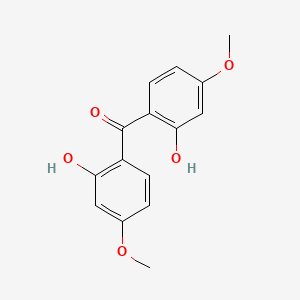
CAS 131-54-4PubChem CID 8570
Benzophenone-6
2,2'-Dihydroxy-4,4'-dimethoxybenzophenone is a member of benzophenones. — ChEBI
- IUPAC name
- bis(2-hydroxy-4-methoxyphenyl)methanone
- Molecular formula
- C15H14O5
- Molecular weight
- 274.27 g/mol
- Exact mass
- 274.08412354 Da
- XLogP3
- 3.3
- Topological polar surface area
- 76.0 Ų
- Hydrogen-bond donors
- 2
- Hydrogen-bond acceptors
- 5
- Covalent units
- 1
- Defined stereocentres
- 0
Also known as
2,2'-Dihydroxy-4,4'-dimethoxybenzophenoneMethanone, bis(2-hydroxy-4-methoxyphenyl)-Cyasorb UV 12Uvinul D 49Caswell No. 353C2,2-Dihydroxy-4,4-DimethoxybenzophenoneBENZOPHENONE 64,4'-Dimethoxy-2,2'-dihydroxybenzophenone
16 more reported names
EINECS 205-027-3NSC 40149BRN 1887087BENZOPHENONE, 2,2'-DIHYDROXY-4,4'-DIMETHOXY-7813J9CS1GHELISORB 11NSC-40149BENZOPHENONE-6 [MI]BENZOPHENONE-6 [MART.]HSDB 8473BENZOPHENONE-6 [WHO-DD]BENZOPHENONE-6 (MART.)RefChem:5662612,2'-Dihydroxy-4,4'-dimethoxybenzophenone (8CI)BENZOPHENONE-6 [INCI]205-027-3
External database identifiers
- ChEBI:CHEBI:229993
- ChEMBL:CHEMBL1598017
- EPA DTXSID:DTXSID6038875
- PubMed:23037998
- PubMed:18369292
- PubMed:16780223
- PubMed:16497524
- PubMed:16079615
- PubMed:15826804
- PubMed:11266322
Evidence from additional scientific databases
NIH PubChem PUG-View
Exact identifier match8570
Attributed physical-property, hazard, environmental and use annotations.
- Color/Form: Crystals Source: Hazardous Substances Data Bank (HSDB)
- Melting Point: 139.1 °C Source: Hazardous Substances Data Bank (HSDB)
- Melting Point: MP: 139-149 °C Source: Hazardous Substances Data Bank (HSDB)
- Note: This chemical does not meet GHS hazard criteria for 29% (65 of 224) of reports. Source: European Chemicals Agency (ECHA)
- Signal: Warning Source: European Chemicals Agency (ECHA)
- GHS Hazard Statements: H315 (20.1%): Causes skin irritation [Warning Skin corrosion/irritation]; H319 (20.1%): Causes serious eye irritation [Warning Serious eye damage/eye irritation]; H335 (19.6%): May cause respiratory irritation [Warning Specific target organ toxicity, single exposure; Respiratory tract irritation]; H411 (50.9%): Toxic to aquatic life with long lasting effects [Hazardous to the aquatic environment, long-term hazard] Source: European Chemicals Agency (ECHA)
- Precautionary Statement Codes: P261, P264, P264+P265, P271, P273, P280, P302+P352, P304+P340, P305+P351+P338, P319, P321, P332+P317, P337+P317, P362+P364, P391, P403+P233, P405, and P501 (click each P-code to see the statement) Source: European Chemicals Agency (ECHA)
- ECHA C&L Notifications Summary: Aggregated GHS information provided per 224 reports by companies from 6 notifications to the ECHA C&L Inventory. Each notification may be associated with multiple companies.; Reported as not meeting GHS hazard criteria per 65 of 224 reports by companies.; There are 5 notifications provided by 159 of 224 reports by companies with hazard statement code(s).; Information may vary between notifications depending on impurities, additives, and other factors. The percentage value in parenthesis indicates the notified classification ratio from companies that provide hazard codes. Only hazard codes with percentage values above 10% are shown. For more detailed information, please visit ECHA C&L website. Source: European Chemicals Agency (ECHA)
- Cosmetic Ingredient Review Finding(s): Safe in the present practices of use and concentration. Ingredient, concentration, and use information are available in documents discoverable at https://cir-reports.cir-safety.org Source: Cosmetic Ingredient Review (CIR)
- Toxicity Summary: IDENTIFICATION AND USE: 2,2'-Dihydroxy-4,4'-dimethoxybenzophenone (Benzophenone-6) is used as a cosmetic ingredient in a range of cosmetic products. HUMAN STUDIES: There are no data available. ANIMAL STUDIES: Benzophenone-6 was hepatotoxic in guinea pigs when given i.p. for 15 days at 5 mg/kg. Benzophenone-6 was nonmutagenic when assayed directly and was mutagenic with metabolic activation in Salmonella strain TA1537. Benzophenone-6 did not induce sister chromatid exchanges in vivo in the bone marrow of Chinese hamsters. Source: Hazardous Substances Data Bank (HSDB)
- Environmental Bioconcentration: An estimated BCF of 45 was calculated in fish for 2,2'-dihydroxy-4,4'-dimethoxybenzophenone(SRC), using an estimated log Kow of 3.90(1) and a regression-derived equation(1). According to a classification scheme(2), this BCF suggests the potential for bioconcentration in aquatic organisms is moderate(SRC). Source: Hazardous Substances Data Bank (HSDB)
- Environmental Fate: TERRESTRIAL FATE: Based on a classification scheme(1), an estimated Koc value of 800(SRC), determined from a structure estimation method(2), indicates that 2,2'-dihydroxy-4,4'-dimethoxybenzophenone is expected to have low mobility in soil(SRC). Volatilization of 2,2'-dihydroxy-4,4'-dimethoxybenzophenone from moist soil surfaces is not expected to be an important fate process(SRC) given an estimated Henry's Law constant of 1.2X10⁻¹⁰ atm-cu m/mole(SRC), developed using a fragment constant estimation method(2). 2,2'-Dihydroxy-4,4'-dimethoxybenzophenone is not expected to volatilize from dry soil surfaces(SRC) based upon an estimated vapor pressure of 7.4X10⁻⁹ mm Hg at 25 °C(SRC), determined from a fragment constant method(2). Utilizing the Modified MITI test, 0% of the Theoretical BOD was reached in 4 weeks(3) indicating that biodegradation is not an important environmental fate process in soil(SRC). Source: Hazardous Substances Data Bank (HSDB)
- Environmental Fate: AQUATIC FATE: Based on a classification scheme(1), an estimated Koc value of 800(SRC), determined from a structure estimation method(2), indicates that 2,2'-dihydroxy-4,4'-dimethoxybenzophenone is expected to adsorb to suspended solids and sediment(SRC). Volatilization from water surfaces is not expected(3) based upon an estimated Henry's Law constant of 1.2X10⁻¹⁰ atm-cu m/mole(SRC), developed using a fragment constant estimation method(2). According to a classification scheme(4), an estimated BCF of 45(SRC), from an estimated log Kow of 3.90(2) and a regression-derived equation(2), suggests the potential for bioconcentration in aquatic organisms is moderate(SRC). Utilizing the Modified MITI test, 0% of the Theoretical BOD was reached in 4 weeks(5) indicating that biodegradation is not an important environmental fate process in water(SRC). Source: Hazardous Substances Data Bank (HSDB)
- Environmental Fate: ATMOSPHERIC FATE: According to a model of gas/particle partitioning of semivolatile organic compounds in the atmosphere(1), 2,2'-dihydroxy-4,4'-dimethoxybenzophenone, which has an estimated vapor pressure of 7.4X10⁻⁹ mm Hg at 25 °C(SRC), determined from a fragment constant method(2), is expected to exist solely in the particulate phase in the ambient atmosphere. Particulate-phase 2,2'-dihydroxy-4,4'-dimethoxybenzophenone may be removed from the air by wet and dry deposition(SRC). 2,2'-Dihydroxy-4,4'-dimethoxybenzophenone absorbs UV light at wavelengths of 284 and 340 nm(3) and, therefore, may be susceptible to direct photolysis by sunlight(SRC). Source: Hazardous Substances Data Bank (HSDB)
- Cosmetic Ingredient Review Link: CIR ingredient: Benzophenone-6 Source: Cosmetic Ingredient Review (CIR)
- Uses: As ultraviolet light absorber, especially in paints, plastics. Source: Hazardous Substances Data Bank (HSDB)
- Uses: Table: Total uses/ranges for benzophenone-6 [Table#8581] Source: Hazardous Substances Data Bank (HSDB)
Mapped by: Existing checksum-valid CAS to unique PubChem CID match. Retrieved: 2026-08-31. Open source record
Scientific classifications and hazard annotations provide context and do not replace the market-specific regulatory decision shown above.
Additional source coverage and match status
| Source | Result | Checked |
|---|---|---|
| NIH PubChem PUG-View | Exact match | 2026-08-31 |
A recorded no-match is useful evidence that the source was checked; it is not a claim that the substance does not exist elsewhere.
Retrieved from NIH PubChem on 2026-08-31 by checksum-valid CAS matching. Chemical properties do not replace the regulatory decision on this page.