
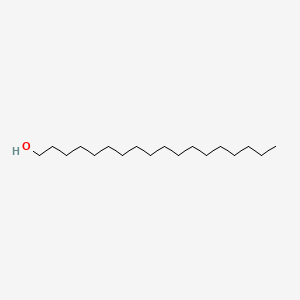
Stearyl Alcohol
Octadecan-1-ol is a long-chain primary fatty alcohol consisting of a hydroxy function at C-1 of an unbranched saturated chain of 18 carbon atoms. It has a role as a plant metabolite, a human metabolite and an algal metabolite. It is an octadecanol and a long-chain primary fatty alcohol. — ChEBI
- IUPAC name
- octadecan-1-ol
- Molecular formula
- C18H38O
- Molecular weight
- 270.5 g/mol
- Exact mass
- 270.292265831 Da
- XLogP3
- 8.4
- Topological polar surface area
- 20.2 Ų
- Hydrogen-bond donors
- 1
- Hydrogen-bond acceptors
- 1
- Covalent units
- 1
- Defined stereocentres
- 0
Also known as
16 more reported names
External database identifiers
- ChEBI:CHEBI:32154
- ChEMBL:CHEMBL24640
- EPA DTXSID:DTXSID8026935
- PubMed:23122150
- PubMed:23064772
- PubMed:22898614
- PubMed:22679362
- PubMed:22639192
- PubMed:22562053
- PubMed:22523455
- PubMed:22491314
- PubMed:22378014
- PubMed:22364438
- PubMed:22305293
- PubMed:22272217
Evidence from additional scientific databases
NIH PubChem PUG-View
Attributed physical-property, hazard, environmental and use annotations.
- Autoignition Temperature: 842 °F (450 °C) Source: Hazardous Substances Data Bank (HSDB)
- Autoignition Temperature: 450 °C Source: ILO-WHO International Chemical Safety Cards (ICSCs)
- Boiling Point: 210.5 °C at 15 mm Hg Source: Hazardous Substances Data Bank (HSDB)
- Boiling Point: 336 °C Source: ILO-WHO International Chemical Safety Cards (ICSCs)
- Boiling Point: 202 °C @760 [mm Hg] Source: PAC Chemical Database, U.S. Department of Energy
- Color/Form: Leaflets from ethanol Source: Hazardous Substances Data Bank (HSDB)
- Color/Form: Unctuous white flakes or granules Source: Hazardous Substances Data Bank (HSDB)
- Density: 0.8124 at 59 °C/4 °C Source: Hazardous Substances Data Bank (HSDB)
- Density: Relative density (water = 1): 0.81 (liquid) Source: ILO-WHO International Chemical Safety Cards (ICSCs)
- Density: 0.8124 @ 59°C Source: PAC Chemical Database, U.S. Department of Energy
- Flash Point: 200 °C Source: Haz-Map, Information on Hazardous Chemicals and Occupational Diseases
- Flash Point: 392 °F (200 °C) (Closed cup) Source: Hazardous Substances Data Bank (HSDB)
- Flash Point: 170 °C Source: ILO-WHO International Chemical Safety Cards (ICSCs)
- LogP: 8.22 Source: ILO-WHO International Chemical Safety Cards (ICSCs)
- Melting Point: 59.5 °C Source: Hazardous Substances Data Bank (HSDB)
- Melting Point: Heat of fusion at melting point = 7.4057X10+7 J/kmol (for the gamma phase, no selection of the alpha phase, crystal I can be made). Source: Hazardous Substances Data Bank (HSDB)
- Melting Point: 59.5 °C Source: Human Metabolome Database (HMDB)
- Melting Point: 59.8 °C Source: ILO-WHO International Chemical Safety Cards (ICSCs)
- Melting Point: 58 °C Source: PAC Chemical Database, U.S. Department of Energy
- Odor: Faint Source: Hazardous Substances Data Bank (HSDB)
- Physical Description: Large Crystals; Liquid; Other Solid; Liquid; Other Solid; Dry Powder; Large Crystals Source: EPA Chemical Data Reporting (CDR)
- Physical Description: White solid; [Hawley] Source: Haz-Map, Information on Hazardous Chemicals and Occupational Diseases
- Physical Description: Solid Source: Human Metabolome Database (HMDB)
- Physical Description: COLOURLESS-TO-WHITE SLIGHTLY WAXY FLAKES OR LEAFLETS. Source: ILO-WHO International Chemical Safety Cards (ICSCs)
- Solubility: Soluble in alcohol, ether, benzene, acetone Source: Hazardous Substances Data Bank (HSDB)
- Solubility: Soluble in chloroform; slightly soluble in acetone, benzene Source: Hazardous Substances Data Bank (HSDB)
- Solubility: In water, 1.1X10⁻³ mg/L at 25 °C Source: Hazardous Substances Data Bank (HSDB)
- Solubility: 1.1e-06 mg/mL at 25 °C Source: Human Metabolome Database (HMDB)
- Solubility: Solubility in water: none Source: ILO-WHO International Chemical Safety Cards (ICSCs)
- Vapor Pressure: 0.0000027 [mmHg] Source: Haz-Map, Information on Hazardous Chemicals and Occupational Diseases
- Vapor Pressure: Vapor pressure = 0.1 mm Hg @ 125 °C Source: Hazardous Substances Data Bank (HSDB)
- Vapor Pressure: Vapor pressure, Pa at 150 °C: 133 Source: ILO-WHO International Chemical Safety Cards (ICSCs)
- Vapor Pressure: 0.0000026 [mm Hg] @25 °C Source: PAC Chemical Database, U.S. Department of Energy
- Note: This chemical does not meet GHS hazard criteria for 61.7% (1186 of 1921) of all reports. Source: European Chemicals Agency (ECHA)
- Signal: Warning Source: European Chemicals Agency (ECHA)
- GHS Hazard Statements: H319 (23.1%): Causes serious eye irritation [Warning Serious eye damage/eye irritation]; H400 (15%): Very toxic to aquatic life [Warning Hazardous to the aquatic environment, acute hazard]; H411 (15.4%): Toxic to aquatic life with long lasting effects [Hazardous to the aquatic environment, long-term hazard]; H412 (15%): Harmful to aquatic life with long lasting effects [Hazardous to the aquatic environment, long-term hazard] Source: European Chemicals Agency (ECHA)
- Precautionary Statement Codes: P264+P265, P273, P280, P305+P351+P338, P337+P317, P391, and P501 (click each P-code to see the statement) Source: European Chemicals Agency (ECHA)
- ECHA C&L Notifications Summary: Aggregated GHS information provided per 1921 reports by companies from 12 notifications to the ECHA C&L Inventory. Each notification may be associated with multiple companies.; Reported as not meeting GHS hazard criteria per 1186 of 1921 reports by companies.; There are 10 notifications provided by 735 of 1921 reports by companies with hazard statement code(s).; Information may vary between notifications depending on impurities, additives, and other factors. The percentage value in parenthesis indicates the notified classification ratio from companies that provide hazard codes. Only hazard codes with percentage values above 10% are shown. For more detailed information, please visit ECHA C&L website. Source: European Chemicals Agency (ECHA)
- NFPA Health Rating: 0 - Materials that, under emergency conditions, would offer no hazard beyond that of ordinary combustible materials. Source: Hazardous Substances Data Bank (HSDB)
- NFPA Fire Rating: 0 - Materials that will not burn under typical fire conditions, including intrinsically noncombustible materials such as concrete, stone, and sand. Source: Hazardous Substances Data Bank (HSDB)
- NFPA Instability Rating: 0 - Materials that in themselves are normally stable, even under fire conditions. Source: Hazardous Substances Data Bank (HSDB)
- Cosmetic Ingredient Review Finding(s): Safe in the present practices of use and concentration. Ingredient, concentration, and use information are available in documents discoverable at https://cir-reports.cir-safety.org Source: Cosmetic Ingredient Review (CIR)
- Environmental Bioconcentration: An estimated BCF value of 2.8X10+4 was calculated for 1-octadecanol(SRC), using an experimental water solubility of 1.1X10⁻³ mg/L at 25 °C(1) and a recommended regression-derived equation(2). According to a classification scheme(3), this BCF suggests the potential for bioconcentration in aquatic organisms is very high(SRC), provided the compound is not metabolized by the organism(SRC). Source: Hazardous Substances Data Bank (HSDB)
- Environmental Fate: TERRESTRIAL FATE: Based on a classification scheme(1), an estimated Koc value of 1.8X10+5(SRC), determined from a water solubility of 1.1X10⁻³ mg/L(2) and a regression-derived equation(3), indicates that 1-octadecanol is expected to be immobile in soil(SRC). Volatilization of 1-octadecanol from moist soil surfaces may be expected to be an important fate process(SRC) given an estimated Henry's Law constant of 8.41X10⁻⁴ atm-cu m/mole(SRC), derived from a vapor pressure of 2.7X10⁻⁶ mm Hg at 25 °C(4), and its water solubility(2). However, adsorption to soil is expected to attenuate volatilization(SRC). 1-Octadecanol is not expected to volatilize from dry soil surfaces(SRC) based upon it's vapor pressure(4). Biodegradation of 1-octadecanol may be an important fate process in soil based on a mixed shake flask culture study(5). Source: Hazardous Substances Data Bank (HSDB)
- Environmental Fate: AQUATIC FATE: Based on a classification scheme(1), an estimated Koc value of 1.8X10+5(SRC), determined from a water solubility of 1.1X10⁻³ mg/L(2) and a regression-derived equation(3), indicates that 1-octadecanol is expected to adsorb to suspended solids and sediments(SRC). Volatilization from water surfaces is expected(3) based upon an estimated Henry's Law constant of 8.4X10⁻⁴ atm-cu m/mole(SRC), calculated from its water solubility(2) and vapor pressure, 2.7X10⁻⁶ mm Hg(4), values. Using this Henry's Law constant and an estimation method(3), volatilization half-lives for a model river and model lake are 2.8 hours and 7 days, respectively(SRC). However, volatilization from water surfaces is expected to be attenuated by adsorption to suspended solids and sediment in the water column. The estimated volatilization half-life from a model pond is 140 days if adsorption is considered (5). According to a classification scheme(6), an estimated BCF value of 2.8X10+4(3), from its water solubility(2), suggests the potential for bioconcentration in aquatic organisms is very high(SRC). A percent theoretical oxygen demand value of 0.3 in 24 hrs using a Warburg test(7) suggests that biodegradat Source: Hazardous Substances Data Bank (HSDB)
- Environmental Fate: ATMOSPHERIC FATE: According to a model of gas/particle partitioning of semivolatile organic compounds in the atmosphere(1), 1-octadecanol, which has a vapor pressure of 2.7X10⁻⁶ mm Hg at 25 °C(2), will exist in both the vapor and particulate phases in the ambient atmosphere. Vapor-phase 1-octadecanol is degraded in the atmosphere by reaction with photochemically-produced hydroxyl radicals(SRC); the half-life for this reaction in air is estimated to be about 14 hours(3), calculated from its rate constant of 2.67X10⁻¹¹ cu cm/molecule-sec at 25 °C(SRC), that was derived using a structure estimation method(3). Particulate-phase 1-octadecanol may be removed from the air by wet or dry deposition(SRC). Source: Hazardous Substances Data Bank (HSDB)
- Consumer Uses: Cleaning agent; Not Known or Reasonably Ascertainable; Emulsifier; Softener and conditioner; Solvent; Other; Binder; Lubricating agent; Surfactant (surface active agent); Fuel Source: EPA Chemical Data Reporting (CDR)
- Industry Uses: Defoamer; Intermediate; Emulsifier; Not Known or Reasonably Ascertainable; Stabilizing agent; Sealant (barrier); Cleaning agent; Fuel; Antioxidant; Surfactant (surface active agent); Lubricating agent; Other; Binder; Solvent Source: EPA Chemical Data Reporting (CDR)
- Cosmetic Ingredient Review Link: CIR ingredient: Stearyl Alcohol Source: Cosmetic Ingredient Review (CIR)
- Sources/Uses: Used as a substitute for cetyl alcohol in pharmaceutical dispensing; in cosmetic creams and perfumery; in textile oils and finishes; as an antifoam agent; and in lubricants, resins, and surface active agents; Synthetic stearyl alcohol has been approved as a direct and indirect food additive ingredient and as an ingredient in over-the-counter drugs; [HSDB] Source: Haz-Map, Information on Hazardous Chemicals and Occupational Diseases
- Industrial Processes with risk of exposure: Textiles (Printing, Dyeing, or Finishing) [Category: Industry] Source: Haz-Map, Information on Hazardous Chemicals and Occupational Diseases
- Uses: Substitute for cetyl alcohol in pharmaceutical dispensing, in cosmetic creams, for emulsions, textile oils and finishes; as antifoam agent, lubricant, and chemical raw material. Source: Hazardous Substances Data Bank (HSDB)
- Uses: Perfumery, cosmetics, intermediate, surface active agents, lubricants, resins, antifoam agent. Source: Hazardous Substances Data Bank (HSDB)
- Uses: Antifoam agent /for bioprocesses/ Source: Hazardous Substances Data Bank (HSDB)
- Uses: Stearyl alcohol is used in ... resins, and USP ointments. Synthetic stearyl alcohol has been approved as a direct and indirect food additive ingredient and as an ingredient in over-the-counter drugs. Source: Hazardous Substances Data Bank (HSDB)
Mapped by: Existing checksum-valid CAS to unique PubChem CID match. Retrieved: 2026-08-31. Open source record
Scientific classifications and hazard annotations provide context and do not replace the market-specific regulatory decision shown above.
Additional source coverage and match status
| Source | Result | Checked |
|---|---|---|
| NIH PubChem PUG-View | Exact match | 2026-08-31 |
A recorded no-match is useful evidence that the source was checked; it is not a claim that the substance does not exist elsewhere.
Retrieved from NIH PubChem on 2026-08-31 by checksum-valid CAS matching. Chemical properties do not replace the regulatory decision on this page.