
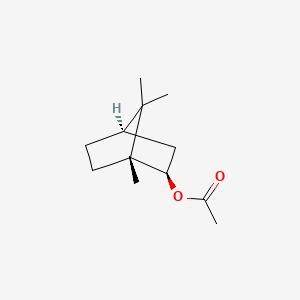
Isobornyl acetate
(±)-isobornyl acetate has been reported in Santolina chamaecyparissus, Santolina villosa, and other organisms with data available. — LOTUS - the natural products occurrence database
- IUPAC name
- [(1R,2R,4R)-1,7,7-trimethyl-2-bicyclo[2.2.1]heptanyl] acetate
- Molecular formula
- C12H20O2
- Molecular weight
- 196.29 g/mol
- Exact mass
- 196.146329876 Da
- XLogP3
- 3.3
- Topological polar surface area
- 26.3 Ų
- Hydrogen-bond donors
- 0
- Hydrogen-bond acceptors
- 2
- Covalent units
- 1
- Defined stereocentres
- 3
Also known as
16 more reported names
External database identifiers
- ChEMBL:CHEMBL3183823
- PubMed:29844252
Evidence from additional scientific databases
NIH PubChem PUG-View
Attributed physical-property, hazard, environmental and use annotations.
- Boiling Point: 220-224 °C Source: Hazardous Substances Data Bank (HSDB)
- Boiling Point: BP: 227 °C. Specific gravity: 0.979-0.984 at 25 °C Source: Hazardous Substances Data Bank (HSDB)
- Boiling Point: 227 °C Source: Joint FAO/WHO Expert Committee on Food Additives (JECFA)
- Color/Form: Colorless to very pale straw-colored liquid Source: Hazardous Substances Data Bank (HSDB)
- Density: 0.978 at °C Source: Hazardous Substances Data Bank (HSDB)
- Density: 0.979-0.984 Source: Joint FAO/WHO Expert Committee on Food Additives (JECFA)
- Flash Point: 190 °F (88 °C) /closed cup/ Source: Hazardous Substances Data Bank (HSDB)
- LogP: log Kow = 4.30 Source: Hazardous Substances Data Bank (HSDB)
- Odor: Pine needles Source: Hazardous Substances Data Bank (HSDB)
- Odor: Pleasant, camphor-like odor reminiscent of some varieties of pine needles and hemlock Source: Hazardous Substances Data Bank (HSDB)
- Odor: Camphoraceous, piney, balsamic odor Source: Hazardous Substances Data Bank (HSDB)
- Physical Description: CBI; Liquid; Other Solid; Liquid; Dry Powder; Liquid Source: EPA Chemical Data Reporting (CDR)
- Physical Description: Colourless to very pale straw coloured liquid; Camphoraceous, piney, balsamic aroma Source: Joint FAO/WHO Expert Committee on Food Additives (JECFA)
- Refractive Index: Index of refraction: 1.462-1.465 at 20 °C Source: Hazardous Substances Data Bank (HSDB)
- Refractive Index: 1.462-1.465 Source: Joint FAO/WHO Expert Committee on Food Additives (JECFA)
- Solubility: Insoluble in water Source: Hazardous Substances Data Bank (HSDB)
- Solubility: Soluble in most fixed oils and in mineral oil Source: Hazardous Substances Data Bank (HSDB)
- Solubility: Soluble in alcohol, fixed oils; slightly soluble in propylene glycol Source: Hazardous Substances Data Bank (HSDB)
- Solubility: In 70% alcohol, 1:3; slightly soluble in propylene glycol; insoluble in glycerin Source: Hazardous Substances Data Bank (HSDB)
- Solubility: Soluble in most fixed oils; Slightly soluble in propylene glycol; Insoluble in water, glycerin Source: Joint FAO/WHO Expert Committee on Food Additives (JECFA)
- Solubility: Soluble (in ethanol) Source: Joint FAO/WHO Expert Committee on Food Additives (JECFA)
- Note: This chemical does not meet GHS hazard criteria for 98.4% (1857 of 1887) of all reports. Source: European Chemicals Agency (ECHA)
- GHS Hazard Statements: Not Classified; Reported as not meeting GHS hazard criteria by 1857 of 1887 companies (only 1.6% companies provided GHS information). For more detailed information, please visit ECHA C&L website. Source: European Chemicals Agency (ECHA)
- ECHA C&L Notifications Summary: Aggregated GHS information provided per 1887 reports by companies from 7 notifications to the ECHA C&L Inventory.; Reported as not meeting GHS hazard criteria per 1857 of 1887 reports by companies.; There are 5 notifications provided by 30 of 1887 reports by companies with hazard statement code(s).; Information may vary between notifications depending on impurities, additives, and other factors. The percentage value in parenthesis indicates the notified classification ratio from companies that provide hazard codes. Only hazard codes with percentage values above 10% are shown. For more detailed information, please visit ECHA C&L website. Source: European Chemicals Agency (ECHA)
- Signal: Warning Source: NITE-CMC
- GHS Hazard Statements: H227: Combustible liquid [Warning Flammable liquids] Source: NITE-CMC
- Precautionary Statement Codes: P210, P280, P370+P378, P403, and P501 (click each P-code to see the statement) Source: NITE-CMC
- Signal: Warning Source: Hazardous Substances Data Bank (HSDB)
- GHS Hazard Statements: H227: Combustible liquid [Warning Flammable liquids] Source: Hazardous Substances Data Bank (HSDB)
- Precautionary Statement Codes: P210, P280, P370+P378, P403, and P501 (click each P-code to see the statement) Source: Hazardous Substances Data Bank (HSDB)
- NFPA Health Rating: 1 - Materials that, under emergency conditions, can cause significant irritation. Source: Hazardous Substances Data Bank (HSDB)
- NFPA Fire Rating: 2 - Materials that must be moderately heated or exposed to relatively high ambient temperatures before ignition can occur. Materials would not under normal conditions form hazardous atmospheres with air, but under high ambient temperatures or under moderate heating could release vapor in sufficient quantities to produce hazardous atmospheres with air. Source: Hazardous Substances Data Bank (HSDB)
- NFPA Instability Rating: 0 - Materials that in themselves are normally stable, even under fire conditions. Source: Hazardous Substances Data Bank (HSDB)
- Toxicity Summary: IDENTIFICATION AND USE: Isobornyl acetate is used in soaps, detergents, creams and lotions and perfumes. HUMAN STUDIES: A maximization test was carried out on 25 volunteers. The material was tested at a concentration of 10% and produced no sensitization reactions. ANIMAL STUDIES: Isobornyl acetate applied full strength to intact or abraded rabbit skin for 24 hr under occlusion was mildly irritating. Isobornyl acetate was administered daily to rats in doses of 0, 15, 90 or 270 mg/kg bw for 13 wk. Male rats had signs of nephrotoxicity at 90 mg/kg and 270 mg/kg/day, as well as signs of hepatotoxicity at 270 mg/kg. Isobornyl acetate was investigated in a 1-generation reproduction study in rats and it did not produce developmental toxicity. Increased incidences of excess salivation occurred in parent generation male and female rats at 100 and/or 300 mg/kg/d throughout the dosage period, and low incidences of urine-stained abdominal fur were seen in females at 300 mg/kg/d during the gestation period. Source: Hazardous Substances Data Bank (HSDB)
- Environmental Bioconcentration: An estimated BCF of 320 was calculated in fish for isobornyl acetate(SRC), using a log Kow of 4.30(1) and a regression-derived equation(2). According to a classification scheme(3), this BCF suggests the potential for bioconcentration in aquatic organisms is high(SRC). Source: Hazardous Substances Data Bank (HSDB)
- Environmental Fate: TERRESTRIAL FATE: Based on a classification scheme(1), an estimated Koc value of 420(SRC), determined from a structure estimation method(2), indicates that isobornyl acetate is expected to have moderate mobility in soil(SRC). Volatilization of isobornyl acetate from moist soil surfaces is expected to be an important fate process(SRC) given an estimated Henry's Law constant of 9.5X10⁻⁵ atm-cu m/mole(SRC), developed using a fragment constant estimation method(2). Isobornyl acetate has an estimated vapor pressure of 0.11 mm Hg(2) and exists as a liquid under environmental conditions; therefore, isobornyl acetate may volatilize from dry soil. Using the OECD Biodegradability test, isoborneol acetate was biodegraded in 10 days(3), suggesting that biodegradation is an important environment fate process in soil(SRC). Source: Hazardous Substances Data Bank (HSDB)
- Environmental Fate: AQUATIC FATE: Based on a classification scheme(1), an estimated Koc value of 420(SRC), determined from a structure estimation method(2), indicates that isobornyl acetate is expected to adsorb to suspended solids and sediment(SRC). Volatilization from water surfaces is expected(3) based upon an estimated Henry's Law constant of 9.5X10⁻⁵ atm-cu m/mole(SRC), developed using a fragment constant estimation method(2). Using this Henry's Law constant and an estimation method(3), volatilization half-lives for a model river and model lake are 17 hrs and 9.5 days, respectively(SRC). According to a classification scheme(4), an estimated BCF of 320(SRC), from its log Kow of 4.30(5) and a regression-derived equation(2), suggests the potential for bioconcentration in aquatic organisms is moderate(SRC). Using the OECD Biodegradability test, isoborneol acetate was biodegraded in 10 days(5), suggesting that biodegradation is an important environment fate process in water(SRC). Source: Hazardous Substances Data Bank (HSDB)
- Environmental Fate: ATMOSPHERIC FATE: According to a model of gas/particle partitioning of semivolatile organic compounds in the atmosphere(1), isobornyl acetate, which has an estimated vapor pressure of 0.11 mm Hg at 25 °C(SRC), determined from a fragment constant method(2), is expected to exist solely as a vapor in the ambient atmosphere. Vapor-phase isobornyl acetate is degraded in the atmosphere by reaction with photochemically-produced hydroxyl radicals(SRC); the half-life for this reaction in air is estimated to be 50 hrs(SRC), calculated from its rate constant of 7.7X10⁻¹² cu cm/molecule-sec at 25 °C(SRC) that was derived using a structure estimation method(2). Isobornyl acetate does not contain chromophores that absorb at wavelengths >290 nm(3) and, therefore, is not expected to be susceptible to direct photolysis by sunlight(SRC). Source: Hazardous Substances Data Bank (HSDB)
- Consumer Uses: Fragrance; Other Source: EPA Chemical Data Reporting (CDR)
- Industry Uses: Fragrance; Solvent; Flavoring and nutrient; Other Source: EPA Chemical Data Reporting (CDR)
- Uses: For isobornyl acetate (USEPA/OPP Pesticide Code: 128875) there are 0 labels match. /SRP: Not registered for current use in the USA, but approved pesticide uses may change periodically and so federal, state and local authorities must be consulted for currently approved uses./ Source: Hazardous Substances Data Bank (HSDB)
- Uses: Isobornyl acetate is used in large amounts for perfuming soap, bath products, and air fresheners. However, the major use of isobornyl acetate is as an intermediate in the production of camphor. Source: Hazardous Substances Data Bank (HSDB)
- Uses: Reported uses (ppm):; Table: Reported uses (ppm): (Flavor and Extract Manufacturers' Association, 1994) [Table#8555] Source: Hazardous Substances Data Bank (HSDB)
- Uses: Table: Concentration in final product (%) [Table#8556] Source: Hazardous Substances Data Bank (HSDB)
Mapped by: Existing checksum-valid CAS to unique PubChem CID match. Retrieved: 2026-08-31. Open source record
Scientific classifications and hazard annotations provide context and do not replace the market-specific regulatory decision shown above.
Additional source coverage and match status
| Source | Result | Checked |
|---|---|---|
| NIH PubChem PUG-View | Exact match | 2026-08-31 |
A recorded no-match is useful evidence that the source was checked; it is not a claim that the substance does not exist elsewhere.
Retrieved from NIH PubChem on 2026-08-31 by checksum-valid CAS matching. Chemical properties do not replace the regulatory decision on this page.