
Borates, tetraborates, octaborates and boric acid salts and esters, including: Disodium octaborate anhydrous [1] Disodium octaborate tetrahydrate [2] 2-Aminoethanol, monoester with boric acid [3] 2-Hydroxypropyl ammonium dihydrogen orthoborate [4] Potassium borate, boric acid potassium salt [5] Trioctyldodecyl borate [6] Zinc borate [7] Sodium borate, disodium tetraborate anhydrous; boric acid, sodium salt [8] Tetraboron disodium heptaoxide, hydrate [9] Orthoboric acid, sodium salt [10] Disodium tetraborate decahydrate; borax decahydrate [11] Disodium tetraborate pentahydrate; borax pentahydrate [12]
Borates, tetraborates, octaborates and boric acid salts and esters, including: Disodium octaborate anhydrous [1] Disodium octaborate tetrahydrate [2] 2-Aminoethanol, monoester with boric acid [3] 2-Hydroxypropyl ammonium dihydrogen orthoborate [4] Potassium borate, boric acid potassium salt [5] Trioctyldodecyl borate [6] Zinc borate [7] Sodium borate, disodium tetraborate anhydrous; boric acid, sodium salt [8] Tetraboron disodium heptaoxide, hydrate [9] Orthoboric acid, sodium salt [10] Disodium tetraborate decahydrate; borax decahydrate [11] Disodium tetraborate pentahydrate; borax pentahydrate [12] figure à l’annexe II en tant que substance interdite dans les produits cosmétiques mis sur le marché de l’UE.
Détails de la fiche
Nom chimique
Borates, tetraborates, octaborates and boric acid salts and esters, including: Disodium octaborate anhydrous [1] Disodium octaborate tetrahydrate [2] 2-Aminoethanol, monoester with boric acid [3] 2-Hydroxypropyl ammonium dihydrogen orthoborate [4] Potassium borate, boric acid potassium salt [5] Trioctyldodecyl borate [6] Zinc borate [7] Sodium borate, disodium tetraborate anhydrous; boric acid, sodium salt [8] Tetraboron disodium heptaoxide, hydrate [9] Orthoboric acid, sodium salt [10] Disodium tetraborate decahydrate; borax decahydrate [11] Disodium tetraborate pentahydrate; borax pentahydrate [12]
Nom chimique / IUPAC
NA
Informations réglementaires
Données clés
Identité et propriétés chimiques
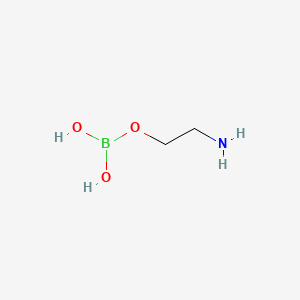
Monoethanolamine borate
- Nom IUPAC
- 2-aminoethoxyboronic acid
- Formule moléculaire
- C2H8BNO3
- Masse moléculaire
- 104.90 g/mol
- Masse exacte
- 105.0597233 Da
- Surface polaire topologique
- 75,7 Ų
- Donneurs de liaisons hydrogène
- 3
- Accepteurs de liaisons hydrogène
- 4
- Unités covalentes
- 1
- Stéréocentres définis
- 0
Également connu sous le nom de
12 autres noms signalés
Identifiants de bases de données externes
- EPA DTXSID:DTXSID3049673
Preuves issues de bases de données scientifiques complémentaires
NIH PubChem PUG-View
Attributed physical-property, hazard, environmental and use annotations.
- Note: This chemical does not meet GHS hazard criteria for 29.7% (11 of 37) of reports. Source: European Chemicals Agency (ECHA)
- Signal: Warning Source: European Chemicals Agency (ECHA)
- GHS Hazard Statements: H315 (70.3%): Causes skin irritation [Warning Skin corrosion/irritation]; H319 (70.3%): Causes serious eye irritation [Warning Serious eye damage/eye irritation]; H335 (67.6%): May cause respiratory irritation [Warning Specific target organ toxicity, single exposure; Respiratory tract irritation] Source: European Chemicals Agency (ECHA)
- Precautionary Statement Codes: P261, P264, P264+P265, P271, P280, P302+P352, P304+P340, P305+P351+P338, P319, P321, P332+P317, P337+P317, P362+P364, P403+P233, P405, and P501 (click each P-code to see the statement) Source: European Chemicals Agency (ECHA)
- ECHA C&L Notifications Summary: Aggregated GHS information provided per 37 reports by companies from 3 notifications to the ECHA C&L Inventory. Each notification may be associated with multiple companies.; Reported as not meeting GHS hazard criteria per 11 of 37 reports by companies.; There are 2 notifications provided by 26 of 37 reports by companies with hazard statement code(s).; Information may vary between notifications depending on impurities, additives, and other factors. The percentage value in parenthesis indicates the notified classification ratio from companies that provide hazard codes. Only hazard codes with percentage values above 10% are shown. For more detailed information, please visit ECHA C&L website. Source: European Chemicals Agency (ECHA)
Mis en correspondance par: Existing checksum-valid CAS to unique PubChem CID match. Récupéré le: 2026-08-31. Ouvrir la fiche source
Les classifications scientifiques et les annotations de danger apportent du contexte et ne remplacent pas la décision réglementaire propre au marché indiquée ci-dessus.
Couverture des sources complémentaires et état des correspondances
| Source | Résultat | Vérifié |
|---|---|---|
| EMBL-EBI ChEBI | Aucune fiche exacte | 2026-08-31 |
| NIH PubChem PUG-View | Correspondance exacte | 2026-08-31 |
Une absence de correspondance enregistrée est une preuve utile que la source a été vérifiée ; ce n’est pas l’affirmation que la substance n’existe pas ailleurs.
Récupéré depuis NIH PubChem le 2026-09-02 par correspondance CAS à somme de contrôle valide. Les propriétés chimiques ne remplacent pas la décision réglementaire de cette page.
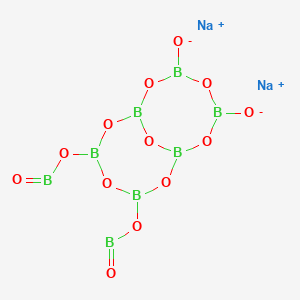
Boron sodium oxide (B8Na2O13)
- Nom IUPAC
- disodium;(9,11-dioxido-5-oxoboranyloxy-2,4,6,8,10,12,13-heptaoxa-1,3,5,7,9,11-hexaborabicyclo[5.5.1]tridecan-3-yl)oxy-oxoborane
- Formule moléculaire
- B8Na2O13
- Masse moléculaire
- 340.5 g/mol
- Masse exacte
- 340.9915016 Da
- Surface polaire topologique
- 163,0 Ų
- Donneurs de liaisons hydrogène
- 0
- Accepteurs de liaisons hydrogène
- 13
- Unités covalentes
- 3
- Stéréocentres définis
- 0
Également connu sous le nom de
12 autres noms signalés
Identifiants de bases de données externes
- EPA DTXSID:DTXSID6034390
Preuves issues de bases de données scientifiques complémentaires
NIH PubChem PUG-View
Attributed physical-property, hazard, environmental and use annotations.
- Color/Form: Crystalline rod Source: Hazardous Substances Data Bank (HSDB)
- Physical Description: Dry Powder Source: EPA Chemical Data Reporting (CDR)
- Solubility: Dissolves rapidly in water ... easily forms viscous supersaturated solutions at elevated temperatures. Solubility at 30 degC: 21.9wt % /Disodium octaborate tetrahydrate/ Source: Hazardous Substances Data Bank (HSDB)
- Solubility: Solubility: 9.5 g/100 g water /Disodium octaborate tetrahydrate/ Source: Hazardous Substances Data Bank (HSDB)
- Signal: Danger Source: Regulation (EC) No 1272/2008 of the European Parliament and of the Council
- GHS Hazard Statements: H360FD: May damage fertility; May damage the unborn child [Danger Reproductive toxicity] Source: Regulation (EC) No 1272/2008 of the European Parliament and of the Council
- Precautionary Statement Codes: P203, P280, P318, P405, and P501 (click each P-code to see the statement) Source: Regulation (EC) No 1272/2008 of the European Parliament and of the Council
- Note: This chemical does not meet GHS hazard criteria for 0.5% (1 of 222) of reports. Source: European Chemicals Agency (ECHA)
- Signal: Danger Source: European Chemicals Agency (ECHA)
- GHS Hazard Statements: H360 (86.5%): May damage fertility or the unborn child [Danger Reproductive toxicity]; H360FD (18.5%): May damage fertility; May damage the unborn child [Danger Reproductive toxicity] Source: European Chemicals Agency (ECHA)
- Precautionary Statement Codes: P203, P280, P318, P405, and P501 (click each P-code to see the statement) Source: European Chemicals Agency (ECHA)
- ECHA C&L Notifications Summary: Aggregated GHS information provided per 222 reports by companies from 10 notifications to the ECHA C&L Inventory. Each notification may be associated with multiple companies.; Reported as not meeting GHS hazard criteria per 1 of 222 reports by companies.; There are 9 notifications provided by 221 of 222 reports by companies with hazard statement code(s).; Information may vary between notifications depending on impurities, additives, and other factors. The percentage value in parenthesis indicates the notified classification ratio from companies that provide hazard codes. Only hazard codes with percentage values above 10% are shown. For more detailed information, please visit ECHA C&L website. Source: European Chemicals Agency (ECHA)
- Toxicity Summary: The inorganic borates display low acute toxicity. They are either not irritant or mild skin and eye irritants. They are not skin sensitisers, nor are they mutagenic or carcinogenic. The most sensitive endpoints of toxicity are considered to be effects on the reproductive organs, fertility in males, and developmental effects. The doses that cause these effects are far higher than any levels to which the human population could be exposed... /Inorganic borates/ Source: Hazardous Substances Data Bank (HSDB)
- Consumer Uses: Adhesion/cohesion promoter; Corrosion inhibitor; Soil amendments (fertilizers) Source: EPA Chemical Data Reporting (CDR)
- Industry Uses: Soil amendments (fertilizers); Adhesion/cohesion promoter; Swelling agent Source: EPA Chemical Data Reporting (CDR)
- Uses: For disodium octaborate (USEPA/OPP Pesticide Code: 011107) ACTIVE products with label matches. /SRP: Registered for use in the U.S. but approved pesticide uses may change periodically and so federal, state and local authorities must be consulted for currently approved uses./ Source: Hazardous Substances Data Bank (HSDB)
- Uses: For disodium octaborate tetrahydrate (USEPA/OPP Pesticide Code: 011103) ACTIVE products with label matches. /SRP: Registered for use in the U.S. but approved pesticide uses may change periodically and so federal, state and local authorities must be consulted for currently approved uses./ /Disodium octaborate tetrahydrate/ Source: Hazardous Substances Data Bank (HSDB)
- Uses: Used to prevent and control decay fungi in lumber and timber products. Source: Hazardous Substances Data Bank (HSDB)
- Uses: Multimicronutrient fertilizer /Disodium octaborate tetrahydrate/ Source: Hazardous Substances Data Bank (HSDB)
- Uses: For more Uses (Complete) data for DISODIUM OCTABORATE (8 total), please visit the HSDB record page. Source: Hazardous Substances Data Bank (HSDB)
Mis en correspondance par: Existing checksum-valid CAS to unique PubChem CID match. Récupéré le: 2026-08-31. Ouvrir la fiche source
Les classifications scientifiques et les annotations de danger apportent du contexte et ne remplacent pas la décision réglementaire propre au marché indiquée ci-dessus.
Couverture des sources complémentaires et état des correspondances
| Source | Résultat | Vérifié |
|---|---|---|
| NIH PubChem PUG-View | Correspondance exacte | 2026-08-31 |
Une absence de correspondance enregistrée est une preuve utile que la source a été vérifiée ; ce n’est pas l’affirmation que la substance n’existe pas ailleurs.
Récupéré depuis NIH PubChem le 2026-09-02 par correspondance CAS à somme de contrôle valide. Les propriétés chimiques ne remplacent pas la décision réglementaire de cette page.
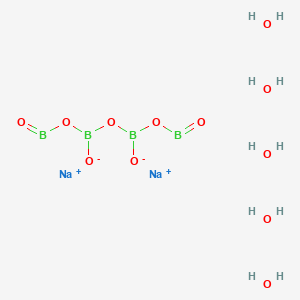
Sodium tetraborate pentahydrate
- Nom IUPAC
- disodium;[oxido(oxoboranyloxy)boranyl]oxy-oxoboranyloxyborinate;pentahydrate
- Formule moléculaire
- B4H10Na2O12
- Masse moléculaire
- 291.3 g/mol
- Masse exacte
- 292.0339850 Da
- Surface polaire topologique
- 113,0 Ų
- Donneurs de liaisons hydrogène
- 5
- Accepteurs de liaisons hydrogène
- 12
- Unités covalentes
- 8
- Stéréocentres définis
- 0
Également connu sous le nom de
6 autres noms signalés
Identifiants de bases de données externes
- EPA DTXSID:DTXSID7034389
Preuves issues de bases de données scientifiques complémentaires
NIH PubChem PUG-View
Attributed physical-property, hazard, environmental and use annotations.
- Density: 1.82 Source: Occupational Safety and Health Administration (OSHA)
- Density: 1.82 Source: The National Institute for Occupational Safety and Health (NIOSH)
- Melting Point: 392 °F Source: Occupational Safety and Health Administration (OSHA)
- Melting Point: 392 °F Source: The National Institute for Occupational Safety and Health (NIOSH)
- Physical Description: CBI; Dry Powder; Liquid; Other Solid Source: EPA Chemical Data Reporting (CDR)
- Physical Description: Colorless or white, odorless crystals or free-flowing powder; Begins to lose water of hydration at 252 degrees F; [NIOSH] Source: Haz-Map, Information on Hazardous Chemicals and Occupational Diseases
- Physical Description: Colorless or white, odorless crystals or free-flowing powder. Source: Occupational Safety and Health Administration (OSHA)
- Physical Description: Colorless or white, odorless crystals or free-flowing powder. [herbicide] [Note: Begins to lose water of hydration at 252 °F.] Source: The National Institute for Occupational Safety and Health (NIOSH)
- Solubility: 3% Source: The National Institute for Occupational Safety and Health (NIOSH)
- Vapor Pressure: 0 mmHg (approx) Source: Occupational Safety and Health Administration (OSHA)
- Vapor Pressure: 0 mmHg (approx) Source: The National Institute for Occupational Safety and Health (NIOSH)
- Exposure Routes: inhalation, ingestion, skin and/or eye contact Source: The National Institute for Occupational Safety and Health (NIOSH)
- First Aid: (General first aid procedures); Eye: Irrigate immediately - If this chemical contacts the eyes, immediately wash (irrigate) the eyes with large amounts of water, occasionally lifting the lower and upper lids. Get medical attention immediately.; Skin: Soap wash - If this chemical contacts the skin, wash the contaminated skin with soap and water.; Breathing: Respiratory support; Swallow: Medical attention immediately - If this chemical has been swallowed, get medical attention immediately. Source: The National Institute for Occupational Safety and Health (NIOSH)
- Signal: Danger Source: Regulation (EC) No 1272/2008 of the European Parliament and of the Council
- GHS Hazard Statements: H360FD: May damage fertility; May damage the unborn child [Danger Reproductive toxicity] Source: Regulation (EC) No 1272/2008 of the European Parliament and of the Council
- Precautionary Statement Codes: P203, P280, P318, P405, and P501 (click each P-code to see the statement) Source: Regulation (EC) No 1272/2008 of the European Parliament and of the Council
- Signal: Danger Source: European Chemicals Agency (ECHA)
- GHS Hazard Statements: H319 (57.2%): Causes serious eye irritation [Warning Serious eye damage/eye irritation]; H360 (91.2%): May damage fertility or the unborn child [Danger Reproductive toxicity] Source: European Chemicals Agency (ECHA)
- Precautionary Statement Codes: P203, P264+P265, P280, P305+P351+P338, P318, P337+P317, P405, and P501 (click each P-code to see the statement) Source: European Chemicals Agency (ECHA)
- ECHA C&L Notifications Summary: Aggregated GHS information provided per 339 reports by companies from 12 notifications to the ECHA C&L Inventory. Each notification may be associated with multiple companies.; Information may vary between notifications depending on impurities, additives, and other factors. The percentage value in parenthesis indicates the notified classification ratio from companies that provide hazard codes. Only hazard codes with percentage values above 10% are shown. For more detailed information, please visit ECHA C&L website. Source: European Chemicals Agency (ECHA)
- Signal: Danger Source: NITE-CMC
- GHS Hazard Statements: H335: May cause respiratory irritation [Warning Specific target organ toxicity, single exposure; Respiratory tract irritation]; H360: May damage fertility or the unborn child [Danger Reproductive toxicity]; H370: Causes damage to organs [Danger Specific target organ toxicity, single exposure] Source: NITE-CMC
- Precautionary Statement Codes: P203, P260, P261, P264, P270, P271, P280, P304+P340, P308+P316, P318, P319, P321, P403+P233, P405, and P501 (click each P-code to see the statement) Source: NITE-CMC
- Signal: Danger Source: Hazardous Chemical Information System (HCIS), Safe Work Australia
- GHS Hazard Statements: H360FD: May damage fertility; May damage the unborn child [Danger Reproductive toxicity] Source: Hazardous Chemical Information System (HCIS), Safe Work Australia
- Target Organs: Eyes, skin, respiratory system Source: The National Institute for Occupational Safety and Health (NIOSH)
- Consumer Uses: Flame retardant; Anti-adhesive/cohesive Source: EPA Chemical Data Reporting (CDR)
- Industry Uses: Anti-adhesive/cohesive; Plating agent; Flame retardant; Corrosion inhibitor; Not Known or Reasonably Ascertainable; Etching agent; Chelating agent; Defoamer Source: EPA Chemical Data Reporting (CDR)
- Sources/Uses: Used as a preservative, antiseptic and fungicide; also used to manufacture glazes, enamels, soldering fluxes and cleaning compounds and to fireproof textiles and wood; [ACGIH] Boric acid and borates as tablets or powder are used to kill larvae in barns and other insects in houses. Rarely, they are sprayed as herbicides. [EPA: Recognition of Pesticide Poisonings] Source: Haz-Map, Information on Hazardous Chemicals and Occupational Diseases
- Industrial Processes with risk of exposure: Soldering [Category: Heat or Machine]; Using Disinfectants or Biocides [Category: Clean]; Farming (Pesticides) [Category: Industry]; Textiles (Printing, Dyeing, or Finishing) [Category: Industry] Source: Haz-Map, Information on Hazardous Chemicals and Occupational Diseases
Mis en correspondance par: Existing checksum-valid CAS to unique PubChem CID match. Récupéré le: 2026-08-31. Ouvrir la fiche source
Les classifications scientifiques et les annotations de danger apportent du contexte et ne remplacent pas la décision réglementaire propre au marché indiquée ci-dessus.
Couverture des sources complémentaires et état des correspondances
| Source | Résultat | Vérifié |
|---|---|---|
| NIH PubChem PUG-View | Correspondance exacte | 2026-08-31 |
Une absence de correspondance enregistrée est une preuve utile que la source a été vérifiée ; ce n’est pas l’affirmation que la substance n’existe pas ailleurs.
Récupéré depuis NIH PubChem le 2026-09-02 par correspondance CAS à somme de contrôle valide. Les propriétés chimiques ne remplacent pas la décision réglementaire de cette page.
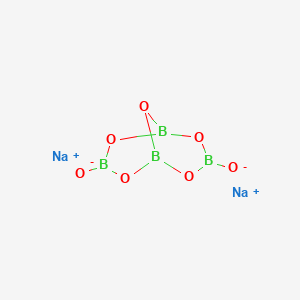
Sodium Tetraborate
- Nom IUPAC
- disodium;3,7-dioxido-2,4,6,8,9-pentaoxa-1,3,5,7-tetraborabicyclo[3.3.1]nonane
- Formule moléculaire
- B4Na2O7
- Masse moléculaire
- 201.2 g/mol
- Masse exacte
- 201.9811616 Da
- Surface polaire topologique
- 92,3 Ų
- Donneurs de liaisons hydrogène
- 0
- Accepteurs de liaisons hydrogène
- 7
- Unités covalentes
- 3
- Stéréocentres définis
- 0
Également connu sous le nom de
16 autres noms signalés
Identifiants de bases de données externes
- EPA DTXSID:DTXSID101014358
- PubMed:21774671
- PubMed:19059942
- PubMed:1432568
Preuves issues de bases de données scientifiques complémentaires
NIH PubChem PUG-View
Attributed physical-property, hazard, environmental and use annotations.
- Boiling Point: 1,575 °C (decomposes) Source: Hazardous Substances Data Bank (HSDB)
- Boiling Point: 2867 °F (decomposes) Source: Occupational Safety and Health Administration (OSHA)
- Boiling Point: 2867 °F (Decomposes) Source: The National Institute for Occupational Safety and Health (NIOSH)
- Color/Form: Colorless glassy solid; hygroscopic Source: Hazardous Substances Data Bank (HSDB)
- Color/Form: Light grey, vitreous granules Source: Hazardous Substances Data Bank (HSDB)
- Color/Form: White to gray powder; becomes opaque on exposure to air Source: Hazardous Substances Data Bank (HSDB)
- Density: 2.367 Source: Hazardous Substances Data Bank (HSDB)
- Density: White crystals or powder, odorless; density: 1.73 20 °C/4 °C; loses water of crystallization when heated, with melting between 75 and 320 °C; fuses to a glassy mass at red heat (borax glass); effloresces slightly in warm dry air; soluble in water, glycerol; insoluble in alcohol /Sodium tetraborate decahydrate/ Source: Hazardous Substances Data Bank (HSDB)
- Density: Relative density (water = 1): 2.4 Source: ILO-WHO International Chemical Safety Cards (ICSCs)
- Density: 2.37 Source: Occupational Safety and Health Administration (OSHA)
- Density: 2.37 Source: The National Institute for Occupational Safety and Health (NIOSH)
- Melting Point: Between 171 °C and 175 °C with decomposition Source: EU Food Improvement Agents
- Melting Point: 743 °C Source: Hazardous Substances Data Bank (HSDB)
- Melting Point: 742 °C Source: ILO-WHO International Chemical Safety Cards (ICSCs)
- Melting Point: 1366 °F Source: Occupational Safety and Health Administration (OSHA)
- Melting Point: 1366 °F Source: The National Institute for Occupational Safety and Health (NIOSH)
- Odor: Odorless Source: Hazardous Substances Data Bank (HSDB)
- Physical Description: Liquid; Liquid; Other Solid; Dry Powder; Large Crystals; Large Crystals; Dry Powder; Other Solid Source: EPA Chemical Data Reporting (CDR)
- Physical Description: Powder or glass-like plates becoming opaque on exposure to air; slowly soluble in water Source: EU Food Improvement Agents
- Physical Description: White to gray, odorless powder; Becomes opaque on exposure to air; [NIOSH] Source: Haz-Map, Information on Hazardous Chemicals and Occupational Diseases
- Physical Description: COLOURLESS-TO-WHITE HYGROSCOPIC CRYSTALS OR POWDER. TURNS OPAQUE ON EXPOSURE TO AIR. Source: ILO-WHO International Chemical Safety Cards (ICSCs)
- Physical Description: White to gray, odorless powder. Source: Occupational Safety and Health Administration (OSHA)
- Physical Description: White to gray, odorless powder. [herbicide] [Note: Becomes opaque on exposure to air.] Source: The National Institute for Occupational Safety and Health (NIOSH)
- Refractive Index: INDEX OF REFRACTION: 1.5010 Source: Hazardous Substances Data Bank (HSDB)
- Solubility: Water solubility: 3.1% at 25 °C; 2.5% at 20 °C Source: Hazardous Substances Data Bank (HSDB)
- Solubility: Solubility at 25 °C: 16.7% in methanol; 30% in ethylene glycol; 40.6 g/L in formamide Source: Hazardous Substances Data Bank (HSDB)
- Solubility: Solubility in water, g/100ml at 20 °C: 2.56 Source: ILO-WHO International Chemical Safety Cards (ICSCs)
- Solubility: 4% Source: The National Institute for Occupational Safety and Health (NIOSH)
- Vapor Pressure: Negligible at 20 °C Source: Hazardous Substances Data Bank (HSDB)
- Vapor Pressure: 0 mmHg (approx) Source: Occupational Safety and Health Administration (OSHA)
- Vapor Pressure: 0 mmHg (approx) Source: The National Institute for Occupational Safety and Health (NIOSH)
- pH: pH = 9.3 at 20 °C (3% solution) Source: Hazardous Substances Data Bank (HSDB)
- Exposure Routes: The substance can be absorbed into the body by inhalation of its aerosol and by ingestion. Source: ILO-WHO International Chemical Safety Cards (ICSCs)
- Exposure Routes: inhalation, ingestion, skin and/or eye contact Source: The National Institute for Occupational Safety and Health (NIOSH)
- First Aid: (General first aid procedures); Eye: Irrigate immediately - If this chemical contacts the eyes, immediately wash (irrigate) the eyes with large amounts of water, occasionally lifting the lower and upper lids. Get medical attention immediately.; Skin: Soap wash - If this chemical contacts the skin, wash the contaminated skin with soap and water.; Breathing: Respiratory support; Swallow: Medical attention immediately - If this chemical has been swallowed, get medical attention immediately. Source: The National Institute for Occupational Safety and Health (NIOSH)
- Signal: Danger Source: Regulation (EC) No 1272/2008 of the European Parliament and of the Council
- GHS Hazard Statements: H360FD: May damage fertility; May damage the unborn child [Danger Reproductive toxicity] Source: Regulation (EC) No 1272/2008 of the European Parliament and of the Council
- Precautionary Statement Codes: P203, P280, P318, P405, and P501 (click each P-code to see the statement) Source: Regulation (EC) No 1272/2008 of the European Parliament and of the Council
- Signal: Danger Source: European Chemicals Agency (ECHA)
- GHS Hazard Statements: H319 (53.2%): Causes serious eye irritation [Warning Serious eye damage/eye irritation]; H360 (88.5%): May damage fertility or the unborn child [Danger Reproductive toxicity]; H360FD (22.3%): May damage fertility; May damage the unborn child [Danger Reproductive toxicity] Source: European Chemicals Agency (ECHA)
- Precautionary Statement Codes: P203, P264+P265, P280, P305+P351+P338, P318, P337+P317, P405, and P501 (click each P-code to see the statement) Source: European Chemicals Agency (ECHA)
- ECHA C&L Notifications Summary: Aggregated GHS information provided per 1733 reports by companies from 44 notifications to the ECHA C&L Inventory. Each notification may be associated with multiple companies.; Information may vary between notifications depending on impurities, additives, and other factors. The percentage value in parenthesis indicates the notified classification ratio from companies that provide hazard codes. Only hazard codes with percentage values above 10% are shown. For more detailed information, please visit ECHA C&L website. Source: European Chemicals Agency (ECHA)
- Signal: Danger Source: NITE-CMC
- GHS Hazard Statements: H315: Causes skin irritation [Warning Skin corrosion/irritation]; H319: Causes serious eye irritation [Warning Serious eye damage/eye irritation]; H335: May cause respiratory irritation [Warning Specific target organ toxicity, single exposure; Respiratory tract irritation]; H360: May damage fertility or the unborn child [Danger Reproductive toxicity]; H370: Causes damage to organs [Danger Specific target organ toxicity, single exposure]; H372: Causes damage to organs through prolonged or repeated exposure [Danger Specific target organ toxicity, repeated exposure] Source: NITE-CMC
- Precautionary Statement Codes: P203, P260, P261, P264, P264+P265, P270, P271, P280, P302+P352, P304+P340, P305+P351+P338, P308+P316, P318, P319, P321, P332+P317, P337+P317, P362+P364, P403+P233, P405, and P501 (click each P-code to see the statement) Source: NITE-CMC
- GHS Hazard Statements: H320: Causes eye irritation [Warning Serious eye damage/eye irritation]; H335: May cause respiratory irritation [Warning Specific target organ toxicity, single exposure; Respiratory tract irritation]; H360: May damage fertility or the unborn child [Danger Reproductive toxicity]; H370: Causes damage to organs [Danger Specific target organ toxicity, single exposure]; H372: Causes damage to organs through prolonged or repeated exposure [Danger Specific target organ toxicity, repeated exposure]; H373: May causes damage to organs through prolonged or repeated exposure [Warning Specific target organ toxicity, repeated exposure]; H402: Harmful to aquatic life [Hazardous to the aquatic environment, acute hazard]; H412: Harmful to aquatic life with long lasting effects [Hazardous to the aquatic environment, long-term hazard] Source: NITE-CMC
- Precautionary Statement Codes: P203, P260, P261, P264, P264+P265, P270, P271, P273, P280, P304+P340, P305+P351+P338, P308+P316, P318, P319, P321, P337+P317, P403+P233, P405, and P501 (click each P-code to see the statement) Source: NITE-CMC
- Target Organs: Eyes, skin, respiratory system Source: The National Institute for Occupational Safety and Health (NIOSH)
- Environmental Bioconcentration: Accumulates in the plant Source: Hazardous Substances Data Bank (HSDB)
- Environmental Fate: Terrestrial Fate: Average persistence at recommended rates is one or more years, depending on soil type and rainfall. Less persistent in acid soils and in high rainfall areas. Source: Hazardous Substances Data Bank (HSDB)
- Consumer Uses: Adhesion/cohesion promoter; Flux agent; Soil amendments (fertilizers); Filler; Not Known or Reasonably Ascertainable; Bleaching agent; Anti-freeze agent; Other Source: EPA Chemical Data Reporting (CDR)
- Industry Uses: Processing aids not otherwise specified; Bleaching agent; Anti-freeze agent; Other; Heat stabilizer; Hardener; Adhesion/cohesion promoter; Flame retardant; Flux agent; Filler; Soil amendments (fertilizers) Source: EPA Chemical Data Reporting (CDR)
- Sources/Uses: Used as tablets or powder to kill larvae in livestock confinements and crawling insects in residences; [EPA Pesticides] Used as a fluxing agent, a buffering agent, a biocide (preservative, antiseptic, insecticide, fungicide, herbicide, algicide, nematicide), a fireproofing agent, a corrosion inhibitor, a tanning agent, and a textile bleaching agent; Used to manufacture glazes, enamels, borosilicate glass, fertilizers, detergents, antifreeze, pharmaceuticals, and cosmetics; [HSDB] Source: Haz-Map, Information on Hazardous Chemicals and Occupational Diseases
- Industrial Processes with risk of exposure: Acid and Alkali Cleaning of Metals [Category: Clean]; Using Disinfectants or Biocides [Category: Clean]; Farming (Pesticides) [Category: Industry]; Glass Manufacturing [Category: Industry] Source: Haz-Map, Information on Hazardous Chemicals and Occupational Diseases
- Uses: For sodium tetraborate (USEPA/OPP Pesticide Code: 011112) ACTIVE products with label matches. /SRP: Registered for use in the U.S. but approved pesticide uses may change periodically and so federal, state and local authorities must be consulted for currently approved uses./ Source: Hazardous Substances Data Bank (HSDB)
- Uses: Manufacture of glass, enamels, & other ceramic products Source: Hazardous Substances Data Bank (HSDB)
- Uses: Soldering metals; manufacture of glazes and enamels; tanning; in cleaning compounds; artificially aging wood; ...curing and preserving skins Source: Hazardous Substances Data Bank (HSDB)
- Uses: As preservative either alone or with other antiseptics against wood fungus; fireproofing fabrics & wood Source: Hazardous Substances Data Bank (HSDB)
- Uses: For more Uses (Complete) data for SODIUM TETRABORATE (15 total), please visit the HSDB record page. Source: Hazardous Substances Data Bank (HSDB)
Mis en correspondance par: Existing checksum-valid CAS to unique PubChem CID match. Récupéré le: 2026-08-31. Ouvrir la fiche source
Les classifications scientifiques et les annotations de danger apportent du contexte et ne remplacent pas la décision réglementaire propre au marché indiquée ci-dessus.
Couverture des sources complémentaires et état des correspondances
| Source | Résultat | Vérifié |
|---|---|---|
| NIH PubChem PUG-View | Correspondance exacte | 2026-08-31 |
Une absence de correspondance enregistrée est une preuve utile que la source a été vérifiée ; ce n’est pas l’affirmation que la substance n’existe pas ailleurs.
Récupéré depuis NIH PubChem le 2026-09-02 par correspondance CAS à somme de contrôle valide. Les propriétés chimiques ne remplacent pas la décision réglementaire de cette page.
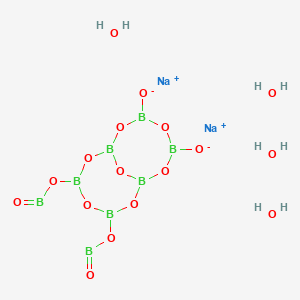
Disodium octaborate tetrahydrate
- Nom IUPAC
- disodium;(9,11-dioxido-5-oxoboranyloxy-2,4,6,8,10,12,13-heptaoxa-1,3,5,7,9,11-hexaborabicyclo[5.5.1]tridecan-3-yl)oxy-oxoborane;tetrahydrate
- Formule moléculaire
- B8H8Na2O17
- Masse moléculaire
- 412.5 g/mol
- Masse exacte
- 413.0337604 Da
- Surface polaire topologique
- 167,0 Ų
- Donneurs de liaisons hydrogène
- 4
- Accepteurs de liaisons hydrogène
- 17
- Unités covalentes
- 7
- Stéréocentres définis
- 0
Également connu sous le nom de
16 autres noms signalés
Identifiants de bases de données externes
- EPA DTXSID:DTXSID1034391
Preuves issues de bases de données scientifiques complémentaires
NIH PubChem PUG-View
Attributed physical-property, hazard, environmental and use annotations.
- Physical Description: Large Crystals; CBI Source: EPA Chemical Data Reporting (CDR)
- Physical Description: White odorless solid; [Reference #1] White odorless powder; [U.S. Borax MSDS] Source: Haz-Map, Information on Hazardous Chemicals and Occupational Diseases
- Signal: Danger Source: Regulation (EC) No 1272/2008 of the European Parliament and of the Council
- GHS Hazard Statements: H360FD: May damage fertility; May damage the unborn child [Danger Reproductive toxicity] Source: Regulation (EC) No 1272/2008 of the European Parliament and of the Council
- Precautionary Statement Codes: P203, P280, P318, P405, and P501 (click each P-code to see the statement) Source: Regulation (EC) No 1272/2008 of the European Parliament and of the Council
- Note: This chemical does not meet GHS hazard criteria for 7.1% (2 of 28) of reports. Source: European Chemicals Agency (ECHA)
- Signal: Danger Source: European Chemicals Agency (ECHA)
- GHS Hazard Statements: H315 (14.3%): Causes skin irritation [Warning Skin corrosion/irritation]; H319 (71.4%): Causes serious eye irritation [Warning Serious eye damage/eye irritation]; H360 (78.6%): May damage fertility or the unborn child [Danger Reproductive toxicity] Source: European Chemicals Agency (ECHA)
- Precautionary Statement Codes: P203, P264, P264+P265, P280, P302+P352, P305+P351+P338, P318, P321, P332+P317, P337+P317, P362+P364, P405, and P501 (click each P-code to see the statement) Source: European Chemicals Agency (ECHA)
- ECHA C&L Notifications Summary: Aggregated GHS information provided per 28 reports by companies from 4 notifications to the ECHA C&L Inventory. Each notification may be associated with multiple companies.; Reported as not meeting GHS hazard criteria per 2 of 28 reports by companies.; There are 3 notifications provided by 26 of 28 reports by companies with hazard statement code(s).; Information may vary between notifications depending on impurities, additives, and other factors. The percentage value in parenthesis indicates the notified classification ratio from companies that provide hazard codes. Only hazard codes with percentage values above 10% are shown. For more detailed information, please visit ECHA C&L website. Source: European Chemicals Agency (ECHA)
- Signal: Danger Source: NITE-CMC
- GHS Hazard Statements: H335: May cause respiratory irritation [Warning Specific target organ toxicity, single exposure; Respiratory tract irritation]; H360: May damage fertility or the unborn child [Danger Reproductive toxicity]; H370: Causes damage to organs [Danger Specific target organ toxicity, single exposure]; H372: Causes damage to organs through prolonged or repeated exposure [Danger Specific target organ toxicity, repeated exposure]; H373: May causes damage to organs through prolonged or repeated exposure [Warning Specific target organ toxicity, repeated exposure] Source: NITE-CMC
- Precautionary Statement Codes: P203, P260, P261, P264, P270, P271, P280, P304+P340, P308+P316, P318, P319, P321, P403+P233, P405, and P501 (click each P-code to see the statement) Source: NITE-CMC
- Signal: Danger Source: Hazardous Chemical Information System (HCIS), Safe Work Australia
- Consumer Uses: Other; Not Known or Reasonably Ascertainable Source: EPA Chemical Data Reporting (CDR)
- Industry Uses: Soil amendments (fertilizers); Other Source: EPA Chemical Data Reporting (CDR)
- Sources/Uses: Used as an insecticide (ants, cockroaches, flies, silverfish, termites, and wood boring insects) and fungicidal wood preservative; Not used on crops but used on compost, manure, and animal quarters; [Reference #1] Source: Haz-Map, Information on Hazardous Chemicals and Occupational Diseases
- Industrial Processes with risk of exposure: Applying Wood Preservatives [Category: Other]; Farming (Pesticides) [Category: Industry] Source: Haz-Map, Information on Hazardous Chemicals and Occupational Diseases
Mis en correspondance par: Existing checksum-valid CAS to unique PubChem CID match. Récupéré le: 2026-08-31. Ouvrir la fiche source
Les classifications scientifiques et les annotations de danger apportent du contexte et ne remplacent pas la décision réglementaire propre au marché indiquée ci-dessus.
Couverture des sources complémentaires et état des correspondances
| Source | Résultat | Vérifié |
|---|---|---|
| NIH PubChem PUG-View | Correspondance exacte | 2026-08-31 |
Une absence de correspondance enregistrée est une preuve utile que la source a été vérifiée ; ce n’est pas l’affirmation que la substance n’existe pas ailleurs.
Récupéré depuis NIH PubChem le 2026-09-02 par correspondance CAS à somme de contrôle valide. Les propriétés chimiques ne remplacent pas la décision réglementaire de cette page.
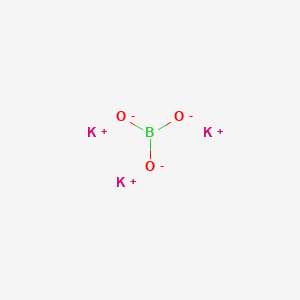
boric acid, potassium salt
Tripotassium borate is a member of borate salts. — ChEBI
- Nom IUPAC
- tripotassium;borate
- Formule moléculaire
- BK3O3
- Masse moléculaire
- 176.11 g/mol
- Masse exacte
- 175.8851685 Da
- Surface polaire topologique
- 69,2 Ų
- Donneurs de liaisons hydrogène
- 0
- Accepteurs de liaisons hydrogène
- 3
- Unités covalentes
- 4
- Stéréocentres définis
- 0
Également connu sous le nom de
4 autres noms signalés
Identifiants de bases de données externes
- ChEBI:CHEBI:38911
- EPA DTXSID:DTXSID3049750
Preuves issues de bases de données scientifiques complémentaires
NIH PubChem PUG-View
Attributed physical-property, hazard, environmental and use annotations.
- Signal: Danger Source: European Chemicals Agency (ECHA)
- GHS Hazard Statements: H315 (71%): Causes skin irritation [Warning Skin corrosion/irritation]; H319 (71%): Causes serious eye irritation [Warning Serious eye damage/eye irritation]; H335 (35.5%): May cause respiratory irritation [Warning Specific target organ toxicity, single exposure; Respiratory tract irritation]; H360 (29%): May damage fertility or the unborn child [Danger Reproductive toxicity] Source: European Chemicals Agency (ECHA)
- Precautionary Statement Codes: P203, P261, P264, P264+P265, P271, P280, P302+P352, P304+P340, P305+P351+P338, P318, P319, P321, P332+P317, P337+P317, P362+P364, P403+P233, P405, and P501 (click each P-code to see the statement) Source: European Chemicals Agency (ECHA)
- ECHA C&L Notifications Summary: Aggregated GHS information provided per 62 reports by companies from 3 notifications to the ECHA C&L Inventory. Each notification may be associated with multiple companies.; Information may vary between notifications depending on impurities, additives, and other factors. The percentage value in parenthesis indicates the notified classification ratio from companies that provide hazard codes. Only hazard codes with percentage values above 10% are shown. For more detailed information, please visit ECHA C&L website. Source: European Chemicals Agency (ECHA)
- Signal: Danger Source: Hazardous Chemical Information System (HCIS), Safe Work Australia
- GHS Hazard Statements: H360FD: May damage fertility; May damage the unborn child [Danger Reproductive toxicity] Source: Hazardous Chemical Information System (HCIS), Safe Work Australia
- Precautionary Statement Codes: P203, P280, P318, P405, and P501 (click each P-code to see the statement) Source: Hazardous Chemical Information System (HCIS), Safe Work Australia
Mis en correspondance par: Existing checksum-valid CAS to unique PubChem CID match. Récupéré le: 2026-08-31. Ouvrir la fiche source
Les classifications scientifiques et les annotations de danger apportent du contexte et ne remplacent pas la décision réglementaire propre au marché indiquée ci-dessus.
Couverture des sources complémentaires et état des correspondances
| Source | Résultat | Vérifié |
|---|---|---|
| NIH PubChem PUG-View | Correspondance exacte | 2026-08-31 |
Une absence de correspondance enregistrée est une preuve utile que la source a été vérifiée ; ce n’est pas l’affirmation que la substance n’existe pas ailleurs.
Récupéré depuis NIH PubChem le 2026-09-02 par correspondance CAS à somme de contrôle valide. Les propriétés chimiques ne remplacent pas la décision réglementaire de cette page.
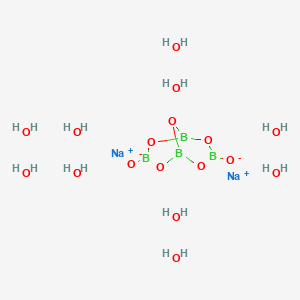
Borax (B4Na2O7.10H2O)
Borax is a mineral with formula of Na2B4O5(OH)4·8H2O. The IMA symbol is Brx. — RRUFF Project
- Nom IUPAC
- disodium;3,7-dioxido-2,4,6,8,9-pentaoxa-1,3,5,7-tetraborabicyclo[3.3.1]nonane;decahydrate
- Formule moléculaire
- B4H20Na2O17
- Masse moléculaire
- 381.4 g/mol
- Masse exacte
- 382.0868084 Da
- Surface polaire topologique
- 102,0 Ų
- Donneurs de liaisons hydrogène
- 10
- Accepteurs de liaisons hydrogène
- 17
- Unités covalentes
- 13
- Stéréocentres définis
- 0
Également connu sous le nom de
16 autres noms signalés
Identifiants de bases de données externes
- ChEMBL:CHEMBL3833375
- EPA DTXSID:DTXSID701014356
- PubMed:10010
Preuves issues de bases de données scientifiques complémentaires
NIH PubChem PUG-View
Attributed physical-property, hazard, environmental and use annotations.
- Boiling Point: 608 °F Source: Occupational Safety and Health Administration (OSHA)
- Boiling Point: 608 °F Source: The National Institute for Occupational Safety and Health (NIOSH)
- Color/Form: White, monoclinic crystals Source: Hazardous Substances Data Bank (HSDB)
- Color/Form: Hard crystals, granules or crystalline powder; efflorescent in dry air, the crystals often being coated with white powder Source: Hazardous Substances Data Bank (HSDB)
- Color/Form: Crystalline granules or crystalline powder Source: Hazardous Substances Data Bank (HSDB)
- Color/Form: White, crystalline solid [Note: Becomes anhydrous at 608 degrees F] Source: Hazardous Substances Data Bank (HSDB)
- Density: 1.73 g/cu cm Source: Hazardous Substances Data Bank (HSDB)
- Density: Relative density (water = 1): 1.7 Source: ILO-WHO International Chemical Safety Cards (ICSCs)
- Density: 1.73 Source: Occupational Safety and Health Administration (OSHA)
- Density: 1.73 @25 °C Source: PAC Chemical Database, U.S. Department of Energy
- Density: 1.73 Source: The National Institute for Occupational Safety and Health (NIOSH)
- Melting Point: 75 °C (decomposes) Source: Hazardous Substances Data Bank (HSDB)
- Melting Point: 167 °F Source: Occupational Safety and Health Administration (OSHA)
- Melting Point: 167 °F Source: The National Institute for Occupational Safety and Health (NIOSH)
- Odor: Odorless Source: Hazardous Substances Data Bank (HSDB)
- Physical Description: Liquid; Other Solid; Large Crystals; Wet Solid; Dry Powder Source: EPA Chemical Data Reporting (CDR)
- Physical Description: White, odorless, crystalline solid; Becomes anhydrous at 608 degrees F; [NIOSH] Source: Haz-Map, Information on Hazardous Chemicals and Occupational Diseases
- Physical Description: WHITE CRYSTALS OR CRYSTALLINE POWDER. Source: ILO-WHO International Chemical Safety Cards (ICSCs)
- Physical Description: White, odorless, crystalline solid. Source: Occupational Safety and Health Administration (OSHA)
- Physical Description: White, odorless, crystalline solid. [herbicide] [Note: Becomes anhydrous at 608 °F.] Source: The National Institute for Occupational Safety and Health (NIOSH)
- Refractive Index: Index of refraction: 1.447 (alpha); 1.469 (beta); 1.472 (gamma) Source: Hazardous Substances Data Bank (HSDB)
- Solubility: Aqueous solution is alkaline to litmus and phenolphthalein; pH about pH = 9.5 Source: Hazardous Substances Data Bank (HSDB)
- Solubility: At 100 °C loses 5H2O; at 150 °C loses 9H2O; becomes anhydrous at 320 °C; borax dissolves many metallic oxides when fused with them Source: Hazardous Substances Data Bank (HSDB)
- Solubility: In water, 5.93X10+4 mg/L at 25 °C Source: Hazardous Substances Data Bank (HSDB)
- Solubility: 3.17 g/100 g water at 25 °C Source: Hazardous Substances Data Bank (HSDB)
- Solubility: 1 g/16 mL in water; 1 g/0.6 mL boiling water; 1 g/1 mL glycerol; insoluble in alcohol Source: Hazardous Substances Data Bank (HSDB)
- Solubility: Insoluble in ethanol Source: Hazardous Substances Data Bank (HSDB)
- Solubility: 0.60 g/100 g acetone Source: Hazardous Substances Data Bank (HSDB)
- Solubility: Solubility in water, g/100ml at 20 °C: 5.1 Source: ILO-WHO International Chemical Safety Cards (ICSCs)
- Solubility: 6% Source: The National Institute for Occupational Safety and Health (NIOSH)
- Vapor Pressure: Approximately 0 mm Hg Source: Hazardous Substances Data Bank (HSDB)
- Vapor Pressure: 0 mmHg (approx) Source: Occupational Safety and Health Administration (OSHA)
- Vapor Pressure: 0 mmHg (approx) Source: The National Institute for Occupational Safety and Health (NIOSH)
- pH: pH at 20 °C: 9.3 (0.1% solution); 9.2 (1.0% solution) Source: Hazardous Substances Data Bank (HSDB)
- Exposure Routes: The substance can be absorbed into the body by inhalation and by ingestion. Source: ILO-WHO International Chemical Safety Cards (ICSCs)
- Exposure Routes: inhalation, ingestion, skin and/or eye contact Source: The National Institute for Occupational Safety and Health (NIOSH)
- First Aid: (General first aid procedures); Eye: Irrigate immediately - If this chemical contacts the eyes, immediately wash (irrigate) the eyes with large amounts of water, occasionally lifting the lower and upper lids. Get medical attention immediately.; Skin: Soap wash - If this chemical contacts the skin, wash the contaminated skin with soap and water.; Breathing: Respiratory support; Swallow: Medical attention immediately - If this chemical has been swallowed, get medical attention immediately. Source: The National Institute for Occupational Safety and Health (NIOSH)
- Signal: Danger Source: Regulation (EC) No 1272/2008 of the European Parliament and of the Council
- GHS Hazard Statements: H360FD: May damage fertility; May damage the unborn child [Danger Reproductive toxicity] Source: Regulation (EC) No 1272/2008 of the European Parliament and of the Council
- Precautionary Statement Codes: P203, P280, P318, P405, and P501 (click each P-code to see the statement) Source: Regulation (EC) No 1272/2008 of the European Parliament and of the Council
- Note: This chemical does not meet GHS hazard criteria for < 0.1% (1 of 2865) of reports. Source: European Chemicals Agency (ECHA)
- Signal: Danger Source: European Chemicals Agency (ECHA)
- GHS Hazard Statements: H319 (12.6%): Causes serious eye irritation [Warning Serious eye damage/eye irritation]; H360 (93.2%): May damage fertility or the unborn child [Danger Reproductive toxicity] Source: European Chemicals Agency (ECHA)
- Precautionary Statement Codes: P203, P264+P265, P280, P305+P351+P338, P318, P337+P317, P405, and P501 (click each P-code to see the statement) Source: European Chemicals Agency (ECHA)
- ECHA C&L Notifications Summary: Aggregated GHS information provided per 2865 reports by companies from 31 notifications to the ECHA C&L Inventory. Each notification may be associated with multiple companies.; Reported as not meeting GHS hazard criteria per 1 of 2865 reports by companies.; There are 30 notifications provided by 2864 of 2865 reports by companies with hazard statement code(s).; Information may vary between notifications depending on impurities, additives, and other factors. The percentage value in parenthesis indicates the notified classification ratio from companies that provide hazard codes. Only hazard codes with percentage values above 10% are shown. For more detailed information, please visit ECHA C&L website. Source: European Chemicals Agency (ECHA)
- Signal: Danger Source: NITE-CMC
- GHS Hazard Statements: H315: Causes skin irritation [Warning Skin corrosion/irritation]; H319: Causes serious eye irritation [Warning Serious eye damage/eye irritation]; H335: May cause respiratory irritation [Warning Specific target organ toxicity, single exposure; Respiratory tract irritation]; H360: May damage fertility or the unborn child [Danger Reproductive toxicity]; H370: Causes damage to organs [Danger Specific target organ toxicity, single exposure]; H372: Causes damage to organs through prolonged or repeated exposure [Danger Specific target organ toxicity, repeated exposure]; H413: May cause long lasting harmful effects to aquatic life [Hazardous to the aquatic environment, long-term hazard] Source: NITE-CMC
- Precautionary Statement Codes: P203, P260, P261, P264, P264+P265, P270, P271, P273, P280, P302+P352, P304+P340, P305+P351+P338, P308+P316, P318, P319, P321, P332+P317, P337+P317, P362+P364, P403+P233, P405, and P501 (click each P-code to see the statement) Source: NITE-CMC
- GHS Hazard Statements: H303: May be harmful if swallowed [Warning Acute toxicity, oral]; H315: Causes skin irritation [Warning Skin corrosion/irritation]; H319: Causes serious eye irritation [Warning Serious eye damage/eye irritation]; H361: Suspected of damaging fertility or the unborn child [Warning Reproductive toxicity]; H370: Causes damage to organs [Danger Specific target organ toxicity, single exposure]; H372: Causes damage to organs through prolonged or repeated exposure [Danger Specific target organ toxicity, repeated exposure]; H373: May causes damage to organs through prolonged or repeated exposure [Warning Specific target organ toxicity, repeated exposure] Source: NITE-CMC
- Target Organs: Eyes, skin, respiratory system Source: The National Institute for Occupational Safety and Health (NIOSH)
- Cosmetic Ingredient Review Conclusion: The Expert Panel concludes that Sodium Borate and Boric Acid, in concentrations less than or equal to 5 percent, are safe as cosmetic ingredients when used as currently recommended; however, cosmetic formulations containing free Sodium Borate or Boric Acid at this concentration should not be used on infant skin or injured skin. Note: In 2003, the CIR Expert Panel considered available new data on these ingredients and reaffirmed the above conclusion. Source: Cosmetic Ingredient Review (CIR)
- Cosmetic Ingredient Review Finding(s): Safe for use in cosmetics, with qualifications Source: Cosmetic Ingredient Review (CIR)
- Environmental Bioconcentration: In a greenhouse experiment with sandy loam soil treated with 0-8.0 ppm boron as borax, boron toxicity symptoms appeared earliest in lentil plants and barley seedlings exposed to 8.0 ppm boron. In barley the severity of boron toxicity decreased with the decrease in boron levels, whereas in lentil the severity of the symptoms eventually reached the same level in 2 and 4 ppm boron treatments as with the highest concentration. Dry matter yield decreased 38.6% in lentil and 23.4% in barley exposed to 8.0 ppm boron in comparison with controls. Boron contents of lentil and barley plants on soil treated with 8 ppm boron were approximately 7- and approximately 8-fold those of control plants, respectively. Source: Hazardous Substances Data Bank (HSDB)
- Environmental Fate: TERRESTRIAL FATE: Boron is naturally occurring and ubiquitous in the environment. No microbial degradation. Disappearance from soil is by washing out. Persistence in soil is about 2 years, depending on rainfall and soil structure. Source: Hazardous Substances Data Bank (HSDB)
- Consumer Uses: Other; Adhesion/cohesion promoter; Soil amendments (fertilizers); Not Known or Reasonably Ascertainable; Flame retardant Source: EPA Chemical Data Reporting (CDR)
- Industry Uses: Abrasives; Plating agent; Etching agent; Chelating agent; Flame retardant; Soil amendments (fertilizers) Source: EPA Chemical Data Reporting (CDR)
- Cosmetic Ingredient Review Link: CIR ingredient: Sodium Borate Source: Cosmetic Ingredient Review (CIR)
- Sources/Uses: Used as a preservative, antiseptic and fungicide; also used to manufacture glazes, enamels, soldering fluxes and cleaning compounds and to fireproof textiles and wood; [ACGIH] Boric acid and borates as tablets or powder are used to kill larvae in barns and other insects in houses. Rarely, they are sprayed as herbicides. [EPA: Recognition of Pesticide Poisonings] Used in photo developing bath; [www.ci.tucson.az.us/arthazards/medium.html] Borax (borax decahydrate) is found naturally in some salt lakes and alkaline soils. Boric acid is formed by crystallizing a solution of hydrochloric acid or sulfuric acid and borax. [Hawley] Source: Haz-Map, Information on Hazardous Chemicals and Occupational Diseases
- Industrial Processes with risk of exposure: Soldering [Category: Heat or Machine]; Using Disinfectants or Biocides [Category: Clean]; Farming (Pesticides) [Category: Industry]; Photographic Processing [Category: Other]; Textiles (Printing, Dyeing, or Finishing) [Category: Industry] Source: Haz-Map, Information on Hazardous Chemicals and Occupational Diseases
- Uses: For borax (USEPA/OPP Pesticide Code: 011102) ACTIVE products with label matches. /SRP: Registered for use in the U.S. but approved pesticide uses may change periodically and so federal, state and local authorities must be consulted for currently approved uses./ Source: Hazardous Substances Data Bank (HSDB)
- Uses: Long been used as a mild antiseptic fungicide and as a herbicide ... Total control of vegetation on non-crop land, such as paths, giving long-term control. Also used in insect baits for food stores to control Formicidae. Source: Hazardous Substances Data Bank (HSDB)
- Uses: Soldering metals; manufacture of glazes and enamels; tanning; in cleaning compounds; artificially aging wood; as preservative, either alone or with other antiseptics against wood fungus; fireproofing fabrics and wood; curing and preserving skins; in cockroach control. In buffers; as a complexing or masking agent in analytical chemistry. Pharmaceutic aid (alkalizer). Source: Hazardous Substances Data Bank (HSDB)
- Uses: Used in ant poisons, for fly control around refuse and manure piles, as a larvicide, in manufacture of glazes, enamels, cleaning compounds, and in soldering metals Source: Hazardous Substances Data Bank (HSDB)
- Uses: For more Uses (Complete) data for BORAX (17 total), please visit the HSDB record page. Source: Hazardous Substances Data Bank (HSDB)
Mis en correspondance par: Existing checksum-valid CAS to unique PubChem CID match. Récupéré le: 2026-08-31. Ouvrir la fiche source
Les classifications scientifiques et les annotations de danger apportent du contexte et ne remplacent pas la décision réglementaire propre au marché indiquée ci-dessus.
Couverture des sources complémentaires et état des correspondances
| Source | Résultat | Vérifié |
|---|---|---|
| NIH PubChem PUG-View | Correspondance exacte | 2026-08-31 |
Une absence de correspondance enregistrée est une preuve utile que la source a été vérifiée ; ce n’est pas l’affirmation que la substance n’existe pas ailleurs.
Récupéré depuis NIH PubChem le 2026-09-02 par correspondance CAS à somme de contrôle valide. Les propriétés chimiques ne remplacent pas la décision réglementaire de cette page.
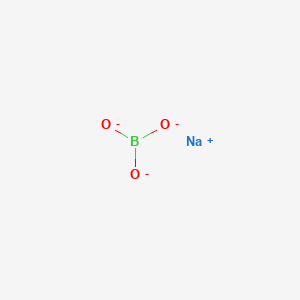
Boric acid (H3BO3), sodium salt (1:?)
- Nom IUPAC
- sodium borate
- Formule moléculaire
- BNaO3-2
- Masse moléculaire
- 81.80 g/mol
- Masse exacte
- 81.9838183 Da
- Surface polaire topologique
- 69,2 Ų
- Donneurs de liaisons hydrogène
- 0
- Accepteurs de liaisons hydrogène
- 3
- Unités covalentes
- 2
- Stéréocentres définis
- 0
Également connu sous le nom de
2 autres noms signalés
Récupéré depuis NIH PubChem le 2026-09-02 par correspondance CAS à somme de contrôle valide. Les propriétés chimiques ne remplacent pas la décision réglementaire de cette page.
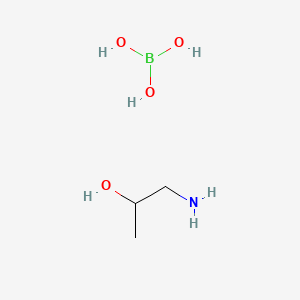
(2-Hydroxypropyl)ammonium dihydrogen orthoborate
- Nom IUPAC
- 1-aminopropan-2-ol;boric acid
- Formule moléculaire
- C3H12BNO4
- Masse moléculaire
- 136.95 g/mol
- Masse exacte
- 137.0859380 Da
- Surface polaire topologique
- 107,0 Ų
- Donneurs de liaisons hydrogène
- 5
- Accepteurs de liaisons hydrogène
- 5
- Unités covalentes
- 2
- Stéréocentres définis
- 0
Également connu sous le nom de
5 autres noms signalés
Identifiants de bases de données externes
- EPA DTXSID:DTXSID10892195
Récupéré depuis NIH PubChem le 2026-09-02 par correspondance CAS à somme de contrôle valide. Les propriétés chimiques ne remplacent pas la décision réglementaire de cette page.
Liens d’inventaire pour Borates, tetraborates, octaborates and boric acid salts and esters, including: Disodium octaborate anhydrous [1] Disodium octaborate tetrahydrate [2] 2-Aminoethanol, monoester with boric acid [3] 2-Hydroxypropyl ammonium dihydrogen orthoborate [4] Potassium borate, boric acid potassium salt [5] Trioctyldodecyl borate [6] Zinc borate [7] Sodium borate, disodium tetraborate anhydrous; boric acid, sodium salt [8] Tetraboron disodium heptaoxide, hydrate [9] Orthoboric acid, sodium salt [10] Disodium tetraborate decahydrate; borax decahydrate [11] Disodium tetraborate pentahydrate; borax pentahydrate [12]
MEA-BORATE
PHENYL MERCURIC BORATE
SODIUM PERBORATE
Fiches associées pour Borates, tetraborates, octaborates and boric acid salts and esters, including: Disodium octaborate anhydrous [1] Disodium octaborate tetrahydrate [2] 2-Aminoethanol, monoester with boric acid [3] 2-Hydroxypropyl ammonium dihydrogen orthoborate [4] Potassium borate, boric acid potassium salt [5] Trioctyldodecyl borate [6] Zinc borate [7] Sodium borate, disodium tetraborate anhydrous; boric acid, sodium salt [8] Tetraboron disodium heptaoxide, hydrate [9] Orthoboric acid, sodium salt [10] Disodium tetraborate decahydrate; borax decahydrate [11] Disodium tetraborate pentahydrate; borax pentahydrate [12]
Les correspondances directes sont limitées pour cette fiche ; des entrées voisines de l’annexe II sont donc également affichées.
Boric acid [1]; Boric acid [2]
Perboric acid (H3BO2(O2)), monosodium salt trihydrate [1] Perboric acid, sodium salt, tetrahydrate …
Diboron trioxide; boric oxide
Dibutyltin hydrogen borate
N-Methyl-2-pyrrolidone; 1-methyl-2-pyrrolidone
Nickel bis(tetrafluoroborate)
1-Cyclopropyl-6,7-difluoro-1,4-dihydro-4-oxoquinoline-3-carboxylic acid
Mancozeb (ISO); manganese ethylenebis(dithiocarbamate) (polymeric) complex with zinc salt
Maneb (ISO); manganese ethylenebis(dithiocarbamate) (polymeric)
2,2'-((3,3',5,5'-Tetramethyl-(1,1'-biphenyl)-4,4'-diyl)-bis(oxymethylene))-bis-oxirane
Benfuracarb (ISO); ethyl N-[2,3-dihydro-2,2-dimethylbenzofuran-7-yloxycarbonyl(methyl)aminothio]-N-…
Ce que signifie l’annexe II pour Borates, tetraborates, octaborates and boric acid salts and esters, including: Disodium octaborate anhydrous [1] Disodium octaborate tetrahydrate [2] 2-Aminoethanol, monoester with boric acid [3] 2-Hydroxypropyl ammonium dihydrogen orthoborate [4] Potassium borate, boric acid potassium salt [5] Trioctyldodecyl borate [6] Zinc borate [7] Sodium borate, disodium tetraborate anhydrous; boric acid, sodium salt [8] Tetraboron disodium heptaoxide, hydrate [9] Orthoboric acid, sodium salt [10] Disodium tetraborate decahydrate; borax decahydrate [11] Disodium tetraborate pentahydrate; borax pentahydrate [12]
Borates, tetraborates, octaborates and boric acid salts and esters, including: Disodium octaborate anhydrous [1] Disodium octaborate tetrahydrate [2] 2-Aminoethanol, monoester with boric acid [3] 2-Hydroxypropyl ammonium dihydrogen orthoborate [4] Potassium borate, boric acid potassium salt [5] Trioctyldodecyl borate [6] Zinc borate [7] Sodium borate, disodium tetraborate anhydrous; boric acid, sodium salt [8] Tetraboron disodium heptaoxide, hydrate [9] Orthoboric acid, sodium salt [10] Disodium tetraborate decahydrate; borax decahydrate [11] Disodium tetraborate pentahydrate; borax pentahydrate [12] figure comme substance interdite à l’annexe II du règlement (CE) n° 1223/2009 relatif aux produits cosmétiques et ne doit pas être ajouté intentionnellement. L’article 17 traite séparément des traces involontaires, techniquement inévitables dans le respect des bonnes pratiques de fabrication et compatibles avec l’exigence de sécurité de l’article 3.
Les formulateurs doivent contrôler leurs ingrédients et matières premières afin de s’assurer qu’aucun ne contient cette substance. Les fournisseurs doivent fournir, sur demande, une documentation confirmant son absence.
Cette fiche est liée à 13 ingrédients de l’inventaire CosIng pour le recoupement des noms et des identifiants. La page fait également apparaître 12 fiches d’annexe associées présentant des identifiants, une logique d’annexe ou des schémas de dénomination qui se recoupent.
Liste de contrôle de conformité
- Vérifiez que cette substance est absente de toutes les matières premières et formulations finies.
- Demandez aux fournisseurs de matières premières une attestation d’absence ou un certificat d’analyse.
- Consignez le résultat du contrôle dans le dossier d’information produit (DIP).
Questions fréquentes
Note de source pour la fiche Borates, tetraborates, octaborates and boric acid salts and esters, including: Disodium octaborate anhydrous [1] Disodium octaborate tetrahydrate [2] 2-Aminoethanol, monoester with boric acid [3] 2-Hydroxypropyl ammonium dihydrogen orthoborate [4] Potassium borate, boric acid potassium salt [5] Trioctyldodecyl borate [6] Zinc borate [7] Sodium borate, disodium tetraborate anhydrous; boric acid, sodium salt [8] Tetraboron disodium heptaoxide, hydrate [9] Orthoboric acid, sodium salt [10] Disodium tetraborate decahydrate; borax decahydrate [11] Disodium tetraborate pentahydrate; borax pentahydrate [12] de l’annexe II
Cette page résume une fiche de l’annexe II pour Borates, tetraborates, octaborates and boric acid salts and esters, including: Disodium octaborate anhydrous [1] Disodium octaborate tetrahydrate [2] 2-Aminoethanol, monoester with boric acid [3] 2-Hydroxypropyl ammonium dihydrogen orthoborate [4] Potassium borate, boric acid potassium salt [5] Trioctyldodecyl borate [6] Zinc borate [7] Sodium borate, disodium tetraborate anhydrous; boric acid, sodium salt [8] Tetraboron disodium heptaoxide, hydrate [9] Orthoboric acid, sodium salt [10] Disodium tetraborate decahydrate; borax decahydrate [11] Disodium tetraborate pentahydrate; borax pentahydrate [12] à partir de documents publics de la Commission européenne sur les cosmétiques et ajoute les correspondances d’inventaire ou d’identifiants associées lorsqu’elles sont disponibles.
Utilisez cette page de fiche pour examiner les conditions de l’annexe II pour Borates, tetraborates, octaborates and boric acid salts and esters, including: Disodium octaborate anhydrous [1] Disodium octaborate tetrahydrate [2] 2-Aminoethanol, monoester with boric acid [3] 2-Hydroxypropyl ammonium dihydrogen orthoborate [4] Potassium borate, boric acid potassium salt [5] Trioctyldodecyl borate [6] Zinc borate [7] Sodium borate, disodium tetraborate anhydrous; boric acid, sodium salt [8] Tetraboron disodium heptaoxide, hydrate [9] Orthoboric acid, sodium salt [10] Disodium tetraborate decahydrate; borax decahydrate [11] Disodium tetraborate pentahydrate; borax pentahydrate [12], mais confirmez toute décision réglementaire finale auprès du libellé officiel en vigueur de l’annexe et des fichiers sources.
Outils et étapes suivantes
Vérifiez votre formule
Collez une liste INCI complète pour détecter Borates, tetraborates, octaborates and boric acid salts and esters, including: Disodium octaborate anhydrous [1] Disodium octaborate tetrahydrate [2] 2-Aminoethanol, monoester with boric acid [3] 2-Hydroxypropyl ammonium dihydrogen orthoborate [4] Potassium borate, boric acid potassium salt [5] Trioctyldodecyl borate [6] Zinc borate [7] Sodium borate, disodium tetraborate anhydrous; boric acid, sodium salt [8] Tetraboron disodium heptaoxide, hydrate [9] Orthoboric acid, sodium salt [10] Disodium tetraborate decahydrate; borax decahydrate [11] Disodium tetraborate pentahydrate; borax pentahydrate [12] et d’autres fiches d’annexe de l’UE signalées en une seule passe.
Vérificateur INCIComparer des entrées
Comparez Borates, tetraborates, octaborates and boric acid salts and esters, including: Disodium octaborate anhydrous [1] Disodium octaborate tetrahydrate [2] 2-Aminoethanol, monoester with boric acid [3] 2-Hydroxypropyl ammonium dihydrogen orthoborate [4] Potassium borate, boric acid potassium salt [5] Trioctyldodecyl borate [6] Zinc borate [7] Sodium borate, disodium tetraborate anhydrous; boric acid, sodium salt [8] Tetraboron disodium heptaoxide, hydrate [9] Orthoboric acid, sodium salt [10] Disodium tetraborate decahydrate; borax decahydrate [11] Disodium tetraborate pentahydrate; borax pentahydrate [12] côte à côte avec une autre fiche d’annexe pour examiner les différences de restrictions, de concentrations et d’annexe.
ComparerParcourir l’annexe
Consultez toutes les fiches de l’annexe II et comparez les conditions réglementaires entre les substances de cette annexe.
Ouvrir l’annexe II