
HOMOSALATE
Benzoic acid, 2-hydroxy-, 3,3,5-trimethylcyclohexyl ester / Homosalate
HOMOSALATE appears in Annex VI as a positive-list UV filter entry for EU cosmetics. Maximum concentration in this record: 7,34 %.
Reading this entry
Homosalate was cut back in 2022 to face products only, at 7.34%, after the SCCS reassessed it. Body sunscreens that once used it as a bulk filter no longer have an entry to sit in.
- 7.34%, and only in face products, excluding propellant sprays.
- Body sunscreens and spray formats are outside the permitted product type entirely.
- 1 January 2025 stops non-compliant products being placed on the market; 1 July 2025 stops them being made available.
- The previous limit was 10% across products, so a reformulation is not a small adjustment.
The number changed and the product scope changed with it, and the second is the harder constraint. Homosalate may be used at up to 7.34% in face products, excluding propellant sprays. It has no permitted use in a body sunscreen at all, which is the format that previously accounted for most of its volume.
The route here is the usual one for a UV filter: an SCCS reassessment concluded that the earlier 10% was not supported for the exposure pattern of a whole-body product, and the entry was narrowed to a use the evidence covered. That is worth knowing when comparing markets, because a filter reduced in the EU on exposure grounds often remains at its old limit elsewhere.
The two dates work as they always do. From 1 January 2025 a non-compliant product may not be placed on the Union market by its manufacturer or importer; from 1 July 2025 it may not be made available by anyone, including a retailer holding stock bought before the first date.
Checked against
Chemical identity and properties
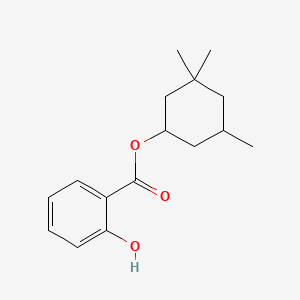
Homosalate
2-hydroxybenzoic acid (3,3,5-trimethylcyclohexyl) ester is a member of phenols and a benzoate ester. It is functionally related to a salicylic acid. — ChEBI
- IUPAC name
- (3,3,5-trimethylcyclohexyl) 2-hydroxybenzoate
- Molecular formula
- C16H22O3
- Molecular weight
- 262.34 g/mol
- Exact mass
- 262.15689456 Da
- XLogP3
- 5.0
- Topological polar surface area
- 46.5 Ų
- Hydrogen-bond donors
- 1
- Hydrogen-bond acceptors
- 3
- Covalent units
- 1
- Defined stereocentres
- 0
Also known as
16 more reported names
External database identifiers
- ChEBI:CHEBI:91642
- ChEMBL:CHEMBL1377575
- EPA DTXSID:DTXSID1026241
- PubMed:39159849
- PubMed:38381479
- PubMed:28551711
- PubMed:24004914
- PubMed:23769903
- PubMed:23062433
- PubMed:22884209
- PubMed:22749456
- PubMed:22669305
- PubMed:22612478
- PubMed:22214440
- PubMed:21872075
Evidence from additional scientific databases
NIH PubChem PUG-View
Attributed physical-property, hazard, environmental and use annotations.
- Boiling Point: 322 to 329 °F at 760 mmHg (NTP, 1992) Source: CAMEO Chemicals
- Density: 1.045 at 77 °F (NTP, 1992) - Denser than water; will sink Source: CAMEO Chemicals
- Flash Point: greater than 200 °F (NTP, 1992) Source: CAMEO Chemicals
- Physical Description: 3,3,5-trimethylcyclohexylsalicylate appears as viscous or light yellow to slightly tan liquid or oil. (NTP, 1992) Source: CAMEO Chemicals
- Solubility: Insoluble (<1 mg/ml at 79 °F) (NTP, 1992) Source: CAMEO Chemicals
- First Aid: EYES: First check the victim for contact lenses and remove if present. Flush victim's eyes with water or normal saline solution for 20 to 30 minutes while simultaneously calling a hospital or poison control center. Do not put any ointments, oils, or medication in the victim's eyes without specific instructions from a physician. IMMEDIATELY transport the victim after flushing eyes to a hospital even if no symptoms (such as redness or irritation) develop.; SKIN: IMMEDIATELY flood affected skin with water while removing and isolating all contaminated clothing. Gently wash all affected skin areas thoroughly with soap and water. If symptoms such as redness or irritation develop, IMMEDIATELY call a physician and be prepared to transport the victim to a hospital for treatment.; INHALATION: IMMEDIATELY leave the contaminated area; take deep breaths of fresh air. If symptoms (such as wheezing, coughing, shortness of breath, or burning in the mouth, throat, or chest) develop, call a physician and be prepared to transport the victim to a hospital. Provide proper respiratory protection to rescuers entering an unknown atmosphere. Whenever possible, Self-Contained Breathing Apparatus (SCBA) shou Source: CAMEO Chemicals
- Note: This chemical does not meet GHS hazard criteria for 67% (152 of 227) of all reports. Source: European Chemicals Agency (ECHA)
- Signal: Warning Source: European Chemicals Agency (ECHA)
- GHS Hazard Statements: H315 (16.7%): Causes skin irritation [Warning Skin corrosion/irritation]; H319 (16.7%): Causes serious eye irritation [Warning Serious eye damage/eye irritation]; H335 (16.7%): May cause respiratory irritation [Warning Specific target organ toxicity, single exposure; Respiratory tract irritation]; H361d (11.5%): Suspected of damaging the unborn child [Warning Reproductive toxicity]; H410 (11.5%): Very toxic to aquatic life with long lasting effects [Warning Hazardous to the aquatic environment, long-term hazard] Source: European Chemicals Agency (ECHA)
- Precautionary Statement Codes: P203, P261, P264, P264+P265, P271, P273, P280, P302+P352, P304+P340, P305+P351+P338, P318, P319, P321, P332+P317, P337+P317, P362+P364, P391, P403+P233, P405, and P501 (click each P-code to see the statement) Source: European Chemicals Agency (ECHA)
- ECHA C&L Notifications Summary: Aggregated GHS information provided per 227 reports by companies from 4 notifications to the ECHA C&L Inventory. Each notification may be associated with multiple companies.; Reported as not meeting GHS hazard criteria per 152 of 227 reports by companies.; There are 3 notifications provided by 75 of 227 reports by companies with hazard statement code(s).; Information may vary between notifications depending on impurities, additives, and other factors. The percentage value in parenthesis indicates the notified classification ratio from companies that provide hazard codes. Only hazard codes with percentage values above 10% are shown. For more detailed information, please visit ECHA C&L website. Source: European Chemicals Agency (ECHA)
- Industry Uses: Not Known or Reasonably Ascertainable Source: EPA Chemical Data Reporting (CDR)
Mapped by: Existing checksum-valid CAS to unique PubChem CID match. Retrieved: 2026-08-31. Open source record
Scientific classifications and hazard annotations provide context and do not replace the market-specific regulatory decision shown above.
Additional source coverage and match status
| Source | Result | Checked |
|---|---|---|
| NIH PubChem PUG-View | Exact match | 2026-08-31 |
A recorded no-match is useful evidence that the source was checked; it is not a claim that the substance does not exist elsewhere.
Retrieved from NIH PubChem on 2026-09-02 by checksum-valid CAS matching. Chemical properties do not replace the regulatory decision on this page.
Record details
Maximum concentration
7,34 %
Other restrictions
From 1 January 2025 cosmetic products containing that substance and not complying with the conditions shall not be placed on the Union market. From 1 July 2025 cosmetic products containing that substance and not complying with the conditions shall not be made available on the Union market.
INCI glossary name
HOMOSALATE
Chemical name
Benzoic acid, 2-hydroxy-, 3,3,5-trimethylcyclohexyl ester / Homosalate
Chemical / IUPAC name
Benzoic acid, 2-hydroxy-, 3,3,5-trimethylcyclohexyl ester / Homosalate
Regulatory information
SCCS opinions
Identified ingredients
Key data
Inventory links for HOMOSALATE
Related records for HOMOSALATE
Direct matches are limited for this record, so nearby entries from Annex VI are shown as well.
Camphor benzalkonium methosulfate
PHENYLBENZIMIDAZOLE SULFONIC ACID
TEREPHTHALYLIDENE DICAMPHOR SULFONIC ACID
Butyl Methoxydibenzoylmethane
POLYACRYLAMIDOMETHYL BENZYLIDENE CAMPHOR
What Annex VI means for HOMOSALATE
HOMOSALATE is an approved UV filter listed in Annex VI of EU Cosmetics Regulation 1223/2009. Only UV filters included in this positive list may be used to provide UV protection in EU cosmetic products.
The maximum permitted concentration specified in this entry applies to the ready-to-use product. Some UV filters are restricted to specific application types or require label warnings.
This record is linked to 1 CosIng inventory ingredient for name and identifier cross-reference. The page also surfaces 12 related annex records with overlapping identifiers, annex logic or naming patterns.
Compliance checklist
- Concentration in ready-to-use product must not exceed: 7,34 %
- Check whether the UV filter is approved for both leave-on and rinse-off applications.
Frequently asked questions
Source note for Annex VI record HOMOSALATE
This page summarizes one Annex VI record for HOMOSALATE from public European Commission cosmetic materials and adds linked inventory or identifier matches when available.
Use this record page to review Annex VI conditions for HOMOSALATE, but confirm any final regulatory decision against the current official annex wording and source files.
Tools & next steps
Check your formula
Paste a full INCI list to detect HOMOSALATE and other flagged EU annex records in one pass.
INCI CheckerCompare entries
Compare HOMOSALATE side by side with another annex record to review differences in restrictions, concentrations and annex placement.
CompareBrowse the annex
See all records in Annex VI and compare regulatory conditions across substances in this annex.
Open Annex VI