
TITANIUM DIOXIDE (NANO)
Titanium dioxide (nano)
TITANIUM DIOXIDE (NANO) appears in Annex VI as a positive-list UV filter entry for EU cosmetics. Maximum concentration in this record: 25% - In case of combined use of Titanium Dioxide and Titanium Dioxide (nano), the sum shall not exceed the limit of 25%..
Chemical identity and properties
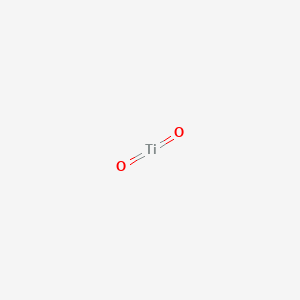
Titanium dioxide
Titanium dioxide is a titanium oxide with the formula TiO2. A naturally occurring oxide sourced from ilmenite, rutile and anatase, it has a wide range of applications. It has a role as a food colouring. — ChEBI
- IUPAC name
- dioxotitanium
- Molecular formula
- O2Ti
- Molecular weight
- 79.866 g/mol
- Exact mass
- 79.9377699 Da
- Topological polar surface area
- 34.1 Ų
- Hydrogen-bond donors
- 0
- Hydrogen-bond acceptors
- 2
- Covalent units
- 1
- Defined stereocentres
- 0
Also known as
16 more reported names
External database identifiers
Retrieved from NIH PubChem on 2026-08-31 by checksum-valid CAS matching. Chemical properties do not replace the regulatory decision on this page.
Record details
Maximum concentration
25% - In case of combined use of Titanium Dioxide and Titanium Dioxide (nano), the sum shall not exceed the limit of 25%.
Warnings
Not to be used in applications that may lead to exposure of the end-user's lungs by inhalation
Only nanomaterials having the following characteristics are allowed:
— purity ≥ 99 %,
— rutile form, or rutile with up to 5 % anatase, with crystalline structure and physical appearance as clusters of spherical, needle, or lanceolate shapes,
— median particle size based on number size distribution ≥ 30 nm,
— aspect ratio from 1 to 4,5, and volume specific surface area ≤ 460 m2/cm3,
— coated with Silica, Hydrated Silica, Alumina, Aluminium Hydroxide, Aluminium Stearate, Stearic Acid, Trimethoxycaprylylsilane, Glycerin, Dimethicone, Hydrogen Dimethicone, Simethicone;
or coated with one of the following combinations:
—Silica at a maximum concentration of 16 % and Cetyl Phosphate at a maximum concentration of 6 %,
—Alumina at a maximum concentration of 7 % and Manganese Dioxide at a maximum concentration of 0,7 % (not to be used in lip products), —Alumina at a maximum concentration of 3 % and Triethoxycaprylylsilane at a maximum concentration of 9 %,
— photocatalytic activity ≤ 10 % compared to corresponding non-coated or non-doped reference,
— nanoparticles are photostable in the final formulation.
Wording of conditions of use and warnings:
For face products containing Titanium Dioxide (nano) coated with the combination Alumina and Manganese Dioxide: Not to be used on the lips.
INCI glossary name
TITANIUM DIOXIDE (NANO)
Chemical name
Titanium dioxide (nano)
Chemical / IUPAC name
Titanium dioxide [1];Anatase (TiO2) [2];Rutile (TiO2) [3]
Regulatory information
SCCS opinions
- Opinion on Titanium Dioxide
- Opinion for clarification of the meaning of the term "sprayable applications/products" for the nano forms of Carbon Black CI 77266, Titanium Oxide and Zinc Oxide
- OPINION ON Titanium Dioxide (nano form) as UV-Filter in sprays
- OPINION ON Titanium Dioxide (nano form) coated with Cetyl Phosphate, Manganese Dioxide or Triethoxycaprylylsilane as UV-filter in dermally applied cosmetic
Key data
Inventory links for TITANIUM DIOXIDE (NANO)
Related records for TITANIUM DIOXIDE (NANO)
Direct matches are limited for this record, so nearby entries from Annex VI are shown as well.
TITANIUM DIOXIDE
TITANIUM DIOXIDE
BIS-ETHYLHEXYLOXYPHENOL METHOXYPHENYL TRIAZINE
DIETHYLAMINO HYDROXYBENZOYL HEXYL BENZOATE
DISODIUM PHENYL DIBENZIMIDAZOLE TETRASULFONATE
TRIS-BIPHENYL TRIAZINE / TRIS-BIPHENYL TRIAZINE (NANO)
METHYLENE BIS-BENZOTRIAZOLYL TETRAMETHYLBUTYLPHENOL
METHYLENE BIS-BENZOTRIAZOLYL TETRAMETHYLBUTYLPHENOL (NANO)
What Annex VI means for TITANIUM DIOXIDE (NANO)
TITANIUM DIOXIDE (NANO) is an approved UV filter listed in Annex VI of EU Cosmetics Regulation 1223/2009. Only UV filters included in this positive list may be used to provide UV protection in EU cosmetic products.
The maximum permitted concentration specified in this entry applies to the ready-to-use product. Some UV filters are restricted to specific application types or require label warnings.
This record is linked to 2 CosIng inventory ingredients for name and identifier cross-reference. The page also surfaces 11 related annex records with overlapping identifiers, annex logic or naming patterns.
Compliance checklist
- Concentration in ready-to-use product must not exceed: 25% - In case of combined use of Titanium Dioxide and Titanium Dioxide (nano), the sum shall not exceed the limit of 25%.
- Check whether the UV filter is approved for both leave-on and rinse-off applications.
- Include SPF or UV protection warning statements as required.
Frequently asked questions
Source note for Annex VI record TITANIUM DIOXIDE (NANO)
This page summarizes one Annex VI record for TITANIUM DIOXIDE (NANO) from public European Commission cosmetic materials and adds linked inventory or identifier matches when available.
Use this record page to review Annex VI conditions for TITANIUM DIOXIDE (NANO), but confirm any final regulatory decision against the current official annex wording and source files.
Tools & next steps
Check your formula
Paste a full INCI list to detect TITANIUM DIOXIDE (NANO) and other flagged EU annex records in one pass.
INCI CheckerCompare entries
Compare TITANIUM DIOXIDE (NANO) side by side with another annex record to review differences in restrictions, concentrations and annex placement.
CompareBrowse the annex
See all records in Annex VI and compare regulatory conditions across substances in this annex.
Open Annex VI