
METHYL SALICYLATE
Methyl 2-hydroxybenzoate
METHYL SALICYLATE is listed in Annex III and may only be used under the conditions shown in this record. Maximum concentration in this record: (a) 0,06 % (b) 0,05 % (c) 0,002 % (d) 0,009 % (e) 0,003 % (f) 0,04 % (g) 0,06 % (h) 0,6 % (i) 0,6 % (j) 0,03 % (k) 2,52 % (l) 0,1 % (m) 0,6 % (n) 0,65 %.
Chemical identity and properties
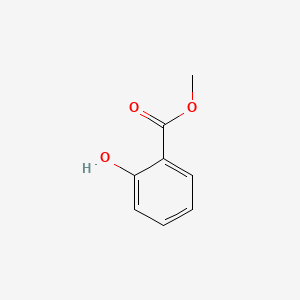
Methyl Salicylate
Methyl salicylate (oil of wintergreen or wintergreen oil) is an organic ester naturally produced by many species of plants, particularly wintergreens. The compound was first extracted and isolated from plant species Gaultheria procumbens in 1843. It can be manufactured synthetically and it used as a fragrance, in foods, beverages, and liniments. It forms a colorless to yellow or reddish liquid and exhibits a characteristic odor and taste of wintergreen. For acute joint and muscular pain, methyl salicylate is used as a rubefacient and analgesic in deep heating liniments. It is used as a flavoring agent in chewing gums and mints in small concentrations and added as antiseptic in mouthwash solutions. — DrugBank
- IUPAC name
- methyl 2-hydroxybenzoate
- Molecular formula
- C8H8O3
- Molecular weight
- 152.15 g/mol
- Exact mass
- 152.047344113 Da
- XLogP3
- 2.3
- Topological polar surface area
- 46.5 Ų
- Hydrogen-bond donors
- 1
- Hydrogen-bond acceptors
- 3
- Covalent units
- 1
- Defined stereocentres
- 0
Also known as
16 more reported names
External database identifiers
- ChEBI:CHEBI:31832
- ChEMBL:CHEMBL108545
- EPA DTXSID:DTXSID5025659
- PubMed:39159849
- PubMed:36416909
- PubMed:31734321
- PubMed:28826779
- PubMed:27965148
- PubMed:27729775
- PubMed:26973745
- PubMed:26795242
- PubMed:25425092
- PubMed:25411557
- PubMed:24712652
- PubMed:23583298
Evidence from additional scientific databases
NIH PubChem PUG-View
Attributed physical-property, hazard, environmental and use annotations.
- Autoignition Temperature: 847 °F (USCG, 1999) Source: CAMEO Chemicals
- Autoignition Temperature: 850 °F Source: Hazardous Substances Data Bank (HSDB)
- Autoignition Temperature: 450 °C Source: ILO-WHO International Chemical Safety Cards (ICSCs)
- Boiling Point: 432 °F at 760 mmHg (NTP, 1992) Source: CAMEO Chemicals
- Boiling Point: 220-224 Source: DrugBank
- Boiling Point: 220-224 °C Source: Hazardous Substances Data Bank (HSDB)
- Boiling Point: 222.00 to 224.00 °C. @ 760.00 mm Hg Source: Human Metabolome Database (HMDB)
- Boiling Point: 223 °C Source: ILO-WHO International Chemical Safety Cards (ICSCs)
- Boiling Point: 222 °C Source: Joint FAO/WHO Expert Committee on Food Additives (JECFA)
- Boiling Point: 223.3 °C @760 [mm Hg] Source: PAC Chemical Database, U.S. Department of Energy
- Color/Form: COLORLESS, YELLOWISH OR REDDISH, OILY LIQ Source: Hazardous Substances Data Bank (HSDB)
- Density: 1.174 (USCG, 1999) - Denser than water; will sink Source: CAMEO Chemicals
- Density: 1.184 @ 25 °C/25 °C Source: Hazardous Substances Data Bank (HSDB)
- Density: DENSITY OF NATURAL ESTER IS ABOUT 1.180 Source: Hazardous Substances Data Bank (HSDB)
- Density: Relative density (water = 1): 1.18 Source: ILO-WHO International Chemical Safety Cards (ICSCs)
- Density: 1.176-1.185 Source: Joint FAO/WHO Expert Committee on Food Additives (JECFA)
- Density: 1.184 @25 °C Source: PAC Chemical Database, U.S. Department of Energy
- Dissociation Constants: pKa = 9.8 Source: Hazardous Substances Data Bank (HSDB)
- Flash Point: 205 °F (NTP, 1992) Source: CAMEO Chemicals
- Flash Point: 205 °F (96 °C) (Closed cup) Source: Hazardous Substances Data Bank (HSDB)
- Flash Point: 101 °C c.c. Source: ILO-WHO International Chemical Safety Cards (ICSCs)
- LogP: 2.5 Source: DrugBank
- LogP: Log Kow = 2.55 Source: Hazardous Substances Data Bank (HSDB)
- LogP: 2.55 Source: Human Metabolome Database (HMDB)
- LogP: 2.55 Source: ILO-WHO International Chemical Safety Cards (ICSCs)
- Melting Point: 16.5 °F (NTP, 1992) Source: CAMEO Chemicals
- Melting Point: -8.6 Source: DrugBank
- Melting Point: -8.6 °C Source: Hazardous Substances Data Bank (HSDB)
- Melting Point: -8.6 °C Source: Human Metabolome Database (HMDB)
- Melting Point: -8 °C Source: ILO-WHO International Chemical Safety Cards (ICSCs)
- Melting Point: -8.6 °C Source: PAC Chemical Database, U.S. Department of Energy
- Odor: LIQUID HAVING THE CHARACTERISTIC ODOR OF WINTERGREEN Source: Hazardous Substances Data Bank (HSDB)
- Physical Description: Methyl salicylate appears as colorless yellowish or reddish liquid with odor of wintergreen. (USCG, 1999) Source: CAMEO Chemicals
- Physical Description: CBI; Liquid Source: EPA Chemical Data Reporting (CDR)
- Physical Description: Colorless, yellow, or red liquid with a wintergreen odor; [HSDB] Clear slightly yellow-green liquid; [MSDSonline] Source: Haz-Map, Information on Hazardous Chemicals and Occupational Diseases
- Physical Description: Liquid Source: Human Metabolome Database (HMDB)
- Physical Description: COLOURLESS OR YELLOW-TO-RED OILY LIQUID WITH CHARACTERISTIC ODOUR. Source: ILO-WHO International Chemical Safety Cards (ICSCs)
- Physical Description: colourless to yellowish liquid with a characteristic wintergreen odour Source: Joint FAO/WHO Expert Committee on Food Additives (JECFA)
- Refractive Index: INDEX OF REFRACTION: 1.5369 AT 20 °C/D; MAX ABSORPTION: 306 NM (LOG E= 3.64); SADTLER REFERENCE NUMBER: 2238 (IR, PRISM); MAX ABSORPTION (ALC): 238 NM (LOG E= 3.97) Source: Hazardous Substances Data Bank (HSDB)
- Refractive Index: 1.534-1.538 Source: Joint FAO/WHO Expert Committee on Food Additives (JECFA)
- Solubility: less than 1 mg/mL at 66 °F (NTP, 1992) Source: CAMEO Chemicals
- Solubility: Slightly soluble Source: DrugBank
- Solubility: SOL IN CHLOROFORM, ETHER; MISCIBLE WITH ALC, GLACIAL ACETIC ACID Source: Hazardous Substances Data Bank (HSDB)
- Solubility: SOL IN DIETHYL ETHER Source: Hazardous Substances Data Bank (HSDB)
- Solubility: SOLUBLE IN MOST COMMON ORGANIC SOLVENTS Source: Hazardous Substances Data Bank (HSDB)
- Solubility: Sol in water: 0.74%w @ 30 °C Source: Hazardous Substances Data Bank (HSDB)
- Solubility: 0.7 mg/mL at 30 °C Source: Human Metabolome Database (HMDB)
- Solubility: Solubility in water, g/l at 30 °C: 0.74 (very slightly soluble) Source: ILO-WHO International Chemical Safety Cards (ICSCs)
- Solubility: slightly soluble in water; soluble in organic solvents, oils Source: Joint FAO/WHO Expert Committee on Food Additives (JECFA)
- Solubility: miscible at room temperature (in ethanol) Source: Joint FAO/WHO Expert Committee on Food Additives (JECFA)
- Vapor Pressure: 0.0975 mmHg at 68 °F ; 1 mmHg at 129 °F (NTP, 1992) Source: CAMEO Chemicals
- Vapor Pressure: 0.03 [mmHg] Source: Haz-Map, Information on Hazardous Chemicals and Occupational Diseases
- Vapor Pressure: Vapor pressure = 0.0343 mm Hg @ 25 °C Source: Hazardous Substances Data Bank (HSDB)
- Vapor Pressure: Vapor pressure, Pa at 20 °C: 13 Source: ILO-WHO International Chemical Safety Cards (ICSCs)
- Vapor Pressure: 0.0343 [mm Hg] @25 °C Source: PAC Chemical Database, U.S. Department of Energy
- Viscosity: 1.535 mPa*s at 25 °C Source: ILO-WHO International Chemical Safety Cards (ICSCs)
- Carcinogen Classification: No indication of carcinogenicity to humans (not listed by IARC). Source: Toxin and Toxin Target Database (T3DB)
- Exposure Routes: The substance can be absorbed into the body by inhalation, through the skin and by ingestion. Source: ILO-WHO International Chemical Safety Cards (ICSCs)
- First Aid: EYES: First check the victim for contact lenses and remove if present. Flush victim's eyes with water or normal saline solution for 20 to 30 minutes while simultaneously calling a hospital or poison control center. Do not put any ointments, oils, or medication in the victim's eyes without specific instructions from a physician. IMMEDIATELY transport the victim after flushing eyes to a hospital even if no symptoms (such as redness or irritation) develop.; SKIN: IMMEDIATELY flood affected skin with water while removing and isolating all contaminated clothing. Gently wash all affected skin areas thoroughly with soap and water. If symptoms such as redness or irritation develop, IMMEDIATELY call a physician and be prepared to transport the victim to a hospital for treatment.; INHALATION: IMMEDIATELY leave the contaminated area; take deep breaths of fresh air. If symptoms (such as wheezing, coughing, shortness of breath, or burning in the mouth, throat, or chest) develop, call a physician and be prepared to transport the victim to a hospital. Provide proper respiratory protection to rescuers entering an unknown atmosphere. Whenever possible, Self-Contained Breathing Apparatus (SCBA) shou Source: CAMEO Chemicals
- Signal: Warning Source: Regulation (EC) No 1272/2008 of the European Parliament and of the Council
- GHS Hazard Statements: H302: Harmful if swallowed [Warning Acute toxicity, oral]; H317: May cause an allergic skin reaction [Warning Sensitization, Skin]; H361d: Suspected of damaging the unborn child [Warning Reproductive toxicity]; H412: Harmful to aquatic life with long lasting effects [Hazardous to the aquatic environment, long-term hazard] Source: Regulation (EC) No 1272/2008 of the European Parliament and of the Council
- Precautionary Statement Codes: P203, P261, P264, P270, P272, P273, P280, P301+P317, P302+P352, P318, P321, P330, P333+P317, P362+P364, P405, and P501 (click each P-code to see the statement) Source: Regulation (EC) No 1272/2008 of the European Parliament and of the Council
- Note: This chemical does not meet GHS hazard criteria for 0.3% (6 of 2210) of reports. Source: European Chemicals Agency (ECHA)
- Signal: Warning Source: European Chemicals Agency (ECHA)
- GHS Hazard Statements: H302 (96.9%): Harmful if swallowed [Warning Acute toxicity, oral] Source: European Chemicals Agency (ECHA)
- Precautionary Statement Codes: P264, P270, P301+P317, P330, and P501 (click each P-code to see the statement) Source: European Chemicals Agency (ECHA)
- ECHA C&L Notifications Summary: Aggregated GHS information provided per 2210 reports by companies from 32 notifications to the ECHA C&L Inventory.; Reported as not meeting GHS hazard criteria per 6 of 2210 reports by companies.; There are 31 notifications provided by 2204 of 2210 reports by companies with hazard statement code(s).; Information may vary between notifications depending on impurities, additives, and other factors. The percentage value in parenthesis indicates the notified classification ratio from companies that provide hazard codes. Only hazard codes with percentage values above 10% are shown. For more detailed information, please visit ECHA C&L website. Source: European Chemicals Agency (ECHA)
- Note: This chemical does not meet GHS hazard criteria for 2.4% (37 of 1530) of reports. Source: European Chemicals Agency (ECHA)
- GHS Hazard Statements: H302 (97.5%): Harmful if swallowed [Warning Acute toxicity, oral]; H319 (91.1%): Causes serious eye irritation [Warning Serious eye damage/eye irritation] Source: European Chemicals Agency (ECHA)
- Precautionary Statement Codes: P264, P264+P265, P270, P280, P301+P317, P305+P351+P338, P330, P337+P317, and P501 (click each P-code to see the statement) Source: European Chemicals Agency (ECHA)
- ECHA C&L Notifications Summary: Aggregated GHS information provided per 1530 reports by companies from 10 notifications to the ECHA C&L Inventory. Each notification may be associated with multiple companies.; Reported as not meeting GHS hazard criteria per 37 of 1530 reports by companies.; There are 9 notifications provided by 1493 of 1530 reports by companies with hazard statement code(s).; Information may vary between notifications depending on impurities, additives, and other factors. The percentage value in parenthesis indicates the notified classification ratio from companies that provide hazard codes. Only hazard codes with percentage values above 10% are shown. For more detailed information, please visit ECHA C&L website. Source: European Chemicals Agency (ECHA)
- NFPA Health Rating: 1 - Materials that, under emergency conditions, can cause significant irritation. Source: Hazardous Substances Data Bank (HSDB)
- NFPA Fire Rating: 1 - Materials that must be preheated before ignition can occur. Materials require considerable preheating, under all ambient temperature conditions, before ignition and combustion can occur. Source: Hazardous Substances Data Bank (HSDB)
- NFPA Instability Rating: 0 - Materials that in themselves are normally stable, even under fire conditions. Source: Hazardous Substances Data Bank (HSDB)
- Cosmetic Ingredient Review Conclusion: The Panel concluded that the following ingredients are safe in cosmetics in the present practices of use and concentration described in the safety assessment, when formulated to be non-irritating and non-sensitizing, which may be based on a quantitative risk assessment (QRA)...Methyl Salicylate... Source: Cosmetic Ingredient Review (CIR)
- Cosmetic Ingredient Review Finding(s): Safe for use in cosmetics, with qualifications Source: Cosmetic Ingredient Review (CIR)
- Environmental Bioconcentration: The log octanol/water partition coefficient for methyl salicylate is 2.55(1). The BCF estimated from this log Kow using a regression equation is 4 which indicates that the ester will not bioconcentrate in fish(SRC). Source: Hazardous Substances Data Bank (HSDB)
- Environmental Fate: TERRESTRIAL FATE: If released on soil, methyl salicylate would readily leach. It would also be expected to partially volatilize from dry soil and photolyze on the soil surface. Based on the results of sceening tests, it would be expected to readily biodregrade. Chemical hydrolysis may be important in alkaline soil. (SRC) Source: Hazardous Substances Data Bank (HSDB)
- Environmental Fate: AQUATIC FATE: Methyl salicylate is readily biodegradable in screening tests and may be expected to biodegrade in surface waters. Methyl salicylate is expected to hydrolyze in water, the hydrolysis rate increasing with pH. At pH 7.5, its hydrolysis half-life is estimated to be 14.1 days(1,2,SRC). Methyl salicylate will react with singlet oxygen in natural surface waters resulting in a half-life of about 52 hr(3). Methyl salicylate absorbs UV radiation >290 nm and therefore may undergo direct photolysis under environmental conditions. Based on an estimated Henry's Law constant of 9.3X10⁻⁷ atm-cu-m/mol(4,5,SRC), a volatilization half-life of 49 days would be expected in a model river(SRC). Source: Hazardous Substances Data Bank (HSDB)
- Environmental Fate: ATMOSPHERIC FATE: Methyl salicylate reacts with photochemically-produced hydroxyl radicals in the atmosphere resulting in an estimated half-life of 1.4 days(1,SRC). It is fairly soluble in water, 7400 mg/L(2) and may be washed out by rain. Source: Hazardous Substances Data Bank (HSDB)
- Consumer Uses: Fragrance; Not Known or Reasonably Ascertainable; Other Source: EPA Chemical Data Reporting (CDR)
- Industry Uses: Not Known or Reasonably Ascertainable; Fragrance; Flavoring and nutrient; Intermediates Source: EPA Chemical Data Reporting (CDR)
- Cosmetic Ingredient Review Link: CIR ingredient: Methyl Salicylate Source: Cosmetic Ingredient Review (CIR)
- Sources/Uses: Used as food flavor (restricted by FDA); [Hawley] Used as flavor, UV-absorber in sunscreens, fragrance, solvent (insecticides, polishes, and inks), antiseptic in oral hygiene products, dye carrier, UV light stabilizer in acrylic resins, and topical analgesic in human and veterinary medicine; [HSDB] Source: Haz-Map, Information on Hazardous Chemicals and Occupational Diseases
- Industrial Processes with risk of exposure: Using Disinfectants or Biocides [Category: Clean] Source: Haz-Map, Information on Hazardous Chemicals and Occupational Diseases
- Uses: OIL: IN FERN AND CYPRESS TYPE PERFUMES & IN TOOTHPASTE Source: Hazardous Substances Data Bank (HSDB)
- Uses: MEDICATION (VET) Source: Hazardous Substances Data Bank (HSDB)
- Uses: MEDICATION Source: Hazardous Substances Data Bank (HSDB)
- Uses: UV-absorber in sunburn lotions; flavor in foods, beverages, pharmaceuticals; odorant Source: Hazardous Substances Data Bank (HSDB)
- Uses: For more Uses (Complete) data for METHYL SALICYLATE (9 total), please visit the HSDB record page. Source: Hazardous Substances Data Bank (HSDB)
Mapped by: Existing checksum-valid CAS to unique PubChem CID match. Retrieved: 2026-08-31. Open source record
Scientific classifications and hazard annotations provide context and do not replace the market-specific regulatory decision shown above.
Additional source coverage and match status
| Source | Result | Checked |
|---|---|---|
| NIH PubChem PUG-View | Exact match | 2026-08-31 |
A recorded no-match is useful evidence that the source was checked; it is not a claim that the substance does not exist elsewhere.
Retrieved from NIH PubChem on 2026-09-02 by checksum-valid CAS matching. Chemical properties do not replace the regulatory decision on this page.
Record details
Maximum concentration
(a) 0,06 % (b) 0,05 % (c) 0,002 % (d) 0,009 % (e) 0,003 % (f) 0,04 % (g) 0,06 % (h) 0,6 % (i) 0,6 % (j) 0,03 % (k) 2,52 % (l) 0,1 % (m) 0,6 % (n) 0,65 %
Product type
Other restrictions
Not to be used in preparations for children under 6 years of age, with the exception of (k) “Toothpaste”. The presence of the substance shall be indicated in the list of ingredients referred to in Article 19(1), point (g), when its concentration exceeds: — 0,001 % in leave-on products — 0,01 % in rinse-off products.
INCI glossary name
METHYL SALICYLATE
Chemical name
Methyl 2-hydroxybenzoate
Chemical / IUPAC name
Methyl 2-hydroxybenzoate
Regulatory information
Identified ingredients
CMR
| Category | Carcinogenic | Mutagenic | Reprotoxic |
|---|---|---|---|
| Cat. 2 | — | — | ✓ |
Key data
Inventory links for METHYL SALICYLATE
Related records for METHYL SALICYLATE
Direct matches are limited for this record, so nearby entries from Annex III are shown as well.
POTASSIUM CHLORATE / SODIUM CHLORATE
TITANIUM DIOXIDE
What Annex III means for METHYL SALICYLATE
METHYL SALICYLATE is a restricted substance under Annex III of EU Cosmetics Regulation 1223/2009. Its use in cosmetics is only permitted under the specific conditions set out in the entry above, including applicable concentration limits, product type restrictions and required warning statements.
When including this substance in a formulation, all conditions — maximum concentration, product scope and warning labels — must be met simultaneously. Compliance with one condition does not override the others.
This record is linked to 1 CosIng inventory ingredient for name and identifier cross-reference. The page also surfaces 11 related annex records with overlapping identifiers, annex logic or naming patterns.
Compliance checklist
- Ensure formulation concentration does not exceed: (a) 0,06 % (b) 0,05 % (c) 0,002 % (d) 0,009 % (e) 0,003 % (f) 0,04 % (g) 0,06 % (h) 0,6 % (i) 0,6 % (j) 0,03 % (k) 2,52 % (l) 0,1 % (m) 0,6 % (n) 0,65 %
- Confirm product type compatibility: (a) Leave-on skin products (except face makeup, spray/aerosol body lotion, spray/aerosol deodorant and hydroalcoholic-based fragrances) and leave on hair products (except spray/aerosol products) (b) Face makeup (except lip products, eye makeup and makeup remover) (c) Eye makeup and makeup remover (d) Leave-on hair products (spray/aerosol) (e) Deodorant spray/aerosol (f) Body lotion spray/aerosol (g) Rinse-off skin products (except hand wash) and rinse-off hair products (h) Hand wash (i) Hydroalcoholic-based fragrances (j) Lip products (k) Toothpaste (l) Mouthwash intended for children aged 6–10 years (m) Mouthwash intended for children above 10 years of age and adults (n) Mouth spray
- Document conditions of use in the Product Information File (PIF).
- This substance has CMR classification. Review the CMR table above and verify current Annex II/III status before use.
Frequently asked questions
Source note for Annex III record METHYL SALICYLATE
This page summarizes one Annex III record for METHYL SALICYLATE from public European Commission cosmetic materials and adds linked inventory or identifier matches when available.
Use this record page to review Annex III conditions for METHYL SALICYLATE, but confirm any final regulatory decision against the current official annex wording and source files.
Tools & next steps
Check your formula
Paste a full INCI list to detect METHYL SALICYLATE and other flagged EU annex records in one pass.
INCI CheckerCompare entries
Compare METHYL SALICYLATE side by side with another annex record to review differences in restrictions, concentrations and annex placement.
CompareBrowse the annex
See all records in Annex III and compare regulatory conditions across substances in this annex.
Open Annex III