
CAS 108-73-6
CAS 108-73-6 与法规 1223/2009 附件 II–VI 中的 1 条欧盟附件记录相匹配。
CAS 108-73-6 的记录
1 共化学身份与性质
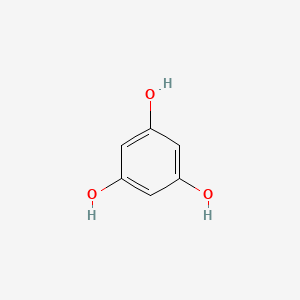
Phloroglucinol
Phloroglucinol is a benzenetriol with hydroxy groups at position 1, 3 and 5. It has a role as an algal metabolite. It is a phenolic donor and a benzenetriol. — ChEBI
- IUPAC 名称
- benzene-1,3,5-triol
- 分子式
- C6H6O3
- 分子量
- 126.11 g/mol
- 精确质量
- 126.031694049 Da
- XLogP3
- 0.2
- 拓扑极性表面积
- 60.7 Ų
- 氢键供体
- 3
- 氢键受体
- 3
- 共价单元
- 1
- 已定义的立体中心
- 0
又称
另有 16 个已报告名称
外部数据库标识符
- ChEBI:CHEBI:16204
- ChEMBL:CHEMBL473159
- EPA DTXSID:DTXSID9048354
- PubMed:26054450
- PubMed:23800587
- PubMed:23178381
- PubMed:23013382
- PubMed:22978662
- PubMed:22978223
- PubMed:22938149
- PubMed:22934600
- PubMed:22927079
- PubMed:22896828
- PubMed:22889530
- PubMed:22868169
来自其他科学数据库的证据
NIH PubChem PUG-View
Attributed physical-property, hazard, environmental and use annotations.
- LogP: 0.16 来源: Human Metabolome Database (HMDB)
- Melting Point: 218.5 °C 来源: Human Metabolome Database (HMDB)
- Physical Description: White solid; Discolored by light; [Merck Index] White or cream colored powder; [MSDSonline] Crystallizes in anhydrous or dihydrate form; Sweet tasting crystals; [Ullmann] 来源: Haz-Map, Information on Hazardous Chemicals and Occupational Diseases
- Physical Description: Solid 来源: Human Metabolome Database (HMDB)
- Solubility: 10.6 mg/mL at 20 °C 来源: Human Metabolome Database (HMDB)
- Vapor Pressure: 0.00016 [mmHg] 来源: Haz-Map, Information on Hazardous Chemicals and Occupational Diseases
- Note: This chemical does not meet GHS hazard criteria for 1.9% (2 of 108) of reports. 来源: European Chemicals Agency (ECHA)
- Signal: Warning 来源: European Chemicals Agency (ECHA)
- GHS Hazard Statements: H315 (81.5%): Causes skin irritation [Warning Skin corrosion/irritation]; H317 (41.7%): May cause an allergic skin reaction [Warning Sensitization, Skin]; H319 (81.5%): Causes serious eye irritation [Warning Serious eye damage/eye irritation]; H335 (81.5%): May cause respiratory irritation [Warning Specific target organ toxicity, single exposure; Respiratory tract irritation]; H341 (11.1%): Suspected of causing genetic defects [Warning Germ cell mutagenicity]; H361 (11.1%): Suspected of damaging fertility or the unborn child [Warning Reproductive toxicity]; H412 (12%): Harmful to aquatic life with long lasting effects [Hazardous to the aquatic environment, long-term hazard] 来源: European Chemicals Agency (ECHA)
- Precautionary Statement Codes: P203, P261, P264, P264+P265, P271, P272, P273, P280, P302+P352, P304+P340, P305+P351+P338, P318, P319, P321, P332+P317, P333+P317, P337+P317, P362+P364, P403+P233, P405, and P501 (click each P-code to see the statement) 来源: European Chemicals Agency (ECHA)
- ECHA C&L Notifications Summary: Aggregated GHS information provided per 108 reports by companies from 23 notifications to the ECHA C&L Inventory. Each notification may be associated with multiple companies.; Reported as not meeting GHS hazard criteria per 2 of 108 reports by companies.; There are 22 notifications provided by 106 of 108 reports by companies with hazard statement code(s).; Information may vary between notifications depending on impurities, additives, and other factors. The percentage value in parenthesis indicates the notified classification ratio from companies that provide hazard codes. Only hazard codes with percentage values above 10% are shown. For more detailed information, please visit ECHA C&L website. 来源: European Chemicals Agency (ECHA)
- Cosmetic Ingredient Review Conclusion: On the basis of the available data, the CIR Panel cannot conclude that Phloroglucinol is safe for use in cosmetic products until the appropriate safety data have been obtained and evaluated. 来源: Cosmetic Ingredient Review (CIR)
- Cosmetic Ingredient Review Finding(s): Ingredients for which the data are insufficient and their use in cosmetics is not supported 来源: Cosmetic Ingredient Review (CIR)
- Cosmetic Ingredient Review Link: CIR ingredient: Phloroglucinol 来源: Cosmetic Ingredient Review (CIR)
- Sources/Uses: Used to decalcify bones, to make pharmaceuticals and dyes, to preserve cut flowers, and to dye and print textiles; [Hawley] Used in diazo-type printing, cosmetics (antioxidant), hair colorants, chemical reagents, cloud seeding, tree and shrub rooting, and pharmaceuticals (antispasmodic); [Merck Index] Isolated from bark of fruit trees in 1855; [Ullmann] 来源: Haz-Map, Information on Hazardous Chemicals and Occupational Diseases
- Industrial Processes with risk of exposure: Textiles (Printing, Dyeing, or Finishing) [Category: Industry] 来源: Haz-Map, Information on Hazardous Chemicals and Occupational Diseases
映射方: Existing checksum-valid CAS to unique PubChem CID match. 检索时间: 2026-08-31. 打开来源记录
科学分类和危害注释仅提供背景信息,不能取代上方所示针对具体市场的监管决定。
其他来源的覆盖范围和匹配状态
| 来源 | 结果 | 已检查 |
|---|---|---|
| NIH PubChem PUG-View | 精确匹配 | 2026-08-31 |
已记录的无匹配结果是该来源已被检查的有效证据;这并不表示该物质在别处不存在。
于 2026-08-31 通过校验和有效的 CAS 匹配从美国国立卫生研究院 (NIH) PubChem 检索。化学性质不能取代本页的监管决定。
本站如何使用 CAS 108-73-6
CAS 108-73-6 是化学文摘社 (Chemical Abstracts Service) 的标识符,用于将本页对应到特定物质。在当前数据集中,有 1 条欧盟附件记录共用该标识符,可帮助您交叉核对同一物质是出现在一种还是多种监管情境中。
当供应商规格书、SDS 或原料档案给出 CAS 108-73-6,而您需要在一处查看所有关联的附件 II–VI 记录时,请使用本页。上方的条目卡片是查看浓度限值、警示语、附件归属和产品类型条件的最快途径。