
CAS 108-73-6
CAS 108-73-6은(는) 규정 1223/2009의 부속서 II–VI에 걸쳐 EU 부속서 기록 1건과 일치합니다.
CAS 108-73-6의 기록
1 총화학적 정체 및 특성
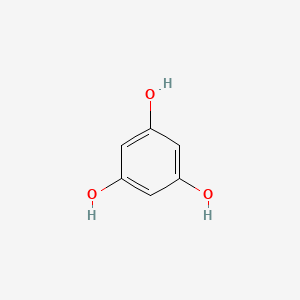
Phloroglucinol
Phloroglucinol is a benzenetriol with hydroxy groups at position 1, 3 and 5. It has a role as an algal metabolite. It is a phenolic donor and a benzenetriol. — ChEBI
- IUPAC 명칭
- benzene-1,3,5-triol
- 분자식
- C6H6O3
- 분자량
- 126.11 g/mol
- 정확한 질량
- 126.031694049 Da
- XLogP3
- 0.2
- 위상 극성 표면적
- 60.7 Ų
- 수소 결합 공여체
- 3
- 수소 결합 수용체
- 3
- 공유결합 단위
- 1
- 정의된 입체중심
- 0
다른 이름
보고된 명칭 16개 더 보기
외부 데이터베이스 식별자
- ChEBI:CHEBI:16204
- ChEMBL:CHEMBL473159
- EPA DTXSID:DTXSID9048354
- PubMed:26054450
- PubMed:23800587
- PubMed:23178381
- PubMed:23013382
- PubMed:22978662
- PubMed:22978223
- PubMed:22938149
- PubMed:22934600
- PubMed:22927079
- PubMed:22896828
- PubMed:22889530
- PubMed:22868169
추가 과학 데이터베이스의 근거
NIH PubChem PUG-View
Attributed physical-property, hazard, environmental and use annotations.
- LogP: 0.16 출처: Human Metabolome Database (HMDB)
- Melting Point: 218.5 °C 출처: Human Metabolome Database (HMDB)
- Physical Description: White solid; Discolored by light; [Merck Index] White or cream colored powder; [MSDSonline] Crystallizes in anhydrous or dihydrate form; Sweet tasting crystals; [Ullmann] 출처: Haz-Map, Information on Hazardous Chemicals and Occupational Diseases
- Physical Description: Solid 출처: Human Metabolome Database (HMDB)
- Solubility: 10.6 mg/mL at 20 °C 출처: Human Metabolome Database (HMDB)
- Vapor Pressure: 0.00016 [mmHg] 출처: Haz-Map, Information on Hazardous Chemicals and Occupational Diseases
- Note: This chemical does not meet GHS hazard criteria for 1.9% (2 of 108) of reports. 출처: European Chemicals Agency (ECHA)
- Signal: Warning 출처: European Chemicals Agency (ECHA)
- GHS Hazard Statements: H315 (81.5%): Causes skin irritation [Warning Skin corrosion/irritation]; H317 (41.7%): May cause an allergic skin reaction [Warning Sensitization, Skin]; H319 (81.5%): Causes serious eye irritation [Warning Serious eye damage/eye irritation]; H335 (81.5%): May cause respiratory irritation [Warning Specific target organ toxicity, single exposure; Respiratory tract irritation]; H341 (11.1%): Suspected of causing genetic defects [Warning Germ cell mutagenicity]; H361 (11.1%): Suspected of damaging fertility or the unborn child [Warning Reproductive toxicity]; H412 (12%): Harmful to aquatic life with long lasting effects [Hazardous to the aquatic environment, long-term hazard] 출처: European Chemicals Agency (ECHA)
- Precautionary Statement Codes: P203, P261, P264, P264+P265, P271, P272, P273, P280, P302+P352, P304+P340, P305+P351+P338, P318, P319, P321, P332+P317, P333+P317, P337+P317, P362+P364, P403+P233, P405, and P501 (click each P-code to see the statement) 출처: European Chemicals Agency (ECHA)
- ECHA C&L Notifications Summary: Aggregated GHS information provided per 108 reports by companies from 23 notifications to the ECHA C&L Inventory. Each notification may be associated with multiple companies.; Reported as not meeting GHS hazard criteria per 2 of 108 reports by companies.; There are 22 notifications provided by 106 of 108 reports by companies with hazard statement code(s).; Information may vary between notifications depending on impurities, additives, and other factors. The percentage value in parenthesis indicates the notified classification ratio from companies that provide hazard codes. Only hazard codes with percentage values above 10% are shown. For more detailed information, please visit ECHA C&L website. 출처: European Chemicals Agency (ECHA)
- Cosmetic Ingredient Review Conclusion: On the basis of the available data, the CIR Panel cannot conclude that Phloroglucinol is safe for use in cosmetic products until the appropriate safety data have been obtained and evaluated. 출처: Cosmetic Ingredient Review (CIR)
- Cosmetic Ingredient Review Finding(s): Ingredients for which the data are insufficient and their use in cosmetics is not supported 출처: Cosmetic Ingredient Review (CIR)
- Cosmetic Ingredient Review Link: CIR ingredient: Phloroglucinol 출처: Cosmetic Ingredient Review (CIR)
- Sources/Uses: Used to decalcify bones, to make pharmaceuticals and dyes, to preserve cut flowers, and to dye and print textiles; [Hawley] Used in diazo-type printing, cosmetics (antioxidant), hair colorants, chemical reagents, cloud seeding, tree and shrub rooting, and pharmaceuticals (antispasmodic); [Merck Index] Isolated from bark of fruit trees in 1855; [Ullmann] 출처: Haz-Map, Information on Hazardous Chemicals and Occupational Diseases
- Industrial Processes with risk of exposure: Textiles (Printing, Dyeing, or Finishing) [Category: Industry] 출처: Haz-Map, Information on Hazardous Chemicals and Occupational Diseases
매핑 기준: Existing checksum-valid CAS to unique PubChem CID match. 가져온 시각: 2026-08-31. 출처 기록 열기
과학적 분류와 유해성 주석은 맥락을 제공할 뿐이며, 위에 표시된 시장별 규제 판단을 대체하지 않습니다.
추가 출처 적용 범위 및 일치 상태
| 출처 | 결과 | 확인됨 |
|---|---|---|
| NIH PubChem PUG-View | 정확히 일치 | 2026-08-31 |
기록된 불일치는 출처를 확인했다는 유용한 근거이며, 해당 물질이 다른 곳에 존재하지 않는다는 주장이 아닙니다.
체크섬이 유효한 CAS 일치를 통해 2026-08-31에 NIH PubChem에서 가져왔습니다. 화학적 특성은 이 페이지의 규제 판단을 대체하지 않습니다.
이 사이트에서 CAS 108-73-6을(를) 사용하는 방식
CAS 108-73-6은(는) 이 페이지를 특정 물질에 고정하는 데 사용하는 Chemical Abstracts Service 식별자입니다. 현재 데이터세트에서는 EU 부속서 기록 1건이 이 식별자를 공유하며, 같은 물질이 하나의 규제 맥락에 나타나는지 여러 맥락에 나타나는지 교차 확인하는 데 도움이 됩니다.
공급업체 규격서, SDS 또는 원료 문서에 CAS 108-73-6이(가) 제시되어 있고 연결된 모든 부속서 II–VI 기록을 한곳에서 확인해야 할 때 이 페이지를 이용하세요. 위의 항목 카드는 농도 한도, 경고 문구, 부속서 위치 및 제품 유형 조건을 가장 빠르게 확인하는 방법입니다.