
Carmines
CI 75470
Carmines 作为欧盟化妆品准用清单着色剂条目出现在附件 IV 中。
记录详情
警示语
Purity criteria as set out in Commission Directive 95/45/EC (E 120)
颜色索引或词汇表
CI 75470
化学名称
Carmines
化学名称 / IUPAC 名称
Carmines
颜色
Red
监管信息
关键数据
化学身份与性质
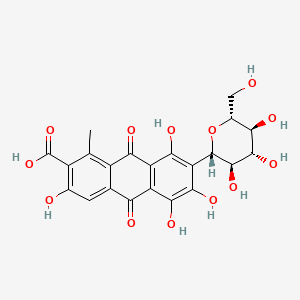
Carminic Acid
Carminic acid is a tetrahydroxyanthraquinone that is that is 1,3,4,6-tetrahydroxy-9,10-anthraquinone substituted by a methyl group at position 8, a carboxy group at position 7 and a 1,5-anhydro-D-glucitol moiety at position 2 via a C-glycosidic linkage. It is a natural dye isolated from several insects such as Dactylopius coccus. It has a role as an animal metabolite and a histological dye. It is a C-glycosyl compound, a monocarboxylic acid and a tetrahydroxyanthraquinone. It is a conjugate acid of a carminate(2-). — ChEBI
- IUPAC 名称
- 3,5,6,8-tetrahydroxy-1-methyl-9,10-dioxo-7-[(2S,3R,4R,5S,6R)-3,4,5-trihydroxy-6-(hydroxymethyl)oxan-2-yl]anthracene-2-carboxylic acid
- 分子式
- C22H20O13
- 分子量
- 492.4 g/mol
- 精确质量
- 492.09039069 Da
- XLogP3
- 0.5
- 拓扑极性表面积
- 243.0 Ų
- 氢键供体
- 9
- 氢键受体
- 13
- 共价单元
- 1
- 已定义的立体中心
- 5
又称
另有 16 个已报告名称
外部数据库标识符
- ChEBI:CHEBI:78310
- ChEMBL:CHEMBL263094
- EPA DTXSID:DTXSID9022817
- PubMed:7249
来自其他科学数据库的证据
NIH PubChem PUG-View
Attributed physical-property, hazard, environmental and use annotations.
- Color/Form: Red monoclinic prisms from aqueous methanol 来源: Hazardous Substances Data Bank (HSDB)
- Color/Form: Dark, purplish-brown mass or bright-red powder 来源: Hazardous Substances Data Bank (HSDB)
- Color/Form: Deep red color in water; yellow to violet in acid solutions 来源: Hazardous Substances Data Bank (HSDB)
- Dissociation Constants: pKa1 = 2.81; pKa2 = 5.43; pKa3 = 8.10 来源: Hazardous Substances Data Bank (HSDB)
- Melting Point: Decomposes at 277 °F (NTP, 1992) 来源: CAMEO Chemicals
- Melting Point: 136 °C (decomposes) 来源: Hazardous Substances Data Bank (HSDB)
- Melting Point: No distinct melting point; darkens at 120 °C 来源: Hazardous Substances Data Bank (HSDB)
- Physical Description: Carminic acid appears as dark purplish-brown mass or bright red or dark red powder. Darkens at 248 °F. Deep red color in water. Yellow to violet in acidic aqueous solutions. (NTP, 1992) 来源: CAMEO Chemicals
- Physical Description: Red to dark red, friable, solid or powder. Cochineal extract is generally a dark red liquid but can also be dried as a powder. 来源: EU Food Improvement Agents
- Physical Description: Dark purplish-brown or bright red solid; [Hawley] Deep violet fine crystals; [MSDSonline] 来源: Haz-Map, Information on Hazardous Chemicals and Occupational Diseases
- Solubility: less than 1 mg/mL at 70 °F (NTP, 1992) 来源: CAMEO Chemicals
- Solubility: Soluble in alcohol, concentrated sulfuric acid; slightly soluble in ether; practically insoluble in petroleum ether, benzene, chloroform 来源: Hazardous Substances Data Bank (HSDB)
- Solubility: In water, 1.30 g/L (1.30X10+3 mg/L) at 25 °C 来源: Hazardous Substances Data Bank (HSDB)
- pH: pH = 4.8 (yellow); pH = 6.2 (violet) 来源: Hazardous Substances Data Bank (HSDB)
- Carcinogen Classification: No indication of carcinogenicity to humans (not listed by IARC). 来源: Toxin and Toxin Target Database (T3DB)
- First Aid: EYES: First check the victim for contact lenses and remove if present. Flush victim's eyes with water or normal saline solution for 20 to 30 minutes while simultaneously calling a hospital or poison control center. Do not put any ointments, oils, or medication in the victim's eyes without specific instructions from a physician. IMMEDIATELY transport the victim after flushing eyes to a hospital even if no symptoms (such as redness or irritation) develop.; SKIN: IMMEDIATELY flood affected skin with water while removing and isolating all contaminated clothing. Gently wash all affected skin areas thoroughly with soap and water. If symptoms such as redness or irritation develop, IMMEDIATELY call a physician and be prepared to transport the victim to a hospital for treatment.; INHALATION: IMMEDIATELY leave the contaminated area; take deep breaths of fresh air. If symptoms (such as wheezing, coughing, shortness of breath, or burning in the mouth, throat, or chest) develop, call a physician and be prepared to transport the victim to a hospital. Provide proper respiratory protection to rescuers entering an unknown atmosphere. Whenever possible, Self-Contained Breathing Apparatus (SCBA) shou 来源: CAMEO Chemicals
- Note: This chemical does not meet GHS hazard criteria for 98.9% (89 of 90) of all reports. 来源: European Chemicals Agency (ECHA)
- GHS Hazard Statements: Not Classified; Reported as not meeting GHS hazard criteria by 89 of 90 companies (only 1.1% companies provided GHS information). For more detailed information, please visit ECHA C&L website. 来源: European Chemicals Agency (ECHA)
- ECHA C&L Notifications Summary: Aggregated GHS information provided per 90 reports by companies from 2 notifications to the ECHA C&L Inventory.; Reported as not meeting GHS hazard criteria per 89 of 90 reports by companies.; There is 1 notification provided by 1 of 90 reports by companies with hazard statement code(s).; Information may vary between notifications depending on impurities, additives, and other factors. The percentage value in parenthesis indicates the notified classification ratio from companies that provide hazard codes. Only hazard codes with percentage values above 10% are shown. For more detailed information, please visit ECHA C&L website. 来源: European Chemicals Agency (ECHA)
- Environmental Bioconcentration: An estimated BCF of 3.2 was calculated in fish for carminic acid(SRC), using an estimated log Kow of 0.97(1) and a regression-derived equation(2). According to a classification scheme(3), this BCF suggests the potential for bioconcentration in aquatic organisms is low(SRC). 来源: Hazardous Substances Data Bank (HSDB)
- Environmental Fate: TERRESTRIAL FATE: Based on a classification scheme(1), an estimated Koc value of 440(SRC), determined from a structure estimation method(2), indicates that carminic acid is expected to have moderate mobility in soil(SRC). The pKa values of carminic acid are 2.81, 5.43 and 8.10(3), indicate that this compound will almost entirely exist in anion form in the environment and anions generally do not adsorb more strongly to soils containing organic carbon and clay than their neutral counterparts(4). Volatilization from moist soil is not expected because the acid exists as an anion and anions do not volatilize(SRC). Carminic acid is not expected to volatilize from dry soil surfaces(SRC) based upon an estimated vapor pressure of 5.07X10⁻²⁷ mm Hg at 25 °C(SRC), determined from a fragment constant method(5). Biodegradation data in soil were not available(SRC, 2010). 来源: Hazardous Substances Data Bank (HSDB)
- Environmental Fate: AQUATIC FATE: Based on a classification scheme(1), an estimated Koc value of 440(SRC), determined from a structure estimation method(2), indicates that carminic acid is expected to adsorb to suspended solids and sediment(SRC). The pKa values of 2.81, 5.43 and 8.10(3) indicate carminic acid will exist almost entirely in the anion form at pH values of 5 to 9 and therefore volatilization from water surfaces is not expected to be an important fate process(SRC). According to a classification scheme(4), an estimated BCF of 3.2(SRC), from an estimated log Kow of 0.97(5) and a regression-derived equation(2), suggests the potential for bioconcentration in aquatic organisms is low(SRC). Biodegradation data in water were not available(SRC, 2010). 来源: Hazardous Substances Data Bank (HSDB)
- Environmental Fate: ATMOSPHERIC FATE: According to a model of gas/particle partitioning of semivolatile organic compounds in the atmosphere(1), carminic acid, which has an estimated vapor pressure of 5.07X10⁻²⁷ mm Hg at 25 °C(SRC), determined from a fragment constant method(2), is expected to exist solely in the particulate phase in the ambient atmosphere. Particulate-phase carminic acid may be removed from the air by wet or dry deposition(SRC). Carminic acid contains chromophores that absorb at wavelengths >290 nm(3), and therefore may be susceptible to direct photolysis by sunlight(SRC); its UV absorption maxima is approximately 500 nm in water(4) and primary aliphatic alcohols(5). 来源: Hazardous Substances Data Bank (HSDB)
- Sources/Uses: Extracted from the insects Coccus cacti (cochineal); [Hawley] Used as a free acid in color photography, a pigment for artists' paints, a bacteriological stain, a reagent for aluminum, a complexing agent for cations, a dye, and rarely now as an acid-base indicator or oxidimetric indicator; [HSDB] 来源: Haz-Map, Information on Hazardous Chemicals and Occupational Diseases
- Industrial Processes with risk of exposure: Photographic Processing [Category: Other] 来源: Haz-Map, Information on Hazardous Chemicals and Occupational Diseases
- Activities with risk of exposure: Painting [Category: Hobbies] 来源: Haz-Map, Information on Hazardous Chemicals and Occupational Diseases
- Uses: Free acid in color photography; pigment for artists' paints; as bacteriological stain; reagent for aluminum; rarely now as acid-base indicator or oxidimetric indicator; complexing agent for cations 来源: Hazardous Substances Data Bank (HSDB)
- Uses: Colorant used in cosmetics 来源: Hazardous Substances Data Bank (HSDB)
- Uses: Coloring proprietary medicines; pigment for fine oil colors; indicators in analytical chemistry 来源: Hazardous Substances Data Bank (HSDB)
- Uses: Used as dye; in inks, coloring food products and galenicals; in microscopy for making various stains /Aluminum calcium lake/ 来源: Hazardous Substances Data Bank (HSDB)
- Uses: Used as a food dye in products such as juices, ice cream, yogurt, and candy; as a dye in cosmetic products such as eye shadow and lipstick. /Carmine/ 来源: Hazardous Substances Data Bank (HSDB)
映射方: Existing checksum-valid CAS to unique PubChem CID match. 检索时间: 2026-08-31. 打开来源记录
科学分类和危害注释仅提供背景信息,不能取代上方所示针对具体市场的监管决定。
其他来源的覆盖范围和匹配状态
| 来源 | 结果 | 已检查 |
|---|---|---|
| NIH PubChem PUG-View | 精确匹配 | 2026-08-31 |
已记录的无匹配结果是该来源已被检查的有效证据;这并不表示该物质在别处不存在。
于 2026-09-02 通过校验和有效的 CAS 匹配从美国国立卫生研究院 (NIH) PubChem 检索。化学性质不能取代本页的监管决定。
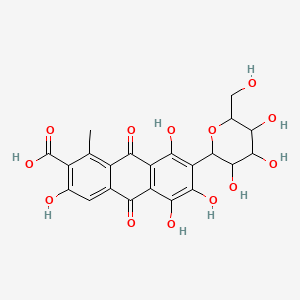
7-Hexopyranosyl-9,10-dihydro-3,5,6,8-tetrahydroxy-1-methyl-9,10-dioxo-2-anthracenecarboxylic acid
Red food colouring The source of this color is a picture of a "deep carmine pink" flower at the following website:; The source of this color is a watercolor color swatch called light carmine displayed at the following website:. Carmine red belongs to the family of Anthraquinone Glycosides. These are organic compounds containing an anthraquinone moiety glycosidically bound to a carbohydrate moiety. — Toxin and Toxin Target Database (T3DB)
- IUPAC 名称
- 3,5,6,8-tetrahydroxy-1-methyl-9,10-dioxo-7-[3,4,5-trihydroxy-6-(hydroxymethyl)oxan-2-yl]anthracene-2-carboxylic acid
- 分子式
- C22H20O13
- 分子量
- 492.4 g/mol
- 精确质量
- 492.09039069 Da
- XLogP3
- 0.5
- 拓扑极性表面积
- 243.0 Ų
- 氢键供体
- 9
- 氢键受体
- 13
- 共价单元
- 1
- 已定义的立体中心
- 0
又称
另有 9 个已报告名称
外部数据库标识符
- EPA DTXSID:DTXSID20859613
于 2026-09-02 通过校验和有效的 CAS 匹配从美国国立卫生研究院 (NIH) PubChem 检索。化学性质不能取代本页的监管决定。
Carmines 的清单链接
Carmines 的相关记录
该记录的直接匹配结果有限,因此同时显示附件 IV 中的相邻条目。
附件 IV 对 Carmines 意味着什么
Carmines 是欧盟化妆品法规 1223/2009 附件 IV 所列的准用着色剂。只有列入该准用清单的着色剂才可用于欧盟市场上的化妆品着色。
附件 IV 中的部分着色剂按产品类型受到限制——例如禁止用于眼部周围或涂抹于黏膜的产品。使用前请查看上方的产品类型和条件字段。
本记录与 2 个 CosIng 清单成分相关联,便于名称和标识符的交叉引用。 本页还显示 12 条相关附件记录,其标识符、附件逻辑或命名模式存在重叠。
合规核查清单
- 确认着色剂仅用于上述准许的产品类型。
- 在成分标示中记录颜色索引编号和 CAS 标识符。