
Carmines
CI 75470
Carmines steht in Anhang IV als Eintrag der Positivliste für Farbstoffe in kosmetischen Mitteln der EU.
Eintragsdetails
Warnhinweise
Purity criteria as set out in Commission Directive 95/45/EC (E 120)
Colour Index oder Glossar
CI 75470
Chemische Bezeichnung
Carmines
Chemische / IUPAC-Bezeichnung
Carmines
Farbe
Red
Regulatorische Informationen
Kerndaten
Chemische Identität und Eigenschaften
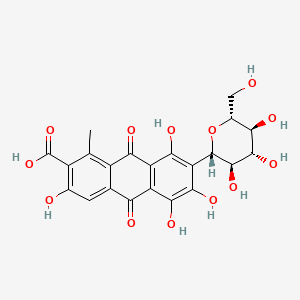
Carminic Acid
Carminic acid is a tetrahydroxyanthraquinone that is that is 1,3,4,6-tetrahydroxy-9,10-anthraquinone substituted by a methyl group at position 8, a carboxy group at position 7 and a 1,5-anhydro-D-glucitol moiety at position 2 via a C-glycosidic linkage. It is a natural dye isolated from several insects such as Dactylopius coccus. It has a role as an animal metabolite and a histological dye. It is a C-glycosyl compound, a monocarboxylic acid and a tetrahydroxyanthraquinone. It is a conjugate acid of a carminate(2-). — ChEBI
- IUPAC-Name
- 3,5,6,8-tetrahydroxy-1-methyl-9,10-dioxo-7-[(2S,3R,4R,5S,6R)-3,4,5-trihydroxy-6-(hydroxymethyl)oxan-2-yl]anthracene-2-carboxylic acid
- Summenformel
- C22H20O13
- Molekulargewicht
- 492.4 g/mol
- Exakte Masse
- 492.09039069 Da
- XLogP3
- 0,5
- Topologische polare Oberfläche
- 243,0 Ų
- Wasserstoffbrücken-Donoren
- 9
- Wasserstoffbrücken-Akzeptoren
- 13
- Kovalente Einheiten
- 1
- Definierte Stereozentren
- 5
Auch bekannt als
16 weitere gemeldete Namen
Kennungen in externen Datenbanken
- ChEBI:CHEBI:78310
- ChEMBL:CHEMBL263094
- EPA DTXSID:DTXSID9022817
- PubMed:7249
Belege aus weiteren wissenschaftlichen Datenbanken
NIH PubChem PUG-View
Attributed physical-property, hazard, environmental and use annotations.
- Color/Form: Red monoclinic prisms from aqueous methanol Quelle: Hazardous Substances Data Bank (HSDB)
- Color/Form: Dark, purplish-brown mass or bright-red powder Quelle: Hazardous Substances Data Bank (HSDB)
- Color/Form: Deep red color in water; yellow to violet in acid solutions Quelle: Hazardous Substances Data Bank (HSDB)
- Dissociation Constants: pKa1 = 2.81; pKa2 = 5.43; pKa3 = 8.10 Quelle: Hazardous Substances Data Bank (HSDB)
- Melting Point: Decomposes at 277 °F (NTP, 1992) Quelle: CAMEO Chemicals
- Melting Point: 136 °C (decomposes) Quelle: Hazardous Substances Data Bank (HSDB)
- Melting Point: No distinct melting point; darkens at 120 °C Quelle: Hazardous Substances Data Bank (HSDB)
- Physical Description: Carminic acid appears as dark purplish-brown mass or bright red or dark red powder. Darkens at 248 °F. Deep red color in water. Yellow to violet in acidic aqueous solutions. (NTP, 1992) Quelle: CAMEO Chemicals
- Physical Description: Red to dark red, friable, solid or powder. Cochineal extract is generally a dark red liquid but can also be dried as a powder. Quelle: EU Food Improvement Agents
- Physical Description: Dark purplish-brown or bright red solid; [Hawley] Deep violet fine crystals; [MSDSonline] Quelle: Haz-Map, Information on Hazardous Chemicals and Occupational Diseases
- Solubility: less than 1 mg/mL at 70 °F (NTP, 1992) Quelle: CAMEO Chemicals
- Solubility: Soluble in alcohol, concentrated sulfuric acid; slightly soluble in ether; practically insoluble in petroleum ether, benzene, chloroform Quelle: Hazardous Substances Data Bank (HSDB)
- Solubility: In water, 1.30 g/L (1.30X10+3 mg/L) at 25 °C Quelle: Hazardous Substances Data Bank (HSDB)
- pH: pH = 4.8 (yellow); pH = 6.2 (violet) Quelle: Hazardous Substances Data Bank (HSDB)
- Carcinogen Classification: No indication of carcinogenicity to humans (not listed by IARC). Quelle: Toxin and Toxin Target Database (T3DB)
- First Aid: EYES: First check the victim for contact lenses and remove if present. Flush victim's eyes with water or normal saline solution for 20 to 30 minutes while simultaneously calling a hospital or poison control center. Do not put any ointments, oils, or medication in the victim's eyes without specific instructions from a physician. IMMEDIATELY transport the victim after flushing eyes to a hospital even if no symptoms (such as redness or irritation) develop.; SKIN: IMMEDIATELY flood affected skin with water while removing and isolating all contaminated clothing. Gently wash all affected skin areas thoroughly with soap and water. If symptoms such as redness or irritation develop, IMMEDIATELY call a physician and be prepared to transport the victim to a hospital for treatment.; INHALATION: IMMEDIATELY leave the contaminated area; take deep breaths of fresh air. If symptoms (such as wheezing, coughing, shortness of breath, or burning in the mouth, throat, or chest) develop, call a physician and be prepared to transport the victim to a hospital. Provide proper respiratory protection to rescuers entering an unknown atmosphere. Whenever possible, Self-Contained Breathing Apparatus (SCBA) shou Quelle: CAMEO Chemicals
- Note: This chemical does not meet GHS hazard criteria for 98.9% (89 of 90) of all reports. Quelle: European Chemicals Agency (ECHA)
- GHS Hazard Statements: Not Classified; Reported as not meeting GHS hazard criteria by 89 of 90 companies (only 1.1% companies provided GHS information). For more detailed information, please visit ECHA C&L website. Quelle: European Chemicals Agency (ECHA)
- ECHA C&L Notifications Summary: Aggregated GHS information provided per 90 reports by companies from 2 notifications to the ECHA C&L Inventory.; Reported as not meeting GHS hazard criteria per 89 of 90 reports by companies.; There is 1 notification provided by 1 of 90 reports by companies with hazard statement code(s).; Information may vary between notifications depending on impurities, additives, and other factors. The percentage value in parenthesis indicates the notified classification ratio from companies that provide hazard codes. Only hazard codes with percentage values above 10% are shown. For more detailed information, please visit ECHA C&L website. Quelle: European Chemicals Agency (ECHA)
- Environmental Bioconcentration: An estimated BCF of 3.2 was calculated in fish for carminic acid(SRC), using an estimated log Kow of 0.97(1) and a regression-derived equation(2). According to a classification scheme(3), this BCF suggests the potential for bioconcentration in aquatic organisms is low(SRC). Quelle: Hazardous Substances Data Bank (HSDB)
- Environmental Fate: TERRESTRIAL FATE: Based on a classification scheme(1), an estimated Koc value of 440(SRC), determined from a structure estimation method(2), indicates that carminic acid is expected to have moderate mobility in soil(SRC). The pKa values of carminic acid are 2.81, 5.43 and 8.10(3), indicate that this compound will almost entirely exist in anion form in the environment and anions generally do not adsorb more strongly to soils containing organic carbon and clay than their neutral counterparts(4). Volatilization from moist soil is not expected because the acid exists as an anion and anions do not volatilize(SRC). Carminic acid is not expected to volatilize from dry soil surfaces(SRC) based upon an estimated vapor pressure of 5.07X10⁻²⁷ mm Hg at 25 °C(SRC), determined from a fragment constant method(5). Biodegradation data in soil were not available(SRC, 2010). Quelle: Hazardous Substances Data Bank (HSDB)
- Environmental Fate: AQUATIC FATE: Based on a classification scheme(1), an estimated Koc value of 440(SRC), determined from a structure estimation method(2), indicates that carminic acid is expected to adsorb to suspended solids and sediment(SRC). The pKa values of 2.81, 5.43 and 8.10(3) indicate carminic acid will exist almost entirely in the anion form at pH values of 5 to 9 and therefore volatilization from water surfaces is not expected to be an important fate process(SRC). According to a classification scheme(4), an estimated BCF of 3.2(SRC), from an estimated log Kow of 0.97(5) and a regression-derived equation(2), suggests the potential for bioconcentration in aquatic organisms is low(SRC). Biodegradation data in water were not available(SRC, 2010). Quelle: Hazardous Substances Data Bank (HSDB)
- Environmental Fate: ATMOSPHERIC FATE: According to a model of gas/particle partitioning of semivolatile organic compounds in the atmosphere(1), carminic acid, which has an estimated vapor pressure of 5.07X10⁻²⁷ mm Hg at 25 °C(SRC), determined from a fragment constant method(2), is expected to exist solely in the particulate phase in the ambient atmosphere. Particulate-phase carminic acid may be removed from the air by wet or dry deposition(SRC). Carminic acid contains chromophores that absorb at wavelengths >290 nm(3), and therefore may be susceptible to direct photolysis by sunlight(SRC); its UV absorption maxima is approximately 500 nm in water(4) and primary aliphatic alcohols(5). Quelle: Hazardous Substances Data Bank (HSDB)
- Sources/Uses: Extracted from the insects Coccus cacti (cochineal); [Hawley] Used as a free acid in color photography, a pigment for artists' paints, a bacteriological stain, a reagent for aluminum, a complexing agent for cations, a dye, and rarely now as an acid-base indicator or oxidimetric indicator; [HSDB] Quelle: Haz-Map, Information on Hazardous Chemicals and Occupational Diseases
- Industrial Processes with risk of exposure: Photographic Processing [Category: Other] Quelle: Haz-Map, Information on Hazardous Chemicals and Occupational Diseases
- Activities with risk of exposure: Painting [Category: Hobbies] Quelle: Haz-Map, Information on Hazardous Chemicals and Occupational Diseases
- Uses: Free acid in color photography; pigment for artists' paints; as bacteriological stain; reagent for aluminum; rarely now as acid-base indicator or oxidimetric indicator; complexing agent for cations Quelle: Hazardous Substances Data Bank (HSDB)
- Uses: Colorant used in cosmetics Quelle: Hazardous Substances Data Bank (HSDB)
- Uses: Coloring proprietary medicines; pigment for fine oil colors; indicators in analytical chemistry Quelle: Hazardous Substances Data Bank (HSDB)
- Uses: Used as dye; in inks, coloring food products and galenicals; in microscopy for making various stains /Aluminum calcium lake/ Quelle: Hazardous Substances Data Bank (HSDB)
- Uses: Used as a food dye in products such as juices, ice cream, yogurt, and candy; as a dye in cosmetic products such as eye shadow and lipstick. /Carmine/ Quelle: Hazardous Substances Data Bank (HSDB)
Zugeordnet durch: Existing checksum-valid CAS to unique PubChem CID match. Abgerufen: 2026-08-31. Quelleneintrag öffnen
Wissenschaftliche Klassifizierungen und Gefahrenannotationen liefern Kontext und ersetzen nicht die oben gezeigte marktspezifische regulatorische Entscheidung.
Weitere Quellenabdeckung und Trefferstatus
| Quelle | Ergebnis | Geprüft |
|---|---|---|
| NIH PubChem PUG-View | Exakter Treffer | 2026-08-31 |
Ein erfasster Nicht-Treffer ist ein nützlicher Beleg dafür, dass die Quelle geprüft wurde; er ist keine Behauptung, dass der Stoff anderswo nicht existiert.
Am 2026-09-02 von NIH PubChem durch prüfsummengültigen CAS-Abgleich abgerufen. Chemische Eigenschaften ersetzen nicht die regulatorische Entscheidung auf dieser Seite.
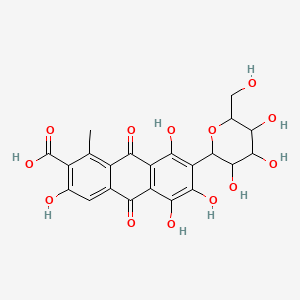
7-Hexopyranosyl-9,10-dihydro-3,5,6,8-tetrahydroxy-1-methyl-9,10-dioxo-2-anthracenecarboxylic acid
Red food colouring The source of this color is a picture of a "deep carmine pink" flower at the following website:; The source of this color is a watercolor color swatch called light carmine displayed at the following website:. Carmine red belongs to the family of Anthraquinone Glycosides. These are organic compounds containing an anthraquinone moiety glycosidically bound to a carbohydrate moiety. — Toxin and Toxin Target Database (T3DB)
- IUPAC-Name
- 3,5,6,8-tetrahydroxy-1-methyl-9,10-dioxo-7-[3,4,5-trihydroxy-6-(hydroxymethyl)oxan-2-yl]anthracene-2-carboxylic acid
- Summenformel
- C22H20O13
- Molekulargewicht
- 492.4 g/mol
- Exakte Masse
- 492.09039069 Da
- XLogP3
- 0,5
- Topologische polare Oberfläche
- 243,0 Ų
- Wasserstoffbrücken-Donoren
- 9
- Wasserstoffbrücken-Akzeptoren
- 13
- Kovalente Einheiten
- 1
- Definierte Stereozentren
- 0
Auch bekannt als
9 weitere gemeldete Namen
Kennungen in externen Datenbanken
- EPA DTXSID:DTXSID20859613
Am 2026-09-02 von NIH PubChem durch prüfsummengültigen CAS-Abgleich abgerufen. Chemische Eigenschaften ersetzen nicht die regulatorische Entscheidung auf dieser Seite.
Verzeichnisverknüpfungen für Carmines
Verwandte Einträge zu Carmines
Für diesen Eintrag gibt es nur wenige direkte Treffer; daher werden auch nahe liegende Einträge aus Anhang IV angezeigt.
CI 75300
CI 75810
CI 77002
CI 75130
CI 77007
CI 75120
CI 77015
Was Anhang IV für Carmines bedeutet
Carmines ist ein zugelassener Farbstoff, der in Anhang IV der EU-Kosmetikverordnung (EG) Nr. 1223/2009 aufgeführt ist. Nur Farbstoffe dieser Positivliste dürfen zum Färben kosmetischer Mittel auf dem EU-Markt verwendet werden.
Einige Farbstoffe in Anhang IV sind nach Produktart beschränkt – zum Beispiel ist ihre Verwendung in Augennähe oder in Produkten, die auf Schleimhäuten angewendet werden, verboten. Prüfen Sie vor der Verwendung die oben genannten Felder zu Produktart und Bedingungen.
Dieser Eintrag ist zum Abgleich von Namen und Kennungen mit 2 Inhaltsstoffen des CosIng-Verzeichnisses verknüpft. Die Seite zeigt außerdem 12 verwandte Anhangseinträge mit überschneidenden Kennungen, Anhangslogik oder Namensmustern.
Compliance-Checkliste
- Prüfen Sie, dass der Farbstoff nur in den oben genannten zulässigen Produktarten verwendet wird.
- Geben Sie die Colour-Index-Nummer und die CAS-Kennung in der Inhaltsstoffangabe an.
Häufig gestellte Fragen
Quellenhinweis zu Anhang IV, Eintrag Carmines
Diese Seite fasst einen Eintrag aus Anhang IV für Carmines aus öffentlichen Materialien der Europäischen Kommission zu kosmetischen Mitteln zusammen und ergänzt, soweit verfügbar, verknüpfte Treffer aus dem Verzeichnis oder bei Kennungen.
Nutzen Sie diese Eintragsseite, um die Bedingungen aus Anhang IV für Carmines zu prüfen; bestätigen Sie jede endgültige regulatorische Entscheidung jedoch anhand des aktuellen amtlichen Anhangswortlauts und der Quelldateien.
Werkzeuge und nächste Schritte
Rezeptur prüfen
Fügen Sie eine vollständige INCI-Liste ein, um Carmines und andere markierte EU-Anhangseinträge in einem Durchgang zu finden.
INCI-CheckerEinträge vergleichen
Carmines nebeneinander mit einem anderen Anhangseintrag vergleichen, um Unterschiede bei Beschränkungen, Konzentrationen und Anhangszuordnung zu prüfen.
VergleichenDen Anhang durchsuchen
Alle Einträge in Anhang IV ansehen und die regulatorischen Bedingungen der Stoffe in diesem Anhang vergleichen.
Anhang IV öffnen