
Ammonium bromide
Ammonium bromide 在附件 II 中被列为在欧盟市场上市的化妆品的禁用物质。
记录详情
化学名称
Ammonium bromide
监管信息
关键数据
化学身份与性质
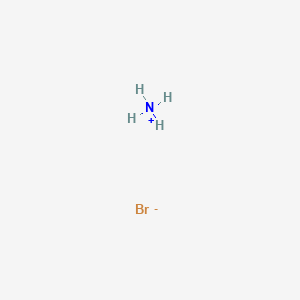
Ammonium Bromide
Ammonium bromide is an ammonium salt composed of ammonium and bromide ions in a 1:1 ratio. It is a bromide salt and an ammonium salt. — ChEBI
- IUPAC 名称
- azanium bromide
- 分子式
- BrH4N
- 分子量
- 97.94 g/mol
- 精确质量
- 96.95271 Da
- 拓扑极性表面积
- 1.0 Ų
- 氢键供体
- 1
- 氢键受体
- 1
- 共价单元
- 2
- 已定义的立体中心
- 0
又称
另有 16 个已报告名称
外部数据库标识符
- ChEBI:CHEBI:85364
- EPA DTXSID:DTXSID8035681
来自其他科学数据库的证据
NIH PubChem PUG-View
Attributed physical-property, hazard, environmental and use annotations.
- Autoignition Temperature: Not flammable (USCG, 1999) 来源: CAMEO Chemicals
- Boiling Point: Sublimes 1007 °F (USCG, 1999) 来源: CAMEO Chemicals
- Boiling Point: 396 °C (sublimation point) 来源: Hazardous Substances Data Bank (HSDB)
- Boiling Point: BP: 235 °C (in vacuum) 来源: Hazardous Substances Data Bank (HSDB)
- Boiling Point: 235 °C @760 [mm Hg] 来源: PAC Chemical Database, U.S. Department of Energy
- Color/Form: White tetragonal crystals 来源: Hazardous Substances Data Bank (HSDB)
- Color/Form: White crystals or granules 来源: Hazardous Substances Data Bank (HSDB)
- Color/Form: Colorless crystals or yellowish white powder 来源: Hazardous Substances Data Bank (HSDB)
- Density: 2.429 at 68 °F (USCG, 1999) - Denser than water; will sink 来源: CAMEO Chemicals
- Density: 2.429 at 25 °C 来源: Hazardous Substances Data Bank (HSDB)
- Density: 2.429 @25 °C 来源: PAC Chemical Database, U.S. Department of Energy
- Melting Point: Sublimes without melting (USCG, 1999) 来源: CAMEO Chemicals
- Melting Point: 542 °C (decomposes) 来源: Hazardous Substances Data Bank (HSDB)
- Melting Point: 452 °C 来源: PAC Chemical Database, U.S. Department of Energy
- Odor: Odorless 来源: Hazardous Substances Data Bank (HSDB)
- Physical Description: Ammonium bromide appears as white odorless crystals or granules that become yellow upon exposure to air. Sinks and mixes in water. (USCG, 1999) 来源: CAMEO Chemicals
- Physical Description: Dry Powder 来源: EPA Chemical Data Reporting (CDR)
- Physical Description: White odorless solid; Slightly hygroscopic; Yellows slowly in air; [Merck Index] Colorless granules; [MSDSonline] 来源: Haz-Map, Information on Hazardous Chemicals and Occupational Diseases
- Refractive Index: Index of refraction: 1.712 at 25 °C 来源: Hazardous Substances Data Bank (HSDB)
- Solubility: In water, 78.3 g/100 g water at 25 °C 来源: Hazardous Substances Data Bank (HSDB)
- Solubility: Soluble in acetone, ether, ammonia, in water, 97 g/100 cc at 25 °C, 145.6 g/100 cc at 100 °C; in alcohol, 10 g/100 cc at 78 °C 来源: Hazardous Substances Data Bank (HSDB)
- Solubility: Freely soluble in methanol, ethanol, acetone; slightly soluble in ether; practically insoluble in ethyl acetate 来源: Hazardous Substances Data Bank (HSDB)
- Vapor Pressure: VP: 1 mm Hg at 198.3 °C 来源: Hazardous Substances Data Bank (HSDB)
- pH: Slightly acid to litmus 来源: Hazardous Substances Data Bank (HSDB)
- Carcinogen Classification: No indication of carcinogenicity to humans (not listed by IARC). 来源: Toxin and Toxin Target Database (T3DB)
- Exposure Routes: Oral (L626) ; inhalation (L626) ; dermal (L626) 来源: Toxin and Toxin Target Database (T3DB)
- First Aid: EYES AND SKIN: Flush with large amounts of water.; INGESTION: Induce vomiting and call a doctor. (USCG, 1999) 来源: CAMEO Chemicals
- Signal: Danger 来源: Regulation (EC) No 1272/2008 of the European Parliament and of the Council
- GHS Hazard Statements: H319: Causes serious eye irritation [Warning Serious eye damage/eye irritation]; H336: May cause drowsiness or dizziness [Warning Specific target organ toxicity, single exposure; Narcotic effects]; H360FD: May damage fertility; May damage the unborn child [Danger Reproductive toxicity]; H362: May cause harm to breast-fed children [Reproductive toxicity, effects on or via lactation]; H372: Causes damage to organs through prolonged or repeated exposure [Danger Specific target organ toxicity, repeated exposure] 来源: Regulation (EC) No 1272/2008 of the European Parliament and of the Council
- Precautionary Statement Codes: P203, P260, P261, P263, P264, P264+P265, P270, P271, P280, P304+P340, P305+P351+P338, P318, P319, P337+P317, P403+P233, P405, and P501 (click each P-code to see the statement) 来源: Regulation (EC) No 1272/2008 of the European Parliament and of the Council
- Note: This chemical does not meet GHS hazard criteria for 0.4% (3 of 704) of reports. 来源: European Chemicals Agency (ECHA)
- Signal: Danger 来源: European Chemicals Agency (ECHA)
- GHS Hazard Statements: H319 (99.6%): Causes serious eye irritation [Warning Serious eye damage/eye irritation]; H336 (21%): May cause drowsiness or dizziness [Warning Specific target organ toxicity, single exposure; Narcotic effects]; H360FD (17.8%): May damage fertility; May damage the unborn child [Danger Reproductive toxicity]; H362 (20.9%): May cause harm to breast-fed children [Reproductive toxicity, effects on or via lactation]; H372 (20.9%): Causes damage to organs through prolonged or repeated exposure [Danger Specific target organ toxicity, repeated exposure] 来源: European Chemicals Agency (ECHA)
- Precautionary Statement Codes: P203, P260, P261, P263, P264, P264+P265, P270, P271, P280, P304+P340, P305+P351+P338, P318, P319, P337+P317, P403+P233, P405, and P501 (click each P-code to see the statement) 来源: European Chemicals Agency (ECHA)
- ECHA C&L Notifications Summary: Aggregated GHS information provided per 704 reports by companies from 12 notifications to the ECHA C&L Inventory. Each notification may be associated with multiple companies.; Reported as not meeting GHS hazard criteria per 3 of 704 reports by companies.; There are 11 notifications provided by 701 of 704 reports by companies with hazard statement code(s).; Information may vary between notifications depending on impurities, additives, and other factors. The percentage value in parenthesis indicates the notified classification ratio from companies that provide hazard codes. Only hazard codes with percentage values above 10% are shown. For more detailed information, please visit ECHA C&L website. 来源: European Chemicals Agency (ECHA)
- Signal: Danger 来源: NITE-CMC
- GHS Hazard Statements: H320: Causes eye irritation [Warning Serious eye damage/eye irritation]; H336: May cause drowsiness or dizziness [Warning Specific target organ toxicity, single exposure; Narcotic effects]; H360: May damage fertility or the unborn child [Danger Reproductive toxicity]; H371: May cause damage to organs [Warning Specific target organ toxicity, single exposure]; H372: Causes damage to organs through prolonged or repeated exposure [Danger Specific target organ toxicity, repeated exposure]; H400: Very toxic to aquatic life [Warning Hazardous to the aquatic environment, acute hazard]; H410: Very toxic to aquatic life with long lasting effects [Warning Hazardous to the aquatic environment, long-term hazard] 来源: NITE-CMC
- Precautionary Statement Codes: P203, P260, P261, P264, P264+P265, P270, P271, P273, P280, P304+P340, P305+P351+P338, P308+P316, P318, P319, P337+P317, P391, P403+P233, P405, and P501 (click each P-code to see the statement) 来源: NITE-CMC
- Health Effects: Bromine vapour causes irritation and direct damage to the mucous membranes. Elemental bromine also burns the skin. The bromide ion is a central nervous system depressant and chronic exposure produces neuronal effects. This is called bromism and can result in central reactions reaching from somnolence to coma, cachexia, exicosis, loss of reflexes or pathologic reflexes, clonic seizures, tremor, ataxia, loss of neural sensitivity, paresis, papillar edema of the eyes, abnormal speech, cerebral edema, delirium, aggressiveness, and psychoses. (L625, L626, L627) 来源: Toxin and Toxin Target Database (T3DB)
- Toxicity Summary: IDENTIFICATION AND USE: Ammonium bromide exists as white crystals or granules. It is used in process engraving and lithography, fireproofing of wood, and as a corrosion inhibitor. Bromide- containing medications is a prominent former use. HUMAN EXPOSURE AND TOXICITY: The warning symptoms of bromide intoxication, bromism, include mental dullness, slurred speech, weakened memory, apathy, anorexia, constipation, drowsiness and loss of sensitivity to touch and pain. These symptoms disappear on discontinuing the drug, but continued use leads to more serious symptoms including restlessness, disorientation, ocular disturbances, ataxia, hallucinations, delirium, stupor and coma. Bromide rash, of an acneform, nodular, or sometimes erythematous type, is of fairly common occurrence but may be absent even in patients who have developed severe mental symptoms. Transplacental bromism had been described in the literature. ANIMAL STUDIES: Ammonium bromide was not irritating to skin, but slightly irritating to eyes in rabbits. Ames test conducted in Salmonella typhimurium strains TA1535,TA100,TA1538,TA98,TA1537 with and without metabolic activation was negative. 来源: Hazardous Substances Data Bank (HSDB)
- Toxicity Summary: Bromine is a powerful oxidizing agent and is able to release oxygen free radicals from the water in mucous membranes. These free radicals are also potent oxidizers and produce tissue damage. In additon, the formation of hydrobromic and bromic acids will result in secondary irritation. The bromide ion is also known to affect the central nervous system, causing bromism. This is believed to be a result of bromide ions substituting for chloride ions in the in actions of neurotransmitters and transport systems, thus affecting numerous synaptic processes. (L626, L627, A543) 来源: Toxin and Toxin Target Database (T3DB)
- Industry Uses: Processing aids not otherwise specified; Flux agent; Flame retardant 来源: EPA Chemical Data Reporting (CDR)
- Sources/Uses: Used in process engraving and lithography, fireproofing wood, textile finishing, manufacturing photographic emulsions, and metal treatment, Also used as a corrosion inhibitor and as a catalyst in the production of diphenylamine; [HSDB] Used as a sedative; [Merck Index] 来源: Haz-Map, Information on Hazardous Chemicals and Occupational Diseases
- Industrial Processes with risk of exposure: Textiles (Printing, Dyeing, or Finishing) [Category: Industry] 来源: Haz-Map, Information on Hazardous Chemicals and Occupational Diseases
- Activities with risk of exposure: Lithography printing [Category: Hobbies] 来源: Haz-Map, Information on Hazardous Chemicals and Occupational Diseases
- Uses: For ammonium bromide (USEPA/OPP Pesticide Code: 000352) ACTIVE products with label matches. /SRP: Registered for use in the USA but approved pesticide uses may change periodically and so federal, state and local authorities must be consulted for currently approved uses./ 来源: Hazardous Substances Data Bank (HSDB)
- Uses: Manufacturing of photographic films, plates, and papers; in process engraving and lithography; fireproofing of wood; in corrosion inhibitors; in photochemical reactions; precipitation of silver salts. 来源: Hazardous Substances Data Bank (HSDB)
- Uses: Analytical chemistry, ... textile finishing, fire retardant, anticorrosive agent. 来源: Hazardous Substances Data Bank (HSDB)
- Uses: MFR OF PHOTOGRAPHIC EMULSIONS; IN METAL TREATMENT; CATALYST IN PRODN OF DIPHENYLAMINE 来源: Hazardous Substances Data Bank (HSDB)
- Uses: For more Uses (Complete) data for AMMONIUM BROMIDE (6 total), please visit the HSDB record page. 来源: Hazardous Substances Data Bank (HSDB)
- Uses: Ammonium bromide is used for photography in films, plates and papers, for fireproofing wood, in lithography and process engraving, in corrosion inhibitors, and in pharmaceutical preparations. (L640) 来源: Toxin and Toxin Target Database (T3DB)
映射方: Existing checksum-valid CAS to unique PubChem CID match. 检索时间: 2026-08-31. 打开来源记录
科学分类和危害注释仅提供背景信息,不能取代上方所示针对具体市场的监管决定。
其他来源的覆盖范围和匹配状态
| 来源 | 结果 | 已检查 |
|---|---|---|
| NIH PubChem PUG-View | 精确匹配 | 2026-08-31 |
已记录的无匹配结果是该来源已被检查的有效证据;这并不表示该物质在别处不存在。
于 2026-08-31 通过校验和有效的 CAS 匹配从美国国立卫生研究院 (NIH) PubChem 检索。化学性质不能取代本页的监管决定。
Ammonium bromide 的相关记录
该记录的直接匹配结果有限,因此同时显示附件 II 中的相邻条目。
Desmedipham (ISO); ethyl 3-phenylcarbamoyloxyphenylcarbamate
Triticonazole (ISO); (RS)-(E)-5-(4-chlorobenzylidene)-2,2-dimethyl-1-(1H-1,2,4-triazol-1-methyl)c...
Thiamethoxam (ISO); 3-(2-chloro-thiazol-5-ylmethyl)-5-methyl[1,3,5]oxadiazinan-4-ylidene-N-nitroa...
Imazamox (ISO); (RS)-2-(4-isopropyl-4-methyl-5-oxo-2-imidazolin-2-yl)-5-methoxymethylnicotinic acid
Dimethomorph (ISO); (E,Z)-4-(3-(4-chlorophenyl)-3-(3,4-dimethoxyphenyl)acryloyl)morpholine
2,2-dimethylpropan-1-ol,tribromo derivative; 3-bromo-2,2-bis(bromomethyl)propan-1-ol
4-methylpentan-2-one; isobutyl methyl ketone (MIBK)
附件 II 对 Ammonium bromide 意味着什么
Ammonium bromide 被列为欧盟化妆品法规 1223/2009 附件 II 中的禁用物质,不得有意添加。第 17 条另行规定了在良好生产规范下技术上不可避免、且符合第 3 条安全要求的非有意微量存在的情形。
配方师必须筛查其成分和原料,确保均不含该物质。供应商应在被要求时提供证明不含该物质的文件。
本页还显示 12 条相关附件记录,其标识符、附件逻辑或命名模式存在重叠。
合规核查清单
- 核实该物质不存在于所有原料和成品配方中。
- 向原料供应商索取不含该物质的确认函或 CoA。
- 将筛查结果记录在产品信息档案 (PIF) 中。