
Ammonium bromide
Ammonium bromide ist in Anhang II als verbotener Stoff für kosmetische Mittel aufgeführt, die in der EU in Verkehr gebracht werden.
Eintragsdetails
Chemische Bezeichnung
Ammonium bromide
Regulatorische Informationen
Kerndaten
Chemische Identität und Eigenschaften
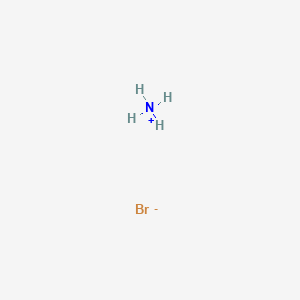
Ammonium Bromide
Ammonium bromide is an ammonium salt composed of ammonium and bromide ions in a 1:1 ratio. It is a bromide salt and an ammonium salt. — ChEBI
- IUPAC-Name
- azanium bromide
- Summenformel
- BrH4N
- Molekulargewicht
- 97.94 g/mol
- Exakte Masse
- 96.95271 Da
- Topologische polare Oberfläche
- 1,0 Ų
- Wasserstoffbrücken-Donoren
- 1
- Wasserstoffbrücken-Akzeptoren
- 1
- Kovalente Einheiten
- 2
- Definierte Stereozentren
- 0
Auch bekannt als
16 weitere gemeldete Namen
Kennungen in externen Datenbanken
- ChEBI:CHEBI:85364
- EPA DTXSID:DTXSID8035681
Belege aus weiteren wissenschaftlichen Datenbanken
NIH PubChem PUG-View
Attributed physical-property, hazard, environmental and use annotations.
- Autoignition Temperature: Not flammable (USCG, 1999) Quelle: CAMEO Chemicals
- Boiling Point: Sublimes 1007 °F (USCG, 1999) Quelle: CAMEO Chemicals
- Boiling Point: 396 °C (sublimation point) Quelle: Hazardous Substances Data Bank (HSDB)
- Boiling Point: BP: 235 °C (in vacuum) Quelle: Hazardous Substances Data Bank (HSDB)
- Boiling Point: 235 °C @760 [mm Hg] Quelle: PAC Chemical Database, U.S. Department of Energy
- Color/Form: White tetragonal crystals Quelle: Hazardous Substances Data Bank (HSDB)
- Color/Form: White crystals or granules Quelle: Hazardous Substances Data Bank (HSDB)
- Color/Form: Colorless crystals or yellowish white powder Quelle: Hazardous Substances Data Bank (HSDB)
- Density: 2.429 at 68 °F (USCG, 1999) - Denser than water; will sink Quelle: CAMEO Chemicals
- Density: 2.429 at 25 °C Quelle: Hazardous Substances Data Bank (HSDB)
- Density: 2.429 @25 °C Quelle: PAC Chemical Database, U.S. Department of Energy
- Melting Point: Sublimes without melting (USCG, 1999) Quelle: CAMEO Chemicals
- Melting Point: 542 °C (decomposes) Quelle: Hazardous Substances Data Bank (HSDB)
- Melting Point: 452 °C Quelle: PAC Chemical Database, U.S. Department of Energy
- Odor: Odorless Quelle: Hazardous Substances Data Bank (HSDB)
- Physical Description: Ammonium bromide appears as white odorless crystals or granules that become yellow upon exposure to air. Sinks and mixes in water. (USCG, 1999) Quelle: CAMEO Chemicals
- Physical Description: Dry Powder Quelle: EPA Chemical Data Reporting (CDR)
- Physical Description: White odorless solid; Slightly hygroscopic; Yellows slowly in air; [Merck Index] Colorless granules; [MSDSonline] Quelle: Haz-Map, Information on Hazardous Chemicals and Occupational Diseases
- Refractive Index: Index of refraction: 1.712 at 25 °C Quelle: Hazardous Substances Data Bank (HSDB)
- Solubility: In water, 78.3 g/100 g water at 25 °C Quelle: Hazardous Substances Data Bank (HSDB)
- Solubility: Soluble in acetone, ether, ammonia, in water, 97 g/100 cc at 25 °C, 145.6 g/100 cc at 100 °C; in alcohol, 10 g/100 cc at 78 °C Quelle: Hazardous Substances Data Bank (HSDB)
- Solubility: Freely soluble in methanol, ethanol, acetone; slightly soluble in ether; practically insoluble in ethyl acetate Quelle: Hazardous Substances Data Bank (HSDB)
- Vapor Pressure: VP: 1 mm Hg at 198.3 °C Quelle: Hazardous Substances Data Bank (HSDB)
- pH: Slightly acid to litmus Quelle: Hazardous Substances Data Bank (HSDB)
- Carcinogen Classification: No indication of carcinogenicity to humans (not listed by IARC). Quelle: Toxin and Toxin Target Database (T3DB)
- Exposure Routes: Oral (L626) ; inhalation (L626) ; dermal (L626) Quelle: Toxin and Toxin Target Database (T3DB)
- First Aid: EYES AND SKIN: Flush with large amounts of water.; INGESTION: Induce vomiting and call a doctor. (USCG, 1999) Quelle: CAMEO Chemicals
- Signal: Danger Quelle: Regulation (EC) No 1272/2008 of the European Parliament and of the Council
- GHS Hazard Statements: H319: Causes serious eye irritation [Warning Serious eye damage/eye irritation]; H336: May cause drowsiness or dizziness [Warning Specific target organ toxicity, single exposure; Narcotic effects]; H360FD: May damage fertility; May damage the unborn child [Danger Reproductive toxicity]; H362: May cause harm to breast-fed children [Reproductive toxicity, effects on or via lactation]; H372: Causes damage to organs through prolonged or repeated exposure [Danger Specific target organ toxicity, repeated exposure] Quelle: Regulation (EC) No 1272/2008 of the European Parliament and of the Council
- Precautionary Statement Codes: P203, P260, P261, P263, P264, P264+P265, P270, P271, P280, P304+P340, P305+P351+P338, P318, P319, P337+P317, P403+P233, P405, and P501 (click each P-code to see the statement) Quelle: Regulation (EC) No 1272/2008 of the European Parliament and of the Council
- Note: This chemical does not meet GHS hazard criteria for 0.4% (3 of 704) of reports. Quelle: European Chemicals Agency (ECHA)
- Signal: Danger Quelle: European Chemicals Agency (ECHA)
- GHS Hazard Statements: H319 (99.6%): Causes serious eye irritation [Warning Serious eye damage/eye irritation]; H336 (21%): May cause drowsiness or dizziness [Warning Specific target organ toxicity, single exposure; Narcotic effects]; H360FD (17.8%): May damage fertility; May damage the unborn child [Danger Reproductive toxicity]; H362 (20.9%): May cause harm to breast-fed children [Reproductive toxicity, effects on or via lactation]; H372 (20.9%): Causes damage to organs through prolonged or repeated exposure [Danger Specific target organ toxicity, repeated exposure] Quelle: European Chemicals Agency (ECHA)
- Precautionary Statement Codes: P203, P260, P261, P263, P264, P264+P265, P270, P271, P280, P304+P340, P305+P351+P338, P318, P319, P337+P317, P403+P233, P405, and P501 (click each P-code to see the statement) Quelle: European Chemicals Agency (ECHA)
- ECHA C&L Notifications Summary: Aggregated GHS information provided per 704 reports by companies from 12 notifications to the ECHA C&L Inventory. Each notification may be associated with multiple companies.; Reported as not meeting GHS hazard criteria per 3 of 704 reports by companies.; There are 11 notifications provided by 701 of 704 reports by companies with hazard statement code(s).; Information may vary between notifications depending on impurities, additives, and other factors. The percentage value in parenthesis indicates the notified classification ratio from companies that provide hazard codes. Only hazard codes with percentage values above 10% are shown. For more detailed information, please visit ECHA C&L website. Quelle: European Chemicals Agency (ECHA)
- Signal: Danger Quelle: NITE-CMC
- GHS Hazard Statements: H320: Causes eye irritation [Warning Serious eye damage/eye irritation]; H336: May cause drowsiness or dizziness [Warning Specific target organ toxicity, single exposure; Narcotic effects]; H360: May damage fertility or the unborn child [Danger Reproductive toxicity]; H371: May cause damage to organs [Warning Specific target organ toxicity, single exposure]; H372: Causes damage to organs through prolonged or repeated exposure [Danger Specific target organ toxicity, repeated exposure]; H400: Very toxic to aquatic life [Warning Hazardous to the aquatic environment, acute hazard]; H410: Very toxic to aquatic life with long lasting effects [Warning Hazardous to the aquatic environment, long-term hazard] Quelle: NITE-CMC
- Precautionary Statement Codes: P203, P260, P261, P264, P264+P265, P270, P271, P273, P280, P304+P340, P305+P351+P338, P308+P316, P318, P319, P337+P317, P391, P403+P233, P405, and P501 (click each P-code to see the statement) Quelle: NITE-CMC
- Health Effects: Bromine vapour causes irritation and direct damage to the mucous membranes. Elemental bromine also burns the skin. The bromide ion is a central nervous system depressant and chronic exposure produces neuronal effects. This is called bromism and can result in central reactions reaching from somnolence to coma, cachexia, exicosis, loss of reflexes or pathologic reflexes, clonic seizures, tremor, ataxia, loss of neural sensitivity, paresis, papillar edema of the eyes, abnormal speech, cerebral edema, delirium, aggressiveness, and psychoses. (L625, L626, L627) Quelle: Toxin and Toxin Target Database (T3DB)
- Toxicity Summary: IDENTIFICATION AND USE: Ammonium bromide exists as white crystals or granules. It is used in process engraving and lithography, fireproofing of wood, and as a corrosion inhibitor. Bromide- containing medications is a prominent former use. HUMAN EXPOSURE AND TOXICITY: The warning symptoms of bromide intoxication, bromism, include mental dullness, slurred speech, weakened memory, apathy, anorexia, constipation, drowsiness and loss of sensitivity to touch and pain. These symptoms disappear on discontinuing the drug, but continued use leads to more serious symptoms including restlessness, disorientation, ocular disturbances, ataxia, hallucinations, delirium, stupor and coma. Bromide rash, of an acneform, nodular, or sometimes erythematous type, is of fairly common occurrence but may be absent even in patients who have developed severe mental symptoms. Transplacental bromism had been described in the literature. ANIMAL STUDIES: Ammonium bromide was not irritating to skin, but slightly irritating to eyes in rabbits. Ames test conducted in Salmonella typhimurium strains TA1535,TA100,TA1538,TA98,TA1537 with and without metabolic activation was negative. Quelle: Hazardous Substances Data Bank (HSDB)
- Toxicity Summary: Bromine is a powerful oxidizing agent and is able to release oxygen free radicals from the water in mucous membranes. These free radicals are also potent oxidizers and produce tissue damage. In additon, the formation of hydrobromic and bromic acids will result in secondary irritation. The bromide ion is also known to affect the central nervous system, causing bromism. This is believed to be a result of bromide ions substituting for chloride ions in the in actions of neurotransmitters and transport systems, thus affecting numerous synaptic processes. (L626, L627, A543) Quelle: Toxin and Toxin Target Database (T3DB)
- Industry Uses: Processing aids not otherwise specified; Flux agent; Flame retardant Quelle: EPA Chemical Data Reporting (CDR)
- Sources/Uses: Used in process engraving and lithography, fireproofing wood, textile finishing, manufacturing photographic emulsions, and metal treatment, Also used as a corrosion inhibitor and as a catalyst in the production of diphenylamine; [HSDB] Used as a sedative; [Merck Index] Quelle: Haz-Map, Information on Hazardous Chemicals and Occupational Diseases
- Industrial Processes with risk of exposure: Textiles (Printing, Dyeing, or Finishing) [Category: Industry] Quelle: Haz-Map, Information on Hazardous Chemicals and Occupational Diseases
- Activities with risk of exposure: Lithography printing [Category: Hobbies] Quelle: Haz-Map, Information on Hazardous Chemicals and Occupational Diseases
- Uses: For ammonium bromide (USEPA/OPP Pesticide Code: 000352) ACTIVE products with label matches. /SRP: Registered for use in the USA but approved pesticide uses may change periodically and so federal, state and local authorities must be consulted for currently approved uses./ Quelle: Hazardous Substances Data Bank (HSDB)
- Uses: Manufacturing of photographic films, plates, and papers; in process engraving and lithography; fireproofing of wood; in corrosion inhibitors; in photochemical reactions; precipitation of silver salts. Quelle: Hazardous Substances Data Bank (HSDB)
- Uses: Analytical chemistry, ... textile finishing, fire retardant, anticorrosive agent. Quelle: Hazardous Substances Data Bank (HSDB)
- Uses: MFR OF PHOTOGRAPHIC EMULSIONS; IN METAL TREATMENT; CATALYST IN PRODN OF DIPHENYLAMINE Quelle: Hazardous Substances Data Bank (HSDB)
- Uses: For more Uses (Complete) data for AMMONIUM BROMIDE (6 total), please visit the HSDB record page. Quelle: Hazardous Substances Data Bank (HSDB)
- Uses: Ammonium bromide is used for photography in films, plates and papers, for fireproofing wood, in lithography and process engraving, in corrosion inhibitors, and in pharmaceutical preparations. (L640) Quelle: Toxin and Toxin Target Database (T3DB)
Zugeordnet durch: Existing checksum-valid CAS to unique PubChem CID match. Abgerufen: 2026-08-31. Quelleneintrag öffnen
Wissenschaftliche Klassifizierungen und Gefahrenannotationen liefern Kontext und ersetzen nicht die oben gezeigte marktspezifische regulatorische Entscheidung.
Weitere Quellenabdeckung und Trefferstatus
| Quelle | Ergebnis | Geprüft |
|---|---|---|
| NIH PubChem PUG-View | Exakter Treffer | 2026-08-31 |
Ein erfasster Nicht-Treffer ist ein nützlicher Beleg dafür, dass die Quelle geprüft wurde; er ist keine Behauptung, dass der Stoff anderswo nicht existiert.
Am 2026-08-31 von NIH PubChem durch prüfsummengültigen CAS-Abgleich abgerufen. Chemische Eigenschaften ersetzen nicht die regulatorische Entscheidung auf dieser Seite.
Verwandte Einträge zu Ammonium bromide
Für diesen Eintrag gibt es nur wenige direkte Treffer; daher werden auch nahe liegende Einträge aus Anhang II angezeigt.
Desmedipham (ISO); ethyl 3-phenylcarbamoyloxyphenylcarbamate
Dibutyltin bis(2-ethylhexanoate)
Triticonazole (ISO); (RS)-(E)-5-(4-chlorobenzylidene)-2,2-dimethyl-1-(1H-1,2,4-triazol-1-methyl)cyc…
Dibutyltin di(acetate)
Thiamethoxam (ISO); 3-(2-chloro-thiazol-5-ylmethyl)-5-methyl[1,3,5]oxadiazinan-4-ylidene-N-nitroami…
Tellurium dioxide
Imazamox (ISO); (RS)-2-(4-isopropyl-4-methyl-5-oxo-2-imidazolin-2-yl)-5-methoxymethylnicotinic acid
Barium diboron tetraoxide
Dimethomorph (ISO); (E,Z)-4-(3-(4-chlorophenyl)-3-(3,4-dimethoxyphenyl)acryloyl)morpholine
2,2-dimethylpropan-1-ol,tribromo derivative; 3-bromo-2,2-bis(bromomethyl)propan-1-ol
4-methylpentan-2-one; isobutyl methyl ketone (MIBK)
2,4,6-tri-tert-butylphenol
Was Anhang II für Ammonium bromide bedeutet
Ammonium bromide ist in Anhang II der EU-Kosmetikverordnung (EG) Nr. 1223/2009 als verbotener Stoff aufgeführt und darf nicht absichtlich zugesetzt werden. Artikel 17 regelt gesondert unbeabsichtigte geringe Mengen, die bei guter Herstellungspraxis technisch unvermeidbar und mit der Sicherheitsanforderung nach Artikel 3 vereinbar sind.
Rezepturentwickler müssen ihre Inhaltsstoffe und Rohstoffe prüfen, um sicherzustellen, dass keiner davon diesen Stoff enthält. Lieferanten sollten auf Anfrage eine Dokumentation vorlegen, die die Abwesenheit bestätigt.
Die Seite zeigt außerdem 12 verwandte Anhangseinträge mit überschneidenden Kennungen, Anhangslogik oder Namensmustern.
Compliance-Checkliste
- Prüfen Sie, dass dieser Stoff in allen Rohstoffen und fertigen Rezepturen nicht enthalten ist.
- Fordern Sie von Rohstofflieferanten eine Abwesenheitsbestätigung oder ein Analysenzertifikat an.
- Dokumentieren Sie das Prüfergebnis in der Produktinformationsdatei (PIF).
Häufig gestellte Fragen
Quellenhinweis zu Anhang II, Eintrag Ammonium bromide
Diese Seite fasst einen Eintrag aus Anhang II für Ammonium bromide aus öffentlichen Materialien der Europäischen Kommission zu kosmetischen Mitteln zusammen und ergänzt, soweit verfügbar, verknüpfte Treffer aus dem Verzeichnis oder bei Kennungen.
Nutzen Sie diese Eintragsseite, um die Bedingungen aus Anhang II für Ammonium bromide zu prüfen; bestätigen Sie jede endgültige regulatorische Entscheidung jedoch anhand des aktuellen amtlichen Anhangswortlauts und der Quelldateien.
Werkzeuge und nächste Schritte
Rezeptur prüfen
Fügen Sie eine vollständige INCI-Liste ein, um Ammonium bromide und andere markierte EU-Anhangseinträge in einem Durchgang zu finden.
INCI-CheckerEinträge vergleichen
Ammonium bromide nebeneinander mit einem anderen Anhangseintrag vergleichen, um Unterschiede bei Beschränkungen, Konzentrationen und Anhangszuordnung zu prüfen.
VergleichenDen Anhang durchsuchen
Alle Einträge in Anhang II ansehen und die regulatorischen Bedingungen der Stoffe in diesem Anhang vergleichen.
Anhang II öffnen