
Cadmium nitrate; cadmium dinitrate
Cadmium nitrate; cadmium dinitrate 在附件 II 中被列为在欧盟市场上市的化妆品的禁用物质。
记录详情
化学名称
Cadmium nitrate; cadmium dinitrate
化学名称 / IUPAC 名称
Cadmium nitrate; cadmium dinitrate
监管信息
CMR
| 类别 | Carcinogenic | Mutagenic | Reprotoxic |
|---|---|---|---|
| Cat. 1B | ✓ | ✓ | — |
关键数据
化学身份与性质
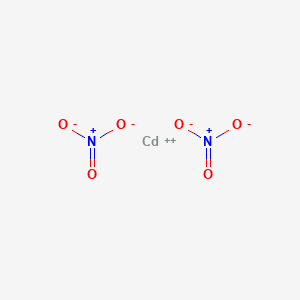
Cadmium Nitrate
Cadmium nitrate is an inorganic nitrate salt having Cd(2+) as the counterion. It has a role as a genotoxin, a carcinogenic agent and a hepatotoxic agent. It is a cadmium salt and an inorganic nitrate salt. It contains a cadmium(2+). — ChEBI
- IUPAC 名称
- cadmium(2+) dinitrate
- 分子式
- CdN2O6
- 分子量
- 236.42 g/mol
- 精确质量
- 237.879001 Da
- 拓扑极性表面积
- 126.0 Ų
- 氢键供体
- 0
- 氢键受体
- 6
- 共价单元
- 3
- 已定义的立体中心
- 0
又称
另有 14 个已报告名称
外部数据库标识符
- ChEBI:CHEBI:77732
来自其他科学数据库的证据
EMBL-EBI ChEBI
cadmium nitrate
An inorganic nitrate salt having Cd(2+) as the counterion.
- 配方
- Cd.2NO3
- 平均质量
- 236.420 g/mol
- 单同位素质量
- 237.87899 Da
- 形式电荷
- 0
- cadmium salt — is a (CHEBI:50293)
- inorganic nitrate salt — is a (CHEBI:51084)
- carcinogenic agent — has role (CHEBI:50903)
- hepatotoxic agent — has role (CHEBI:50908)
- genotoxin — has role (CHEBI:50902)
- cadmium(2+) — has part (CHEBI:48775)
- carcinogenic agent — has role (CHEBI:50903)
- hepatotoxic agent — has role (CHEBI:50908)
- genotoxin — has role (CHEBI:50902)
- cadmium salt — is a (CHEBI:50293)
- inorganic nitrate salt — is a (CHEBI:51084)
其他整理的名称
来自此来源的交叉引用
- CAS: 10325-94-7 — ChemIDplus
- REGISTRY_NUMBER: 8156730 — Reaxys
- MANUAL_X_REF: Cadmium_nitrate — Wikipedia
映射方: Exact CAS cross-reference in the ChEBI compound record. 来源更新: 2015-06-24. 检索时间: 2026-08-31. 打开来源记录
NIH PubChem PUG-View
Attributed physical-property, hazard, environmental and use annotations.
- Boiling Point: 132 °C @760 [mm Hg] 来源: PAC Chemical Database, U.S. Department of Energy
- Color/Form: White cubic crystals 来源: Hazardous Substances Data Bank (HSDB)
- Color/Form: White, amorphous pieces or hygroscopic needles 来源: Hazardous Substances Data Bank (HSDB)
- Color/Form: White, prismatic needles 来源: Hazardous Substances Data Bank (HSDB)
- Density: 2.45 at 68 °F (USCG, 1999) - Denser than water; will sink 来源: CAMEO Chemicals
- Density: 3.6 g/cu cm 来源: Hazardous Substances Data Bank (HSDB)
- Density: 3.6 @25 °C 来源: PAC Chemical Database, U.S. Department of Energy
- Melting Point: 138 °F (USCG, 1999) 来源: CAMEO Chemicals
- Melting Point: 360 °C 来源: Hazardous Substances Data Bank (HSDB)
- Melting Point: 360 °C 来源: PAC Chemical Database, U.S. Department of Energy
- Physical Description: Cadmium nitrate is an odorless white solid. Sinks in water. (USCG, 1999) 来源: CAMEO Chemicals
- Physical Description: White solid; [HSDB] White odorless crystals; [MSDSonline] There are 3 hydrates that form at temperatures <56 deg C; [Ullmann] 来源: Haz-Map, Information on Hazardous Chemicals and Occupational Diseases
- Solubility: Soluble in ammonia, alcohol 来源: Hazardous Substances Data Bank (HSDB)
- Solubility: Sol in ethanol 来源: Hazardous Substances Data Bank (HSDB)
- Solubility: Soluble in ether, acetone 来源: Hazardous Substances Data Bank (HSDB)
- Solubility: In water, 156 g/100 g water at 25 °C 来源: Hazardous Substances Data Bank (HSDB)
- Carcinogen Classification: 1, carcinogenic to humans. (L135) 来源: Toxin and Toxin Target Database (T3DB)
- Exposure Routes: Oral (L6) ; inhalation (L6) ; dermal (L6) 来源: Toxin and Toxin Target Database (T3DB)
- First Aid: INHALATION: remove patient to fresh air; seek medical attention.; INGESTION: give large amounts of water and induce vomiting; give milk or egg whites; seek medical attention.; EYES: flush with copious amounts of water for 15 min.; consult a physician.; SKIN: wash with soap and water. (USCG, 1999) 来源: CAMEO Chemicals
- Signal: Danger 来源: Regulation (EC) No 1272/2008 of the European Parliament and of the Council
- GHS Hazard Statements: H302: Harmful if swallowed [Warning Acute toxicity, oral]; H312: Harmful in contact with skin [Warning Acute toxicity, dermal]; H332: Harmful if inhaled [Warning Acute toxicity, inhalation]; H340: May cause genetic defects [Danger Germ cell mutagenicity]; H350: May cause cancer [Danger Carcinogenicity]; H372: Causes damage to organs through prolonged or repeated exposure [Danger Specific target organ toxicity, repeated exposure]; H400: Very toxic to aquatic life [Warning Hazardous to the aquatic environment, acute hazard]; H410: Very toxic to aquatic life with long lasting effects [Warning Hazardous to the aquatic environment, long-term hazard] 来源: Regulation (EC) No 1272/2008 of the European Parliament and of the Council
- Precautionary Statement Codes: P203, P260, P261, P264, P270, P271, P273, P280, P301+P317, P302+P352, P304+P340, P317, P318, P319, P321, P330, P362+P364, P391, P405, and P501 (click each P-code to see the statement) 来源: Regulation (EC) No 1272/2008 of the European Parliament and of the Council
- Signal: Danger 来源: European Chemicals Agency (ECHA)
- GHS Hazard Statements: H301 (90%): Toxic if swallowed [Danger Acute toxicity, oral]; H302+H312+H332 (31.4%): Harmful if swallowed, in contact with skin or if inhaled [Warning Acute toxicity, oral; acute toxicity, dermal; acute toxicity, inhalation]; H302 (10%): Harmful if swallowed [Warning Acute toxicity, oral]; H312 (42.9%): Harmful in contact with skin [Warning Acute toxicity, dermal]; H330 (90%): Fatal if inhaled [Danger Acute toxicity, inhalation]; H332 (10%): Harmful if inhaled [Warning Acute toxicity, inhalation]; H340 (90%): May cause genetic defects [Danger Germ cell mutagenicity]; H350 (92.9%): May cause cancer [Danger Carcinogenicity]; H360 (88.6%): May damage fertility or the unborn child [Danger Reproductive toxicity]; H372 (90%): Causes damage to organs through prolonged or repeated exposure [Danger Specific target organ toxicity, repeated exposure]; H400 (100%): Very toxic to aquatic life [Warning Hazardous to the aquatic environment, acute hazard]; H410 (100%): Very toxic to aquatic life with long lasting effects [Warning Hazardous to the aquatic environment, long-term hazard] 来源: European Chemicals Agency (ECHA)
- Precautionary Statement Codes: P203, P260, P261, P264, P270, P271, P273, P280, P284, P301+P316, P301+P317, P302+P352, P304+P340, P316, P317, P318, P319, P320, P321, P330, P362+P364, P391, P403+P233, P405, and P501 (click each P-code to see the statement) 来源: European Chemicals Agency (ECHA)
- ECHA C&L Notifications Summary: Aggregated GHS information provided per 70 reports by companies from 8 notifications to the ECHA C&L Inventory. Each notification may be associated with multiple companies.; Information may vary between notifications depending on impurities, additives, and other factors. The percentage value in parenthesis indicates the notified classification ratio from companies that provide hazard codes. Only hazard codes with percentage values above 10% are shown. For more detailed information, please visit ECHA C&L website. 来源: European Chemicals Agency (ECHA)
- Signal: Danger 来源: NITE-CMC
- GHS Hazard Statements: H340: May cause genetic defects [Danger Germ cell mutagenicity] 来源: NITE-CMC
- Precautionary Statement Codes: P203, P280, P318, P405, and P501 (click each P-code to see the statement) 来源: NITE-CMC
- GHS Hazard Statements: H301: Toxic if swallowed [Danger Acute toxicity, oral]; H341: Suspected of causing genetic defects [Warning Germ cell mutagenicity]; H350: May cause cancer [Danger Carcinogenicity]; H361: Suspected of damaging fertility or the unborn child [Warning Reproductive toxicity]; H370: Causes damage to organs [Danger Specific target organ toxicity, single exposure]; H372: Causes damage to organs through prolonged or repeated exposure [Danger Specific target organ toxicity, repeated exposure] 来源: NITE-CMC
- Precautionary Statement Codes: P203, P260, P264, P270, P280, P301+P316, P308+P316, P318, P319, P321, P330, P405, and P501 (click each P-code to see the statement) 来源: NITE-CMC
- Health Effects: Chronic exposure to cadmium fumes can cause chemical pneumonitis, pulmonary edema, and lung diseases such as bronchitis and emphysema. Cadmium also accumulates in the kidneys, causing permanent damage. Loss of bone density also occurs. Nitrate and nitrite poisoning causes methemoglobinemia. Nitrites may cause pregnancy complications and developmental effects. They may also be carcinogenic. (L1137, L6) 来源: Toxin and Toxin Target Database (T3DB)
- Toxicity Summary: Cadmium initially binds to metallothionein and is transported to the kidney. Toxic effects are observed once the concentration of cadmium exceeds that of available metallothionein, and it has also been shown that the cadmium-metallothionein complex may be damaging. Accumulation of cadmium in the kidney results in increased excretion of vital low and high weight molecular proteins. Cadmium is a high affinity zinc analog and can interfere in its biological processes. It also binds to and activates the estrogen receptor, likely stimulating the growth of certain types of cancer cells and causing other estrogenic effects, such as reproductive dysfunction. Cadmium causes cell apoptosis by activating mitogen-activated protein kinases. Nitrate's toxicity is a result of it's conversion to nitrite once in the body. Nitrite causes the autocatalytic oxidation of oxyhemoglobin to hydrogen peroxide and methemoglobin. This elevation of methemoglobin levels is a condition known as methemoglobinemia, and is characterized by tissue hypoxia, as methemoglobin cannot bind oxygen. (A2450, L1613, L8, A18, A19, A28) 来源: Toxin and Toxin Target Database (T3DB)
- Environmental Bioconcentration: Salvinia natans (fern) exposed to cadmium nitrate for 21 days exhibited a bioconcentration factor of 960. 来源: Hazardous Substances Data Bank (HSDB)
- Environmental Bioconcentration: Mya arenaria, (soft shell clam) exposed to cadmium nitrate for 70 days exhibited a bioconcentration factor of 160. 来源: Hazardous Substances Data Bank (HSDB)
- Environmental Bioconcentration: Crassostrea virginica, (American oyster) exposed to cadmium nitrate for 98 days exhibited a bioconcentration factor of 1,220. 来源: Hazardous Substances Data Bank (HSDB)
- Environmental Bioconcentration: Lemna valdiviana (duck weed) exposed to cadmium nitrate for 21 days exhibited a bioconcentration factor of 603. 来源: Hazardous Substances Data Bank (HSDB)
- Sources/Uses: Used in photographic emulsions, nuclear reactors to control rate of nuclear fission, and glass and ceramic colorants; [HSDB] Used in storage batteries and to make red lusters in glass and porcelain; [Ullmann] 来源: Haz-Map, Information on Hazardous Chemicals and Occupational Diseases
- Industrial Processes with risk of exposure: Battery Manufacturing [Category: Industry]; Photographic Processing [Category: Other]; Glass Manufacturing [Category: Industry] 来源: Haz-Map, Information on Hazardous Chemicals and Occupational Diseases
- Activities with risk of exposure: Ceramics making [Category: Hobbies] 来源: Haz-Map, Information on Hazardous Chemicals and Occupational Diseases
- Uses: In making other cadmium salts; in photographic emulsions. 来源: Hazardous Substances Data Bank (HSDB)
- Uses: Oxidation of the sulfide or sulfite under carefully controlled oxidizing atmospheres at high temperature. An alternate method involves treatment of powdered cadmium nitrate, halide, oxide, or carbonate with dimethyl sulfate. 来源: Hazardous Substances Data Bank (HSDB)
- Uses: The use of cadmium soaps as components of PVC stabilizers is decreasing because of their toxic properties. Solid PVC stabilizers contain cadmium soaps of saturated fatty acids, whereas liquid stabilizers contain soaps of unsaturated or branched, short-chain fatty acids. The soaps act as heat and light stabilizers, and soaps of saturated fatty acids are used as lubricants in the processing of PVC. Unlike other metallic soaps used in the PVC sector, cadmium soaps do not affect transparency and are suitable for hard, transparent PVC products. However, for safety reason their use is nowadays being replaced by mixtures of calcium-zinc stearate plus other stabilizers. /Cadmium metallic soaps/ 来源: Hazardous Substances Data Bank (HSDB)
- Uses: Production of red lusters in glass and porcelain and in cadmium-nickel sinter plates of storage batteries. 来源: Hazardous Substances Data Bank (HSDB)
- Uses: For more Uses (Complete) data for CADMIUM NITRATE (6 total), please visit the HSDB record page. 来源: Hazardous Substances Data Bank (HSDB)
- Uses: Cadmium nitrate is used mainly to prepare other cadmium salts. It is also used for coloring glass and porcelain and as a flash powder in photography. (L450) 来源: Toxin and Toxin Target Database (T3DB)
映射方: Existing checksum-valid CAS to unique PubChem CID match. 检索时间: 2026-08-31. 打开来源记录
科学分类和危害注释仅提供背景信息,不能取代上方所示针对具体市场的监管决定。
其他来源的覆盖范围和匹配状态
| 来源 | 结果 | 已检查 |
|---|---|---|
| EMBL-EBI ChEBI | 精确匹配 | 2026-08-31 |
| NIH PubChem PUG-View | 精确匹配 | 2026-08-31 |
已记录的无匹配结果是该来源已被检查的有效证据;这并不表示该物质在别处不存在。
于 2026-09-02 通过校验和有效的 CAS 匹配从美国国立卫生研究院 (NIH) PubChem 检索。化学性质不能取代本页的监管决定。
Cadmium nitrate; cadmium dinitrate 的相关记录
该记录的直接匹配结果有限,因此同时显示附件 II 中的相邻条目。
Dibutyltin dilaurate; dibutyl[bis(dodecanoyloxy)] stannane
Cyproconazole (ISO); (2RS,3RS;2RS,3SR)-2-(4-chlorophenyl)-3-cyclopropyl-1-(1H-1,2,4-triazol-1-yl)...
Nonadecafluorodecanoic acid [1]; Ammonium nonadecafluorodecanoate [2]; Sodium nonadecafluorodecan...
N,N'-Methylenedimorpholine; N,N'-methylenebismorpholine; [formaldehyde released from N,N'-Methyle...
Spiroxamine (ISO); 8-tert-butyl-1,4-dioxaspirol[4.5]decan-2-ylmethyl(ethyl)(propyl)amine
附件 II 对 Cadmium nitrate; cadmium dinitrate 意味着什么
Cadmium nitrate; cadmium dinitrate 被列为欧盟化妆品法规 1223/2009 附件 II 中的禁用物质,不得有意添加。第 17 条另行规定了在良好生产规范下技术上不可避免、且符合第 3 条安全要求的非有意微量存在的情形。
配方师必须筛查其成分和原料,确保均不含该物质。供应商应在被要求时提供证明不含该物质的文件。
本页还显示 12 条相关附件记录,其标识符、附件逻辑或命名模式存在重叠。
合规核查清单
- 核实该物质不存在于所有原料和成品配方中。
- 向原料供应商索取不含该物质的确认函或 CoA。
- 将筛查结果记录在产品信息档案 (PIF) 中。
- 该物质具有 CMR 分类。使用前请查看上方的 CMR 表,并核实现行附件 II/III 状态。