
SODIUM SULFITE / AMMONIUM BISULFITE / AMMONIUM SULFITE / POTASSIUM SULFITE / POTASSIUM hydrogen SULFITE / SODIUM BISULFITE / SODIUM METABISULFITE / POTASSIUM METABISULFITE
Inorganic sulphites and hydrogensulphites (5)
SODIUM SULFITE / AMMONIUM BISULFITE / AMMONIUM SULFITE / POTASSIUM SULFITE / POTASSIUM hydrogen SULFITE / SODIUM BISULFITE / SODIUM METABISULFITE / POTASSIUM METABISULFITE figure à l’annexe V comme conservateur de la liste positive pour les cosmétiques de l’UE. Concentration maximale dans cette fiche : 0.2% (as free SO2).
Détails de la fiche
Concentration maximale
0.2% (as free SO2)
Nom du glossaire INCI
SODIUM SULFITE / AMMONIUM BISULFITE / AMMONIUM SULFITE / POTASSIUM SULFITE / POTASSIUM hydrogen SULFITE / SODIUM BISULFITE / SODIUM METABISULFITE / POTASSIUM METABISULFITE
Nom chimique
Inorganic sulphites and hydrogensulphites (5)
Informations réglementaires
Avis du SCCS
Données clés
Identité et propriétés chimiques
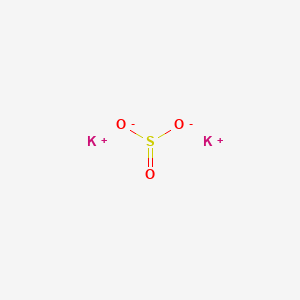
Potassium Sulfite
- Nom IUPAC
- dipotassium;sulfite
- Formule moléculaire
- K2O3S
- Masse moléculaire
- 158.26 g/mol
- Masse exacte
- 157.88422800 Da
- Surface polaire topologique
- 82,4 Ų
- Donneurs de liaisons hydrogène
- 0
- Accepteurs de liaisons hydrogène
- 4
- Unités covalentes
- 3
- Stéréocentres définis
- 0
Également connu sous le nom de
16 autres noms signalés
Identifiants de bases de données externes
- EPA DTXSID:DTXSID80889532
Preuves issues de bases de données scientifiques complémentaires
NIH PubChem PUG-View
Attributed physical-property, hazard, environmental and use annotations.
- Physical Description: Liquid Source: EPA Chemical Data Reporting (CDR)
- Physical Description: Dihydrate: White solid; Slowly oxidized by air to sulfate; [Merck Index] White powder; [MSDSonline] Source: Haz-Map, Information on Hazardous Chemicals and Occupational Diseases
- Solubility: White crystals or crystalline powder; sol in about 3.5 parts water; decomposed by diluted acids with evolution of sulfur dioxide; pH about 8 /dihydrate/ Source: Hazardous Substances Data Bank (HSDB)
- Solubility: White-yellowish, hexagonal form; insol in ammonia; slightly sol in alcohol /dihydrate/ Source: Hazardous Substances Data Bank (HSDB)
- Note: This chemical does not meet GHS hazard criteria for 81.5% (242 of 297) of all reports. Source: European Chemicals Agency (ECHA)
- Signal: Warning Source: European Chemicals Agency (ECHA)
- GHS Hazard Statements: H315 (16.5%): Causes skin irritation [Warning Skin corrosion/irritation]; H319 (18.2%): Causes serious eye irritation [Warning Serious eye damage/eye irritation]; H335 (16.2%): May cause respiratory irritation [Warning Specific target organ toxicity, single exposure; Respiratory tract irritation] Source: European Chemicals Agency (ECHA)
- Precautionary Statement Codes: P261, P264, P264+P265, P271, P280, P302+P352, P304+P340, P305+P351+P338, P319, P321, P332+P317, P337+P317, P362+P364, P403+P233, P405, and P501 (click each P-code to see the statement) Source: European Chemicals Agency (ECHA)
- ECHA C&L Notifications Summary: Aggregated GHS information provided per 297 reports by companies from 10 notifications to the ECHA C&L Inventory. Each notification may be associated with multiple companies.; Reported as not meeting GHS hazard criteria per 242 of 297 reports by companies.; There are 7 notifications provided by 55 of 297 reports by companies with hazard statement code(s).; Information may vary between notifications depending on impurities, additives, and other factors. The percentage value in parenthesis indicates the notified classification ratio from companies that provide hazard codes. Only hazard codes with percentage values above 10% are shown. For more detailed information, please visit ECHA C&L website. Source: European Chemicals Agency (ECHA)
- Signal: Danger Source: Hazardous Chemical Information System (HCIS), Safe Work Australia
- GHS Hazard Statements: H302: Harmful if swallowed [Warning Acute toxicity, oral]; H318: Causes serious eye damage [Danger Serious eye damage/eye irritation] Source: Hazardous Chemical Information System (HCIS), Safe Work Australia
- Precautionary Statement Codes: P264, P264+P265, P270, P280, P301+P317, P305+P354+P338, P317, P330, and P501 (click each P-code to see the statement) Source: Hazardous Chemical Information System (HCIS), Safe Work Australia
- Cosmetic Ingredient Review Finding(s): Safe in the present practices of use and concentration. Ingredient, concentration, and use information are available in documents discoverable at https://cir-reports.cir-safety.org Source: Cosmetic Ingredient Review (CIR)
- Consumer Uses: Etching agent; Soil amendments (fertilizers) Source: EPA Chemical Data Reporting (CDR)
- Industry Uses: Reducing agent; Soil amendments (fertilizers) Source: EPA Chemical Data Reporting (CDR)
- Cosmetic Ingredient Review Link: CIR ingredient: Potassium Sulfite Source: Cosmetic Ingredient Review (CIR)
- Sources/Uses: Used in photography, food and cosmetics (preservative and antioxidant), and drugs (cathartic and diuretic); [HSDB] Source: Haz-Map, Information on Hazardous Chemicals and Occupational Diseases
- Industrial Processes with risk of exposure: Photographic Processing [Category: Other] Source: Haz-Map, Information on Hazardous Chemicals and Occupational Diseases
- Uses: Photography; preservative and antioxidant in foods Source: Hazardous Substances Data Bank (HSDB)
- Uses: Medication: cathartic, diuretic Source: Hazardous Substances Data Bank (HSDB)
- Uses: COMPONENT OF PHOTOGRAPHIC DEVELOPERS; FOOD ADDITIVE (EG, PRESERVATIVE & ANTIOXIDANT); INGREDIENT IN COSMETICS (EG, HAIR PREPARATIONS) Source: Hazardous Substances Data Bank (HSDB)
Mis en correspondance par: Existing checksum-valid CAS to unique PubChem CID match. Récupéré le: 2026-08-31. Ouvrir la fiche source
Les classifications scientifiques et les annotations de danger apportent du contexte et ne remplacent pas la décision réglementaire propre au marché indiquée ci-dessus.
Couverture des sources complémentaires et état des correspondances
| Source | Résultat | Vérifié |
|---|---|---|
| EMBL-EBI ChEBI | Aucune fiche exacte | 2026-08-31 |
| NIH PubChem PUG-View | Correspondance exacte | 2026-08-31 |
Une absence de correspondance enregistrée est une preuve utile que la source a été vérifiée ; ce n’est pas l’affirmation que la substance n’existe pas ailleurs.
Récupéré depuis NIH PubChem le 2026-09-02 par correspondance CAS à somme de contrôle valide. Les propriétés chimiques ne remplacent pas la décision réglementaire de cette page.
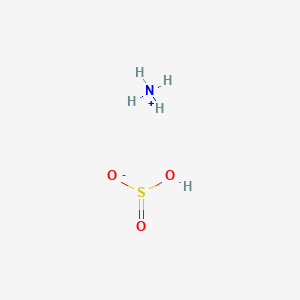
Ammonium Bisulfite
Ammonium bisulfite is colorless crystals which are soluble in water. It is noncombustible. It is corrosive to aluminum. It is a strong irritant to skin and mucous membranes. It is toxic by skin absorption. — CAMEO Chemicals
- Nom IUPAC
- azanium hydrogen sulfite
- Formule moléculaire
- H5NO3S
- Masse moléculaire
- 99.11 g/mol
- Masse exacte
- 98.99901420 Da
- Surface polaire topologique
- 80,6 Ų
- Donneurs de liaisons hydrogène
- 2
- Accepteurs de liaisons hydrogène
- 4
- Unités covalentes
- 2
- Stéréocentres définis
- 0
Également connu sous le nom de
16 autres noms signalés
Identifiants de bases de données externes
- EPA DTXSID:DTXSID1050462
Preuves issues de bases de données scientifiques complémentaires
NIH PubChem PUG-View
Attributed physical-property, hazard, environmental and use annotations.
- Boiling Point: Sublimates at 302.0 °F (USCG, 1999) Source: CAMEO Chemicals
- Boiling Point: at 101.1kPa: 100 °C Source: ILO-WHO International Chemical Safety Cards (ICSCs)
- Color/Form: Colorless crystals Source: Hazardous Substances Data Bank (HSDB)
- Color/Form: Colorless to yellow Source: Hazardous Substances Data Bank (HSDB)
- Density: 2.03 at 68 °F 1.40 (72% aqueous solution) (USCG, 1999) - Denser than water; will sink Source: CAMEO Chemicals
- Density: Sp gr: 2.03 Source: Hazardous Substances Data Bank (HSDB)
- Density: Relative density (water = 1): 2.0 Source: ILO-WHO International Chemical Safety Cards (ICSCs)
- Melting Point: -10 °C Source: ILO-WHO International Chemical Safety Cards (ICSCs)
- Physical Description: Ammonium bisulfite is colorless crystals which are soluble in water. It is noncombustible. It is corrosive to aluminum. It is a strong irritant to skin and mucous membranes. It is toxic by skin absorption. Source: CAMEO Chemicals
- Physical Description: Ammonium bisulfite is a solution of yellow crystals. It is a strong irritant to skin and mucous membranes. It is toxic by skin absorption. It may be corrosive to metals. Source: CAMEO Chemicals
- Physical Description: Liquid Source: EPA Chemical Data Reporting (CDR)
- Physical Description: Colorless to yellow solid; [ICSC] Sold only in solution; [Merck Index] Available as 44% and 68% solution; [MSDSonline] Source: Haz-Map, Information on Hazardous Chemicals and Occupational Diseases
- Physical Description: COLOURLESS-TO-YELLOW LIQUID OR CRYSTALS WITH CHARACTERISTIC ODOUR. Source: ILO-WHO International Chemical Safety Cards (ICSCs)
- Solubility: In water: 267 g/100 ml @ 10 °C, 620 G/100 ml @ 60 °C Source: Hazardous Substances Data Bank (HSDB)
- Solubility: In water: 71.8 g/100 ml @ 0 deg Source: Hazardous Substances Data Bank (HSDB)
- Solubility: Solubility in water, g/100ml at 10 °C: 267 (very good) Source: ILO-WHO International Chemical Safety Cards (ICSCs)
- Exposure Routes: The substance can be absorbed into the body by ingestion. Source: ILO-WHO International Chemical Safety Cards (ICSCs)
- First Aid: Call a physician.; EYES: Flush with water.; SKIN: Flush exposed area with water. (USCG, 1999) Source: CAMEO Chemicals
- First Aid: Excerpt from ERG Guide 154 [Substances - Toxic and/or Corrosive (Non-Combustible)]:; Refer to the "General First Aid" section. Specific First Aid: For corrosives, in case of contact, immediately flush skin or eyes with running water for at least 30 minutes. Additional flushing may be required. (ERG, 2024) Source: CAMEO Chemicals
- Note: This chemical does not meet GHS hazard criteria for 3.7% (6 of 162) of reports. Source: European Chemicals Agency (ECHA)
- Signal: Warning Source: European Chemicals Agency (ECHA)
- GHS Hazard Statements: H315 (38.3%): Causes skin irritation [Warning Skin corrosion/irritation]; H319 (94.4%): Causes serious eye irritation [Warning Serious eye damage/eye irritation]; H335 (37.7%): May cause respiratory irritation [Warning Specific target organ toxicity, single exposure; Respiratory tract irritation] Source: European Chemicals Agency (ECHA)
- Precautionary Statement Codes: P261, P264, P264+P265, P271, P280, P302+P352, P304+P340, P305+P351+P338, P319, P321, P332+P317, P337+P317, P362+P364, P403+P233, P405, and P501 (click each P-code to see the statement) Source: European Chemicals Agency (ECHA)
- ECHA C&L Notifications Summary: Aggregated GHS information provided per 162 reports by companies from 11 notifications to the ECHA C&L Inventory. Each notification may be associated with multiple companies.; Reported as not meeting GHS hazard criteria per 6 of 162 reports by companies.; There are 10 notifications provided by 156 of 162 reports by companies with hazard statement code(s).; Information may vary between notifications depending on impurities, additives, and other factors. The percentage value in parenthesis indicates the notified classification ratio from companies that provide hazard codes. Only hazard codes with percentage values above 10% are shown. For more detailed information, please visit ECHA C&L website. Source: European Chemicals Agency (ECHA)
- Signal: Danger Source: Hazardous Chemical Information System (HCIS), Safe Work Australia
- GHS Hazard Statements: H302: Harmful if swallowed [Warning Acute toxicity, oral]; H318: Causes serious eye damage [Danger Serious eye damage/eye irritation] Source: Hazardous Chemical Information System (HCIS), Safe Work Australia
- Precautionary Statement Codes: P264, P264+P265, P270, P280, P301+P317, P305+P354+P338, P317, P330, and P501 (click each P-code to see the statement) Source: Hazardous Chemical Information System (HCIS), Safe Work Australia
- Cosmetic Ingredient Review Finding(s): Safe in the present practices of use and concentration. Ingredient, concentration, and use information are available in documents discoverable at https://cir-reports.cir-safety.org Source: Cosmetic Ingredient Review (CIR)
- Consumer Uses: Reducing agent; Soil amendments (fertilizers); Processing aids not otherwise specified Source: EPA Chemical Data Reporting (CDR)
- Industry Uses: Soil amendments (fertilizers); Reducing agent; Other; Intermediate; Solids separation (precipitating) agent, not otherwise specified; Processing aids not otherwise specified Source: EPA Chemical Data Reporting (CDR)
- Cosmetic Ingredient Review Link: CIR ingredient: Ammonium Bisulfite Source: Cosmetic Ingredient Review (CIR)
- Sources/Uses: Used in preservatives, fertilizers, grain treatments, explosives, paper production, and corrosion control in drilling fluids; [HSDB] Also used in photography, food preservation, and the gold industry (cyanide destruction process); [MSDSonline] Source: Haz-Map, Information on Hazardous Chemicals and Occupational Diseases
- Industrial Processes with risk of exposure: Pulp and Paper Processing [Category: Industry]; Using Disinfectants or Biocides [Category: Clean]; Photographic Processing [Category: Other] Source: Haz-Map, Information on Hazardous Chemicals and Occupational Diseases
- Uses: SOURCE OF SULFUR IN FLUID FERTILIZERS. Source: Hazardous Substances Data Bank (HSDB)
- Uses: IN LIQ ANTIMICROBIAL TREATMENT FOR STORAGE GRAIN. Source: Hazardous Substances Data Bank (HSDB)
- Uses: Manufacture of industrial explosives & blasting agents. Source: Hazardous Substances Data Bank (HSDB)
- Uses: Used in sulfite pulping processes. Source: Hazardous Substances Data Bank (HSDB)
- Uses: For more Uses (Complete) data for AMMONIUM BISULFITE (6 total), please visit the HSDB record page. Source: Hazardous Substances Data Bank (HSDB)
Mis en correspondance par: Existing checksum-valid CAS to unique PubChem CID match. Récupéré le: 2026-08-31. Ouvrir la fiche source
Les classifications scientifiques et les annotations de danger apportent du contexte et ne remplacent pas la décision réglementaire propre au marché indiquée ci-dessus.
Couverture des sources complémentaires et état des correspondances
| Source | Résultat | Vérifié |
|---|---|---|
| EMBL-EBI ChEBI | Aucune fiche exacte | 2026-08-31 |
| NIH PubChem PUG-View | Correspondance exacte | 2026-08-31 |
Une absence de correspondance enregistrée est une preuve utile que la source a été vérifiée ; ce n’est pas l’affirmation que la substance n’existe pas ailleurs.
Récupéré depuis NIH PubChem le 2026-09-02 par correspondance CAS à somme de contrôle valide. Les propriétés chimiques ne remplacent pas la décision réglementaire de cette page.
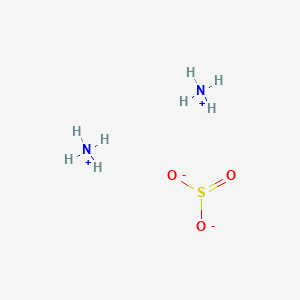
Ammonium Sulfite
Ammonium sulfite is a colorless crystalline solid. The primary hazard is the threat to the environment. Immediate steps should be taken to limit its spread to the environment. It is used in the manufacture of other chemicals, in medicine, and photography. — CAMEO Chemicals
- Nom IUPAC
- diazanium;sulfite
- Formule moléculaire
- H8N2O3S
- Masse moléculaire
- 116.14 g/mol
- Masse exacte
- 116.02556330 Da
- Surface polaire topologique
- 84,4 Ų
- Donneurs de liaisons hydrogène
- 2
- Accepteurs de liaisons hydrogène
- 4
- Unités covalentes
- 3
- Stéréocentres définis
- 0
Également connu sous le nom de
13 autres noms signalés
Identifiants de bases de données externes
- ChEBI:CHEBI:186946
- EPA DTXSID:DTXSID2064991
Preuves issues de bases de données scientifiques complémentaires
EMBL-EBI ChEBI
Diammonium sulfite
- Formule
- 2H4N.O3S
- Masse moyenne
- 116.142 g/mol
- Masse monoisotopique
- 116.02556 Da
- Charge formelle
- 0
- p-block molecular entity — is a (CHEBI:33675)
- sulfite salt — is a (CHEBI:48857)
- p-block molecular entity — is a (CHEBI:33675)
- sulfite salt — is a (CHEBI:48857)
Noms supplémentaires validés
Références croisées de cette source
- CAS: 10196-04-0 — ChemIDplus
- MANUAL_X_REF: 23404 — ChemSpider
Mis en correspondance par: Exact CAS cross-reference in the ChEBI compound record. Récupéré le: 2026-08-31. Ouvrir la fiche source
NIH PubChem PUG-View
Attributed physical-property, hazard, environmental and use annotations.
- Color/Form: White, solid Source: Hazardous Substances Data Bank (HSDB)
- Density: greater than 1.1 at 68 °F (USCG, 1999) Source: CAMEO Chemicals
- Density: 1.41 @25 °C Source: PAC Chemical Database, U.S. Department of Energy
- Odor: Odorless Source: Hazardous Substances Data Bank (HSDB)
- Physical Description: Ammonium sulfite is a colorless crystalline solid. The primary hazard is the threat to the environment. Immediate steps should be taken to limit its spread to the environment. It is used in the manufacture of other chemicals, in medicine, and photography. Source: CAMEO Chemicals
- Physical Description: Large Crystals; Dry Powder; Liquid Source: EPA Chemical Data Reporting (CDR)
- Physical Description: White odorless solid; [HSDB] White odorless crystalline solid; [MSDSonline] Source: Haz-Map, Information on Hazardous Chemicals and Occupational Diseases
- Solubility: Soluble in water, almost insoluble in alcohol, acetone. Source: Hazardous Substances Data Bank (HSDB)
- pH: Its aq soln is alkaline to litmus. /ammonium sulfate monohydrate/ Source: Hazardous Substances Data Bank (HSDB)
- First Aid: INHALATION: move to fresh air.; INGESTION: give large amount of water; get medical attention.; EYES: flush with water for 15 min.; SKIN: flush with water. (USCG, 1999) Source: CAMEO Chemicals
- Note: This chemical does not meet GHS hazard criteria for 71.1% (133 of 187) of all reports. Source: European Chemicals Agency (ECHA)
- Signal: Danger Source: European Chemicals Agency (ECHA)
- GHS Hazard Statements: H314 (13.4%): Causes severe skin burns and eye damage [Danger Skin corrosion/irritation]; H315 (15%): Causes skin irritation [Warning Skin corrosion/irritation]; H319 (15.5%): Causes serious eye irritation [Warning Serious eye damage/eye irritation]; H335 (10.2%): May cause respiratory irritation [Warning Specific target organ toxicity, single exposure; Respiratory tract irritation] Source: European Chemicals Agency (ECHA)
- Precautionary Statement Codes: P260, P261, P264, P264+P265, P271, P280, P301+P330+P331, P302+P352, P302+P361+P354, P304+P340, P305+P351+P338, P305+P354+P338, P316, P319, P321, P332+P317, P337+P317, P362+P364, P363, P403+P233, P405, and P501 (click each P-code to see the statement) Source: European Chemicals Agency (ECHA)
- ECHA C&L Notifications Summary: Aggregated GHS information provided per 187 reports by companies from 6 notifications to the ECHA C&L Inventory. Each notification may be associated with multiple companies.; Reported as not meeting GHS hazard criteria per 133 of 187 reports by companies.; There are 5 notifications provided by 54 of 187 reports by companies with hazard statement code(s).; Information may vary between notifications depending on impurities, additives, and other factors. The percentage value in parenthesis indicates the notified classification ratio from companies that provide hazard codes. Only hazard codes with percentage values above 10% are shown. For more detailed information, please visit ECHA C&L website. Source: European Chemicals Agency (ECHA)
- Signal: Danger Source: Hazardous Chemical Information System (HCIS), Safe Work Australia
- GHS Hazard Statements: H302: Harmful if swallowed [Warning Acute toxicity, oral]; H318: Causes serious eye damage [Danger Serious eye damage/eye irritation] Source: Hazardous Chemical Information System (HCIS), Safe Work Australia
- Precautionary Statement Codes: P264, P264+P265, P270, P280, P301+P317, P305+P354+P338, P317, P330, and P501 (click each P-code to see the statement) Source: Hazardous Chemical Information System (HCIS), Safe Work Australia
- Cosmetic Ingredient Review Finding(s): Safe in the present practices of use and concentration. Ingredient, concentration, and use information are available in documents discoverable at https://cir-reports.cir-safety.org Source: Cosmetic Ingredient Review (CIR)
- Consumer Uses: Soil amendments (fertilizers); Reducing agent; Processing aids not otherwise specified Source: EPA Chemical Data Reporting (CDR)
- Industry Uses: Intermediate; Soil amendments (fertilizers); Reducing agent; Preservative; Processing aids not otherwise specified Source: EPA Chemical Data Reporting (CDR)
- Cosmetic Ingredient Review Link: CIR ingredient: Ammonium Sulfite Source: Cosmetic Ingredient Review (CIR)
- Sources/Uses: Used in photography and in the production of caramel, refractory bricks, lubricants, medicines, permanent wave solutions, ammonium thiosulfite, and ammonium chloride; [HSDB] Source: Haz-Map, Information on Hazardous Chemicals and Occupational Diseases
- Industrial Processes with risk of exposure: Photographic Processing [Category: Other]; Dressing Hair [Category: Other] Source: Haz-Map, Information on Hazardous Chemicals and Occupational Diseases
- Uses: IN PRODN OF CARAMEL. Source: Hazardous Substances Data Bank (HSDB)
- Uses: In photography; as reducing agent; in bricks for blast furnace linings; in lubricants for metal cold-working. Source: Hazardous Substances Data Bank (HSDB)
- Uses: ... Medicine, permanent wave solns. /Ammonium sulfite monohydrate/ Source: Hazardous Substances Data Bank (HSDB)
- Uses: Used in production of ammonium thiosulfite. Source: Hazardous Substances Data Bank (HSDB)
- Uses: For more Uses (Complete) data for AMMONIUM SULFITE (6 total), please visit the HSDB record page. Source: Hazardous Substances Data Bank (HSDB)
Mis en correspondance par: Existing checksum-valid CAS to unique PubChem CID match. Récupéré le: 2026-08-31. Ouvrir la fiche source
Les classifications scientifiques et les annotations de danger apportent du contexte et ne remplacent pas la décision réglementaire propre au marché indiquée ci-dessus.
Couverture des sources complémentaires et état des correspondances
| Source | Résultat | Vérifié |
|---|---|---|
| EMBL-EBI ChEBI | Correspondance exacte | 2026-08-31 |
| NIH PubChem PUG-View | Correspondance exacte | 2026-08-31 |
Une absence de correspondance enregistrée est une preuve utile que la source a été vérifiée ; ce n’est pas l’affirmation que la substance n’existe pas ailleurs.
Récupéré depuis NIH PubChem le 2026-09-02 par correspondance CAS à somme de contrôle valide. Les propriétés chimiques ne remplacent pas la décision réglementaire de cette page.
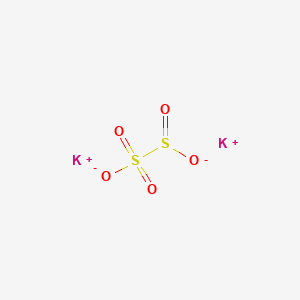
Potassium Metabisulfite
Potassium metabisulfite appears as a white granular or powdery solid with a sharp odor of sulfur dioxide. Decomposes at 150 to 190 °C. Density 2.3 g / cm3. Contact severely irritates skin, eyes, and mucous membranes. Low toxicity. Used as a food preservative and an antioxidant. — CAMEO Chemicals
- Formule moléculaire
- K2O5S2
- Masse moléculaire
- 222.33 g/mol
- Masse exacte
- 221.8461284 Da
- Surface polaire topologique
- 125,0 Ų
- Donneurs de liaisons hydrogène
- 0
- Accepteurs de liaisons hydrogène
- 6
- Unités covalentes
- 3
- Stéréocentres définis
- 0
Également connu sous le nom de
16 autres noms signalés
Identifiants de bases de données externes
- ChEMBL:CHEMBL2106901
- EPA DTXSID:DTXSID1021293
Récupéré depuis NIH PubChem le 2026-09-02 par correspondance CAS à somme de contrôle valide. Les propriétés chimiques ne remplacent pas la décision réglementaire de cette page.
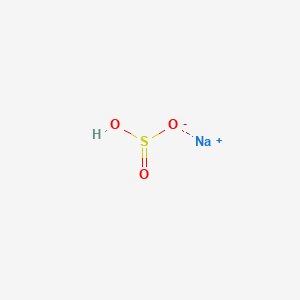
Sodium Bisulfite
Sodium hydrogensulfite is an inorganic sodium salt having hydrogensulfite as the counterion. It has a role as a mutagen, an allergen, a reducing agent, a food antioxidant and a food colour retention agent. It is an inorganic sodium salt and a sulfite salt. It contains a hydrogensulfite. — ChEBI
- Nom IUPAC
- sodium hydrogen sulfite
- Formule moléculaire
- HNaO3S
- Masse moléculaire
- 104.06 g/mol
- Masse exacte
- 103.95440935 Da
- Surface polaire topologique
- 79,6 Ų
- Donneurs de liaisons hydrogène
- 1
- Accepteurs de liaisons hydrogène
- 4
- Unités covalentes
- 2
- Stéréocentres définis
- 0
Également connu sous le nom de
16 autres noms signalés
Identifiants de bases de données externes
- ChEBI:CHEBI:26709
- ChEMBL:CHEMBL1689285
- EPA DTXSID:DTXSID8034902
- PubMed:26980303
- PubMed:25086357
- PubMed:23220588
- PubMed:21873648
- PubMed:12519749
- PubMed:7578186
- PubMed:6703372
- PubMed:1484721
- PubMed:1482805
Récupéré depuis NIH PubChem le 2026-08-31 par correspondance CAS à somme de contrôle valide. Les propriétés chimiques ne remplacent pas la décision réglementaire de cette page.
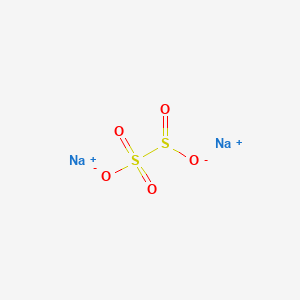
Sodium Pyrosulfite
Sodium disulfite is an inorganic sodium salt composed of sodium and disulfite ions in a 2:1 ratio. It has a role as a food antioxidant. It contains a disulfite. — ChEBI
- Formule moléculaire
- Na2O5S2
- Masse moléculaire
- 190.11 g/mol
- Masse exacte
- 189.89825401 Da
- Surface polaire topologique
- 125,0 Ų
- Donneurs de liaisons hydrogène
- 0
- Accepteurs de liaisons hydrogène
- 6
- Unités covalentes
- 3
- Stéréocentres définis
- 0
Également connu sous le nom de
16 autres noms signalés
Identifiants de bases de données externes
- ChEBI:CHEBI:114786
- ChEMBL:CHEMBL2016976
- EPA DTXSID:DTXSID0029684
- PubMed:40706911
- PubMed:35067933
- PubMed:33957602
- PubMed:33817499
- PubMed:29188487
- PubMed:26795242
- PubMed:26015265
- PubMed:25486021
- PubMed:25463229
- PubMed:14763933
Récupéré depuis NIH PubChem le 2026-09-02 par correspondance CAS à somme de contrôle valide. Les propriétés chimiques ne remplacent pas la décision réglementaire de cette page.
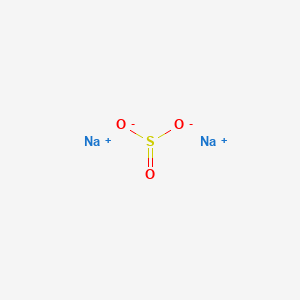
Sodium Sulfite
Sodium sulfite is an inorganic sodium salt having sulfite as the counterion. It has a role as a reducing agent and a food preservative. It is an inorganic sodium salt and a sulfite salt. It contains a sulfite. — ChEBI
- Nom IUPAC
- disodium;sulfite
- Formule moléculaire
- Na2O3S
- Masse moléculaire
- 126.05 g/mol
- Masse exacte
- 125.93635360 Da
- Surface polaire topologique
- 82,4 Ų
- Donneurs de liaisons hydrogène
- 0
- Accepteurs de liaisons hydrogène
- 4
- Unités covalentes
- 3
- Stéréocentres définis
- 0
Également connu sous le nom de
16 autres noms signalés
Identifiants de bases de données externes
- ChEBI:CHEBI:86477
- ChEMBL:CHEMBL1945334
- EPA DTXSID:DTXSID2044260
- PubMed:23973939
- PubMed:21873648
- PubMed:20348042
Récupéré depuis NIH PubChem le 2026-09-02 par correspondance CAS à somme de contrôle valide. Les propriétés chimiques ne remplacent pas la décision réglementaire de cette page.
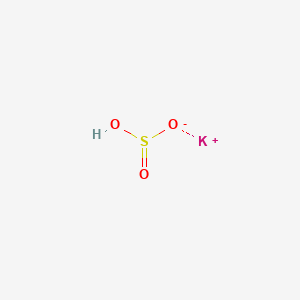
Potassium Bisulfite
Potassium bisulfite solution is a colorless aqueous with a slight sulfur dioxide odor. Used as a reducing agent and chemical preservative. — CAMEO Chemicals
- Nom IUPAC
- potassium hydrogen sulfite
- Formule moléculaire
- HKO3S
- Masse moléculaire
- 120.17 g/mol
- Masse exacte
- 119.92834655 Da
- Surface polaire topologique
- 79,6 Ų
- Donneurs de liaisons hydrogène
- 1
- Accepteurs de liaisons hydrogène
- 4
- Unités covalentes
- 2
- Stéréocentres définis
- 0
Également connu sous le nom de
16 autres noms signalés
Identifiants de bases de données externes
- EPA DTXSID:DTXSID6064795
Récupéré depuis NIH PubChem le 2026-09-02 par correspondance CAS à somme de contrôle valide. Les propriétés chimiques ne remplacent pas la décision réglementaire de cette page.
Liens d’inventaire pour SODIUM SULFITE / AMMONIUM BISULFITE / AMMONIUM SULFITE / POTASSIUM SULFITE / POTASSIUM hydrogen SULFITE / SODIUM BISULFITE / SODIUM METABISULFITE / POTASSIUM METABISULFITE
POTASSIUM METABISULFITE
POTASSIUM SULFITE
SODIUM METABISULFITE
Fiches associées pour SODIUM SULFITE / AMMONIUM BISULFITE / AMMONIUM SULFITE / POTASSIUM SULFITE / POTASSIUM hydrogen SULFITE / SODIUM BISULFITE / SODIUM METABISULFITE / POTASSIUM METABISULFITE
Les correspondances directes sont limitées pour cette fiche ; des entrées voisines de l’annexe V sont donc également affichées.
o-Phenylphenol, Sodium o-Phenylphenate
SORBIC ACID / CALCIUM SORBATE / SODIUM SORBATE / POTASSIUM SORBATE
BUTYLPARABEN/PROPYLPARABEN/SODIUM PROPOYLPARABEN/SODIUM BUTYLPARABEN/POTASSIUM BUTYLPARABEN/POTASSI…
SALICYLIC ACID, CALCIUM SALICYLATE, MAGNESIUM SALICYLATE, MEA- SALICYLATE, SODIUM SALICYLATE, POTAS…
4-HYDROXYBENZOIC ACID / METHYLPARABEN /POTASSIUM ETHYLPARABEN /POTASSIUM PARABEN /SODIUM METHYLPARA…
PROPIONIC ACID / AMMONIUM PROPIONATE / CALCIUM PROPIONATE / MAGNESIUM PROPIONATE / POTASSIUM PROPIO…
Dehydroacetic acid / SODIUM DEHYDROACETATE
BENZOIC ACID; SODIUM BENZOATE
FORMIC ACID / SODIUM FORMATE
AMMONIUM BENZOATE / BUTYL BENZOATE / CALCIUM BENZOATE / ETHYL BENZOATE / ISOBUTYL BENZOATE / ISOPRO…
Dibromohexamidine isethionate
Ce que signifie l’annexe V pour SODIUM SULFITE / AMMONIUM BISULFITE / AMMONIUM SULFITE / POTASSIUM SULFITE / POTASSIUM hydrogen SULFITE / SODIUM BISULFITE / SODIUM METABISULFITE / POTASSIUM METABISULFITE
SODIUM SULFITE / AMMONIUM BISULFITE / AMMONIUM SULFITE / POTASSIUM SULFITE / POTASSIUM hydrogen SULFITE / SODIUM BISULFITE / SODIUM METABISULFITE / POTASSIUM METABISULFITE est un conservateur autorisé figurant à l’annexe V du règlement (CE) n° 1223/2009 relatif aux produits cosmétiques. Seules les substances de cette liste positive peuvent être utilisées comme conservateurs cosmétiques dans l’UE.
Chaque entrée de conservateur précise les concentrations maximales autorisées et le champ d’application des produits. Les concentrations ne doivent pas dépasser le maximum indiqué. Certains conservateurs exigent des mentions d’avertissement sur l’étiquette du produit.
Cette fiche est liée à 7 ingrédients de l’inventaire CosIng pour le recoupement des noms et des identifiants. La page fait également apparaître 12 fiches d’annexe associées présentant des identifiants, une logique d’annexe ou des schémas de dénomination qui se recoupent.
Liste de contrôle de conformité
- La concentration d’utilisation ne doit pas dépasser : 0.2% (as free SO2)
- Vérifiez que le conservateur est efficace à la concentration autorisée pour votre matrice.
Questions fréquentes
Note de source pour la fiche SODIUM SULFITE / AMMONIUM BISULFITE / AMMONIUM SULFITE / POTASSIUM SULFITE / POTASSIUM hydrogen SULFITE / SODIUM BISULFITE / SODIUM METABISULFITE / POTASSIUM METABISULFITE de l’annexe V
Cette page résume une fiche de l’annexe V pour SODIUM SULFITE / AMMONIUM BISULFITE / AMMONIUM SULFITE / POTASSIUM SULFITE / POTASSIUM hydrogen SULFITE / SODIUM BISULFITE / SODIUM METABISULFITE / POTASSIUM METABISULFITE à partir de documents publics de la Commission européenne sur les cosmétiques et ajoute les correspondances d’inventaire ou d’identifiants associées lorsqu’elles sont disponibles.
Utilisez cette page de fiche pour examiner les conditions de l’annexe V pour SODIUM SULFITE / AMMONIUM BISULFITE / AMMONIUM SULFITE / POTASSIUM SULFITE / POTASSIUM hydrogen SULFITE / SODIUM BISULFITE / SODIUM METABISULFITE / POTASSIUM METABISULFITE, mais confirmez toute décision réglementaire finale auprès du libellé officiel en vigueur de l’annexe et des fichiers sources.
Outils et étapes suivantes
Vérifiez votre formule
Collez une liste INCI complète pour détecter SODIUM SULFITE / AMMONIUM BISULFITE / AMMONIUM SULFITE / POTASSIUM SULFITE / POTASSIUM hydrogen SULFITE / SODIUM BISULFITE / SODIUM METABISULFITE / POTASSIUM METABISULFITE et d’autres fiches d’annexe de l’UE signalées en une seule passe.
Vérificateur INCIComparer des entrées
Comparez SODIUM SULFITE / AMMONIUM BISULFITE / AMMONIUM SULFITE / POTASSIUM SULFITE / POTASSIUM hydrogen SULFITE / SODIUM BISULFITE / SODIUM METABISULFITE / POTASSIUM METABISULFITE côte à côte avec une autre fiche d’annexe pour examiner les différences de restrictions, de concentrations et d’annexe.
ComparerParcourir l’annexe
Consultez toutes les fiches de l’annexe V et comparez les conditions réglementaires entre les substances de cette annexe.
Ouvrir l’annexe V