
Triclosan
5-Chloro-2-(2,4-dichlorophenoxy)phenol
Triclosan figure à l’annexe V comme conservateur de la liste positive pour les cosmétiques de l’UE. Concentration maximale dans cette fiche : 0.3%.
Lire cette entrée
Triclosan is permitted as a preservative only in a closed list of product types, at 0.3%, and not in toothpaste for children under three. Outside that list it may not be used as a preservative at all.
- 0.3%, and only in toothpastes, hand soaps, body soaps and shower gels, non-spray deodorants, face powders, blemish concealers, and nail-cleaning products.
- Not permitted in toothpaste intended for children under three years of age.
- Toothpaste containing it must be labelled 'Not to be used for children under 3 years of age'.
- Annex V is a positive list: a product type absent from this entry is a product type where it is not permitted.
Annex V works the opposite way round from Annex II, and this entry is a good illustration of why that matters. The list of product types is not guidance about where triclosan is typically used. It is the complete set of places it may be used as a preservative. A rinse-off cleanser that is not a hand soap, a body soap or a shower gel is not on that list, and the absence is the answer.
The children's exclusion is written twice over, and both halves bind. The substance may not be used in toothpaste intended for children under three, and toothpaste that does contain it must carry the warning. A product cannot satisfy the second requirement instead of the first.
Regulation (EU) 2024/996 set the current conditions. Products meeting the rules as they stood on 23 April 2024 could be placed on the market until 31 December 2024, and that window has closed.
Vérifié par rapport à
Détails de la fiche
Concentration maximale
0.3%
Autres restrictions
Not to be used in toothpaste intended for children under 3 years of age.
Cosmetic products containing that substance that do not comply with the conditions may, provided that they comply with the conditions applicable on 23 April 2024, be placed on the Union market until 31 December 2024 and, if they have already been placed on the market before that date, continue to be made available on the Union market until 31 October 2025.
Avertissements
For toothpaste containing Triclosan the following labelling is obligatory: ‘Not to be used for children under 3 years of age’.
Nom du glossaire INCI
Triclosan
Nom chimique
5-Chloro-2-(2,4-dichlorophenoxy)phenol
Nom chimique / IUPAC
5-Chloro-2-(2,4-dichlorophenoxy)phenol
Informations réglementaires
Avis du SCCS
- Opinion concerning Triclosan
- Opinion on Triclosan
- Opinion on Triclosan Opinion on Triclosan Anti-microbial Resistance,Oinion on Triclosan Addenum to the SCCP opinion on Triclosan
- Request for a scientific advice on the safety of triclocarban and triclosan as substances with potential endocrine disrupting properties
Ingrédients identifiés
Données clés
Identité et propriétés chimiques
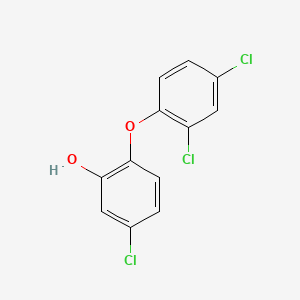
Triclosan
Triclosan is an aromatic ether that is phenol which is substituted at C-5 by a chloro group and at C-2 by a 2,4-dichlorophenoxy group. It is widely used as a preservative and antimicrobial agent in personal care products such as soaps, skin creams, toothpaste and deodorants as well as in household items such as plastic chopping boards, sports equipment and shoes. It has a role as an EC 1.3.1.9 [enoyl-[acyl-carrier-protein] reductase (NADH)] inhibitor, a fungicide, an antibacterial agent, a xenobiotic, an antimalarial, an EC 1.5.1.3 (dihydrofolate reductase) inhibitor, a persistent organic pollutant and a drug allergen. It is a dichlorobenzene, a member of phenols, an aromatic ether and a member of monochlorobenzenes. — ChEBI
- Nom IUPAC
- 5-chloro-2-(2,4-dichlorophenoxy)phenol
- Formule moléculaire
- C12H7Cl3O2
- Masse moléculaire
- 289.5 g/mol
- Masse exacte
- 287.951163 Da
- XLogP3
- 5,0
- Surface polaire topologique
- 29,5 Ų
- Donneurs de liaisons hydrogène
- 1
- Accepteurs de liaisons hydrogène
- 2
- Unités covalentes
- 1
- Stéréocentres définis
- 0
Également connu sous le nom de
16 autres noms signalés
Identifiants de bases de données externes
Récupéré depuis NIH PubChem le 2026-08-31 par correspondance CAS à somme de contrôle valide. Les propriétés chimiques ne remplacent pas la décision réglementaire de cette page.
Liens d’inventaire pour Triclosan
Fiches associées pour Triclosan
Les correspondances directes sont limitées pour cette fiche ; des entrées voisines de l’annexe V sont donc également affichées.
CHLOROXYLENOL
POLYAMINOPROPYL BIGUANIDE
2-BROMO-2-NITROPROPANE-1,3-DIOL
5-BROMO-5-NITRO-1,3-DIOXANE
Ce que signifie l’annexe V pour Triclosan
Triclosan est un conservateur autorisé figurant à l’annexe V du règlement (CE) n° 1223/2009 relatif aux produits cosmétiques. Seules les substances de cette liste positive peuvent être utilisées comme conservateurs cosmétiques dans l’UE.
Chaque entrée de conservateur précise les concentrations maximales autorisées et le champ d’application des produits. Les concentrations ne doivent pas dépasser le maximum indiqué. Certains conservateurs exigent des mentions d’avertissement sur l’étiquette du produit.
Cette fiche est liée à 1 ingrédient de l’inventaire CosIng pour le recoupement des noms et des identifiants. La page fait également apparaître 12 fiches d’annexe associées présentant des identifiants, une logique d’annexe ou des schémas de dénomination qui se recoupent.
Liste de contrôle de conformité
- La concentration d’utilisation ne doit pas dépasser : 0.3%
- Vérifiez que le conservateur est efficace à la concentration autorisée pour votre matrice.
- Appliquez la mention d’avertissement requise sur l’étiquette.
Questions fréquentes
Note de source pour la fiche Triclosan de l’annexe V
Cette page résume une fiche de l’annexe V pour Triclosan à partir de documents publics de la Commission européenne sur les cosmétiques et ajoute les correspondances d’inventaire ou d’identifiants associées lorsqu’elles sont disponibles.
Utilisez cette page de fiche pour examiner les conditions de l’annexe V pour Triclosan, mais confirmez toute décision réglementaire finale auprès du libellé officiel en vigueur de l’annexe et des fichiers sources.
Outils et étapes suivantes
Vérifiez votre formule
Collez une liste INCI complète pour détecter Triclosan et d’autres fiches d’annexe de l’UE signalées en une seule passe.
Vérificateur INCIComparer des entrées
Comparez Triclosan côte à côte avec une autre fiche d’annexe pour examiner les différences de restrictions, de concentrations et d’annexe.
ComparerParcourir l’annexe
Consultez toutes les fiches de l’annexe V et comparez les conditions réglementaires entre les substances de cette annexe.
Ouvrir l’annexe V