
Triclosan
5-Chloro-2-(2,4-dichlorophenoxy)phenol
Triclosan steht in Anhang V als Eintrag der Positivliste für Konservierungsstoffe in kosmetischen Mitteln der EU. Höchstkonzentration in diesem Eintrag: 0.3%.
Diesen Eintrag lesen
Triclosan is permitted as a preservative only in a closed list of product types, at 0.3%, and not in toothpaste for children under three. Outside that list it may not be used as a preservative at all.
- 0.3%, and only in toothpastes, hand soaps, body soaps and shower gels, non-spray deodorants, face powders, blemish concealers, and nail-cleaning products.
- Not permitted in toothpaste intended for children under three years of age.
- Toothpaste containing it must be labelled 'Not to be used for children under 3 years of age'.
- Annex V is a positive list: a product type absent from this entry is a product type where it is not permitted.
Annex V works the opposite way round from Annex II, and this entry is a good illustration of why that matters. The list of product types is not guidance about where triclosan is typically used. It is the complete set of places it may be used as a preservative. A rinse-off cleanser that is not a hand soap, a body soap or a shower gel is not on that list, and the absence is the answer.
The children's exclusion is written twice over, and both halves bind. The substance may not be used in toothpaste intended for children under three, and toothpaste that does contain it must carry the warning. A product cannot satisfy the second requirement instead of the first.
Regulation (EU) 2024/996 set the current conditions. Products meeting the rules as they stood on 23 April 2024 could be placed on the market until 31 December 2024, and that window has closed.
Geprüft anhand von
Eintragsdetails
Höchstkonzentration
0.3%
Sonstige Beschränkungen
Not to be used in toothpaste intended for children under 3 years of age.
Cosmetic products containing that substance that do not comply with the conditions may, provided that they comply with the conditions applicable on 23 April 2024, be placed on the Union market until 31 December 2024 and, if they have already been placed on the market before that date, continue to be made available on the Union market until 31 October 2025.
Warnhinweise
For toothpaste containing Triclosan the following labelling is obligatory: ‘Not to be used for children under 3 years of age’.
INCI-Glossarname
Triclosan
Chemische Bezeichnung
5-Chloro-2-(2,4-dichlorophenoxy)phenol
Chemische / IUPAC-Bezeichnung
5-Chloro-2-(2,4-dichlorophenoxy)phenol
Regulatorische Informationen
SCCS-Gutachten
- Opinion concerning Triclosan
- Opinion on Triclosan
- Opinion on Triclosan Opinion on Triclosan Anti-microbial Resistance,Oinion on Triclosan Addenum to the SCCP opinion on Triclosan
- Request for a scientific advice on the safety of triclocarban and triclosan as substances with potential endocrine disrupting properties
Identifizierte Inhaltsstoffe
Kerndaten
Chemische Identität und Eigenschaften
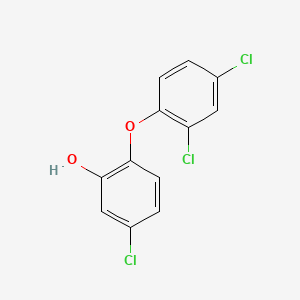
Triclosan
Triclosan is an aromatic ether that is phenol which is substituted at C-5 by a chloro group and at C-2 by a 2,4-dichlorophenoxy group. It is widely used as a preservative and antimicrobial agent in personal care products such as soaps, skin creams, toothpaste and deodorants as well as in household items such as plastic chopping boards, sports equipment and shoes. It has a role as an EC 1.3.1.9 [enoyl-[acyl-carrier-protein] reductase (NADH)] inhibitor, a fungicide, an antibacterial agent, a xenobiotic, an antimalarial, an EC 1.5.1.3 (dihydrofolate reductase) inhibitor, a persistent organic pollutant and a drug allergen. It is a dichlorobenzene, a member of phenols, an aromatic ether and a member of monochlorobenzenes. — ChEBI
- IUPAC-Name
- 5-chloro-2-(2,4-dichlorophenoxy)phenol
- Summenformel
- C12H7Cl3O2
- Molekulargewicht
- 289.5 g/mol
- Exakte Masse
- 287.951163 Da
- XLogP3
- 5,0
- Topologische polare Oberfläche
- 29,5 Ų
- Wasserstoffbrücken-Donoren
- 1
- Wasserstoffbrücken-Akzeptoren
- 2
- Kovalente Einheiten
- 1
- Definierte Stereozentren
- 0
Auch bekannt als
16 weitere gemeldete Namen
Kennungen in externen Datenbanken
Am 2026-08-31 von NIH PubChem durch prüfsummengültigen CAS-Abgleich abgerufen. Chemische Eigenschaften ersetzen nicht die regulatorische Entscheidung auf dieser Seite.
Verzeichnisverknüpfungen für Triclosan
Verwandte Einträge zu Triclosan
Für diesen Eintrag gibt es nur wenige direkte Treffer; daher werden auch nahe liegende Einträge aus Anhang V angezeigt.
CHLOROXYLENOL
IMIDAZOLIDINYL UREA
DICHLOROBENZYL ALCOHOL
POLYAMINOPROPYL BIGUANIDE
2-BROMO-2-NITROPROPANE-1,3-DIOL
5-BROMO-5-NITRO-1,3-DIOXANE
Was Anhang V für Triclosan bedeutet
Triclosan ist ein zugelassener Konservierungsstoff, der in Anhang V der EU-Kosmetikverordnung (EG) Nr. 1223/2009 aufgeführt ist. Nur Stoffe dieser Positivliste dürfen in der EU als kosmetische Konservierungsstoffe verwendet werden.
Jeder Eintrag zu einem Konservierungsstoff legt zulässige Höchstkonzentrationen und den Anwendungsbereich fest. Die Konzentrationen dürfen das aufgeführte Maximum nicht überschreiten. Für einige Konservierungsstoffe sind Warnhinweise auf dem Produktetikett erforderlich.
Dieser Eintrag ist zum Abgleich von Namen und Kennungen mit 1 Inhaltsstoff des CosIng-Verzeichnisses verknüpft. Die Seite zeigt außerdem 12 verwandte Anhangseinträge mit überschneidenden Kennungen, Anhangslogik oder Namensmustern.
Compliance-Checkliste
- Die Einsatzkonzentration darf nicht überschreiten: 0.3%
- Prüfen Sie, dass der Konservierungsstoff bei der zulässigen Konzentration in Ihrer Matrix wirksam ist.
- Bringen Sie den erforderlichen Warnhinweis auf dem Etikett an.
Häufig gestellte Fragen
Quellenhinweis zu Anhang V, Eintrag Triclosan
Diese Seite fasst einen Eintrag aus Anhang V für Triclosan aus öffentlichen Materialien der Europäischen Kommission zu kosmetischen Mitteln zusammen und ergänzt, soweit verfügbar, verknüpfte Treffer aus dem Verzeichnis oder bei Kennungen.
Nutzen Sie diese Eintragsseite, um die Bedingungen aus Anhang V für Triclosan zu prüfen; bestätigen Sie jede endgültige regulatorische Entscheidung jedoch anhand des aktuellen amtlichen Anhangswortlauts und der Quelldateien.
Werkzeuge und nächste Schritte
Rezeptur prüfen
Fügen Sie eine vollständige INCI-Liste ein, um Triclosan und andere markierte EU-Anhangseinträge in einem Durchgang zu finden.
INCI-CheckerEinträge vergleichen
Triclosan nebeneinander mit einem anderen Anhangseintrag vergleichen, um Unterschiede bei Beschränkungen, Konzentrationen und Anhangszuordnung zu prüfen.
VergleichenDen Anhang durchsuchen
Alle Einträge in Anhang V ansehen und die regulatorischen Bedingungen der Stoffe in diesem Anhang vergleichen.
Anhang V öffnen