
Benzyl cinnamate
2-Propenoic acid, 3-phenyl-, phenylmethyl ester
Benzyl cinnamate figure à l’annexe III et ne peut être utilisé que dans les conditions indiquées dans cette fiche.
Cette substance figure sur la liste de l’UE des allergènes de parfum qui doivent être nommés individuellement dans la liste des ingrédients, et non couverts par le mot « parfum », dès qu’ils dépassent 0,001 % dans un produit sans rinçage ou 0,01 % dans un produit rincé.
La déclaration est une obligation d’étiquetage au titre de l’article 19, et non une restriction d’usage. Voir la fiche de l’allergène
Détails de la fiche
Autres restrictions
The presence of the substance must be indicated in the list of ingredients referred to in Article 19(1)g when its concentration exceeds:
- 0.001% in leave-on products
- 0.01% in rinse-off products
Nom du glossaire INCI
Benzyl cinnamate
Nom chimique
2-Propenoic acid, 3-phenyl-, phenylmethyl ester
Informations réglementaires
Avis du SCCS
- Opinion concerning Essential Oils
- Opinion concerning Fragrance Allergy in Consumers - A Review of the Problem - Analysis of the need for appropriate Consumer Information and Identification of Consumer Allergens
- Opinion concerning the Interim Position on Fragrance Allergy
- Memorandum on the SCCNFP Opinion concerning Fragrance Allergy
Ingrédients identifiés
Allergène de parfum de l’UE
Cette substance est liée à une référence d’allergène de parfum de l’UE. Consultez l’entrée actuelle de l’annexe III pour le seuil de déclaration et les éventuelles conditions supplémentaires.
Données clés
Identité et propriétés chimiques
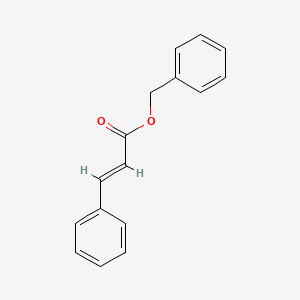
Benzyl Cinnamate
Benzyl cinnamate is the cinnamate ester derived from cinnamic acid and benzyl alcohol. Occuring in Balsam of Peru and Tolu balsam, in Sumatra and Penang benzoin, and as the main constituent of copaiba balsam, it is used in heavy oriental perfumes, as a fixative and as a flavouring agent. It has a role as a flavouring agent, a fragrance, a fixative, an epitope and an antigen. — ChEBI
- Nom IUPAC
- benzyl (E)-3-phenylprop-2-enoate
- Formule moléculaire
- C16H14O2
- Masse moléculaire
- 238.28 g/mol
- Masse exacte
- 238.099379685 Da
- XLogP3
- 3,8
- Surface polaire topologique
- 26,3 Ų
- Donneurs de liaisons hydrogène
- 0
- Accepteurs de liaisons hydrogène
- 2
- Unités covalentes
- 1
- Stéréocentres définis
- 0
Également connu sous le nom de
16 autres noms signalés
Identifiants de bases de données externes
- ChEBI:CHEBI:146174
- ChEMBL:CHEMBL361197
- EPA DTXSID:DTXSID00880905
- PubMed:29540657
- PubMed:27965148
- PubMed:27270453
- PubMed:22023385
- PubMed:20491607
- PubMed:15464616
Preuves issues de bases de données scientifiques complémentaires
NIH PubChem PUG-View
Attributed physical-property, hazard, environmental and use annotations.
- Boiling Point: 228-230 °C @ 22 mm Hg Source: Hazardous Substances Data Bank (HSDB)
- Boiling Point: 350 °C; 195 °C (5 mm Hg) Source: Joint FAO/WHO Expert Committee on Food Additives (JECFA)
- Color/Form: WHITE TO PALE-YELLOW, FUSED, CRYSTALLINE SOLID Source: Hazardous Substances Data Bank (HSDB)
- Color/Form: Crystals from 95% ethanol Source: Hazardous Substances Data Bank (HSDB)
- Color/Form: White crystals Source: Hazardous Substances Data Bank (HSDB)
- Density: 1.109 AT 15 °C Source: Hazardous Substances Data Bank (HSDB)
- Density: PRISMS; SADTLER REFERENCE NUMBER: 1520 (IR, PRISM); 430 (UV); 104 (NMR); DENSITY: 1.109 @ 15 °C /TRANS/ Source: Hazardous Substances Data Bank (HSDB)
- Flash Point: GREATER THAN 100 °C Source: Hazardous Substances Data Bank (HSDB)
- Melting Point: 39 °C Source: Hazardous Substances Data Bank (HSDB)
- Melting Point: MELTING POINT: 35-36 °C /TRANS/; 30 °C /CIS/ Source: Hazardous Substances Data Bank (HSDB)
- Odor: Sweet odor of balsam Source: Hazardous Substances Data Bank (HSDB)
- Physical Description: Solid with a sweet odor of balsam; Practically insoluble in water; mp = 39 deg C; [Merck Index] Source: Haz-Map, Information on Hazardous Chemicals and Occupational Diseases
- Physical Description: White to pale yellow solid Source: Joint FAO/WHO Expert Committee on Food Additives (JECFA)
- Solubility: 1:8 IN 90% ALCOHOL Source: Hazardous Substances Data Bank (HSDB)
- Solubility: Practically insol in water, propylene glycol and glycerin. Sol in alcohol, ether, oils. Source: Hazardous Substances Data Bank (HSDB)
- Solubility: insoluble in water; soluble in oils Source: Joint FAO/WHO Expert Committee on Food Additives (JECFA)
- Solubility: very soluble (in ethanol) Source: Joint FAO/WHO Expert Committee on Food Additives (JECFA)
- Vapor Pressure: 1 mm Hg @ 173.8 °C Source: Hazardous Substances Data Bank (HSDB)
- Carcinogen Classification: No indication of carcinogenicity to humans (not listed by IARC). Source: Toxin and Toxin Target Database (T3DB)
- Signal: Warning Source: European Chemicals Agency (ECHA)
- GHS Hazard Statements: H317 (99.8%): May cause an allergic skin reaction [Warning Sensitization, Skin]; H411 (99.5%): Toxic to aquatic life with long lasting effects [Hazardous to the aquatic environment, long-term hazard] Source: European Chemicals Agency (ECHA)
- Precautionary Statement Codes: P261, P272, P273, P280, P302+P352, P321, P333+P317, P362+P364, P391, and P501 (click each P-code to see the statement) Source: European Chemicals Agency (ECHA)
- ECHA C&L Notifications Summary: Aggregated GHS information provided per 1794 reports by companies from 13 notifications to the ECHA C&L Inventory. Each notification may be associated with multiple companies.; Information may vary between notifications depending on impurities, additives, and other factors. The percentage value in parenthesis indicates the notified classification ratio from companies that provide hazard codes. Only hazard codes with percentage values above 10% are shown. For more detailed information, please visit ECHA C&L website. Source: European Chemicals Agency (ECHA)
- Environmental Bioconcentration: An estimated BCF of 270 was calculated for benzyl cinnamate(SRC), using an estimated log Kow of 4.1(1) and a regression-derived equation(2). According to a classification scheme(3), this BCF suggests the potential for bioconcentration in aquatic organisms is high(SRC). Source: Hazardous Substances Data Bank (HSDB)
- Environmental Fate: TERRESTRIAL FATE: Based on a classification scheme(1), an estimated Koc value of 10,400(SRC), determined from a structure estimation method(2), indicates that benzyl cinnamate is expected to be immobile in soil(SRC). Volatilization of benzyl cinnamate from moist soil surfaces is not expected to be an important fate process(SRC) given an estimated Henry's Law constant of 3.3X10⁻⁷ atm-cu m/mole(SRC), using a fragment constant estimation method(3). Benzyl cinnamate is not expected to volatilize from dry soil surfaces(SRC) based upon an estimated vapor pressure of 1X10⁻⁵ mm Hg(4). Source: Hazardous Substances Data Bank (HSDB)
- Environmental Fate: AQUATIC FATE: Based on a classification scheme(1), an estimated Koc value of 10,390(SRC), determined from a structure estimation method(2), indicates that benzyl cinnamate is expected to adsorb to suspended solids and sediment(SRC). Volatilization from water surfaces is not expected(3) based upon an estimated Henry's Law constant of 3.3X10⁻⁷ atm-cu m/mole(SRC), developed using a fragment constant estimation method(4). A base-catalyzed second-order hydrolysis rate constant of 3.8X10⁻² L/mole-sec(SRC) was estimated using a structure estimation method(5); this corresponds to half-lives of 6 years and 211 days at pH values of 7 and 8, respectively(5). According to a classification scheme(6), an estimated BCF of 269(SRC), from an estimated log Kow of 4.06(7) and a regression derived equation(8), suggests the potential for bioconcentration in aquatic organisms is high(SRC). Source: Hazardous Substances Data Bank (HSDB)
- Environmental Fate: ATMOSPHERIC FATE: According to a model of gas/particle partitioning of semivolatile organic compounds in the atmosphere(1), benzyl cinnamate, which has an estimated vapor pressure of 1X10⁻⁵ mm Hg at 25 °C(2), will exist in both the vapor and particulate phases in the ambient atmosphere. Vapor-phase benzyl cinnamate is degraded in the atmosphere by reaction with photochemically-produced hydroxyl radicals(SRC); the half-life for this reaction in air is estimated to be 14 hours for the cis-isomer and 13 hours for the trans-isomer of benzyl cinnamate(SRC), calculated from their rate constants of 28X10-12 and 31X10-12 cu cm/molecule-sec at 25 °C, respectively(SRC), determined using a structure estimation method(3). Particulate-phase benzyl cinnamate may be removed from the air by wet and dry deposition(SRC). Source: Hazardous Substances Data Bank (HSDB)
- Sources/Uses: Constituent of storax, Peru, and Tolu balsams; [Merck Index] Used in flavors and perfumes; [HSDB] Source: Haz-Map, Information on Hazardous Chemicals and Occupational Diseases
- Uses: In artificial flavors, in perfumes, mainly as a fixative Source: Hazardous Substances Data Bank (HSDB)
- Uses: Fixative in perfumes and as a component of heavy, oriental perfumes. Source: Hazardous Substances Data Bank (HSDB)
Mis en correspondance par: Existing checksum-valid CAS to unique PubChem CID match. Récupéré le: 2026-08-31. Ouvrir la fiche source
Les classifications scientifiques et les annotations de danger apportent du contexte et ne remplacent pas la décision réglementaire propre au marché indiquée ci-dessus.
Couverture des sources complémentaires et état des correspondances
| Source | Résultat | Vérifié |
|---|---|---|
| EMBL-EBI ChEBI | Aucune fiche exacte | 2026-08-31 |
| NIH PubChem PUG-View | Correspondance exacte | 2026-08-31 |
Une absence de correspondance enregistrée est une preuve utile que la source a été vérifiée ; ce n’est pas l’affirmation que la substance n’existe pas ailleurs.
Récupéré depuis NIH PubChem le 2026-09-02 par correspondance CAS à somme de contrôle valide. Les propriétés chimiques ne remplacent pas la décision réglementaire de cette page.
Liens d’inventaire pour Benzyl cinnamate
Fiches associées pour Benzyl cinnamate
Les correspondances directes sont limitées pour cette fiche ; des entrées voisines de l’annexe III sont donc également affichées.
Citronellol
Limonene
Ce que signifie l’annexe III pour Benzyl cinnamate
Benzyl cinnamate est une substance soumise à restrictions en vertu de l’annexe III du règlement (CE) n° 1223/2009 relatif aux produits cosmétiques. Son utilisation dans les cosmétiques n’est autorisée que dans les conditions précises énoncées dans l’entrée ci-dessus, y compris les limites de concentration, les restrictions de type de produit et les mentions d’avertissement requises.
Lorsque cette substance entre dans une formulation, toutes les conditions — concentration maximale, champ d’application du produit et mentions d’avertissement — doivent être respectées simultanément. Le respect d’une condition ne dispense pas des autres.
Cette fiche est liée à 1 ingrédient de l’inventaire CosIng pour le recoupement des noms et des identifiants. La page fait également apparaître 12 fiches d’annexe associées présentant des identifiants, une logique d’annexe ou des schémas de dénomination qui se recoupent.
Liste de contrôle de conformité
- Consignez les conditions d’emploi dans le dossier d’information produit (DIP).
- Cette substance est un allergène de parfum réglementé. Déclarez-le sur l’étiquette par son nom INCI au-delà de 0,001 % dans les produits sans rinçage ou de 0,01 % dans les produits rincés.
Questions fréquentes
Note de source pour la fiche Benzyl cinnamate de l’annexe III
Cette page résume une fiche de l’annexe III pour Benzyl cinnamate à partir de documents publics de la Commission européenne sur les cosmétiques et ajoute les correspondances d’inventaire ou d’identifiants associées lorsqu’elles sont disponibles.
Utilisez cette page de fiche pour examiner les conditions de l’annexe III pour Benzyl cinnamate, mais confirmez toute décision réglementaire finale auprès du libellé officiel en vigueur de l’annexe et des fichiers sources.
Outils et étapes suivantes
Vérifiez votre formule
Collez une liste INCI complète pour détecter Benzyl cinnamate et d’autres fiches d’annexe de l’UE signalées en une seule passe.
Vérificateur INCIComparer des entrées
Comparez Benzyl cinnamate côte à côte avec une autre fiche d’annexe pour examiner les différences de restrictions, de concentrations et d’annexe.
ComparerParcourir l’annexe
Consultez toutes les fiches de l’annexe III et comparez les conditions réglementaires entre les substances de cette annexe.
Ouvrir l’annexe III