
Benzyl cinnamate
2-Propenoic acid, 3-phenyl-, phenylmethyl ester
Benzyl cinnamate은(는) 부속서 III에 등재되어 있으며 이 기록에 표시된 조건에서만 사용할 수 있습니다.
이 물질은 씻어내지 않는 제품에서 0.001%, 씻어내는 제품에서 0.01%를 초과하면 "parfum"이라는 단어로 포괄하지 않고 성분 목록에 개별적으로 명시해야 하는 EU 향료 알레르겐 목록에 있습니다.
표기는 제19조에 따른 표시 의무이며 사용에 대한 제한이 아닙니다. 알레르겐 기록 보기
기록 세부 정보
기타 제한 사항
The presence of the substance must be indicated in the list of ingredients referred to in Article 19(1)g when its concentration exceeds:
- 0.001% in leave-on products
- 0.01% in rinse-off products
INCI 용어집 명칭
Benzyl cinnamate
화학명
2-Propenoic acid, 3-phenyl-, phenylmethyl ester
규제 정보
SCCS 의견
- Opinion concerning Essential Oils
- Opinion concerning Fragrance Allergy in Consumers - A Review of the Problem - Analysis of the need for appropriate Consumer Information and Identification of Consumer Allergens
- Opinion concerning the Interim Position on Fragrance Allergy
- Memorandum on the SCCNFP Opinion concerning Fragrance Allergy
식별된 원료
주요 데이터
화학적 정체 및 특성
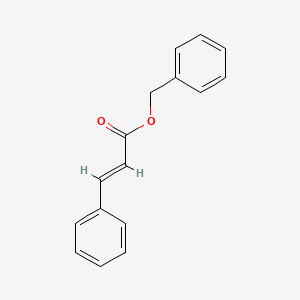
Benzyl Cinnamate
Benzyl cinnamate is the cinnamate ester derived from cinnamic acid and benzyl alcohol. Occuring in Balsam of Peru and Tolu balsam, in Sumatra and Penang benzoin, and as the main constituent of copaiba balsam, it is used in heavy oriental perfumes, as a fixative and as a flavouring agent. It has a role as a flavouring agent, a fragrance, a fixative, an epitope and an antigen. — ChEBI
- IUPAC 명칭
- benzyl (E)-3-phenylprop-2-enoate
- 분자식
- C16H14O2
- 분자량
- 238.28 g/mol
- 정확한 질량
- 238.099379685 Da
- XLogP3
- 3.8
- 위상 극성 표면적
- 26.3 Ų
- 수소 결합 공여체
- 0
- 수소 결합 수용체
- 2
- 공유결합 단위
- 1
- 정의된 입체중심
- 0
다른 이름
보고된 명칭 16개 더 보기
외부 데이터베이스 식별자
- ChEBI:CHEBI:146174
- ChEMBL:CHEMBL361197
- EPA DTXSID:DTXSID00880905
- PubMed:29540657
- PubMed:27965148
- PubMed:27270453
- PubMed:22023385
- PubMed:20491607
- PubMed:15464616
추가 과학 데이터베이스의 근거
NIH PubChem PUG-View
Attributed physical-property, hazard, environmental and use annotations.
- Boiling Point: 228-230 °C @ 22 mm Hg 출처: Hazardous Substances Data Bank (HSDB)
- Boiling Point: 350 °C; 195 °C (5 mm Hg) 출처: Joint FAO/WHO Expert Committee on Food Additives (JECFA)
- Color/Form: WHITE TO PALE-YELLOW, FUSED, CRYSTALLINE SOLID 출처: Hazardous Substances Data Bank (HSDB)
- Color/Form: Crystals from 95% ethanol 출처: Hazardous Substances Data Bank (HSDB)
- Color/Form: White crystals 출처: Hazardous Substances Data Bank (HSDB)
- Density: 1.109 AT 15 °C 출처: Hazardous Substances Data Bank (HSDB)
- Density: PRISMS; SADTLER REFERENCE NUMBER: 1520 (IR, PRISM); 430 (UV); 104 (NMR); DENSITY: 1.109 @ 15 °C /TRANS/ 출처: Hazardous Substances Data Bank (HSDB)
- Flash Point: GREATER THAN 100 °C 출처: Hazardous Substances Data Bank (HSDB)
- Melting Point: 39 °C 출처: Hazardous Substances Data Bank (HSDB)
- Melting Point: MELTING POINT: 35-36 °C /TRANS/; 30 °C /CIS/ 출처: Hazardous Substances Data Bank (HSDB)
- Odor: Sweet odor of balsam 출처: Hazardous Substances Data Bank (HSDB)
- Physical Description: Solid with a sweet odor of balsam; Practically insoluble in water; mp = 39 deg C; [Merck Index] 출처: Haz-Map, Information on Hazardous Chemicals and Occupational Diseases
- Physical Description: White to pale yellow solid 출처: Joint FAO/WHO Expert Committee on Food Additives (JECFA)
- Solubility: 1:8 IN 90% ALCOHOL 출처: Hazardous Substances Data Bank (HSDB)
- Solubility: Practically insol in water, propylene glycol and glycerin. Sol in alcohol, ether, oils. 출처: Hazardous Substances Data Bank (HSDB)
- Solubility: insoluble in water; soluble in oils 출처: Joint FAO/WHO Expert Committee on Food Additives (JECFA)
- Solubility: very soluble (in ethanol) 출처: Joint FAO/WHO Expert Committee on Food Additives (JECFA)
- Vapor Pressure: 1 mm Hg @ 173.8 °C 출처: Hazardous Substances Data Bank (HSDB)
- Carcinogen Classification: No indication of carcinogenicity to humans (not listed by IARC). 출처: Toxin and Toxin Target Database (T3DB)
- Signal: Warning 출처: European Chemicals Agency (ECHA)
- GHS Hazard Statements: H317 (99.8%): May cause an allergic skin reaction [Warning Sensitization, Skin]; H411 (99.5%): Toxic to aquatic life with long lasting effects [Hazardous to the aquatic environment, long-term hazard] 출처: European Chemicals Agency (ECHA)
- Precautionary Statement Codes: P261, P272, P273, P280, P302+P352, P321, P333+P317, P362+P364, P391, and P501 (click each P-code to see the statement) 출처: European Chemicals Agency (ECHA)
- ECHA C&L Notifications Summary: Aggregated GHS information provided per 1794 reports by companies from 13 notifications to the ECHA C&L Inventory. Each notification may be associated with multiple companies.; Information may vary between notifications depending on impurities, additives, and other factors. The percentage value in parenthesis indicates the notified classification ratio from companies that provide hazard codes. Only hazard codes with percentage values above 10% are shown. For more detailed information, please visit ECHA C&L website. 출처: European Chemicals Agency (ECHA)
- Environmental Bioconcentration: An estimated BCF of 270 was calculated for benzyl cinnamate(SRC), using an estimated log Kow of 4.1(1) and a regression-derived equation(2). According to a classification scheme(3), this BCF suggests the potential for bioconcentration in aquatic organisms is high(SRC). 출처: Hazardous Substances Data Bank (HSDB)
- Environmental Fate: TERRESTRIAL FATE: Based on a classification scheme(1), an estimated Koc value of 10,400(SRC), determined from a structure estimation method(2), indicates that benzyl cinnamate is expected to be immobile in soil(SRC). Volatilization of benzyl cinnamate from moist soil surfaces is not expected to be an important fate process(SRC) given an estimated Henry's Law constant of 3.3X10⁻⁷ atm-cu m/mole(SRC), using a fragment constant estimation method(3). Benzyl cinnamate is not expected to volatilize from dry soil surfaces(SRC) based upon an estimated vapor pressure of 1X10⁻⁵ mm Hg(4). 출처: Hazardous Substances Data Bank (HSDB)
- Environmental Fate: AQUATIC FATE: Based on a classification scheme(1), an estimated Koc value of 10,390(SRC), determined from a structure estimation method(2), indicates that benzyl cinnamate is expected to adsorb to suspended solids and sediment(SRC). Volatilization from water surfaces is not expected(3) based upon an estimated Henry's Law constant of 3.3X10⁻⁷ atm-cu m/mole(SRC), developed using a fragment constant estimation method(4). A base-catalyzed second-order hydrolysis rate constant of 3.8X10⁻² L/mole-sec(SRC) was estimated using a structure estimation method(5); this corresponds to half-lives of 6 years and 211 days at pH values of 7 and 8, respectively(5). According to a classification scheme(6), an estimated BCF of 269(SRC), from an estimated log Kow of 4.06(7) and a regression derived equation(8), suggests the potential for bioconcentration in aquatic organisms is high(SRC). 출처: Hazardous Substances Data Bank (HSDB)
- Environmental Fate: ATMOSPHERIC FATE: According to a model of gas/particle partitioning of semivolatile organic compounds in the atmosphere(1), benzyl cinnamate, which has an estimated vapor pressure of 1X10⁻⁵ mm Hg at 25 °C(2), will exist in both the vapor and particulate phases in the ambient atmosphere. Vapor-phase benzyl cinnamate is degraded in the atmosphere by reaction with photochemically-produced hydroxyl radicals(SRC); the half-life for this reaction in air is estimated to be 14 hours for the cis-isomer and 13 hours for the trans-isomer of benzyl cinnamate(SRC), calculated from their rate constants of 28X10-12 and 31X10-12 cu cm/molecule-sec at 25 °C, respectively(SRC), determined using a structure estimation method(3). Particulate-phase benzyl cinnamate may be removed from the air by wet and dry deposition(SRC). 출처: Hazardous Substances Data Bank (HSDB)
- Sources/Uses: Constituent of storax, Peru, and Tolu balsams; [Merck Index] Used in flavors and perfumes; [HSDB] 출처: Haz-Map, Information on Hazardous Chemicals and Occupational Diseases
- Uses: In artificial flavors, in perfumes, mainly as a fixative 출처: Hazardous Substances Data Bank (HSDB)
- Uses: Fixative in perfumes and as a component of heavy, oriental perfumes. 출처: Hazardous Substances Data Bank (HSDB)
매핑 기준: Existing checksum-valid CAS to unique PubChem CID match. 가져온 시각: 2026-08-31. 출처 기록 열기
과학적 분류와 유해성 주석은 맥락을 제공할 뿐이며, 위에 표시된 시장별 규제 판단을 대체하지 않습니다.
추가 출처 적용 범위 및 일치 상태
| 출처 | 결과 | 확인됨 |
|---|---|---|
| EMBL-EBI ChEBI | 정확히 일치하는 기록 없음 | 2026-08-31 |
| NIH PubChem PUG-View | 정확히 일치 | 2026-08-31 |
기록된 불일치는 출처를 확인했다는 유용한 근거이며, 해당 물질이 다른 곳에 존재하지 않는다는 주장이 아닙니다.
체크섬이 유효한 CAS 일치를 통해 2026-09-02에 NIH PubChem에서 가져왔습니다. 화학적 특성은 이 페이지의 규제 판단을 대체하지 않습니다.
Benzyl cinnamate의 목록 링크
Benzyl cinnamate의 관련 기록
이 기록에 직접 일치하는 항목이 제한적이어서, 부속서 III의 인접 항목도 함께 표시합니다.
Citronellol
Limonene
Benzyl cinnamate에 대한 부속서 III의 의미
Benzyl cinnamate은(는) EU 화장품 규정 1223/2009 부속서 III에 따른 사용제한 물질입니다. 화장품에서의 사용은 위 항목에 명시된 농도 한도, 제품 유형 제한 및 필수 경고 문구를 포함한 특정 조건에서만 허용됩니다.
이 물질을 처방에 포함할 때는 최대 농도, 제품 범위 및 경고 표시 등 모든 조건을 동시에 충족해야 합니다. 한 조건을 준수한다고 해서 다른 조건이 면제되지 않습니다.
이 기록은 명칭 및 식별자 교차 참조를 위해 CosIng 목록 원료 1건과 연결되어 있습니다. 또한 이 페이지에는 식별자, 부속서 논리 또는 명칭 패턴이 겹치는 관련 부속서 기록 12건이 표시됩니다.
규제 준수 체크리스트
- 사용 조건을 제품정보파일(PIF)에 기록하세요.
- 이 물질은 규제 대상 향료 알레르겐입니다. 씻어내지 않는 제품에서 0.001%, 씻어내는 제품에서 0.01%를 초과하면 표시 사항에 INCI 명칭으로 표기하세요.