
Retinol; Retinyl Acetate; Retinyl Palmitate
(2E,4E,6E,8E)-3,7-dimethyl-9-(2,6,6-trimethylcyclohexen-1-yl)nona-2,4,6,8-tetraen-1-ol; [(2E,4E,6E,8E)-3,7-dimethyl-9-(2,6,6-trimethylcyclohexen-1-yl)nona-2,4,6,8-tetraenyl] acetate; [(2E,4E,6E,8E)-3,7-dimethyl-9-(2,6,6-trimethylcyclohexen-1-yl)nona-2,4,6,8-tetraenyl] hexadecanoate
Retinol; Retinyl Acetate; Retinyl Palmitate figure à l’annexe III et ne peut être utilisé que dans les conditions indiquées dans cette fiche. Concentration maximale dans cette fiche : (a) 0,05 % Retinol Equivalent (RE) (b) 0,3 % RE.
Lire cette entrée
Vitamin A in cosmetics became a restricted substance in 2024, with limits expressed as Retinol Equivalent, a mandatory label warning, and two different deadlines that mean different things.
- Body lotion: 0.05% Retinol Equivalent. Other leave-on and rinse-off products: 0.3% RE.
- The limit is a Retinol Equivalent, so retinol, retinyl acetate and retinyl palmitate are counted together, not separately.
- The label must read: 'Contains Vitamin A. Consider your daily intake before use'.
- 1 November 2025 stops non-compliant products being placed on the market; 1 May 2027 stops them being made available.
Regulation (EU) 2024/996 added this entry after the SCCS revisited its opinion on vitamin A. The reasoning is about total intake rather than about the product: vitamin A reaches the body from food and supplements as well as from what is applied to skin, and the limits are set with that whole picture in mind. That is also what the mandatory warning is for — it asks the reader to think about their daily intake, not about the cosmetic alone.
Two details in the wording do real work. The limits are Retinol Equivalent, which means retinol, retinyl acetate and retinyl palmitate are converted to a common basis and counted together; a formula using two of them is not entitled to the limit twice. And the two dates are not a grace period followed by a reminder. From 1 November 2025 a non-compliant product may not be placed on the Union market — that is the manufacturer or importer's first supply. From 1 May 2027 it may not be made available, which reaches stock already in a distributor's or retailer's hands.
Between those dates, a product made before the first deadline can lawfully still be sold. After the second, it cannot, wherever it sits in the chain.
Vérifié par rapport à
Détails de la fiche
Concentration maximale
(a) 0,05 % Retinol Equivalent (RE) (b) 0,3 % RE
Type de produit
Autres restrictions
From 1 November 2025 cosmetic products containing that substance and not complying with the conditions shall not be placed on the Union market. From 1 May 2027 cosmetic products containing that substance and not complying with the conditions shall not be made available on the Union market.
Avertissements
For any cosmetic product containing Retinol, Retinyl Acetate or Retinyl Palmitate the following, labelling is obligatory: ‘Contains Vitamin A. Consider your daily intake before use’.
Nom du glossaire INCI
Retinol; Retinyl Acetate; Retinyl Palmitate
Nom chimique
(2E,4E,6E,8E)-3,7-dimethyl-9-(2,6,6-trimethylcyclohexen-1-yl)nona-2,4,6,8-tetraen-1-ol; [(2E,4E,6E,8E)-3,7-dimethyl-9-(2,6,6-trimethylcyclohexen-1-yl)nona-2,4,6,8-tetraenyl] acetate; [(2E,4E,6E,8E)-3,7-dimethyl-9-(2,6,6-trimethylcyclohexen-1-yl)nona-2,4,6,8-tetraenyl] hexadecanoate
Informations réglementaires
Ingrédients identifiés
Données clés
Identité et propriétés chimiques
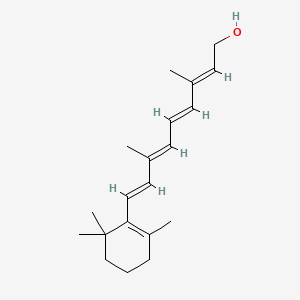
Retinol
All-trans-retinol is a retinol in which all four exocyclic double bonds have E- (trans-) geometry. It has a role as a mouse metabolite, a plant metabolite and a human metabolite. It is a vitamin A and a retinol. — ChEBI
- Nom IUPAC
- (2E,4E,6E,8E)-3,7-dimethyl-9-(2,6,6-trimethylcyclohexen-1-yl)nona-2,4,6,8-tetraen-1-ol
- Formule moléculaire
- C20H30O
- Masse moléculaire
- 286.5 g/mol
- Masse exacte
- 286.229665576 Da
- XLogP3
- 5,7
- Surface polaire topologique
- 20,2 Ų
- Donneurs de liaisons hydrogène
- 1
- Accepteurs de liaisons hydrogène
- 1
- Unités covalentes
- 1
- Stéréocentres définis
- 0
Également connu sous le nom de
16 autres noms signalés
Identifiants de bases de données externes
Preuves issues de bases de données scientifiques complémentaires
NIH PubChem PUG-View
Attributed physical-property, hazard, environmental and use annotations.
- Boiling Point: 279 to 280 °F at 1e-06 mmHg (NTP, 1992) Source: CAMEO Chemicals
- Boiling Point: 137-138 °C at 1X10⁻⁶ mm Hg Source: Hazardous Substances Data Bank (HSDB)
- Color/Form: Solvated crystals from polar solvents, such as methanol or ethyl formate Source: Hazardous Substances Data Bank (HSDB)
- LogP: 5.68 Source: DrugBank
- LogP: log Kow = 5.68 Source: Hazardous Substances Data Bank (HSDB)
- LogP: 5.68 Source: Human Metabolome Database (HMDB)
- Melting Point: 144 to 147 °F (NTP, 1992) Source: CAMEO Chemicals
- Melting Point: 63.5 °C Source: DrugBank
- Melting Point: 62-64 °C Source: Hazardous Substances Data Bank (HSDB)
- Melting Point: Pale yellow prismatic crystals from methanol; mp: 57-58 °C; UV max (ethanol): 326 nm (E=1,550, 1%, 1 cm) /Retinol acetate/ Source: Hazardous Substances Data Bank (HSDB)
- Melting Point: Amorphous or crystalline; mp: 28-29 °C; UV max (ethanol); 325-328 nm (E=975, 1%, 1 cm) /Retinol palmitate/ Source: Hazardous Substances Data Bank (HSDB)
- Melting Point: 61 - 63 °C Source: Human Metabolome Database (HMDB)
- Physical Description: Vitamin a appears as yellow crystals or orange solid. Practically water insoluble. (NTP, 1992) Source: CAMEO Chemicals
- Physical Description: Solid; [Merck Index] Yellow or orange solid; [NTP] Source: Haz-Map, Information on Hazardous Chemicals and Occupational Diseases
- Physical Description: Solid Source: Human Metabolome Database (HMDB)
- Refractive Index: Index of refraction: 1.6410 at 20 °C/D (calculated form refractive indexes of 20-70% solutions in mineral oil); max absorption: 324-325 nm (E=1,835, 1%, 1 cm) Source: Hazardous Substances Data Bank (HSDB)
- Solubility: Practically insoluble (NTP, 1992) Source: CAMEO Chemicals
- Solubility: 0.671 mg/L Source: DrugBank
- Solubility: Practically insoluble in water or glycerol; soluble in absolute alcohol, methanol, chloroform, ether, fats and oils Source: Hazardous Substances Data Bank (HSDB)
- Solubility: Sol in ethanol and acetone and benzene Source: Hazardous Substances Data Bank (HSDB)
- Vapor Pressure: 0.00000008 [mmHg] Source: Haz-Map, Information on Hazardous Chemicals and Occupational Diseases
- Vapor Pressure: 7.5X10⁻⁸ mm Hg at 25 °C /Estimated/ Source: Hazardous Substances Data Bank (HSDB)
- Carcinogen Classification: No indication of carcinogenicity to humans (not listed by IARC). Source: Toxin and Toxin Target Database (T3DB)
- Exposure Routes: Oral, readily absorbed from the normal gastrointestinal tract Source: Toxin and Toxin Target Database (T3DB)
- First Aid: EYES: First check the victim for contact lenses and remove if present. Flush victim's eyes with water or normal saline solution for 20 to 30 minutes while simultaneously calling a hospital or poison control center. Do not put any ointments, oils, or medication in the victim's eyes without specific instructions from a physician. If symptoms (such as redness or irritation) develop, immediately transport the victim to a hospital.; SKIN: IMMEDIATELY flood affected skin with water while removing and isolating all contaminated clothing. Gently wash all affected skin areas thoroughly with soap and water. If symptoms such as redness or irritation develop, IMMEDIATELY call a physician and be prepared to transport the victim to a hospital for treatment.; INHALATION: IMMEDIATELY leave the contaminated area; take deep breaths of fresh air. If symptoms (such as wheezing, coughing, shortness of breath, or burning in the mouth, throat, or chest) develop, call a physician and be prepared to transport the victim to a hospital. Provide proper respiratory protection to rescuers entering an unknown atmosphere. Whenever possible, Self-Contained Breathing Apparatus (SCBA) should be used; if not availabl Source: CAMEO Chemicals
- Note: This chemical does not meet GHS hazard criteria for 0.3% (1 of 311) of reports. Source: European Chemicals Agency (ECHA)
- Signal: Danger Source: European Chemicals Agency (ECHA)
- GHS Hazard Statements: H302 (15.8%): Harmful if swallowed [Warning Acute toxicity, oral]; H317 (74.9%): May cause an allergic skin reaction [Warning Sensitization, Skin]; H319 (75.6%): Causes serious eye irritation [Warning Serious eye damage/eye irritation]; H360 (88.1%): May damage fertility or the unborn child [Danger Reproductive toxicity]; H413 (74.9%): May cause long lasting harmful effects to aquatic life [Hazardous to the aquatic environment, long-term hazard] Source: European Chemicals Agency (ECHA)
- Precautionary Statement Codes: P203, P261, P264, P264+P265, P270, P272, P273, P280, P301+P317, P302+P352, P305+P351+P338, P318, P321, P330, P333+P317, P337+P317, P362+P364, P405, and P501 (click each P-code to see the statement) Source: European Chemicals Agency (ECHA)
- ECHA C&L Notifications Summary: Aggregated GHS information provided per 311 reports by companies from 14 notifications to the ECHA C&L Inventory. Each notification may be associated with multiple companies.; Reported as not meeting GHS hazard criteria per 1 of 311 reports by companies.; There are 13 notifications provided by 310 of 311 reports by companies with hazard statement code(s).; Information may vary between notifications depending on impurities, additives, and other factors. The percentage value in parenthesis indicates the notified classification ratio from companies that provide hazard codes. Only hazard codes with percentage values above 10% are shown. For more detailed information, please visit ECHA C&L website. Source: European Chemicals Agency (ECHA)
- Note: This chemical does not meet GHS hazard criteria for 1% (1 of 105) of reports. Source: European Chemicals Agency (ECHA)
- GHS Hazard Statements: H317 (99%): May cause an allergic skin reaction [Warning Sensitization, Skin]; H319 (99%): Causes serious eye irritation [Warning Serious eye damage/eye irritation]; H360D (99%): May damage the unborn child [Danger Reproductive toxicity] Source: European Chemicals Agency (ECHA)
- Precautionary Statement Codes: P203, P261, P264+P265, P272, P280, P302+P352, P305+P351+P338, P318, P321, P333+P317, P337+P317, P362+P364, P405, and P501 (click each P-code to see the statement) Source: European Chemicals Agency (ECHA)
- ECHA C&L Notifications Summary: Aggregated GHS information provided per 105 reports by companies from 2 notifications to the ECHA C&L Inventory. Each notification may be associated with multiple companies.; Reported as not meeting GHS hazard criteria per 1 of 105 reports by companies.; There is 1 notification provided by 104 of 105 reports by companies with hazard statement code(s).; Information may vary between notifications depending on impurities, additives, and other factors. The percentage value in parenthesis indicates the notified classification ratio from companies that provide hazard codes. Only hazard codes with percentage values above 10% are shown. For more detailed information, please visit ECHA C&L website. Source: European Chemicals Agency (ECHA)
- Cosmetic Ingredient Review Finding(s): Safe in the present practices of use and concentration. Ingredient, concentration, and use information are available in documents discoverable at https://cir-reports.cir-safety.org Source: Cosmetic Ingredient Review (CIR)
- Toxicity Summary: Signs and Symptoms of Overdose; Vitamin A toxicity may present with various clinical symptoms, including abdominal pain, headache, nausea, and facial flushing. Laboratory findings often include mild anemia, thrombocytopenia, elevated liver function tests, and a significant increase in serum retinol levels. Although the diagnosis is primarily clinical, laboratory tests such as serum retinol or retinyl ester levels can assist in confirming the diagnosis. A thorough dietary history is essential to identify excessive vitamin A intake.; Management of Overdose; Symptoms of toxicity may resolve within several weeks after discontinuing vitamin A and initiating supportive therapy. Patients with increased intracranial pressure may require lumbar punctures or medications such as mannitol and diuretics for management. Patients with hypercalcemia may need intravenous fluids and additional treatments, such as calcitonin and corticosteroids. Vitamin A toxicity can present with a range of clinical features, including abdominal pain, headache, nausea, and facial flushing. Laboratory findings often show mild anemia, thrombocytopenia, elevated liver function tests, and a significant increase in serum Source: StatPearls
- Toxicity Summary: Vision:Vitamin A (all-trans retinol) is converted in the retina to the 11-cis-isomer of retinaldehyde or 11-cis-retinal. 11-cis-retinal functions in the retina in the transduction of light into the neural signals necessary for vision. 11-cis-retinal, while attached to opsin in rhodopsin is isomerized to all-trans-retinal by light. This is the event that triggers the nerve impulse to the brain which allows for the perception of light. All-trans-retinal is then released from opsin and reduced to all-trans-retinol. All-trans-retinol is isomerized to 11-cis-retinol in the dark, and then oxidized to 11-cis-retinal. 11-cis-retinal recombines with opsin to re-form rhodopsin. Night blindness or defective vision at low illumination results from a failure to re-synthesize 11-cis retinal rapidly. Epithelial differentiation: The role of Vitamin A in epithelial differentiation, as well as in other physiological processes, involves the binding of Vitamin A to two families of nuclear retinoid receptors (retinoic acid receptors, RARs; and retinoid-X receptors, RXRs). These receptors function as ligand-activated transcription factors that modulate gene transcription. When there is not enough Vitami Source: Toxin and Toxin Target Database (T3DB)
- Cosmetic Ingredient Review Link: CIR ingredient: Retinol Source: Cosmetic Ingredient Review (CIR)
- Sources/Uses: Essential micronutrient found in animals; [Merck Index] Used as a nutritional supplement for foods; [FDA] Permitted for use as an inert ingredient in non-food pesticide products; [EPA] Source: Haz-Map, Information on Hazardous Chemicals and Occupational Diseases
- Uses: Vitamin (antixerophthalmic) Source: Hazardous Substances Data Bank (HSDB)
- Uses: MEDICATION Source: Hazardous Substances Data Bank (HSDB)
- Uses: MEDICATION (VET) Source: Hazardous Substances Data Bank (HSDB)
- Uses: For the treatment of vitamin A deficiency. Vitamin A helps regulate the immune system, which helps prevent or fight off infections by making white blood cells that destroy harmful bacteria and viruses. Source: Toxin and Toxin Target Database (T3DB)
Mis en correspondance par: Existing checksum-valid CAS to unique PubChem CID match. Récupéré le: 2026-08-31. Ouvrir la fiche source
Les classifications scientifiques et les annotations de danger apportent du contexte et ne remplacent pas la décision réglementaire propre au marché indiquée ci-dessus.
Couverture des sources complémentaires et état des correspondances
| Source | Résultat | Vérifié |
|---|---|---|
| NIH PubChem PUG-View | Correspondance exacte | 2026-08-31 |
Une absence de correspondance enregistrée est une preuve utile que la source a été vérifiée ; ce n’est pas l’affirmation que la substance n’existe pas ailleurs.
Récupéré depuis NIH PubChem le 2026-08-31 par correspondance CAS à somme de contrôle valide. Les propriétés chimiques ne remplacent pas la décision réglementaire de cette page.
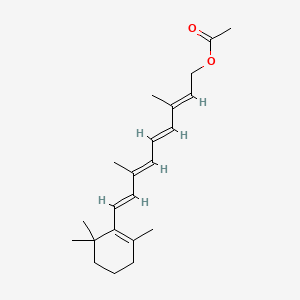
Retinol, acetate
Retinyl acetate is an acetate ester. It is functionally related to an all-trans-retinol. — ChEBI
- Nom IUPAC
- [(2E,4E,6E,8E)-3,7-dimethyl-9-(2,6,6-trimethylcyclohexen-1-yl)nona-2,4,6,8-tetraenyl] acetate
- Formule moléculaire
- C22H32O2
- Masse moléculaire
- 328.5 g/mol
- Masse exacte
- 328.240230259 Da
- XLogP3
- 6,3
- Surface polaire topologique
- 26,3 Ų
- Donneurs de liaisons hydrogène
- 0
- Accepteurs de liaisons hydrogène
- 2
- Unités covalentes
- 1
- Stéréocentres définis
- 0
Également connu sous le nom de
16 autres noms signalés
Identifiants de bases de données externes
- ChEBI:CHEBI:32095
- ChEBI:CHEBI:94695
- ChEMBL:CHEMBL486193
- EPA DTXSID:DTXSID6021240
- PubMed:228596
Preuves issues de bases de données scientifiques complémentaires
NIH PubChem PUG-View
Attributed physical-property, hazard, environmental and use annotations.
- Carcinogen Classification: No indication of carcinogenicity to humans (not listed by IARC). Source: Toxin and Toxin Target Database (T3DB)
- Note: This chemical does not meet GHS hazard criteria for 0.3% (1 of 374) of reports. Source: European Chemicals Agency (ECHA)
- Signal: Danger Source: European Chemicals Agency (ECHA)
- GHS Hazard Statements: H315 (83.4%): Causes skin irritation [Warning Skin corrosion/irritation]; H360 (59.4%): May damage fertility or the unborn child [Danger Reproductive toxicity]; H361 (39.6%): Suspected of damaging fertility or the unborn child [Warning Reproductive toxicity]; H413 (64.4%): May cause long lasting harmful effects to aquatic life [Hazardous to the aquatic environment, long-term hazard] Source: European Chemicals Agency (ECHA)
- Precautionary Statement Codes: P203, P264, P273, P280, P302+P352, P318, P321, P332+P317, P362+P364, P405, and P501 (click each P-code to see the statement) Source: European Chemicals Agency (ECHA)
- ECHA C&L Notifications Summary: Aggregated GHS information provided per 374 reports by companies from 22 notifications to the ECHA C&L Inventory. Each notification may be associated with multiple companies.; Reported as not meeting GHS hazard criteria per 1 of 374 reports by companies.; There are 21 notifications provided by 373 of 374 reports by companies with hazard statement code(s).; Information may vary between notifications depending on impurities, additives, and other factors. The percentage value in parenthesis indicates the notified classification ratio from companies that provide hazard codes. Only hazard codes with percentage values above 10% are shown. For more detailed information, please visit ECHA C&L website. Source: European Chemicals Agency (ECHA)
Mis en correspondance par: Existing checksum-valid CAS to unique PubChem CID match. Récupéré le: 2026-08-31. Ouvrir la fiche source
Les classifications scientifiques et les annotations de danger apportent du contexte et ne remplacent pas la décision réglementaire propre au marché indiquée ci-dessus.
Couverture des sources complémentaires et état des correspondances
| Source | Résultat | Vérifié |
|---|---|---|
| NIH PubChem PUG-View | Correspondance exacte | 2026-08-31 |
Une absence de correspondance enregistrée est une preuve utile que la source a été vérifiée ; ce n’est pas l’affirmation que la substance n’existe pas ailleurs.
Récupéré depuis NIH PubChem le 2026-08-31 par correspondance CAS à somme de contrôle valide. Les propriétés chimiques ne remplacent pas la décision réglementaire de cette page.
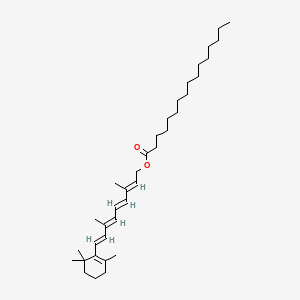
Retinol Palmitate
All-trans-retinyl palmitate is an all-trans-retinyl ester obtained by formal condensation of the carboxy group of palmitic (hexadecanoic acid) with the hydroxy group of all-trans-retinol. It is used in cosmetic products to treat various skin disorders such as acne, skin aging, wrinkles, dark spots, and also protect against psoriasis. It has a role as an antioxidant, a human xenobiotic metabolite and an Escherichia coli metabolite. It is a retinyl palmitate and an all-trans-retinyl ester. It is functionally related to an all-trans-retinol. — ChEBI
- Nom IUPAC
- [(2E,4E,6E,8E)-3,7-dimethyl-9-(2,6,6-trimethylcyclohexen-1-yl)nona-2,4,6,8-tetraenyl] hexadecanoate
- Formule moléculaire
- C36H60O2
- Masse moléculaire
- 524.9 g/mol
- Masse exacte
- 524.45933115 Da
- XLogP3
- 13,6
- Surface polaire topologique
- 26,3 Ų
- Donneurs de liaisons hydrogène
- 0
- Accepteurs de liaisons hydrogène
- 2
- Unités covalentes
- 1
- Stéréocentres définis
- 0
Également connu sous le nom de
16 autres noms signalés
Identifiants de bases de données externes
- ChEBI:CHEBI:17616
- ChEMBL:CHEMBL1675
- EPA DTXSID:DTXSID1021241
- PubMed:38191030
- PubMed:32846153
- PubMed:20679000
- PubMed:19686701
- PubMed:17377406
- PubMed:17303254
- PubMed:17299104
- PubMed:17164434
- PubMed:16798117
- PubMed:16741517
- PubMed:16497549
- PubMed:16299098
Récupéré depuis NIH PubChem le 2026-08-31 par correspondance CAS à somme de contrôle valide. Les propriétés chimiques ne remplacent pas la décision réglementaire de cette page.
Liens d’inventaire pour Retinol; Retinyl Acetate; Retinyl Palmitate
RETINOL
Fiches associées pour Retinol; Retinyl Acetate; Retinyl Palmitate
Les correspondances directes sont limitées pour cette fiche ; des entrées voisines de l’annexe III sont donc également affichées.
Pinene
Ce que signifie l’annexe III pour Retinol; Retinyl Acetate; Retinyl Palmitate
Retinol; Retinyl Acetate; Retinyl Palmitate est une substance soumise à restrictions en vertu de l’annexe III du règlement (CE) n° 1223/2009 relatif aux produits cosmétiques. Son utilisation dans les cosmétiques n’est autorisée que dans les conditions précises énoncées dans l’entrée ci-dessus, y compris les limites de concentration, les restrictions de type de produit et les mentions d’avertissement requises.
Lorsque cette substance entre dans une formulation, toutes les conditions — concentration maximale, champ d’application du produit et mentions d’avertissement — doivent être respectées simultanément. Le respect d’une condition ne dispense pas des autres.
Cette fiche est liée à 3 ingrédients de l’inventaire CosIng pour le recoupement des noms et des identifiants. La page fait également apparaître 11 fiches d’annexe associées présentant des identifiants, une logique d’annexe ou des schémas de dénomination qui se recoupent.
Liste de contrôle de conformité
- Veillez à ce que la concentration de la formulation ne dépasse pas : (a) 0,05 % Retinol Equivalent (RE) (b) 0,3 % RE
- Confirmez la compatibilité avec le type de produit : (a) Body lotion (b) other leave-on and rinse-off products
- Faites figurer la mention d’avertissement requise sur l’étiquette du produit.
- Consignez les conditions d’emploi dans le dossier d’information produit (DIP).
Questions fréquentes
Note de source pour la fiche Retinol; Retinyl Acetate; Retinyl Palmitate de l’annexe III
Cette page résume une fiche de l’annexe III pour Retinol; Retinyl Acetate; Retinyl Palmitate à partir de documents publics de la Commission européenne sur les cosmétiques et ajoute les correspondances d’inventaire ou d’identifiants associées lorsqu’elles sont disponibles.
Utilisez cette page de fiche pour examiner les conditions de l’annexe III pour Retinol; Retinyl Acetate; Retinyl Palmitate, mais confirmez toute décision réglementaire finale auprès du libellé officiel en vigueur de l’annexe et des fichiers sources.
Outils et étapes suivantes
Vérifiez votre formule
Collez une liste INCI complète pour détecter Retinol; Retinyl Acetate; Retinyl Palmitate et d’autres fiches d’annexe de l’UE signalées en une seule passe.
Vérificateur INCIComparer des entrées
Comparez Retinol; Retinyl Acetate; Retinyl Palmitate côte à côte avec une autre fiche d’annexe pour examiner les différences de restrictions, de concentrations et d’annexe.
ComparerParcourir l’annexe
Consultez toutes les fiches de l’annexe III et comparez les conditions réglementaires entre les substances de cette annexe.
Ouvrir l’annexe III