
CoSing Database and INCI Ingredient Checker: How to Search Cosmetic Ingredients in the EU
Learn how to use the CoSing database, check INCI names, cosmetic ingredient functions, EU restrictions, Annex entries, colorants, preservatives and UV filters with CoSingChecker.
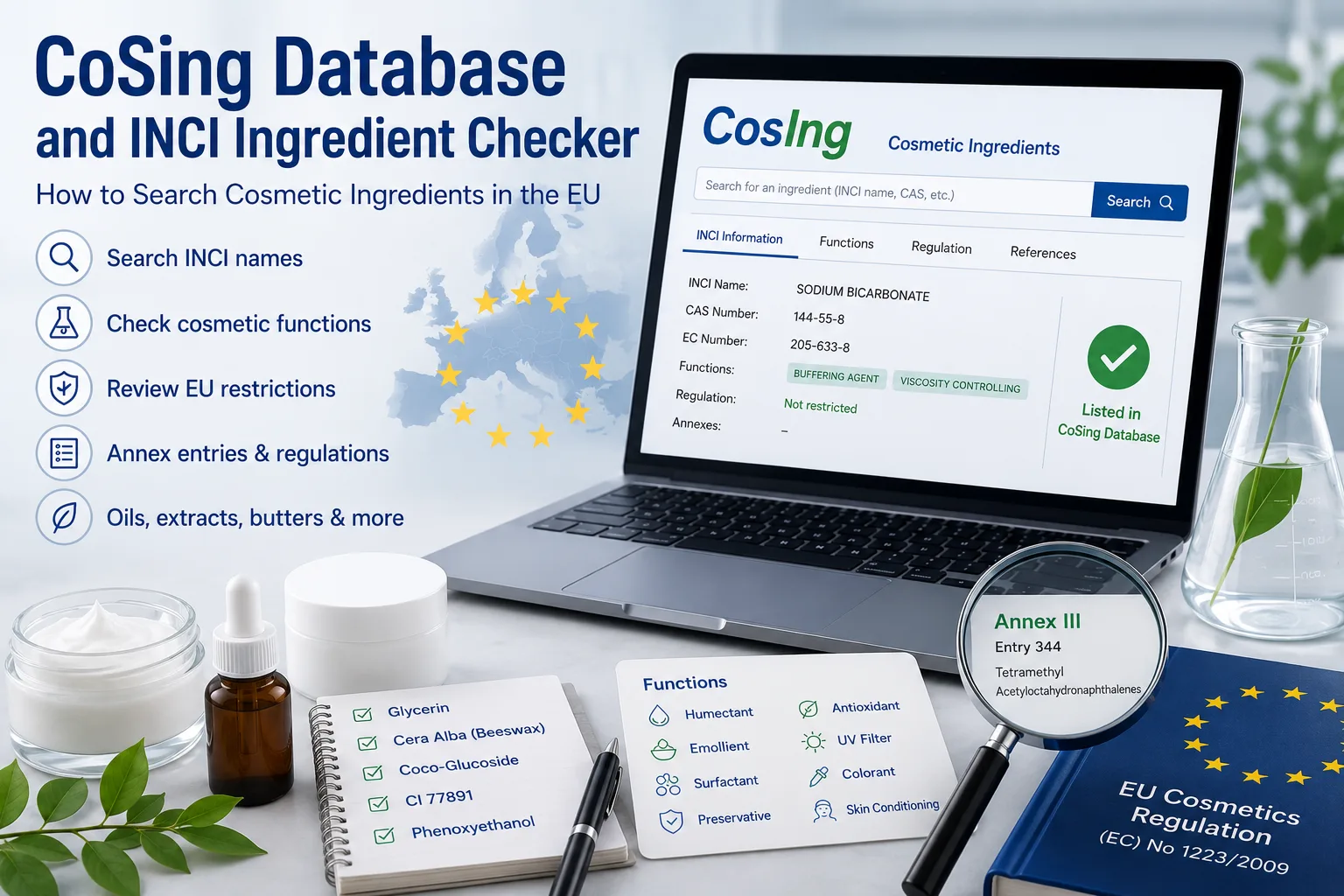
CoSing Database and INCI Ingredient Checker: How to Search Cosmetic Ingredients in the EU
If you work with cosmetics, skincare, haircare, fragrances or raw materials, you have probably searched for an ingredient in the CoSing database. CoSing is the European Commission’s cosmetic ingredient database and is one of the most important reference tools for checking INCI names, cosmetic functions and regulatory information in the European Union.
However, finding the right ingredient is not always simple. Many ingredients have long INCI names, alternative spellings, botanical names, color index numbers or annex restrictions. That is why CoSingChecker helps users search cosmetic ingredients faster and understand the information in a clearer way.
What is the CoSing database?
The CoSing database is a public cosmetic ingredient database used in the EU. It contains information about ingredients used in cosmetic products, including:
- INCI names
- cosmetic functions
- CAS numbers and EC numbers, when available
- colorants
- preservatives
- UV filters
- fragrance allergens
- references to EU cosmetic regulation annexes
For example, users often search for ingredients such as Sodium Bicarbonate, Cera Alba / Beeswax, Glycerin, Coco-Glucoside, Phenoxyethanol, Titanium Dioxide / CI 77891, Butyloctyl Salicylate, Sodium Hyaluronate or botanical ingredients such as Prunus Amygdalus Dulcis Oil Unsaponifiables.
What is an INCI name?
INCI means International Nomenclature of Cosmetic Ingredients. It is the standardized naming system used for cosmetic ingredients on product labels.
For example:
- Sodium Bicarbonate is an INCI name commonly used for baking soda in cosmetic products.
- Cera Alba / Beeswax is connected with beeswax-related cosmetic ingredient naming.
- CI 77891 refers to titanium dioxide as a color index ingredient.
- CI 45370 is a colorant entry listed in Annex IV.
- Phenoxyethanol is listed as a preservative entry in Annex V.
Using the correct INCI name is important because cosmetic labels in the EU must use standardized ingredient names.
How to check a cosmetic ingredient
When checking a cosmetic ingredient, it is useful to look at several types of information.
First, check the official INCI name. Many ingredients are searched by common names, but cosmetic labels usually require the INCI version. For example, users may search for “sweet almond oil”, but the ingredient may appear under a botanical INCI name such as Prunus Amygdalus Dulcis-related entries.
Second, check the cosmetic function. Ingredients can have functions such as:
- skin conditioning
- humectant
- emollient
- surfactant
- cleansing
- preservative
- antioxidant
- fragrance
- UV filter
- colorant
- viscosity controlling
- film forming
For example, Glycerin is commonly searched together with humectant and skin conditioning functions, while Coco-Glucoside is often searched as a surfactant and cleansing ingredient.
Third, check whether the ingredient is connected with any EU restriction, annex entry or special regulatory status.
Why Annex entries matter
Some cosmetic ingredients are not only listed as ingredients but are also connected with specific entries in the annexes of EU cosmetics regulation.
A good example is Tetramethyl Acetyloctahydronaphthalenes — Annex III Entry 344. Users may search for phrases like:
- Tetramethyl Acetyloctahydronaphthalenes Annex III
- Annex III Entry 344
- OTNE Annex III Entry 344
- Tetramethyl Acetyloctahydronaphthalenes EU cosmetics regulation
This type of search usually means the user is not only looking for the INCI name, but also wants to understand whether the ingredient has a restriction, declaration threshold or concentration-related condition.
Colorants and preservatives are also often connected with annex entries. For example, CI 45370 is connected with Annex IV, while Phenoxyethanol is connected with Annex V.
For regulatory work, always check the current legal text and the latest EU cosmetics regulation updates before making a final decision.
Common ingredient searches in CoSing
Many users search the CoSing database for natural oils, waxes, butters, animal-derived ingredients, colorants, preservatives and UV filters.
Popular examples include:
- PEG-40 Olive Glycerides
- Sodium Bicarbonate
- Cera Alba / Beeswax
- Glycerin
- Coco-Glucoside
- Butyloctyl Salicylate
- Sodium Hyaluronate
- CI 77891
- CI 45370
- Phenoxyethanol
- Tetramethyl Acetyloctahydronaphthalenes
- Prunus Amygdalus Dulcis Oil Unsaponifiables
These searches show that users often need a fast way to confirm whether an ingredient exists in CoSing, what its INCI name is, what function it has, and whether it is connected with an EU annex record.
CoSingChecker: faster ingredient search
CoSingChecker helps users search cosmetic ingredients and INCI names more easily. Instead of manually checking long database records, users can search by ingredient name, INCI name, CAS number, function or related regulatory terms.
You can use CoSingChecker to check:
- whether an ingredient appears in the cosmetic ingredient database
- the official INCI name
- cosmetic functions
- color index ingredients, such as CI 77891 and CI 45370
- preservatives, such as Phenoxyethanol
- surfactants, such as Coco-Glucoside
- humectants, such as Glycerin and Sodium Hyaluronate
- ingredients connected with EU annex entries, such as Tetramethyl Acetyloctahydronaphthalenes Annex III Entry 344
This is especially useful for formulators, regulatory specialists, cosmetic brands, raw material suppliers and anyone checking cosmetic labels.
CoSing database vs INCI checker
The CoSing database is the official reference source, while an INCI checker is a practical search tool that helps users find and interpret ingredient data faster.
A good workflow is:
- Search the ingredient in CoSingChecker.
- Check the INCI name and cosmetic functions.
- Review any annex or restriction information.
- Verify the final regulatory status in the current EU legal text when needed.
- Use the correct INCI name on cosmetic documentation and labels.
For example, if you are checking a preservative, you may want to start with a page like Phenoxyethanol. If you are checking a colorant, pages such as CI 77891 or CI 45370 can help you identify the relevant record faster.
Final thoughts
The CoSing database is essential for cosmetic ingredient research in the EU, but ingredient searches can be difficult because names are often long, technical or written in different ways. CoSingChecker makes this process easier by helping users search INCI names, ingredient functions and regulatory references in one place.
Whether you are checking Sodium Bicarbonate, Cera Alba / Beeswax, Glycerin, Coco-Glucoside, Phenoxyethanol, CI 77891, CI 45370 or Annex III Entry 344 for Tetramethyl Acetyloctahydronaphthalenes, a clear ingredient checker can save time and reduce mistakes.
Use CoSingChecker to search cosmetic ingredients, check INCI names and better understand cosmetic ingredient information used in the EU.
About this article
This article is part of the CosIng Checker blog, where we publish guides, notes and practical explainers about EU cosmetic ingredients, Annex II–VI restrictions, warnings, preservatives, UV filters, colorants and related compliance topics.