
Cinnamal (2-propenal, 3-phenyl-)
New Zealand Cosmetic Products Group Standard Schedule 5, reference 76.
监管决定及完整条件
- 状态
- Restricted
- 法律地位
- Binding rule
- 监管摘要
- New Zealand Cosmetic Products Group Standard Schedule 5, reference 76.
- 条件与限制
Other limitations: The presence of the substance must be indicated in the list of ingredients referred to in Schedule 1, condition 1(2) when its concentration exceeds: 0.001% in leave-on products 0.01% in rinse-off products
物质身份
- 官方来源名称
- Cinnamal (2-propenal, 3-phenyl-)
- CAS
- 104-55-2
- EC
- 203-213-9
- 身份映射
- cas_number
- 关联成分
- CINNAMAL
关联的 CosIng 身份数据
名称和别名
CosIng 描述: Cinnamaldehyde; 2-Propenal, 3-phenyl-
欧盟清单限制备注: III/76
已记录的化妆品功能: DENATURANT, FLAVOURING, PERFUMING
功能页面:DENATURANT, FLAVOURING, PERFUMING
查看完整的成分档案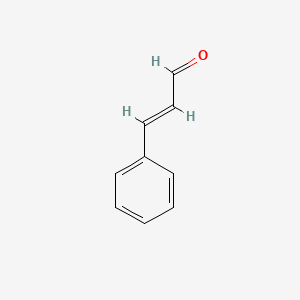
CAS 104-55-2 的已核实化学信息
Cinnamaldehyde
(E)-cinnamaldehyde is the E (trans) stereoisomer of cinnamaldehyde, the parent of the class of cinnamaldehydes. It has a role as a sensitiser, a hypoglycemic agent, a flavouring agent, a vasodilator agent, an antifungal agent, an EC 4.3.1.24 (phenylalanine ammonia-lyase) inhibitor and a plant metabolite. It is a 3-phenylprop-2-enal and a member of cinnamaldehydes. — ChEBI
- IUPAC 名称
- (E)-3-phenylprop-2-enal
- 分子式
- C9H8O
- 分子量
- 132.16 g/mol
- 精确质量
- 132.057514874 Da
- 单同位素质量
- 132.057514874 Da
- XLogP3
- 1.9
- 拓扑极性表面积
- 17.1 Ų
- 分子复杂度
- 121.0
- 形式电荷
- 0
- 氢键供体
- 0
- 氢键受体
- 1
- 可旋转键
- 2
- 重原子
- 10
- 共价单元
- 1
向 PubChem 报告的名称和同义词
另有 16 个已报告名称
外部数据库标识符
- ChEBI:CHEBI:142921
- ChEBI:CHEBI:16731
- ChEMBL:CHEMBL293492
- EPA DTXSID:DTXSID6024834
- PubMed:24010721
- PubMed:23449869
- PubMed:21893402
- PubMed:21708228
- PubMed:21627838
- PubMed:21336686
- PubMed:18035463
- PubMed:16829128
- PubMed:15046718
- PubMed:10879482
高级结构统计
- 已定义的原子立体中心
- 0
- 未定义的原子立体中心
- 0
- 已定义的键立体中心
- 1
- 未定义的键立体中心
- 0
- 三维药效团特征
- 2
- 三维环
- 1
- 三维疏水基团
- 0
- 三维受体特征
- 1
- 三维供体特征
- 0
- 三维阴离子中心
- 0
- 三维阳离子中心
- 0
- 三维构象异构体
- 2
- 有效三维可旋转键
- 2.0
机器可读的结构标识符
- SMILES
C1=CC=C(C=C1)/C=C/C=O- InChI
InChI=1S/C9H8O/c10-8-4-7-9-5-2-1-3-6-9/h1-8H/b7-4+- InChIKey
KJPRLNWUNMBNBZ-QPJJXVBHSA-N
来自其他科学数据库的证据
EMBL-EBI ChEBI
3-phenylprop-2-enal
A member of the class of cinnamaldehydes that is prop-2-enal in which a hydrogen at position 3 has been replaced by a phenyl group. The configuration of the double bond is not specified; the name "cinnamaldehyde" is widely used to refer to the E (trans) isomer.
- 配方
- C9H8O
- 平均质量
- 132.162 g/mol
- 单同位素质量
- 132.05751 Da
- 形式电荷
- 0
- cinnamaldehydes — is a (CHEBI:23245)
- cinnamaldehydes — is a (CHEBI:23245)
其他整理的名称
来自此来源的交叉引用
- CAS: 104-55-2 — PubChem Compound
映射方: Exact CAS cross-reference in the ChEBI compound record. 来源更新: 2019-01-16. 检索时间: 2026-08-31. 打开来源记录
NIH PubChem PUG-View
Attributed physical-property, hazard, environmental and use annotations.
- Boiling Point: 253 °C @ 760 MM HG (SLIGHT DECOMP) 来源: Hazardous Substances Data Bank (HSDB)
- Boiling Point: 248.00 °C. @ 760.00 mm Hg 来源: Human Metabolome Database (HMDB)
- Boiling Point: 248-250 °C 来源: Joint FAO/WHO Expert Committee on Food Additives (JECFA)
- Color/Form: Yellowish oily liquid 来源: Hazardous Substances Data Bank (HSDB)
- Color/Form: GREENISH-YELLOW LIQUID 来源: Hazardous Substances Data Bank (HSDB)
- Density: 1.048-1.052 at 25 °C/25 °C 来源: Hazardous Substances Data Bank (HSDB)
- Density: 1.046-1.053 来源: Joint FAO/WHO Expert Committee on Food Additives (JECFA)
- Flash Point: 160 °F 来源: Haz-Map, Information on Hazardous Chemicals and Occupational Diseases
- Flash Point: 120 °C closed cup 来源: Hazardous Substances Data Bank (HSDB)
- LogP: log Kow = 1.90 来源: Hazardous Substances Data Bank (HSDB)
- LogP: 1.90 来源: Human Metabolome Database (HMDB)
- Melting Point: -7.5 °C 来源: Hazardous Substances Data Bank (HSDB)
- Melting Point: -7.5 °C 来源: Human Metabolome Database (HMDB)
- Odor: PUNGENT, SPICY NOTE 来源: Hazardous Substances Data Bank (HSDB)
- Odor: Strong odor of cinnamon 来源: Hazardous Substances Data Bank (HSDB)
- Physical Description: CBI; Other Solid; Liquid 来源: EPA Chemical Data Reporting (CDR)
- Physical Description: Yellowish oily liquid; [HSDB] 来源: Haz-Map, Information on Hazardous Chemicals and Occupational Diseases
- Physical Description: Clear yellow liquid with a cinnamon odor; [CAMEO] 来源: Haz-Map, Information on Hazardous Chemicals and Occupational Diseases
- Physical Description: Liquid 来源: Human Metabolome Database (HMDB)
- Physical Description: Yellow liquid, strong cinnamon odour 来源: Joint FAO/WHO Expert Committee on Food Additives (JECFA)
- Refractive Index: Index of refraction: 1.618-1.623 at 20 °C/D 来源: Hazardous Substances Data Bank (HSDB)
- Refractive Index: 1.619-1.625 来源: Joint FAO/WHO Expert Committee on Food Additives (JECFA)
- Solubility: Dissolves in about 700 parts water, in about 7 volumes of 60% alcohol. 来源: Hazardous Substances Data Bank (HSDB)
- Solubility: SOL IN ETHER, CHLOROFORM; INSOL IN PETROLEUM ETHER 来源: Hazardous Substances Data Bank (HSDB)
- Solubility: Miscible with alcohol, ether, chloroform, oils 来源: Hazardous Substances Data Bank (HSDB)
- Solubility: SOLUBILITY: 1:5 IN 60%, 1:25 IN 50%, 1:2.5 IN 70% ALC 来源: Hazardous Substances Data Bank (HSDB)
- Solubility: In water, 1.42X10+3 mg/L at 25 °C 来源: Hazardous Substances Data Bank (HSDB)
- Solubility: 1.42 mg/mL at 25 °C 来源: Human Metabolome Database (HMDB)
- Solubility: insoluble in water; miscible in oils 来源: Joint FAO/WHO Expert Committee on Food Additives (JECFA)
- Solubility: miscible (in ethanol) 来源: Joint FAO/WHO Expert Committee on Food Additives (JECFA)
- Vapor Pressure: 2.89X10⁻² mm Hg at 25 °C 来源: Hazardous Substances Data Bank (HSDB)
- Substance: trans-Cinnamaldehyde 来源: NTP Technical Reports
- NTP Technical Report: TR-514: Toxicology and Carcinogenesis Studies of trans-Cinnamaldehyde (Microencapsulated) (CASRN 14371-10-9) in F344/N Rats and B6C3F1 Mice (Feed Studies) (2004 ) 来源: NTP Technical Reports
- Peer Review Date: 09/05/02 来源: NTP Technical Reports
- Conclusion for Male Rat: No Evidence 来源: NTP Technical Reports
- Conclusion for Female Rat: No Evidence 来源: NTP Technical Reports
- Conclusion for Male Mice: No Evidence 来源: NTP Technical Reports
- Conclusion for Female Mice: No Evidence 来源: NTP Technical Reports
- Summary: Under the conditions of this 2-year feed study, there was no evidence of carcinogenic activity of transcinnamaldehyde in male or female F344/N rats exposed to 1,000, 2,100, or 4,100 ppm. There was no evidence of carcinogenic activity of trans-cinnamaldehyde in male or female B6C3F1 mice exposed to 1,000, 2,100, or 4,100 ppm.; Exposure to trans-cinnamaldehyde resulted in olfactory epithelial pigmentation in male and female mice. 来源: NTP Technical Reports
- Carcinogen Classification: No indication of carcinogenicity to humans (not listed by IARC). 来源: Toxin and Toxin Target Database (T3DB)
- Exposure Routes: Inhalation; dermal; ingestion 来源: Toxin and Toxin Target Database (T3DB)
- Signal: Warning 来源: Regulation (EC) No 1272/2008 of the European Parliament and of the Council
- GHS Hazard Statements: H317: May cause an allergic skin reaction [Warning Sensitization, Skin] 来源: Regulation (EC) No 1272/2008 of the European Parliament and of the Council
- Precautionary Statement Codes: P261, P272, P280, P302+P352, P321, P333+P317, P362+P364, and P501 (click each P-code to see the statement) 来源: Regulation (EC) No 1272/2008 of the European Parliament and of the Council
- Note: This chemical does not meet GHS hazard criteria for 0.2% (5 of 2854) of reports. 来源: European Chemicals Agency (ECHA)
- Signal: Warning 来源: European Chemicals Agency (ECHA)
- GHS Hazard Statements: H312 (76%): Harmful in contact with skin [Warning Acute toxicity, dermal]; H315 (98.1%): Causes skin irritation [Warning Skin corrosion/irritation]; H317 (99.7%): May cause an allergic skin reaction [Warning Sensitization, Skin]; H319 (95.6%): Causes serious eye irritation [Warning Serious eye damage/eye irritation] 来源: European Chemicals Agency (ECHA)
- Precautionary Statement Codes: P261, P264, P264+P265, P272, P280, P302+P352, P305+P351+P338, P317, P321, P332+P317, P333+P317, P337+P317, P362+P364, and P501 (click each P-code to see the statement) 来源: European Chemicals Agency (ECHA)
- ECHA C&L Notifications Summary: Aggregated GHS information provided per 2854 reports by companies from 40 notifications to the ECHA C&L Inventory. Each notification may be associated with multiple companies.; Reported as not meeting GHS hazard criteria per 5 of 2854 reports by companies.; There are 39 notifications provided by 2849 of 2854 reports by companies with hazard statement code(s).; Information may vary between notifications depending on impurities, additives, and other factors. The percentage value in parenthesis indicates the notified classification ratio from companies that provide hazard codes. Only hazard codes with percentage values above 10% are shown. For more detailed information, please visit ECHA C&L website. 来源: European Chemicals Agency (ECHA)
- Note: This chemical does not meet GHS hazard criteria for 1.9% (3 of 161) of reports. 来源: European Chemicals Agency (ECHA)
- GHS Hazard Statements: H312 (65.2%): Harmful in contact with skin [Warning Acute toxicity, dermal]; H315 (98.1%): Causes skin irritation [Warning Skin corrosion/irritation]; H317 (98.1%): May cause an allergic skin reaction [Warning Sensitization, Skin]; H319 (98.1%): Causes serious eye irritation [Warning Serious eye damage/eye irritation]; H335 (94.4%): May cause respiratory irritation [Warning Specific target organ toxicity, single exposure; Respiratory tract irritation]; H412 (64.6%): Harmful to aquatic life with long lasting effects [Hazardous to the aquatic environment, long-term hazard] 来源: European Chemicals Agency (ECHA)
- Precautionary Statement Codes: P261, P264, P264+P265, P271, P272, P273, P280, P302+P352, P304+P340, P305+P351+P338, P317, P319, P321, P332+P317, P333+P317, P337+P317, P362+P364, P403+P233, P405, and P501 (click each P-code to see the statement) 来源: European Chemicals Agency (ECHA)
- ECHA C&L Notifications Summary: Aggregated GHS information provided per 161 reports by companies from 12 notifications to the ECHA C&L Inventory. Each notification may be associated with multiple companies.; Reported as not meeting GHS hazard criteria per 3 of 161 reports by companies.; There are 11 notifications provided by 158 of 161 reports by companies with hazard statement code(s).; Information may vary between notifications depending on impurities, additives, and other factors. The percentage value in parenthesis indicates the notified classification ratio from companies that provide hazard codes. Only hazard codes with percentage values above 10% are shown. For more detailed information, please visit ECHA C&L website. 来源: European Chemicals Agency (ECHA)
- Health Effects: Allergic reaction. 来源: Toxin and Toxin Target Database (T3DB)
- Toxicity Summary: Cinnamaldehyde is an allergen. The physiologic effect of cinnamaldehyde is by means of increased histamine release and cell-mediated immunity. 来源: Toxin and Toxin Target Database (T3DB)
- Environmental Bioconcentration: An estimated BCF of 8 was calculated in fish for cinnamaldehyde(SRC), using a log Kow of 1.9(1) and a regression-derived equation(2). According to a classification scheme(3), this BCF suggests the potential for bioconcentration in aquatic organisms is low(SRC). 来源: Hazardous Substances Data Bank (HSDB)
- Environmental Fate: TERRESTRIAL FATE: Based on a classification scheme(1), an estimated Koc value of 37(SRC), determined from a log Kow of 1.9(2) and a regression-derived equation(3), indicates that cinnamaldehyde is expected to have very high mobility in soil(SRC). Volatilization of cinnamaldehyde from moist soil surfaces may be an important fate process(SRC) given an estimated Henry's Law constant of 3.5X10⁻⁶ atm-cu m/mole(SRC), derived from its vapor pressure, 2.89X10⁻² mm Hg(4), and water solubility, 1,420 mg/L(5). Cinnamaldehyde is not expected to volatilize from dry soil surfaces(SRC) based upon its vapor pressure(4). Biodegradation data were not available(SRC, 2009). 来源: Hazardous Substances Data Bank (HSDB)
- Environmental Fate: AQUATIC FATE: Based on a classification scheme(1), an estimated Koc value of 37(SRC), determined from a log Kow of 1.9(2) and a regression-derived equation(3), indicates that cinnamaldehyde is not expected to adsorb to suspended solids and sediment(SRC). Volatilization from water surfaces is expected(3) based upon an estimated Henry's Law constant of 3.5X10⁻⁶ atm-cu m/mole(SRC), derived from its vapor pressure, 2.89X10⁻² mm Hg(4), and water solubility, 1,420 mg/L(5). Using this Henry's Law constant and an estimation method(3), volatilization half-lives for a model river and model lake are 290 hours and 91 days, respectively(SRC). According to a classification scheme(6), an estimated BCF of 8(SRC), from its log Kow (2) and a regression-derived equation(7), suggests the potential for bioconcentration in aquatic organisms is low(SRC). Biodegradation data were not available(SRC, 2009). 来源: Hazardous Substances Data Bank (HSDB)
- Environmental Fate: ATMOSPHERIC FATE: According to a model of gas/particle partitioning of semivolatile organic compounds in the atmosphere(1), cinnamaldehyde, which has a vapor pressure of 2.89X10⁻² mm Hg at 25 °C(2), is expected to exist solely as a vapor in the ambient atmosphere. Vapor-phase cinnamaldehyde is degraded in the atmosphere by reaction with photochemically-produced hydroxyl radicals(SRC); the half-life for this reaction in air is estimated to be 10 hours and 9.5 hours for the cis- and trans-isomers, respectively(SRC), calculated from its rate constant of 3.8X10⁻¹¹ and 4.0X10⁻¹¹ cu cm/molecule-sec at 25 °C for cis- and trans-isomers, respectively(SRC). Cinnamaldehyde does not contain chromophores that absorb at wavelengths >290 nm(4) and therefore is not expected to be susceptible to direct photolysis by sunlight(SRC). 来源: Hazardous Substances Data Bank (HSDB)
- Consumer Uses: Flavoring and nutrient; Not Known or Reasonably Ascertainable; Soil amendments (fertilizers); Fragrance; Processing aids, specific to petroleum production 来源: EPA Chemical Data Reporting (CDR)
- Industry Uses: Processing aids, specific to petroleum production; Soil amendments (fertilizers); Fixing agent (mordant); Fragrance; Flavoring and nutrient; Solvent 来源: EPA Chemical Data Reporting (CDR)
- Cosmetic Ingredient Review Link: CIR ingredient: Cinnamal 来源: Cosmetic Ingredient Review (CIR)
- Sources/Uses: Used to flavor beverages, chewing gum, and dental products; [Marks, p. 77] 来源: Haz-Map, Information on Hazardous Chemicals and Occupational Diseases
- Sources/Uses: Used in flavors and perfumes; [NTP] 来源: Haz-Map, Information on Hazardous Chemicals and Occupational Diseases
- Uses: For cinnamaldehyde (USEPA/OPP Pesticide Code: 040506) ACTIVE products with label matches. /SRP: Registered for use in the U.S. but approved pesticide uses may change periodically and so federal, state and local authorities must be consulted for currently approved uses./ 来源: Hazardous Substances Data Bank (HSDB)
- Uses: In electroplating processes, cinnamaldehyde is utilized as a brightener. Other applications include its efficacy as an animal repellent, its use in compositions to attract insects, and demonstration of a positive antifungal activity. 来源: Hazardous Substances Data Bank (HSDB)
- Uses: In the flavor and perfume industry 来源: Hazardous Substances Data Bank (HSDB)
- Uses: FOOD CHEM TO IMPART CINNAMON FLAVOR TO FOODS, BEVERAGES; PERFUME CHEM; FOOD CHEM; FILTERING AGENT; CINNAMON FLAVORING AGENT IN MEDICINALS, LIQUORS & CORDIALS; RUBBER REINFORCING AGENT 来源: Hazardous Substances Data Bank (HSDB)
- Uses: For more Uses (Complete) data for CINNAMALDEHYDE (8 total), please visit the HSDB record page. 来源: Hazardous Substances Data Bank (HSDB)
映射方: Existing checksum-valid CAS to unique PubChem CID match. 检索时间: 2026-08-31. 打开来源记录
科学分类和危害注释仅提供背景信息,不能取代上方所示针对具体市场的监管决定。
其他来源的覆盖范围和匹配状态
| 来源 | 结果 | 已检查 |
|---|---|---|
| EMBL-EBI ChEBI | 精确匹配 | 2026-08-31 |
| NIH PubChem PUG-View | 精确匹配 | 2026-08-31 |
已记录的无匹配结果是该来源已被检查的有效证据;这并不表示该物质在别处不存在。
于 2026-09-02 通过校验和有效的 CAS 匹配从美国国立卫生研究院 (NIH) PubChem 检索。化学性质不能取代本页的监管决定。
官方来源与出处
- 已登记来源
- New Zealand cosmetic product schedules 4–8
- 来源参考
- Schedule 5, reference 76, source row 104
- 来源记录 ID
S5-104- 来源版本
- effective-2026-01-01
- 来源语言
- English
- 翻译状态
- Original is English
- 生效日期
- 2026-01-01
- 来源更新
- 2024-01-01
- 快照检查时间
- 2026-08-30 04:54 UTC
- 验证方法
- openpyxl extraction; reviewed per-schedule counts
- SHA-256
4e62e372fb0aad7ac630af8c41fa50b38b52a793fd51b99697a65f8ecce1ae8a
已登记的数据集备注
- 数据集覆盖范围
- Prohibited and restricted substances, permitted colorants, preservatives and UV filters
- 权威性说明
- Official EPA group standard schedules; current market-specific rule source
本记录在市场数据集中的位置
状态分布
在 2913 条当前记录中,有 747 条带有条件文本。条件字段为空时,按上述记录类型解释;绝不会被转换为可无限制使用的声明。
New Zealand 市场背景
Complete schedules dataset
覆盖版本: Cosmetic Products Group Standard schedules effective 1 January 2026
Schedules 4–8: prohibited, restricted, colourant, preservative and UV-filter entries.
核实清单
- Search exact identity across Schedules 4–8.
- Apply use, concentration and warning conditions.
- Check hazardous-substance classification and Group Standard scope.
- Confirm the latest legal instrument, not only the spreadsheet.
官方市场来源
- New Zealand cosmetic product schedules 4–8Official EPA group standard schedules; current market-specific rule source
核实工作流程与记录完整性
在将此结果用于合规决定之前
- 确认“Cinnamal (2-propenal, 3-phenyl-)”及每个 CAS/EC 标识符所指的物料与您的供应商规格一致。
- Search exact identity across Schedules 4–8.
- Apply use, concentration and warning conditions.
- Check hazardous-substance classification and Group Standard scope.
- Confirm the latest legal instrument, not only the spreadsheet.
- 记录来源版本,并在生产、备案或上市之前重新核查监管机构。
本记录中的可用字段
- 官方物质名称可用
- CAS可用
- EC可用
- 单独的条件文本可用
- 生效日期可用
- 快照哈希与方法可用
本页回答的问题
稳定引用
Cinnamal (2-propenal, 3-phenyl-). Schedule 5, reference 76, source row 104. New Zealand. Source version effective-2026-01-01. CosIng Checker regulatory record: https://cosingchecker.com/zh-hans/regulations/nz/records/8946/
请将监管机构作为法律依据来引用。本页是结构化的证据索引和核实辅助工具,不能替代官方文本或专业法律评估。
New Zealand 的解读与局限
This substance is not unrestricted: cosmetic use is subject to the conditions in the cited official record.
Check product type, body area, concentration, purity and warning requirements before deciding whether a formulation is compliant.
如何解读法律地位
The cited row forms part of a binding rule or legally incorporated list for this market.
本页证据
- 记录结果:Restricted
- 法律地位:Binding rule
- 来源版本:effective-2026-01-01
- 生效日期:2026-01-01
它不能证明什么
The searchable spreadsheet is an aid; the legal Group Standard and incorporated notices remain authoritative.
进一步的权威物质研究
这些来源均不能推翻上述市场决定。
Cosmetic Ingredient Review safety assessments
Expert Panel conclusions, assessed ingredient groups, use conditions, dates and report documents
Independent expert review considered by FDA; not a government approval or binding market rule
在来源处研究此身份FDA Global Substance Registration System
UNII identifiers, preferred names, substance types, codes and public substance relationships
Identity registry only; UNII availability does not imply FDA review or approval
在来源处研究此身份ILO/WHO International Chemical Safety Cards
Hazards, symptoms, first aid, storage, incompatibilities and physical properties for covered chemicals
International occupational chemical-safety reference; not cosmetic-use approval
在来源处研究此身份Japan NITE-CHRIP
Chemical identity, Japanese and foreign legal lists, GHS hazards and exposure-related information
Chemical-management evidence; cosmetic status remains governed by the applicable MHLW standard and market rules
在来源处研究此身份NIOSH Pocket Guide to Chemical Hazards
REL, PEL, IDLH, properties, exposure routes, symptoms, target organs, first aid and measurement methods for covered workplace chemicals
US occupational-health guidance and limits; not a cosmetic ingredient decision
在来源处研究此身份OECD eChemPortal
Gateway to authority-owned physical-property, fate, ecotoxicity, toxicity, exposure and GHS records
Discovery gateway; each linked authority remains responsible for its data
在来源处研究此身份US EPA CompTox CTX APIs
导入需要 API 密钥DTXSID identity, experimental and predicted properties, toxicity, bioactivity, exposure and environmental data
Scientific and computational evidence; predictions must remain labelled and do not determine cosmetic legality
在来源处研究此身份