
CAS 104-55-2
CAS 104-55-2 与法规 1223/2009 附件 II–VI 中的 1 条欧盟附件记录相匹配。
CAS 104-55-2 的记录
1 共化学身份与性质
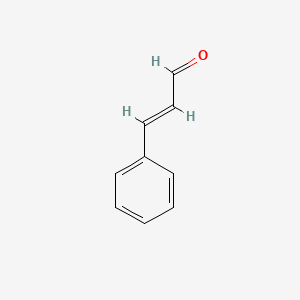
Cinnamaldehyde
(E)-cinnamaldehyde is the E (trans) stereoisomer of cinnamaldehyde, the parent of the class of cinnamaldehydes. It has a role as a sensitiser, a hypoglycemic agent, a flavouring agent, a vasodilator agent, an antifungal agent, an EC 4.3.1.24 (phenylalanine ammonia-lyase) inhibitor and a plant metabolite. It is a 3-phenylprop-2-enal and a member of cinnamaldehydes. — ChEBI
- IUPAC 名称
- (E)-3-phenylprop-2-enal
- 分子式
- C9H8O
- 分子量
- 132.16 g/mol
- 精确质量
- 132.057514874 Da
- XLogP3
- 1.9
- 拓扑极性表面积
- 17.1 Ų
- 氢键供体
- 0
- 氢键受体
- 1
- 共价单元
- 1
- 已定义的立体中心
- 0
又称
另有 16 个已报告名称
外部数据库标识符
- ChEBI:CHEBI:142921
- ChEBI:CHEBI:16731
- ChEMBL:CHEMBL293492
- EPA DTXSID:DTXSID6024834
- PubMed:24010721
- PubMed:23449869
- PubMed:21893402
- PubMed:21708228
- PubMed:21627838
- PubMed:21336686
- PubMed:18035463
- PubMed:16829128
- PubMed:15046718
- PubMed:10879482
来自其他科学数据库的证据
EMBL-EBI ChEBI
3-phenylprop-2-enal
A member of the class of cinnamaldehydes that is prop-2-enal in which a hydrogen at position 3 has been replaced by a phenyl group. The configuration of the double bond is not specified; the name "cinnamaldehyde" is widely used to refer to the E (trans) isomer.
- 配方
- C9H8O
- 平均质量
- 132.162 g/mol
- 单同位素质量
- 132.05751 Da
- 形式电荷
- 0
- cinnamaldehydes — is a (CHEBI:23245)
- cinnamaldehydes — is a (CHEBI:23245)
其他整理的名称
来自此来源的交叉引用
- CAS: 104-55-2 — PubChem Compound
映射方: Exact CAS cross-reference in the ChEBI compound record. 来源更新: 2019-01-16. 检索时间: 2026-08-31. 打开来源记录
NIH PubChem PUG-View
Attributed physical-property, hazard, environmental and use annotations.
- Boiling Point: 253 °C @ 760 MM HG (SLIGHT DECOMP) 来源: Hazardous Substances Data Bank (HSDB)
- Boiling Point: 248.00 °C. @ 760.00 mm Hg 来源: Human Metabolome Database (HMDB)
- Boiling Point: 248-250 °C 来源: Joint FAO/WHO Expert Committee on Food Additives (JECFA)
- Color/Form: Yellowish oily liquid 来源: Hazardous Substances Data Bank (HSDB)
- Color/Form: GREENISH-YELLOW LIQUID 来源: Hazardous Substances Data Bank (HSDB)
- Density: 1.048-1.052 at 25 °C/25 °C 来源: Hazardous Substances Data Bank (HSDB)
- Density: 1.046-1.053 来源: Joint FAO/WHO Expert Committee on Food Additives (JECFA)
- Flash Point: 160 °F 来源: Haz-Map, Information on Hazardous Chemicals and Occupational Diseases
- Flash Point: 120 °C closed cup 来源: Hazardous Substances Data Bank (HSDB)
- LogP: log Kow = 1.90 来源: Hazardous Substances Data Bank (HSDB)
- LogP: 1.90 来源: Human Metabolome Database (HMDB)
- Melting Point: -7.5 °C 来源: Hazardous Substances Data Bank (HSDB)
- Melting Point: -7.5 °C 来源: Human Metabolome Database (HMDB)
- Odor: PUNGENT, SPICY NOTE 来源: Hazardous Substances Data Bank (HSDB)
- Odor: Strong odor of cinnamon 来源: Hazardous Substances Data Bank (HSDB)
- Physical Description: CBI; Other Solid; Liquid 来源: EPA Chemical Data Reporting (CDR)
- Physical Description: Yellowish oily liquid; [HSDB] 来源: Haz-Map, Information on Hazardous Chemicals and Occupational Diseases
- Physical Description: Clear yellow liquid with a cinnamon odor; [CAMEO] 来源: Haz-Map, Information on Hazardous Chemicals and Occupational Diseases
- Physical Description: Liquid 来源: Human Metabolome Database (HMDB)
- Physical Description: Yellow liquid, strong cinnamon odour 来源: Joint FAO/WHO Expert Committee on Food Additives (JECFA)
- Refractive Index: Index of refraction: 1.618-1.623 at 20 °C/D 来源: Hazardous Substances Data Bank (HSDB)
- Refractive Index: 1.619-1.625 来源: Joint FAO/WHO Expert Committee on Food Additives (JECFA)
- Solubility: Dissolves in about 700 parts water, in about 7 volumes of 60% alcohol. 来源: Hazardous Substances Data Bank (HSDB)
- Solubility: SOL IN ETHER, CHLOROFORM; INSOL IN PETROLEUM ETHER 来源: Hazardous Substances Data Bank (HSDB)
- Solubility: Miscible with alcohol, ether, chloroform, oils 来源: Hazardous Substances Data Bank (HSDB)
- Solubility: SOLUBILITY: 1:5 IN 60%, 1:25 IN 50%, 1:2.5 IN 70% ALC 来源: Hazardous Substances Data Bank (HSDB)
- Solubility: In water, 1.42X10+3 mg/L at 25 °C 来源: Hazardous Substances Data Bank (HSDB)
- Solubility: 1.42 mg/mL at 25 °C 来源: Human Metabolome Database (HMDB)
- Solubility: insoluble in water; miscible in oils 来源: Joint FAO/WHO Expert Committee on Food Additives (JECFA)
- Solubility: miscible (in ethanol) 来源: Joint FAO/WHO Expert Committee on Food Additives (JECFA)
- Vapor Pressure: 2.89X10⁻² mm Hg at 25 °C 来源: Hazardous Substances Data Bank (HSDB)
- Substance: trans-Cinnamaldehyde 来源: NTP Technical Reports
- NTP Technical Report: TR-514: Toxicology and Carcinogenesis Studies of trans-Cinnamaldehyde (Microencapsulated) (CASRN 14371-10-9) in F344/N Rats and B6C3F1 Mice (Feed Studies) (2004 ) 来源: NTP Technical Reports
- Peer Review Date: 09/05/02 来源: NTP Technical Reports
- Conclusion for Male Rat: No Evidence 来源: NTP Technical Reports
- Conclusion for Female Rat: No Evidence 来源: NTP Technical Reports
- Conclusion for Male Mice: No Evidence 来源: NTP Technical Reports
- Conclusion for Female Mice: No Evidence 来源: NTP Technical Reports
- Summary: Under the conditions of this 2-year feed study, there was no evidence of carcinogenic activity of transcinnamaldehyde in male or female F344/N rats exposed to 1,000, 2,100, or 4,100 ppm. There was no evidence of carcinogenic activity of trans-cinnamaldehyde in male or female B6C3F1 mice exposed to 1,000, 2,100, or 4,100 ppm.; Exposure to trans-cinnamaldehyde resulted in olfactory epithelial pigmentation in male and female mice. 来源: NTP Technical Reports
- Carcinogen Classification: No indication of carcinogenicity to humans (not listed by IARC). 来源: Toxin and Toxin Target Database (T3DB)
- Exposure Routes: Inhalation; dermal; ingestion 来源: Toxin and Toxin Target Database (T3DB)
- Signal: Warning 来源: Regulation (EC) No 1272/2008 of the European Parliament and of the Council
- GHS Hazard Statements: H317: May cause an allergic skin reaction [Warning Sensitization, Skin] 来源: Regulation (EC) No 1272/2008 of the European Parliament and of the Council
- Precautionary Statement Codes: P261, P272, P280, P302+P352, P321, P333+P317, P362+P364, and P501 (click each P-code to see the statement) 来源: Regulation (EC) No 1272/2008 of the European Parliament and of the Council
- Note: This chemical does not meet GHS hazard criteria for 0.2% (5 of 2854) of reports. 来源: European Chemicals Agency (ECHA)
- Signal: Warning 来源: European Chemicals Agency (ECHA)
- GHS Hazard Statements: H312 (76%): Harmful in contact with skin [Warning Acute toxicity, dermal]; H315 (98.1%): Causes skin irritation [Warning Skin corrosion/irritation]; H317 (99.7%): May cause an allergic skin reaction [Warning Sensitization, Skin]; H319 (95.6%): Causes serious eye irritation [Warning Serious eye damage/eye irritation] 来源: European Chemicals Agency (ECHA)
- Precautionary Statement Codes: P261, P264, P264+P265, P272, P280, P302+P352, P305+P351+P338, P317, P321, P332+P317, P333+P317, P337+P317, P362+P364, and P501 (click each P-code to see the statement) 来源: European Chemicals Agency (ECHA)
- ECHA C&L Notifications Summary: Aggregated GHS information provided per 2854 reports by companies from 40 notifications to the ECHA C&L Inventory. Each notification may be associated with multiple companies.; Reported as not meeting GHS hazard criteria per 5 of 2854 reports by companies.; There are 39 notifications provided by 2849 of 2854 reports by companies with hazard statement code(s).; Information may vary between notifications depending on impurities, additives, and other factors. The percentage value in parenthesis indicates the notified classification ratio from companies that provide hazard codes. Only hazard codes with percentage values above 10% are shown. For more detailed information, please visit ECHA C&L website. 来源: European Chemicals Agency (ECHA)
- Note: This chemical does not meet GHS hazard criteria for 1.9% (3 of 161) of reports. 来源: European Chemicals Agency (ECHA)
- GHS Hazard Statements: H312 (65.2%): Harmful in contact with skin [Warning Acute toxicity, dermal]; H315 (98.1%): Causes skin irritation [Warning Skin corrosion/irritation]; H317 (98.1%): May cause an allergic skin reaction [Warning Sensitization, Skin]; H319 (98.1%): Causes serious eye irritation [Warning Serious eye damage/eye irritation]; H335 (94.4%): May cause respiratory irritation [Warning Specific target organ toxicity, single exposure; Respiratory tract irritation]; H412 (64.6%): Harmful to aquatic life with long lasting effects [Hazardous to the aquatic environment, long-term hazard] 来源: European Chemicals Agency (ECHA)
- Precautionary Statement Codes: P261, P264, P264+P265, P271, P272, P273, P280, P302+P352, P304+P340, P305+P351+P338, P317, P319, P321, P332+P317, P333+P317, P337+P317, P362+P364, P403+P233, P405, and P501 (click each P-code to see the statement) 来源: European Chemicals Agency (ECHA)
- ECHA C&L Notifications Summary: Aggregated GHS information provided per 161 reports by companies from 12 notifications to the ECHA C&L Inventory. Each notification may be associated with multiple companies.; Reported as not meeting GHS hazard criteria per 3 of 161 reports by companies.; There are 11 notifications provided by 158 of 161 reports by companies with hazard statement code(s).; Information may vary between notifications depending on impurities, additives, and other factors. The percentage value in parenthesis indicates the notified classification ratio from companies that provide hazard codes. Only hazard codes with percentage values above 10% are shown. For more detailed information, please visit ECHA C&L website. 来源: European Chemicals Agency (ECHA)
- Health Effects: Allergic reaction. 来源: Toxin and Toxin Target Database (T3DB)
- Toxicity Summary: Cinnamaldehyde is an allergen. The physiologic effect of cinnamaldehyde is by means of increased histamine release and cell-mediated immunity. 来源: Toxin and Toxin Target Database (T3DB)
- Environmental Bioconcentration: An estimated BCF of 8 was calculated in fish for cinnamaldehyde(SRC), using a log Kow of 1.9(1) and a regression-derived equation(2). According to a classification scheme(3), this BCF suggests the potential for bioconcentration in aquatic organisms is low(SRC). 来源: Hazardous Substances Data Bank (HSDB)
- Environmental Fate: TERRESTRIAL FATE: Based on a classification scheme(1), an estimated Koc value of 37(SRC), determined from a log Kow of 1.9(2) and a regression-derived equation(3), indicates that cinnamaldehyde is expected to have very high mobility in soil(SRC). Volatilization of cinnamaldehyde from moist soil surfaces may be an important fate process(SRC) given an estimated Henry's Law constant of 3.5X10⁻⁶ atm-cu m/mole(SRC), derived from its vapor pressure, 2.89X10⁻² mm Hg(4), and water solubility, 1,420 mg/L(5). Cinnamaldehyde is not expected to volatilize from dry soil surfaces(SRC) based upon its vapor pressure(4). Biodegradation data were not available(SRC, 2009). 来源: Hazardous Substances Data Bank (HSDB)
- Environmental Fate: AQUATIC FATE: Based on a classification scheme(1), an estimated Koc value of 37(SRC), determined from a log Kow of 1.9(2) and a regression-derived equation(3), indicates that cinnamaldehyde is not expected to adsorb to suspended solids and sediment(SRC). Volatilization from water surfaces is expected(3) based upon an estimated Henry's Law constant of 3.5X10⁻⁶ atm-cu m/mole(SRC), derived from its vapor pressure, 2.89X10⁻² mm Hg(4), and water solubility, 1,420 mg/L(5). Using this Henry's Law constant and an estimation method(3), volatilization half-lives for a model river and model lake are 290 hours and 91 days, respectively(SRC). According to a classification scheme(6), an estimated BCF of 8(SRC), from its log Kow (2) and a regression-derived equation(7), suggests the potential for bioconcentration in aquatic organisms is low(SRC). Biodegradation data were not available(SRC, 2009). 来源: Hazardous Substances Data Bank (HSDB)
- Environmental Fate: ATMOSPHERIC FATE: According to a model of gas/particle partitioning of semivolatile organic compounds in the atmosphere(1), cinnamaldehyde, which has a vapor pressure of 2.89X10⁻² mm Hg at 25 °C(2), is expected to exist solely as a vapor in the ambient atmosphere. Vapor-phase cinnamaldehyde is degraded in the atmosphere by reaction with photochemically-produced hydroxyl radicals(SRC); the half-life for this reaction in air is estimated to be 10 hours and 9.5 hours for the cis- and trans-isomers, respectively(SRC), calculated from its rate constant of 3.8X10⁻¹¹ and 4.0X10⁻¹¹ cu cm/molecule-sec at 25 °C for cis- and trans-isomers, respectively(SRC). Cinnamaldehyde does not contain chromophores that absorb at wavelengths >290 nm(4) and therefore is not expected to be susceptible to direct photolysis by sunlight(SRC). 来源: Hazardous Substances Data Bank (HSDB)
- Consumer Uses: Flavoring and nutrient; Not Known or Reasonably Ascertainable; Soil amendments (fertilizers); Fragrance; Processing aids, specific to petroleum production 来源: EPA Chemical Data Reporting (CDR)
- Industry Uses: Processing aids, specific to petroleum production; Soil amendments (fertilizers); Fixing agent (mordant); Fragrance; Flavoring and nutrient; Solvent 来源: EPA Chemical Data Reporting (CDR)
- Cosmetic Ingredient Review Link: CIR ingredient: Cinnamal 来源: Cosmetic Ingredient Review (CIR)
- Sources/Uses: Used to flavor beverages, chewing gum, and dental products; [Marks, p. 77] 来源: Haz-Map, Information on Hazardous Chemicals and Occupational Diseases
- Sources/Uses: Used in flavors and perfumes; [NTP] 来源: Haz-Map, Information on Hazardous Chemicals and Occupational Diseases
- Uses: For cinnamaldehyde (USEPA/OPP Pesticide Code: 040506) ACTIVE products with label matches. /SRP: Registered for use in the U.S. but approved pesticide uses may change periodically and so federal, state and local authorities must be consulted for currently approved uses./ 来源: Hazardous Substances Data Bank (HSDB)
- Uses: In electroplating processes, cinnamaldehyde is utilized as a brightener. Other applications include its efficacy as an animal repellent, its use in compositions to attract insects, and demonstration of a positive antifungal activity. 来源: Hazardous Substances Data Bank (HSDB)
- Uses: In the flavor and perfume industry 来源: Hazardous Substances Data Bank (HSDB)
- Uses: FOOD CHEM TO IMPART CINNAMON FLAVOR TO FOODS, BEVERAGES; PERFUME CHEM; FOOD CHEM; FILTERING AGENT; CINNAMON FLAVORING AGENT IN MEDICINALS, LIQUORS & CORDIALS; RUBBER REINFORCING AGENT 来源: Hazardous Substances Data Bank (HSDB)
- Uses: For more Uses (Complete) data for CINNAMALDEHYDE (8 total), please visit the HSDB record page. 来源: Hazardous Substances Data Bank (HSDB)
映射方: Existing checksum-valid CAS to unique PubChem CID match. 检索时间: 2026-08-31. 打开来源记录
科学分类和危害注释仅提供背景信息,不能取代上方所示针对具体市场的监管决定。
其他来源的覆盖范围和匹配状态
| 来源 | 结果 | 已检查 |
|---|---|---|
| EMBL-EBI ChEBI | 精确匹配 | 2026-08-31 |
| NIH PubChem PUG-View | 精确匹配 | 2026-08-31 |
已记录的无匹配结果是该来源已被检查的有效证据;这并不表示该物质在别处不存在。
于 2026-09-02 通过校验和有效的 CAS 匹配从美国国立卫生研究院 (NIH) PubChem 检索。化学性质不能取代本页的监管决定。
本站如何使用 CAS 104-55-2
CAS 104-55-2 是化学文摘社 (Chemical Abstracts Service) 的标识符,用于将本页对应到特定物质。在当前数据集中,有 1 条欧盟附件记录共用该标识符,可帮助您交叉核对同一物质是出现在一种还是多种监管情境中。
当供应商规格书、SDS 或原料档案给出 CAS 104-55-2,而您需要在一处查看所有关联的附件 II–VI 记录时,请使用本页。上方的条目卡片是查看浓度限值、警示语、附件归属和产品类型条件的最快途径。