
CAPROLACTAM
2H-Azepin-2-one, hexahydro-
CAPROLACTAM 列于欧盟 CosIng 清单,但本页尚未关联任何直接的附件记录。
按市场划分的监管证据
此处跟踪的 13 个市场均未导入该成分的规则。
这描述的是本清单,而非法律。没有已导入的规则并不能证明某成分获准使用:规则可能以其他名称或标识符存在,或存在于尚未在此导入的数据集中。
CAPROLACTAM 的清单详情
INCI 名称
CAPROLACTAM
说明
2H-Azepin-2-one, hexahydro-
CAPROLACTAM 的附件记录
关键数据
化学身份与性质
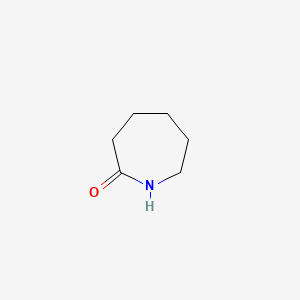
Caprolactam
Epsilon-caprolactam is a member of the class of caprolactams that is azepane substituted by an oxo group at position 2. It has a role as a human blood serum metabolite. — ChEBI
- IUPAC 名称
- azepan-2-one
- 分子式
- C6H11NO
- 分子量
- 113.16 g/mol
- 精确质量
- 113.084063974 Da
- XLogP3
- -0.1
- 拓扑极性表面积
- 29.1 Ų
- 氢键供体
- 1
- 氢键受体
- 1
- 共价单元
- 1
- 已定义的立体中心
- 0
又称
另有 16 个已报告名称
外部数据库标识符
- ChEBI:CHEBI:28579
- ChEMBL:CHEMBL276218
- EPA DTXSID:DTXSID4020240
- PubMed:29968805
- PubMed:22888741
- PubMed:22738851
- PubMed:22548451
- PubMed:22526644
- PubMed:22408965
- PubMed:22359148
- PubMed:22337798
- PubMed:22329416
- PubMed:22319569
- PubMed:22294879
- PubMed:22284875
来自其他科学数据库的证据
EMBL-EBI ChEBI
ε-caprolactam
A member of the class of caprolactams that is azepane substituted by an oxo group at position 2.
- 配方
- C6H11NO
- 平均质量
- 113.160 g/mol
- 单同位素质量
- 113.08406 Da
- 形式电荷
- 0
- caprolactams — is a (CHEBI:23000)
- human blood serum metabolite — has role (CHEBI:85234)
- human blood serum metabolite — has role (CHEBI:85234)
- caprolactams — is a (CHEBI:23000)
其他整理的名称
来自此来源的交叉引用
- REGISTRY_NUMBER: 101802 — Gmelin
- REGISTRY_NUMBER: 106934 — Reaxys
- CAS: 105-60-2 — KEGG COMPOUND
- CAS: 105-60-2 — ChemIDplus
- CAS: 105-60-2 — NIST Chemistry WebBook
- MANUAL_X_REF: C00000318 — KNApSAcK
- MANUAL_X_REF: c0432 — UM-BBD
- MANUAL_X_REF: C06593 — KEGG COMPOUND
- MANUAL_X_REF: Caprolactam — Wikipedia
- MANUAL_X_REF: CPD-883 — MetaCyc
- MANUAL_X_REF: ICC — PDBeChem
- MANUAL_X_REF: KR20120003540 — Patent
- MANUAL_X_REF: US2011183386 — Patent
- MANUAL_X_REF: WO2011108251 — Patent
映射方: Exact CAS cross-reference in the ChEBI compound record. 来源更新: 2020-05-21. 检索时间: 2026-08-31. 打开来源记录
NIH PubChem PUG-View
Attributed physical-property, hazard, environmental and use annotations.
- Autoignition Temperature: 707 °F (NTP, 1992) 来源: CAMEO Chemicals
- Autoignition Temperature: 375 °C 来源: ILO-WHO International Chemical Safety Cards (ICSCs)
- Boiling Point: 512.4 °F at 760 mmHg (NTP, 1992) 来源: CAMEO Chemicals
- Boiling Point: 270 °C 来源: Hazardous Substances Data Bank (HSDB)
- Boiling Point: BP: 180 °C @ 50 mm Hg 来源: Hazardous Substances Data Bank (HSDB)
- Boiling Point: 267 °C 来源: ILO-WHO International Chemical Safety Cards (ICSCs)
- Boiling Point: 515 °F 来源: Occupational Safety and Health Administration (OSHA)
- Boiling Point: 270 °C @760 [mm Hg] 来源: PAC Chemical Database, U.S. Department of Energy
- Boiling Point: 515 °F 来源: The National Institute for Occupational Safety and Health (NIOSH)
- Color/Form: Hygroscopic leaflets from petroleum ether 来源: Hazardous Substances Data Bank (HSDB)
- Color/Form: White, crystalline solid or flakes ... [Note: Significant vapor concentrations would be expected only at elevated temperatures]. 来源: Hazardous Substances Data Bank (HSDB)
- Color/Form: White flakes or fused 来源: Hazardous Substances Data Bank (HSDB)
- Density: 1.02 at 170.6 °F (USCG, 1999) - Denser than water; will sink 来源: CAMEO Chemicals
- Density: Specific gravity: 1.02 at 75 °C/4 °C (liq) 来源: Hazardous Substances Data Bank (HSDB)
- Density: Density: 1.05 @ 25 °C/4 °C /70% aq soln/ 来源: Hazardous Substances Data Bank (HSDB)
- Density: Relative density (water = 1): 1.02 来源: ILO-WHO International Chemical Safety Cards (ICSCs)
- Density: 1.02 来源: Occupational Safety and Health Administration (OSHA)
- Density: 1.02 @ 75°C in Liquid form 来源: PAC Chemical Database, U.S. Department of Energy
- Density: 1.01 来源: The National Institute for Occupational Safety and Health (NIOSH)
- Flash Point: 257 °F (NTP, 1992) 来源: CAMEO Chemicals
- Flash Point: 110 °C 来源: Haz-Map, Information on Hazardous Chemicals and Occupational Diseases
- Flash Point: 125 °C o.c. 来源: ILO-WHO International Chemical Safety Cards (ICSCs)
- Flash Point: 282 °F 来源: Occupational Safety and Health Administration (OSHA)
- Flash Point: 282 °F 来源: The National Institute for Occupational Safety and Health (NIOSH)
- LogP: -0.19 来源: ILO-WHO International Chemical Safety Cards (ICSCs)
- Melting Point: 156 °F (NTP, 1992) 来源: CAMEO Chemicals
- Melting Point: 69.3 °C 来源: Hazardous Substances Data Bank (HSDB)
- Melting Point: 70 °C 来源: ILO-WHO International Chemical Safety Cards (ICSCs)
- Melting Point: 156 °F 来源: Occupational Safety and Health Administration (OSHA)
- Melting Point: 69.3 °C 来源: PAC Chemical Database, U.S. Department of Energy
- Melting Point: 156 °F 来源: The National Institute for Occupational Safety and Health (NIOSH)
- Odor: ... Unpleasant odor ... 来源: Hazardous Substances Data Bank (HSDB)
- Physical Description: Caprolactam is a clear to milky white-colored solution with a mild, disagreeable odor. Contact may cause slight irritation to skin, eyes, and mucous membranes. May be mildly toxic by ingestion. The primary hazard is the threat to the environment. Immediate steps should be taken to limit its spread to the environment. As a liquid it can easily penetrate the soil and contaminate groundwater and nearby streams. Used to make other chemicals. 来源: CAMEO Chemicals
- Physical Description: Large Crystals; CBI; Large Crystals; Liquid; Liquid; Liquid; Other Solid 来源: EPA Chemical Data Reporting (CDR)
- Physical Description: White, crystalline solid or flakes with an unpleasant odor; Note: Significant vapor concentrations would be expected only at elevated temperatures; [NIOSH] 来源: Haz-Map, Information on Hazardous Chemicals and Occupational Diseases
- Physical Description: WHITE HYGROSCOPIC CRYSTALS OR FLAKES. 来源: ILO-WHO International Chemical Safety Cards (ICSCs)
- Physical Description: Yellowish solid; Amine, spicy aroma 来源: Joint FAO/WHO Expert Committee on Food Additives (JECFA)
- Physical Description: Clear to milky white-colored solution with a mild, disagreeable odor. 来源: Occupational Safety and Health Administration (OSHA)
- Physical Description: White, crystalline solid or flakes with an unpleasant odor. [Note: Significant vapor concentrations would be expected only at elevated temperatures.] 来源: The National Institute for Occupational Safety and Health (NIOSH)
- Refractive Index: Index of refraction: 1.4965 @ 31 °C/D; 1.4935 @ 40 °C/D /70% aq soln/ 来源: Hazardous Substances Data Bank (HSDB)
- Solubility: greater than or equal to 100 mg/mL at 68.9 °F (NTP, 1992) 来源: CAMEO Chemicals
- Solubility: Soluble in chlorinated solvents, petroleum distillate, and cyclohexene. 来源: Hazardous Substances Data Bank (HSDB)
- Solubility: Freely sol in methanol, ethanol,tetrahydrofurfuryl alc; ether, dimethylformamide, sol in chlorinated hydrocarbons, cyclohexene, petroleum fractions 来源: Hazardous Substances Data Bank (HSDB)
- Solubility: Soluble in benzene, ethanol, and chloroform 来源: Hazardous Substances Data Bank (HSDB)
- Solubility: In water, 5.25X10+6 mg/l @ 25 °C. 来源: Hazardous Substances Data Bank (HSDB)
- Solubility: Solubility in water: good 来源: ILO-WHO International Chemical Safety Cards (ICSCs)
- Solubility: Soluble in water 来源: Joint FAO/WHO Expert Committee on Food Additives (JECFA)
- Solubility: Soluble (in ethanol) 来源: Joint FAO/WHO Expert Committee on Food Additives (JECFA)
- Solubility: 53% 来源: The National Institute for Occupational Safety and Health (NIOSH)
- Vapor Pressure: 0.001 mmHg at 68 °F ; 3 mmHg at 212 °F (NTP, 1992) 来源: CAMEO Chemicals
- Vapor Pressure: 0.0019 [mmHg] 来源: Haz-Map, Information on Hazardous Chemicals and Occupational Diseases
- Vapor Pressure: Vapor pressure: 6 mm Hg @ 120 °C 来源: Hazardous Substances Data Bank (HSDB)
- Vapor Pressure: 1.9X10⁻³ mm Hg at 25 °C 来源: Hazardous Substances Data Bank (HSDB)
- Vapor Pressure: Vapor pressure, Pa at 25 °C: 0.26 来源: ILO-WHO International Chemical Safety Cards (ICSCs)
- Vapor Pressure: 0.00000008 mmHg 来源: Occupational Safety and Health Administration (OSHA)
- Vapor Pressure: 0.00000008 mmHg 来源: The National Institute for Occupational Safety and Health (NIOSH)
- Viscosity: 9 cP @ 78 °C 来源: Hazardous Substances Data Bank (HSDB)
- IARC Carcinogenic Agent: Caprolactam 来源: International Agency for Research on Cancer (IARC)
- IARC Carcinogenic Classes: Group 3: Not classifiable as to its carcinogenicity to humans 来源: International Agency for Research on Cancer (IARC)
- IARC Monographs: Volume 39: (1986) Some Chemicals Used in Plastics and Elastomers; Volume Sup 7: Overall Evaluations of Carcinogenicity: An Updating of IARC Monographs Volumes 1 to 42, 1987; 440 pages; ISBN 92-832-1411-0 (out of print); Volume 71: (1999) Re-evaluation of Some Organic Chemicals, Hydrazine and Hydrogen Peroxide (Part 1, Part 2, Part 3) 来源: International Agency for Research on Cancer (IARC)
- Publication Year: 1999 来源: International Agency for Research on Cancer (IARC)
- Evaluation Year: 1998 来源: International Agency for Research on Cancer (IARC)
- Additional information: Moved to Group 3 following 2019 update to the IARC Monographs Preamble 来源: International Agency for Research on Cancer (IARC)
- Substance: Caprolactam 来源: NTP Technical Reports
- NTP Technical Report: TR-214: Carcinogenesis Bioassay of Caprolactam (CASRN 105-60-2) in F344 Rats and B6C3F1 Mice (Feed Study) (1982 ) 来源: NTP Technical Reports
- Peer Review Date: 06/27/80 来源: NTP Technical Reports
- Conclusion for Male Rat: No Evidence 来源: NTP Technical Reports
- Conclusion for Female Rat: No Evidence 来源: NTP Technical Reports
- Conclusion for Male Mice: No Evidence 来源: NTP Technical Reports
- Exposure Routes: The substance can be absorbed into the body by inhalation of its aerosol. 来源: ILO-WHO International Chemical Safety Cards (ICSCs)
- Exposure Routes: inhalation, ingestion, skin and/or eye contact 来源: The National Institute for Occupational Safety and Health (NIOSH)
- First Aid: EYES: First check the victim for contact lenses and remove if present. Flush victim's eyes with water or normal saline solution for 20 to 30 minutes while simultaneously calling a hospital or poison control center. Do not put any ointments, oils, or medication in the victim's eyes without specific instructions from a physician. IMMEDIATELY transport the victim after flushing eyes to a hospital even if no symptoms (such as redness or irritation) develop.; SKIN: IMMEDIATELY flood affected skin with water while removing and isolating all contaminated clothing. Gently wash all affected skin areas thoroughly with soap and water. If symptoms such as redness or irritation develop, IMMEDIATELY call a physician and be prepared to transport the victim to a hospital for treatment.; INHALATION: IMMEDIATELY leave the contaminated area; take deep breaths of fresh air. If symptoms (such as wheezing, coughing, shortness of breath, or burning in the mouth, throat, or chest) develop, call a physician and be prepared to transport the victim to a hospital. Provide proper respiratory protection to rescuers entering an unknown atmosphere. Whenever possible, Self-Contained Breathing Apparatus (SCBA) shou 来源: CAMEO Chemicals
- First Aid: (General first aid procedures); Eye: Irrigate immediately - If this chemical contacts the eyes, immediately wash (irrigate) the eyes with large amounts of water, occasionally lifting the lower and upper lids. Get medical attention immediately.; Skin: Water wash immediately - If this chemical contacts the skin, immediately wash the contaminated skin with water. If this chemical penetrates the clothing, immediately remove the clothing and wash the skin with water. If symptoms occur after washing, get medical attention immediately.; Breathing: Respiratory support; Swallow: Medical attention immediately - If this chemical has been swallowed, get medical attention immediately. 来源: The National Institute for Occupational Safety and Health (NIOSH)
- Signal: Warning 来源: Regulation (EC) No 1272/2008 of the European Parliament and of the Council
- GHS Hazard Statements: H302: Harmful if swallowed [Warning Acute toxicity, oral]; H315: Causes skin irritation [Warning Skin corrosion/irritation]; H319: Causes serious eye irritation [Warning Serious eye damage/eye irritation]; H332: Harmful if inhaled [Warning Acute toxicity, inhalation]; H335: May cause respiratory irritation [Warning Specific target organ toxicity, single exposure; Respiratory tract irritation] 来源: Regulation (EC) No 1272/2008 of the European Parliament and of the Council
- Precautionary Statement Codes: P261, P264, P264+P265, P270, P271, P280, P301+P317, P302+P352, P304+P340, P305+P351+P338, P317, P319, P321, P330, P332+P317, P337+P317, P362+P364, P403+P233, P405, and P501 (click each P-code to see the statement) 来源: Regulation (EC) No 1272/2008 of the European Parliament and of the Council
- Note: This chemical does not meet GHS hazard criteria for < 0.1% (1 of 1874) of reports. 来源: European Chemicals Agency (ECHA)
- Signal: Warning 来源: European Chemicals Agency (ECHA)
- GHS Hazard Statements: H302 (99.9%): Harmful if swallowed [Warning Acute toxicity, oral]; H315 (99.9%): Causes skin irritation [Warning Skin corrosion/irritation]; H319 (99.9%): Causes serious eye irritation [Warning Serious eye damage/eye irritation]; H332 (99.9%): Harmful if inhaled [Warning Acute toxicity, inhalation]; H335 (95.8%): May cause respiratory irritation [Warning Specific target organ toxicity, single exposure; Respiratory tract irritation] 来源: European Chemicals Agency (ECHA)
- Precautionary Statement Codes: P261, P264, P264+P265, P270, P271, P280, P301+P317, P302+P352, P304+P340, P305+P351+P338, P317, P319, P321, P330, P332+P317, P337+P317, P362+P364, P403+P233, P405, and P501 (click each P-code to see the statement) 来源: European Chemicals Agency (ECHA)
- ECHA C&L Notifications Summary: Aggregated GHS information provided per 1874 reports by companies from 31 notifications to the ECHA C&L Inventory. Each notification may be associated with multiple companies.; Reported as not meeting GHS hazard criteria per 1 of 1874 reports by companies.; There are 30 notifications provided by 1873 of 1874 reports by companies with hazard statement code(s).; Information may vary between notifications depending on impurities, additives, and other factors. The percentage value in parenthesis indicates the notified classification ratio from companies that provide hazard codes. Only hazard codes with percentage values above 10% are shown. For more detailed information, please visit ECHA C&L website. 来源: European Chemicals Agency (ECHA)
- Signal: Danger 来源: NITE-CMC
- GHS Hazard Statements: H302: Harmful if swallowed [Warning Acute toxicity, oral]; H312: Harmful in contact with skin [Warning Acute toxicity, dermal]; H315: Causes skin irritation [Warning Skin corrosion/irritation]; H319: Causes serious eye irritation [Warning Serious eye damage/eye irritation]; H335: May cause respiratory irritation [Warning Specific target organ toxicity, single exposure; Respiratory tract irritation]; H361: Suspected of damaging fertility or the unborn child [Warning Reproductive toxicity]; H371: May cause damage to organs [Warning Specific target organ toxicity, single exposure]; H372: Causes damage to organs through prolonged or repeated exposure [Danger Specific target organ toxicity, repeated exposure] 来源: NITE-CMC
- Precautionary Statement Codes: P203, P260, P261, P264, P264+P265, P270, P271, P280, P301+P317, P302+P352, P304+P340, P305+P351+P338, P308+P316, P317, P318, P319, P321, P330, P332+P317, P337+P317, P362+P364, P403+P233, P405, and P501 (click each P-code to see the statement) 来源: NITE-CMC
- GHS Hazard Statements: H302: Harmful if swallowed [Warning Acute toxicity, oral]; H312: Harmful in contact with skin [Warning Acute toxicity, dermal]; H316: Causes mild skin irritation [Warning Skin corrosion/irritation]; H319: Causes serious eye irritation [Warning Serious eye damage/eye irritation]; H335: May cause respiratory irritation [Warning Specific target organ toxicity, single exposure; Respiratory tract irritation]; H336: May cause drowsiness or dizziness [Warning Specific target organ toxicity, single exposure; Narcotic effects]; H370: Causes damage to organs [Danger Specific target organ toxicity, single exposure]; H372: Causes damage to organs through prolonged or repeated exposure [Danger Specific target organ toxicity, repeated exposure] 来源: NITE-CMC
- Target Organs: Developmental 来源: EPA Integrated Risk Information System (IRIS)
- Target Organs: Eyes, skin, respiratory system, central nervous system, cardiovascular system, liver, kidneys 来源: The National Institute for Occupational Safety and Health (NIOSH)
- Environmental Bioconcentration: An estimated BCF of 3.2 was calculated for caprolactam(SRC), using an estimated log Kow of 0.66(1,SRC) and a regression-derived equation(2). According to a classification scheme(3), this BCF suggests the potential for bioconcentration in aquatic organisms is low. 来源: Hazardous Substances Data Bank (HSDB)
- Environmental Fate: TERRESTRIAL FATE: Based on a classification scheme(1), an estimated Koc value of 57(SRC), determined from a structure estimation method(2), indicates that caprolactam is expected to have high mobility in soil(SRC). Volatilization of caprolactam from moist soil surfaces is not expected to be an important fate process(SRC) given an estimated Henry's Law constant of 5.4X10⁻¹¹ atm-cu m/mole from its vapor pressure, 1.9X10⁻³ mm Hg at 25 °C(5), and water solubility, 5.25X10+6 mg/l(6). Caprolactam is not expected to volatilize from dry soil surfaces(SRC) based upon a vapor pressure of 1.9X10⁻³ mm Hg at 25 °C(5). Caprolactam is degraded in aquatic environments with a half life of 5 to 15 days, and is expected to be degraded in aerobic soils in a similar timeframe(6). 来源: Hazardous Substances Data Bank (HSDB)
- Environmental Fate: AQUATIC FATE: Based on a classification scheme(1), an estimated Koc value of 57(SRC), determined from an estimation method(2), indicates that caprolactam is not expected to adsorb to suspended solids or to sediments in water(SRC). Volatilization from water surfaces is not expected(3) based upon an estimated Henry's Law constant of 5.4X10⁻¹¹ atm-cu m/mole(SRC) calculated from its vapor pressure, 1.9X10⁻³ mm Hg at 25 °C(4), and water solubility, 5.25X10+6 mg/l(5). According to a classification scheme(6), an estimated BCF of 3.1(SRC), from an estimated log Kow of 0.66(7) suggests the potential for bioconcentration in aquatic organisms is low. Biodegradation in aquatic environments is expected to be extensive; complete degradation of 50-100 ug/ml caprolactam was observed in nutrient-amended or sediment-associated lake water in 21 days(8). Slightly less caprolactam was degraded (36-85%) after 21 days if higher concentrations (1000 to 2000 ug/ml) were used. However, in none of these control cases was any complete degradation (mineralization) of the caprolactam observed. Based on very slow hydrolysis rates of other aliphatic acid amides, hydrolysis is not expected to be an important fate 来源: Hazardous Substances Data Bank (HSDB)
- Environmental Fate: ATMOSPHERIC FATE: According to a model of gas/particle partitioning of semivolatile organic compounds in the atmosphere(1), caprolactam, which has a vapor pressure of 1.9X10⁻³ mm Hg at 25 °C(4), is expected to exist solely as a vapor in the ambient atmosphere. Vapor-phase caprolactam is degraded in the atmosphere by reaction with photochemically-produced hydroxyl radicals(SRC); the half-life for this reaction in air is estimated to be 21 hours(SRC), calculated from its rate constant of 18X10-12 cu cm/molecule-sec at 25 °C(3). Caprolactam does not absorb light in the environmental spectrum (>290 nm), indicating there is little potential for direct photolysis. 来源: Hazardous Substances Data Bank (HSDB)
- Consumer Uses: Monomers; Dye; Intermediate; Catalyst; Soil amendments (fertilizers) 来源: EPA Chemical Data Reporting (CDR)
- Industry Uses: Dye; Intermediate; Catalyst; Not Known or Reasonably Ascertainable; Processing aids not otherwise specified; Monomers; Solvent 来源: EPA Chemical Data Reporting (CDR)
- Uses: Caprolactam is primarily used in the manufacture of synthetic fibers (especially Nylon 6). Caprolactam is also used in brush bristles, textile stiffeners, film coatings, synthetic leather, plastics, plasticizers, paint vehicles, cross-linking for polyurethanes, and in the synthesis of lysine. 来源: EPA Hazardous Air Pollutants
- Sources/Uses: Used as a monomer for synthetic fibers, plastics, coatings, plasticizers, and paint vehicles and as a cross-linking agent for polyurethanes. [ACGIH] 来源: Haz-Map, Information on Hazardous Chemicals and Occupational Diseases
- Industrial Processes with risk of exposure: Painting (Pigments, Binders, and Biocides) [Category: Paint]; Plastic Composites Manufacturing [Category: Industry] 来源: Haz-Map, Information on Hazardous Chemicals and Occupational Diseases
- Uses: Mfr synthetic fibers of the polyamide type (Perlon); solvent for high mol wt polymers 来源: Hazardous Substances Data Bank (HSDB)
- Uses: Manufacture of synthetic fibers (especially nylon 6), plastics, bristles, film, coatings, synthetic leather, plasticizers and paint vehicles, cross-linking agent for polyurethanes, synthesis of amino acid lysine. 来源: Hazardous Substances Data Bank (HSDB)
- Uses: US FDA PERMITS USE OF CAPROLACTAM ETHYLENE-ETHYL ACRYLATE GRAFT POLYMERS AS COMPONENT OF SIDE SEAM CEMENTS INTENDED FOR USE IN CONTACT WITH FOOD ... 来源: Hazardous Substances Data Bank (HSDB)
映射方: Existing checksum-valid CAS to unique PubChem CID match. 检索时间: 2026-08-31. 打开来源记录
科学分类和危害注释仅提供背景信息,不能取代上方所示针对具体市场的监管决定。
其他来源的覆盖范围和匹配状态
| 来源 | 结果 | 已检查 |
|---|---|---|
| EMBL-EBI ChEBI | 精确匹配 | 2026-08-31 |
| NIH PubChem PUG-View | 精确匹配 | 2026-08-31 |
已记录的无匹配结果是该来源已被检查的有效证据;这并不表示该物质在别处不存在。
于 2026-08-31 通过校验和有效的 CAS 匹配从美国国立卫生研究院 (NIH) PubChem 检索。化学性质不能取代本页的监管决定。
相关清单证据
配方功能重叠的成分
其他官方和科学来源
11 个可用于核查此身份的外部数据库
每个链接都会在该来源中搜索此身份。 各来源是什么及其法律效力
CAPROLACTAM 在 CosIng 清单中的呈现方式
CosIng 清单将 CAPROLACTAM 列为化妆品成分,本页将其关联到 0 条附件记录。清单条目记录名称和标识符,而附件记录显示该物质在欧盟化妆品法规中被禁用、限用或列入准用清单的情况。
在官方数据中,CAPROLACTAM 还被标记了 1 项化妆品功能。功能标识描述预期用途,但不能取代在配方或标签工作之前对关联附件记录的监管审查。