
CAPROLACTAM
2H-Azepin-2-one, hexahydro-
CAPROLACTAM figure dans l’inventaire CosIng de l’UE, mais aucune fiche d’annexe directe n’est encore associée sur cette page.
En un coup d’œil
- Fonction
- Not reported
- CAS
- 105-60-2
- EC
- 203-313-2
- Annexes de l’UE
- Non répertoriéAucune fiche d’annexe de l’UE n’est associée. Ce n’est pas une autorisation.
Preuves réglementaires par marché
Aucune règle pour cet ingrédient n’a été importée pour aucun des 13 marchés suivis ici.
Cela décrit cet inventaire, et non le droit. L’absence de règle importée n’est pas la preuve qu’un ingrédient est autorisé : une règle peut exister sous un autre nom ou identifiant, ou dans un jeu de données pas encore importé ici.
Détails d’inventaire pour CAPROLACTAM
Nom INCI
CAPROLACTAM
Description
2H-Azepin-2-one, hexahydro-
Provenance de la fiche
- Référence d’inventaire
- 97428
- Identité importée
- CAPROLACTAM
- Mise à jour de la source
- 14/10/2019
Fiches d’annexe pour CAPROLACTAM
Données clés
Identité et propriétés chimiques
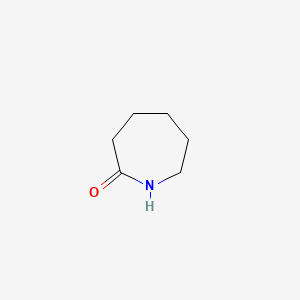
Caprolactam
Epsilon-caprolactam is a member of the class of caprolactams that is azepane substituted by an oxo group at position 2. It has a role as a human blood serum metabolite. — ChEBI
- Nom IUPAC
- azepan-2-one
- Formule moléculaire
- C6H11NO
- Masse moléculaire
- 113.16 g/mol
- Masse exacte
- 113.084063974 Da
- XLogP3
- -0,1
- Surface polaire topologique
- 29,1 Ų
- Donneurs de liaisons hydrogène
- 1
- Accepteurs de liaisons hydrogène
- 1
- Unités covalentes
- 1
- Stéréocentres définis
- 0
Également connu sous le nom de
16 autres noms signalés
Identifiants de bases de données externes
- ChEBI:CHEBI:28579
- ChEMBL:CHEMBL276218
- EPA DTXSID:DTXSID4020240
- PubMed:29968805
- PubMed:22888741
- PubMed:22738851
- PubMed:22548451
- PubMed:22526644
- PubMed:22408965
- PubMed:22359148
- PubMed:22337798
- PubMed:22329416
- PubMed:22319569
- PubMed:22294879
- PubMed:22284875
Preuves issues de bases de données scientifiques complémentaires
EMBL-EBI ChEBI
ε-caprolactam
A member of the class of caprolactams that is azepane substituted by an oxo group at position 2.
- Formule
- C6H11NO
- Masse moyenne
- 113.160 g/mol
- Masse monoisotopique
- 113.08406 Da
- Charge formelle
- 0
- caprolactams — is a (CHEBI:23000)
- human blood serum metabolite — has role (CHEBI:85234)
- human blood serum metabolite — has role (CHEBI:85234)
- caprolactams — is a (CHEBI:23000)
Noms supplémentaires validés
Références croisées de cette source
- REGISTRY_NUMBER: 101802 — Gmelin
- REGISTRY_NUMBER: 106934 — Reaxys
- CAS: 105-60-2 — KEGG COMPOUND
- CAS: 105-60-2 — ChemIDplus
- CAS: 105-60-2 — NIST Chemistry WebBook
- MANUAL_X_REF: C00000318 — KNApSAcK
- MANUAL_X_REF: c0432 — UM-BBD
- MANUAL_X_REF: C06593 — KEGG COMPOUND
- MANUAL_X_REF: Caprolactam — Wikipedia
- MANUAL_X_REF: CPD-883 — MetaCyc
- MANUAL_X_REF: ICC — PDBeChem
- MANUAL_X_REF: KR20120003540 — Patent
- MANUAL_X_REF: US2011183386 — Patent
- MANUAL_X_REF: WO2011108251 — Patent
Mis en correspondance par: Exact CAS cross-reference in the ChEBI compound record. Source mise à jour le: 2020-05-21. Récupéré le: 2026-08-31. Ouvrir la fiche source
NIH PubChem PUG-View
Attributed physical-property, hazard, environmental and use annotations.
- Autoignition Temperature: 707 °F (NTP, 1992) Source: CAMEO Chemicals
- Autoignition Temperature: 375 °C Source: ILO-WHO International Chemical Safety Cards (ICSCs)
- Boiling Point: 512.4 °F at 760 mmHg (NTP, 1992) Source: CAMEO Chemicals
- Boiling Point: 270 °C Source: Hazardous Substances Data Bank (HSDB)
- Boiling Point: BP: 180 °C @ 50 mm Hg Source: Hazardous Substances Data Bank (HSDB)
- Boiling Point: 267 °C Source: ILO-WHO International Chemical Safety Cards (ICSCs)
- Boiling Point: 515 °F Source: Occupational Safety and Health Administration (OSHA)
- Boiling Point: 270 °C @760 [mm Hg] Source: PAC Chemical Database, U.S. Department of Energy
- Boiling Point: 515 °F Source: The National Institute for Occupational Safety and Health (NIOSH)
- Color/Form: Hygroscopic leaflets from petroleum ether Source: Hazardous Substances Data Bank (HSDB)
- Color/Form: White, crystalline solid or flakes ... [Note: Significant vapor concentrations would be expected only at elevated temperatures]. Source: Hazardous Substances Data Bank (HSDB)
- Color/Form: White flakes or fused Source: Hazardous Substances Data Bank (HSDB)
- Density: 1.02 at 170.6 °F (USCG, 1999) - Denser than water; will sink Source: CAMEO Chemicals
- Density: Specific gravity: 1.02 at 75 °C/4 °C (liq) Source: Hazardous Substances Data Bank (HSDB)
- Density: Density: 1.05 @ 25 °C/4 °C /70% aq soln/ Source: Hazardous Substances Data Bank (HSDB)
- Density: Relative density (water = 1): 1.02 Source: ILO-WHO International Chemical Safety Cards (ICSCs)
- Density: 1.02 Source: Occupational Safety and Health Administration (OSHA)
- Density: 1.02 @ 75°C in Liquid form Source: PAC Chemical Database, U.S. Department of Energy
- Density: 1.01 Source: The National Institute for Occupational Safety and Health (NIOSH)
- Flash Point: 257 °F (NTP, 1992) Source: CAMEO Chemicals
- Flash Point: 110 °C Source: Haz-Map, Information on Hazardous Chemicals and Occupational Diseases
- Flash Point: 125 °C o.c. Source: ILO-WHO International Chemical Safety Cards (ICSCs)
- Flash Point: 282 °F Source: Occupational Safety and Health Administration (OSHA)
- Flash Point: 282 °F Source: The National Institute for Occupational Safety and Health (NIOSH)
- LogP: -0.19 Source: ILO-WHO International Chemical Safety Cards (ICSCs)
- Melting Point: 156 °F (NTP, 1992) Source: CAMEO Chemicals
- Melting Point: 69.3 °C Source: Hazardous Substances Data Bank (HSDB)
- Melting Point: 70 °C Source: ILO-WHO International Chemical Safety Cards (ICSCs)
- Melting Point: 156 °F Source: Occupational Safety and Health Administration (OSHA)
- Melting Point: 69.3 °C Source: PAC Chemical Database, U.S. Department of Energy
- Melting Point: 156 °F Source: The National Institute for Occupational Safety and Health (NIOSH)
- Odor: ... Unpleasant odor ... Source: Hazardous Substances Data Bank (HSDB)
- Physical Description: Caprolactam is a clear to milky white-colored solution with a mild, disagreeable odor. Contact may cause slight irritation to skin, eyes, and mucous membranes. May be mildly toxic by ingestion. The primary hazard is the threat to the environment. Immediate steps should be taken to limit its spread to the environment. As a liquid it can easily penetrate the soil and contaminate groundwater and nearby streams. Used to make other chemicals. Source: CAMEO Chemicals
- Physical Description: Large Crystals; CBI; Large Crystals; Liquid; Liquid; Liquid; Other Solid Source: EPA Chemical Data Reporting (CDR)
- Physical Description: White, crystalline solid or flakes with an unpleasant odor; Note: Significant vapor concentrations would be expected only at elevated temperatures; [NIOSH] Source: Haz-Map, Information on Hazardous Chemicals and Occupational Diseases
- Physical Description: WHITE HYGROSCOPIC CRYSTALS OR FLAKES. Source: ILO-WHO International Chemical Safety Cards (ICSCs)
- Physical Description: Yellowish solid; Amine, spicy aroma Source: Joint FAO/WHO Expert Committee on Food Additives (JECFA)
- Physical Description: Clear to milky white-colored solution with a mild, disagreeable odor. Source: Occupational Safety and Health Administration (OSHA)
- Physical Description: White, crystalline solid or flakes with an unpleasant odor. [Note: Significant vapor concentrations would be expected only at elevated temperatures.] Source: The National Institute for Occupational Safety and Health (NIOSH)
- Refractive Index: Index of refraction: 1.4965 @ 31 °C/D; 1.4935 @ 40 °C/D /70% aq soln/ Source: Hazardous Substances Data Bank (HSDB)
- Solubility: greater than or equal to 100 mg/mL at 68.9 °F (NTP, 1992) Source: CAMEO Chemicals
- Solubility: Soluble in chlorinated solvents, petroleum distillate, and cyclohexene. Source: Hazardous Substances Data Bank (HSDB)
- Solubility: Freely sol in methanol, ethanol,tetrahydrofurfuryl alc; ether, dimethylformamide, sol in chlorinated hydrocarbons, cyclohexene, petroleum fractions Source: Hazardous Substances Data Bank (HSDB)
- Solubility: Soluble in benzene, ethanol, and chloroform Source: Hazardous Substances Data Bank (HSDB)
- Solubility: In water, 5.25X10+6 mg/l @ 25 °C. Source: Hazardous Substances Data Bank (HSDB)
- Solubility: Solubility in water: good Source: ILO-WHO International Chemical Safety Cards (ICSCs)
- Solubility: Soluble in water Source: Joint FAO/WHO Expert Committee on Food Additives (JECFA)
- Solubility: Soluble (in ethanol) Source: Joint FAO/WHO Expert Committee on Food Additives (JECFA)
- Solubility: 53% Source: The National Institute for Occupational Safety and Health (NIOSH)
- Vapor Pressure: 0.001 mmHg at 68 °F ; 3 mmHg at 212 °F (NTP, 1992) Source: CAMEO Chemicals
- Vapor Pressure: 0.0019 [mmHg] Source: Haz-Map, Information on Hazardous Chemicals and Occupational Diseases
- Vapor Pressure: Vapor pressure: 6 mm Hg @ 120 °C Source: Hazardous Substances Data Bank (HSDB)
- Vapor Pressure: 1.9X10⁻³ mm Hg at 25 °C Source: Hazardous Substances Data Bank (HSDB)
- Vapor Pressure: Vapor pressure, Pa at 25 °C: 0.26 Source: ILO-WHO International Chemical Safety Cards (ICSCs)
- Vapor Pressure: 0.00000008 mmHg Source: Occupational Safety and Health Administration (OSHA)
- Vapor Pressure: 0.00000008 mmHg Source: The National Institute for Occupational Safety and Health (NIOSH)
- Viscosity: 9 cP @ 78 °C Source: Hazardous Substances Data Bank (HSDB)
- IARC Carcinogenic Agent: Caprolactam Source: International Agency for Research on Cancer (IARC)
- IARC Carcinogenic Classes: Group 3: Not classifiable as to its carcinogenicity to humans Source: International Agency for Research on Cancer (IARC)
- IARC Monographs: Volume 39: (1986) Some Chemicals Used in Plastics and Elastomers; Volume Sup 7: Overall Evaluations of Carcinogenicity: An Updating of IARC Monographs Volumes 1 to 42, 1987; 440 pages; ISBN 92-832-1411-0 (out of print); Volume 71: (1999) Re-evaluation of Some Organic Chemicals, Hydrazine and Hydrogen Peroxide (Part 1, Part 2, Part 3) Source: International Agency for Research on Cancer (IARC)
- Publication Year: 1999 Source: International Agency for Research on Cancer (IARC)
- Evaluation Year: 1998 Source: International Agency for Research on Cancer (IARC)
- Additional information: Moved to Group 3 following 2019 update to the IARC Monographs Preamble Source: International Agency for Research on Cancer (IARC)
- Substance: Caprolactam Source: NTP Technical Reports
- NTP Technical Report: TR-214: Carcinogenesis Bioassay of Caprolactam (CASRN 105-60-2) in F344 Rats and B6C3F1 Mice (Feed Study) (1982 ) Source: NTP Technical Reports
- Peer Review Date: 06/27/80 Source: NTP Technical Reports
- Conclusion for Male Rat: No Evidence Source: NTP Technical Reports
- Conclusion for Female Rat: No Evidence Source: NTP Technical Reports
- Conclusion for Male Mice: No Evidence Source: NTP Technical Reports
- Exposure Routes: The substance can be absorbed into the body by inhalation of its aerosol. Source: ILO-WHO International Chemical Safety Cards (ICSCs)
- Exposure Routes: inhalation, ingestion, skin and/or eye contact Source: The National Institute for Occupational Safety and Health (NIOSH)
- First Aid: EYES: First check the victim for contact lenses and remove if present. Flush victim's eyes with water or normal saline solution for 20 to 30 minutes while simultaneously calling a hospital or poison control center. Do not put any ointments, oils, or medication in the victim's eyes without specific instructions from a physician. IMMEDIATELY transport the victim after flushing eyes to a hospital even if no symptoms (such as redness or irritation) develop.; SKIN: IMMEDIATELY flood affected skin with water while removing and isolating all contaminated clothing. Gently wash all affected skin areas thoroughly with soap and water. If symptoms such as redness or irritation develop, IMMEDIATELY call a physician and be prepared to transport the victim to a hospital for treatment.; INHALATION: IMMEDIATELY leave the contaminated area; take deep breaths of fresh air. If symptoms (such as wheezing, coughing, shortness of breath, or burning in the mouth, throat, or chest) develop, call a physician and be prepared to transport the victim to a hospital. Provide proper respiratory protection to rescuers entering an unknown atmosphere. Whenever possible, Self-Contained Breathing Apparatus (SCBA) shou Source: CAMEO Chemicals
- First Aid: (General first aid procedures); Eye: Irrigate immediately - If this chemical contacts the eyes, immediately wash (irrigate) the eyes with large amounts of water, occasionally lifting the lower and upper lids. Get medical attention immediately.; Skin: Water wash immediately - If this chemical contacts the skin, immediately wash the contaminated skin with water. If this chemical penetrates the clothing, immediately remove the clothing and wash the skin with water. If symptoms occur after washing, get medical attention immediately.; Breathing: Respiratory support; Swallow: Medical attention immediately - If this chemical has been swallowed, get medical attention immediately. Source: The National Institute for Occupational Safety and Health (NIOSH)
- Signal: Warning Source: Regulation (EC) No 1272/2008 of the European Parliament and of the Council
- GHS Hazard Statements: H302: Harmful if swallowed [Warning Acute toxicity, oral]; H315: Causes skin irritation [Warning Skin corrosion/irritation]; H319: Causes serious eye irritation [Warning Serious eye damage/eye irritation]; H332: Harmful if inhaled [Warning Acute toxicity, inhalation]; H335: May cause respiratory irritation [Warning Specific target organ toxicity, single exposure; Respiratory tract irritation] Source: Regulation (EC) No 1272/2008 of the European Parliament and of the Council
- Precautionary Statement Codes: P261, P264, P264+P265, P270, P271, P280, P301+P317, P302+P352, P304+P340, P305+P351+P338, P317, P319, P321, P330, P332+P317, P337+P317, P362+P364, P403+P233, P405, and P501 (click each P-code to see the statement) Source: Regulation (EC) No 1272/2008 of the European Parliament and of the Council
- Note: This chemical does not meet GHS hazard criteria for < 0.1% (1 of 1874) of reports. Source: European Chemicals Agency (ECHA)
- Signal: Warning Source: European Chemicals Agency (ECHA)
- GHS Hazard Statements: H302 (99.9%): Harmful if swallowed [Warning Acute toxicity, oral]; H315 (99.9%): Causes skin irritation [Warning Skin corrosion/irritation]; H319 (99.9%): Causes serious eye irritation [Warning Serious eye damage/eye irritation]; H332 (99.9%): Harmful if inhaled [Warning Acute toxicity, inhalation]; H335 (95.8%): May cause respiratory irritation [Warning Specific target organ toxicity, single exposure; Respiratory tract irritation] Source: European Chemicals Agency (ECHA)
- Precautionary Statement Codes: P261, P264, P264+P265, P270, P271, P280, P301+P317, P302+P352, P304+P340, P305+P351+P338, P317, P319, P321, P330, P332+P317, P337+P317, P362+P364, P403+P233, P405, and P501 (click each P-code to see the statement) Source: European Chemicals Agency (ECHA)
- ECHA C&L Notifications Summary: Aggregated GHS information provided per 1874 reports by companies from 31 notifications to the ECHA C&L Inventory. Each notification may be associated with multiple companies.; Reported as not meeting GHS hazard criteria per 1 of 1874 reports by companies.; There are 30 notifications provided by 1873 of 1874 reports by companies with hazard statement code(s).; Information may vary between notifications depending on impurities, additives, and other factors. The percentage value in parenthesis indicates the notified classification ratio from companies that provide hazard codes. Only hazard codes with percentage values above 10% are shown. For more detailed information, please visit ECHA C&L website. Source: European Chemicals Agency (ECHA)
- Signal: Danger Source: NITE-CMC
- GHS Hazard Statements: H302: Harmful if swallowed [Warning Acute toxicity, oral]; H312: Harmful in contact with skin [Warning Acute toxicity, dermal]; H315: Causes skin irritation [Warning Skin corrosion/irritation]; H319: Causes serious eye irritation [Warning Serious eye damage/eye irritation]; H335: May cause respiratory irritation [Warning Specific target organ toxicity, single exposure; Respiratory tract irritation]; H361: Suspected of damaging fertility or the unborn child [Warning Reproductive toxicity]; H371: May cause damage to organs [Warning Specific target organ toxicity, single exposure]; H372: Causes damage to organs through prolonged or repeated exposure [Danger Specific target organ toxicity, repeated exposure] Source: NITE-CMC
- Precautionary Statement Codes: P203, P260, P261, P264, P264+P265, P270, P271, P280, P301+P317, P302+P352, P304+P340, P305+P351+P338, P308+P316, P317, P318, P319, P321, P330, P332+P317, P337+P317, P362+P364, P403+P233, P405, and P501 (click each P-code to see the statement) Source: NITE-CMC
- GHS Hazard Statements: H302: Harmful if swallowed [Warning Acute toxicity, oral]; H312: Harmful in contact with skin [Warning Acute toxicity, dermal]; H316: Causes mild skin irritation [Warning Skin corrosion/irritation]; H319: Causes serious eye irritation [Warning Serious eye damage/eye irritation]; H335: May cause respiratory irritation [Warning Specific target organ toxicity, single exposure; Respiratory tract irritation]; H336: May cause drowsiness or dizziness [Warning Specific target organ toxicity, single exposure; Narcotic effects]; H370: Causes damage to organs [Danger Specific target organ toxicity, single exposure]; H372: Causes damage to organs through prolonged or repeated exposure [Danger Specific target organ toxicity, repeated exposure] Source: NITE-CMC
- Target Organs: Developmental Source: EPA Integrated Risk Information System (IRIS)
- Target Organs: Eyes, skin, respiratory system, central nervous system, cardiovascular system, liver, kidneys Source: The National Institute for Occupational Safety and Health (NIOSH)
- Environmental Bioconcentration: An estimated BCF of 3.2 was calculated for caprolactam(SRC), using an estimated log Kow of 0.66(1,SRC) and a regression-derived equation(2). According to a classification scheme(3), this BCF suggests the potential for bioconcentration in aquatic organisms is low. Source: Hazardous Substances Data Bank (HSDB)
- Environmental Fate: TERRESTRIAL FATE: Based on a classification scheme(1), an estimated Koc value of 57(SRC), determined from a structure estimation method(2), indicates that caprolactam is expected to have high mobility in soil(SRC). Volatilization of caprolactam from moist soil surfaces is not expected to be an important fate process(SRC) given an estimated Henry's Law constant of 5.4X10⁻¹¹ atm-cu m/mole from its vapor pressure, 1.9X10⁻³ mm Hg at 25 °C(5), and water solubility, 5.25X10+6 mg/l(6). Caprolactam is not expected to volatilize from dry soil surfaces(SRC) based upon a vapor pressure of 1.9X10⁻³ mm Hg at 25 °C(5). Caprolactam is degraded in aquatic environments with a half life of 5 to 15 days, and is expected to be degraded in aerobic soils in a similar timeframe(6). Source: Hazardous Substances Data Bank (HSDB)
- Environmental Fate: AQUATIC FATE: Based on a classification scheme(1), an estimated Koc value of 57(SRC), determined from an estimation method(2), indicates that caprolactam is not expected to adsorb to suspended solids or to sediments in water(SRC). Volatilization from water surfaces is not expected(3) based upon an estimated Henry's Law constant of 5.4X10⁻¹¹ atm-cu m/mole(SRC) calculated from its vapor pressure, 1.9X10⁻³ mm Hg at 25 °C(4), and water solubility, 5.25X10+6 mg/l(5). According to a classification scheme(6), an estimated BCF of 3.1(SRC), from an estimated log Kow of 0.66(7) suggests the potential for bioconcentration in aquatic organisms is low. Biodegradation in aquatic environments is expected to be extensive; complete degradation of 50-100 ug/ml caprolactam was observed in nutrient-amended or sediment-associated lake water in 21 days(8). Slightly less caprolactam was degraded (36-85%) after 21 days if higher concentrations (1000 to 2000 ug/ml) were used. However, in none of these control cases was any complete degradation (mineralization) of the caprolactam observed. Based on very slow hydrolysis rates of other aliphatic acid amides, hydrolysis is not expected to be an important fate Source: Hazardous Substances Data Bank (HSDB)
- Environmental Fate: ATMOSPHERIC FATE: According to a model of gas/particle partitioning of semivolatile organic compounds in the atmosphere(1), caprolactam, which has a vapor pressure of 1.9X10⁻³ mm Hg at 25 °C(4), is expected to exist solely as a vapor in the ambient atmosphere. Vapor-phase caprolactam is degraded in the atmosphere by reaction with photochemically-produced hydroxyl radicals(SRC); the half-life for this reaction in air is estimated to be 21 hours(SRC), calculated from its rate constant of 18X10-12 cu cm/molecule-sec at 25 °C(3). Caprolactam does not absorb light in the environmental spectrum (>290 nm), indicating there is little potential for direct photolysis. Source: Hazardous Substances Data Bank (HSDB)
- Consumer Uses: Monomers; Dye; Intermediate; Catalyst; Soil amendments (fertilizers) Source: EPA Chemical Data Reporting (CDR)
- Industry Uses: Dye; Intermediate; Catalyst; Not Known or Reasonably Ascertainable; Processing aids not otherwise specified; Monomers; Solvent Source: EPA Chemical Data Reporting (CDR)
- Uses: Caprolactam is primarily used in the manufacture of synthetic fibers (especially Nylon 6). Caprolactam is also used in brush bristles, textile stiffeners, film coatings, synthetic leather, plastics, plasticizers, paint vehicles, cross-linking for polyurethanes, and in the synthesis of lysine. Source: EPA Hazardous Air Pollutants
- Sources/Uses: Used as a monomer for synthetic fibers, plastics, coatings, plasticizers, and paint vehicles and as a cross-linking agent for polyurethanes. [ACGIH] Source: Haz-Map, Information on Hazardous Chemicals and Occupational Diseases
- Industrial Processes with risk of exposure: Painting (Pigments, Binders, and Biocides) [Category: Paint]; Plastic Composites Manufacturing [Category: Industry] Source: Haz-Map, Information on Hazardous Chemicals and Occupational Diseases
- Uses: Mfr synthetic fibers of the polyamide type (Perlon); solvent for high mol wt polymers Source: Hazardous Substances Data Bank (HSDB)
- Uses: Manufacture of synthetic fibers (especially nylon 6), plastics, bristles, film, coatings, synthetic leather, plasticizers and paint vehicles, cross-linking agent for polyurethanes, synthesis of amino acid lysine. Source: Hazardous Substances Data Bank (HSDB)
- Uses: US FDA PERMITS USE OF CAPROLACTAM ETHYLENE-ETHYL ACRYLATE GRAFT POLYMERS AS COMPONENT OF SIDE SEAM CEMENTS INTENDED FOR USE IN CONTACT WITH FOOD ... Source: Hazardous Substances Data Bank (HSDB)
Mis en correspondance par: Existing checksum-valid CAS to unique PubChem CID match. Récupéré le: 2026-08-31. Ouvrir la fiche source
Les classifications scientifiques et les annotations de danger apportent du contexte et ne remplacent pas la décision réglementaire propre au marché indiquée ci-dessus.
Couverture des sources complémentaires et état des correspondances
| Source | Résultat | Vérifié |
|---|---|---|
| EMBL-EBI ChEBI | Correspondance exacte | 2026-08-31 |
| NIH PubChem PUG-View | Correspondance exacte | 2026-08-31 |
Une absence de correspondance enregistrée est une preuve utile que la source a été vérifiée ; ce n’est pas l’affirmation que la substance n’existe pas ailleurs.
Récupéré depuis NIH PubChem le 2026-08-31 par correspondance CAS à somme de contrôle valide. Les propriétés chimiques ne remplacent pas la décision réglementaire de cette page.
Preuves d’inventaire associées
Ingrédients ayant des fonctions de formulation communes
Sources officielles et scientifiques complémentaires
11 bases de données externes pour vérifier cette identité
Chaque lien lance une recherche de cette identité dans la source concernée. Ce qu’est chaque source et sa valeur juridique
Comment CAPROLACTAM apparaît dans l’inventaire CosIng
L’inventaire CosIng répertorie CAPROLACTAM comme ingrédient cosmétique et cette page l’associe à 0 fiche d’annexe. L’entrée d’inventaire reprend les noms et identifiants, tandis que la fiche d’annexe indique où la substance est interdite, soumise à restrictions ou inscrite sur une liste positive dans le droit de l’UE sur les cosmétiques.
CAPROLACTAM est aussi associé à 1 fonction cosmétique dans les données officielles. Les désignations de fonction décrivent l’usage prévu, mais ne remplacent pas l’examen réglementaire des fiches d’annexe associées avant un travail de formulation ou d’étiquetage.
Questions fréquentes
Note de source pour CAPROLACTAM
Cette page reproduit l’entrée d’inventaire CosIng de CAPROLACTAM issue de documents publics de la Commission européenne sur les ingrédients cosmétiques et affiche les identifiants associés, même si aucune correspondance directe avec une annexe n’est actuellement rattachée.
Utilisez cette page d’inventaire pour étudier CAPROLACTAM et comparer les fiches associées, mais vérifiez les restrictions et le statut juridique auprès du texte officiel en vigueur et de la législation avant toute décision réglementaire.
Outils et étapes suivantes
Vérifiez votre formule
Analysez une liste INCI complète pour détecter CAPROLACTAM et les éventuelles restrictions d’annexes de l’UE ou signalements d’allergènes associés.
Vérificateur INCIRechercher des ingrédients similaires
Trouvez d’autres ingrédients de l’inventaire et entrées d’annexe liés à CAPROLACTAM, à ses identifiants ou à des variantes de nom proches.
Rechercher