
STRONTIUM NITRATE
STRONTIUM NITRATE 在本页关联 1 条欧盟附件记录。 清单备注:II/403。
按市场划分的监管证据
此矩阵将已核实的成分规则与已映射但尚未导入的来源区分开。没有已导入的规则并不意味着该成分获准使用。
滑动或横向滚动以查看所有列。
| 市场 | 证据状态 | 记录 | 来源语言 |
|---|---|---|---|
| European Union | 已关联证据 Prohibited entry found 打开此证据 | 1 | English and EU languages |
| Great Britain | 已关联证据 Prohibited 打开此证据 | 1 | English |
| Canada | 来源已映射 Official source mapped; ingredient rule not imported | 0 | English and French |
| New Zealand | 已关联证据 Prohibited 打开此证据 | 1 | English |
| ASEAN | 已关联证据 Prohibited 打开此证据 | 1 | English and national languages |
| China | 已关联证据 Prohibited 打开此证据 | 1 | Chinese with selected English material |
| Japan | 来源已映射 Official source mapped; ingredient rule not imported | 0 | Japanese; official English translation available |
| South Korea | 来源已映射 Official source mapped; ingredient rule not imported | 0 | Korean with some English names |
| United States | 来源已映射 Official source mapped; ingredient rule not imported | 0 | English |
| Australia | 来源已映射 Official source mapped; ingredient rule not imported | 0 | English |
| Brazil | 已关联证据 Prohibited 打开此证据 | 1 | Portuguese with INCI crosswalks |
| India | 已关联证据 Prohibited 打开此证据 | 1 | English and Hindi |
| Saudi Arabia | 已关联证据 Prohibited 打开此证据 | 1 | Arabic and English |
STRONTIUM NITRATE 的清单详情
INCI 名称
STRONTIUM NITRATE
STRONTIUM NITRATE 的附件记录
关键数据
- ORAL CARE
Providing cosmetic effects to the oral cavity, e.g. cleansing, deodorising, protecting.
- SKIN CONDITIONING
Maintaining the skin in good condition.
化学身份与性质
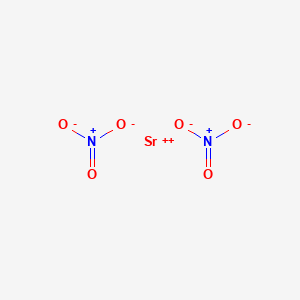
Strontium nitrate
Strontium nitrate appears as a white crystalline solid. Noncombustible but accelerates burning of combustible materials. May explode if large quantities are involved in a fire or the combustible material is finely divided. May explode under prolonged exposure to heat or fire. Toxic oxides of nitrogen are produced in fires. Used in pyrotechnics, in medicine, and to make other chemicals. — CAMEO Chemicals
- IUPAC 名称
- strontium dinitrate
- 分子式
- N2O6Sr
- 分子量
- 211.63 g/mol
- 精确质量
- 211.88124798 Da
- 拓扑极性表面积
- 126.0 Ų
- 氢键供体
- 0
- 氢键受体
- 6
- 共价单元
- 3
- 已定义的立体中心
- 0
又称
另有 16 个已报告名称
外部数据库标识符
- ChEMBL:CHEMBL2219742
- EPA DTXSID:DTXSID9064924
来自其他科学数据库的证据
NIH PubChem PUG-View
Attributed physical-property, hazard, environmental and use annotations.
- Boiling Point: 1193 °F at 760 mmHg (USCG, 1999) 来源: CAMEO Chemicals
- Boiling Point: 645 °C 来源: Hazardous Substances Data Bank (HSDB)
- Boiling Point: 645 °C @760 [mm Hg] 来源: PAC Chemical Database, U.S. Department of Energy
- Color/Form: WHITE GRANULES OR POWDER 来源: Hazardous Substances Data Bank (HSDB)
- Color/Form: Colorless cubic crystals 来源: Hazardous Substances Data Bank (HSDB)
- Density: 2.98 (USCG, 1999) - Denser than water; will sink 来源: CAMEO Chemicals
- Density: 2.99 g/cu-cm 来源: Hazardous Substances Data Bank (HSDB)
- Density: 2.99 @25 °C 来源: PAC Chemical Database, U.S. Department of Energy
- Melting Point: 1058 °F (USCG, 1999) 来源: CAMEO Chemicals
- Melting Point: 570 °C 来源: Hazardous Substances Data Bank (HSDB)
- Melting Point: 570 °C 来源: PAC Chemical Database, U.S. Department of Energy
- Physical Description: Strontium nitrate appears as a white crystalline solid. Noncombustible but accelerates burning of combustible materials. May explode if large quantities are involved in a fire or the combustible material is finely divided. May explode under prolonged exposure to heat or fire. Toxic oxides of nitrogen are produced in fires. Used in pyrotechnics, in medicine, and to make other chemicals. 来源: CAMEO Chemicals
- Physical Description: Dry Powder; CBI; Large Crystals 来源: EPA Chemical Data Reporting (CDR)
- Physical Description: White solid; [Merck Index] White odorless crystalline solid; [MSDSonline] 来源: Haz-Map, Information on Hazardous Chemicals and Occupational Diseases
- Solubility: 70.9 g/100 ml water at 18 °C, 100 g/100 ml water at 100 °C 来源: Hazardous Substances Data Bank (HSDB)
- Solubility: 401 G/L OF WATER @ 0 °C; 1 KG/L WATER @ 90 °C 来源: Hazardous Substances Data Bank (HSDB)
- Solubility: Slightly sol in alcohol or acetone. 来源: Hazardous Substances Data Bank (HSDB)
- Solubility: 0.012 g/100 ml absolute alcohol 来源: Hazardous Substances Data Bank (HSDB)
- pH: AQ SOLN IS NEUTRAL 来源: Hazardous Substances Data Bank (HSDB)
- Carcinogen Classification: Ingested nitrate or nitrite under conditions that result in endogenous nitrosation is probably carcinogenic to humans (Group 2A). (L135) 来源: Toxin and Toxin Target Database (T3DB)
- Exposure Routes: Oral (L1137) ; inhalation (L1137) 来源: Toxin and Toxin Target Database (T3DB)
- First Aid: Call for medical aid.; EYES: Rinse with water.; SKIN: Wash with water for 15 minutes.; INGESTION: Drink water, milk, or activated charcoal; then induce vomiting. (USCG, 1999) 来源: CAMEO Chemicals
- ERG2024, Guide 140 (Strontium nitrate): General First Aid:; · Call 911 or emergency medical service.; · Ensure that medical personnel are aware of the material(s) involved, take precautions to protect themselves and avoid contamination.; · Move victim to fresh air if it can be done safely.; · Administer oxygen if breathing is difficult.; · If victim is not breathing:; -- DO NOT perform mouth-to-mouth resuscitation; the victim may have ingested or inhaled the substance.; -- If equipped and pulse detected, wash face and mouth, then give artificial respiration using a proper respiratory medical device (bag-valve mask, pocket mask equipped with a one-way valve or other device).; -- If no pulse detected or no respiratory medical device available, provide continuous compressions. Conduct a pulse check every two minutes or monitor for any signs of spontaneous respirations.; · Remove and isolate contaminated clothing and shoes.; · For minor skin contact, avoid spreading material on unaffected skin.; · In case of contact with substance, remove immediately by flushing skin or eyes with running water for at least 20 minutes.; · For severe burns, immediate medical attention is required.; · Effects of exposure (inhalation, ingestion, 来源: Emergency Response Guidebook (ERG)
- Note: This chemical does not meet GHS hazard criteria for 0.6% (2 of 363) of reports. 来源: European Chemicals Agency (ECHA)
- Signal: Danger 来源: European Chemicals Agency (ECHA)
- GHS Hazard Statements: H271 (66.1%): May cause fire or explosion; strong Oxidizer [Danger Oxidizing liquids; Oxidizing solids]; H272 (33.1%): May intensify fire; oxidizer [Danger Oxidizing liquids; Oxidizing solids]; H302 (13.5%): Harmful if swallowed [Warning Acute toxicity, oral]; H315 (14.9%): Causes skin irritation [Warning Skin corrosion/irritation]; H318 (77.4%): Causes serious eye damage [Danger Serious eye damage/eye irritation]; H319 (14.9%): Causes serious eye irritation [Warning Serious eye damage/eye irritation]; H335 (13.8%): May cause respiratory irritation [Warning Specific target organ toxicity, single exposure; Respiratory tract irritation] 来源: European Chemicals Agency (ECHA)
- Precautionary Statement Codes: P210, P220, P261, P264, P264+P265, P270, P271, P280, P283, P301+P317, P302+P352, P304+P340, P305+P351+P338, P305+P354+P338, P306+P360, P317, P319, P321, P330, P332+P317, P337+P317, P362+P364, P370+P378, P371+P380+P375, P403+P233, P405, P420, and P501 (click each P-code to see the statement) 来源: European Chemicals Agency (ECHA)
- ECHA C&L Notifications Summary: Aggregated GHS information provided per 363 reports by companies from 22 notifications to the ECHA C&L Inventory. Each notification may be associated with multiple companies.; Reported as not meeting GHS hazard criteria per 2 of 363 reports by companies.; There are 21 notifications provided by 361 of 363 reports by companies with hazard statement code(s).; Information may vary between notifications depending on impurities, additives, and other factors. The percentage value in parenthesis indicates the notified classification ratio from companies that provide hazard codes. Only hazard codes with percentage values above 10% are shown. For more detailed information, please visit ECHA C&L website. 来源: European Chemicals Agency (ECHA)
- Signal: Danger 来源: NITE-CMC
- GHS Hazard Statements: H272: May intensify fire; oxidizer [Danger Oxidizing liquids; Oxidizing solids]; H315: Causes skin irritation [Warning Skin corrosion/irritation]; H320: Causes eye irritation [Warning Serious eye damage/eye irritation] 来源: NITE-CMC
- Precautionary Statement Codes: P210, P220, P264, P264+P265, P280, P302+P352, P305+P351+P338, P321, P332+P317, P337+P317, P362+P364, P370+P378, and P501 (click each P-code to see the statement) 来源: NITE-CMC
- Health Effects: Nitrate and nitrite poisoning causes methemoglobinemia. Nitrites may cause pregnancy complications and developmental effects. They may also be carcinogenic. (L1137) 来源: Toxin and Toxin Target Database (T3DB)
- Toxicity Summary: Nitrate's toxicity is a result of it's conversion to nitrite once in the body. Nitrite causes the autocatalytic oxidation of oxyhemoglobin to hydrogen peroxide and methemoglobin. This elevation of methemoglobin levels is a condition known as methemoglobinemia, and is characterized by tissue hypoxia, as methemoglobin cannot bind oxygen. (A2450, L1613) 来源: Toxin and Toxin Target Database (T3DB)
- Consumer Uses: Not Known or Reasonably Ascertainable; Soil amendments (fertilizers) 来源: EPA Chemical Data Reporting (CDR)
- Industry Uses: Intermediate; Oxidizing agent; Not Known or Reasonably Ascertainable; Other 来源: EPA Chemical Data Reporting (CDR)
- Sources/Uses: Used in pyrotechnics (red fire), signal lights, marine signals, railroad flares, matches, and military tracer bullets; Also used in electron tubes and as a pigment; [HSDB] 来源: Haz-Map, Information on Hazardous Chemicals and Occupational Diseases
- Uses: In signal lights, marine signals, railroad flares, matches; in pyrotechnics (red fire) 来源: Hazardous Substances Data Bank (HSDB)
- Uses: INTERMEDIATE; ELECTRON TUBES 来源: Hazardous Substances Data Bank (HSDB)
- Uses: PIGMENT 来源: Hazardous Substances Data Bank (HSDB)
- Uses: Mfr of pyrotechnics as it imparts brilliant color to flame 来源: Hazardous Substances Data Bank (HSDB)
- Uses: For more Uses (Complete) data for STRONTIUM NITRATE (6 total), please visit the HSDB record page. 来源: Hazardous Substances Data Bank (HSDB)
- Uses: Strontium nitrate is used as an oxidizer and colorant in fireworks. 来源: Toxin and Toxin Target Database (T3DB)
映射方: Existing checksum-valid CAS to unique PubChem CID match. 检索时间: 2026-08-31. 打开来源记录
科学分类和危害注释仅提供背景信息,不能取代上方所示针对具体市场的监管决定。
其他来源的覆盖范围和匹配状态
| 来源 | 结果 | 已检查 |
|---|---|---|
| EMBL-EBI ChEBI | 无精确记录 | 2026-08-31 |
| NIH PubChem PUG-View | 精确匹配 | 2026-08-31 |
已记录的无匹配结果是该来源已被检查的有效证据;这并不表示该物质在别处不存在。
于 2026-09-02 通过校验和有效的 CAS 匹配从美国国立卫生研究院 (NIH) PubChem 检索。化学性质不能取代本页的监管决定。
欧盟官方成分名称证据
该成分名称与 2025 年欧盟官方通用成分名称词汇表完全匹配。
相关清单证据
配方功能重叠的成分
其他官方和科学来源
11 个可用于核查此身份的外部数据库
每个链接都会在该来源中搜索此身份。 各来源是什么及其法律效力
STRONTIUM NITRATE 在 CosIng 清单中的呈现方式
CosIng 清单将 STRONTIUM NITRATE 列为化妆品成分,本页将其关联到 1 条附件记录。清单条目记录名称和标识符,而附件记录显示该物质在欧盟化妆品法规中被禁用、限用或列入准用清单的情况。
在官方数据中,STRONTIUM NITRATE 还被标记了 2 项化妆品功能。功能标识描述预期用途,但不能取代在配方或标签工作之前对关联附件记录的监管审查。