
STRONTIUM NITRATE
STRONTIUM NITRATE ist auf dieser Seite mit 1 EU-Anhangseintrag verknüpft. Hinweis aus dem Verzeichnis: II/403.
Auf einen Blick
- Funktion
- Oral care, skin conditioning
- CAS
- 10042-76-9
- EC
- 233-131-9
- EU-Anhänge
- Anhang II/403
- Anhang II/403: in kosmetischen Mitteln verboten
Wissenschaftliche Grundlage: 2 SCCS-Stellungnahmen
Der Wissenschaftliche Ausschuss „Verbrauchersicherheit“ (SCCS) der EU hat diesen Stoff bewertet. Seine Stellungnahmen sind die wissenschaftliche Grundlage des Anhangeintrags.
Regulatorische Belege nach Markt
Diese Matrix trennt verifizierte Vorschriften zu Inhaltsstoffen von Quellen, die zwar erfasst, aber noch nicht importiert sind. Eine fehlende importierte Vorschrift bedeutet nicht, dass der Inhaltsstoff zulässig ist.
Wischen oder scrollen Sie horizontal, um alle Spalten zu sehen.
| Markt | Belegstatus | Einträge | Quellsprache |
|---|---|---|---|
| European Union | Beleg verknüpft Prohibited entry found Diesen Beleg öffnen | 1 | English and EU languages |
| Great Britain | Beleg verknüpft Prohibited Diesen Beleg öffnen | 1 | English |
| Canada | Quelle erfasst Official source mapped; ingredient rule not imported | 0 | English and French |
| New Zealand | Beleg verknüpft Prohibited Diesen Beleg öffnen | 1 | English |
| ASEAN | Beleg verknüpft Prohibited Diesen Beleg öffnen | 1 | English and national languages |
| China | Beleg verknüpft Prohibited Diesen Beleg öffnen | 1 | Chinese with selected English material |
| Japan | Quelle erfasst Official source mapped; ingredient rule not imported | 0 | Japanese; official English translation available |
| South Korea | Quelle erfasst Official source mapped; ingredient rule not imported | 0 | Korean with some English names |
| United States | Quelle erfasst Official source mapped; ingredient rule not imported | 0 | English |
| Australia | Quelle erfasst Official source mapped; ingredient rule not imported | 0 | English |
| Brazil | Beleg verknüpft Prohibited Diesen Beleg öffnen | 1 | Portuguese with INCI crosswalks |
| India | Beleg verknüpft Prohibited Diesen Beleg öffnen | 1 | English and Hindi |
| Saudi Arabia | Beleg verknüpft Prohibited Diesen Beleg öffnen | 1 | Arabic and English |
Verzeichnisangaben zu STRONTIUM NITRATE
INCI-Name
STRONTIUM NITRATE
Herkunft des Eintrags
- Verzeichnisverweis
- 84481
- Importierte Identität
- STRONTIUM NITRATE
- Quellenaktualisierung
- 15/10/2010
Anhangseinträge für STRONTIUM NITRATE
Kerndaten
- ORAL CARE
Providing cosmetic effects to the oral cavity, e.g. cleansing, deodorising, protecting.
- SKIN CONDITIONING
Maintaining the skin in good condition.
Chemische Identität und Eigenschaften
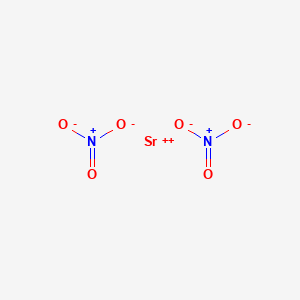
Strontium nitrate
Strontium nitrate appears as a white crystalline solid. Noncombustible but accelerates burning of combustible materials. May explode if large quantities are involved in a fire or the combustible material is finely divided. May explode under prolonged exposure to heat or fire. Toxic oxides of nitrogen are produced in fires. Used in pyrotechnics, in medicine, and to make other chemicals. — CAMEO Chemicals
- IUPAC-Name
- strontium dinitrate
- Summenformel
- N2O6Sr
- Molekulargewicht
- 211.63 g/mol
- Exakte Masse
- 211.88124798 Da
- Topologische polare Oberfläche
- 126,0 Ų
- Wasserstoffbrücken-Donoren
- 0
- Wasserstoffbrücken-Akzeptoren
- 6
- Kovalente Einheiten
- 3
- Definierte Stereozentren
- 0
Auch bekannt als
16 weitere gemeldete Namen
Kennungen in externen Datenbanken
- ChEMBL:CHEMBL2219742
- EPA DTXSID:DTXSID9064924
Belege aus weiteren wissenschaftlichen Datenbanken
NIH PubChem PUG-View
Attributed physical-property, hazard, environmental and use annotations.
- Boiling Point: 1193 °F at 760 mmHg (USCG, 1999) Quelle: CAMEO Chemicals
- Boiling Point: 645 °C Quelle: Hazardous Substances Data Bank (HSDB)
- Boiling Point: 645 °C @760 [mm Hg] Quelle: PAC Chemical Database, U.S. Department of Energy
- Color/Form: WHITE GRANULES OR POWDER Quelle: Hazardous Substances Data Bank (HSDB)
- Color/Form: Colorless cubic crystals Quelle: Hazardous Substances Data Bank (HSDB)
- Density: 2.98 (USCG, 1999) - Denser than water; will sink Quelle: CAMEO Chemicals
- Density: 2.99 g/cu-cm Quelle: Hazardous Substances Data Bank (HSDB)
- Density: 2.99 @25 °C Quelle: PAC Chemical Database, U.S. Department of Energy
- Melting Point: 1058 °F (USCG, 1999) Quelle: CAMEO Chemicals
- Melting Point: 570 °C Quelle: Hazardous Substances Data Bank (HSDB)
- Melting Point: 570 °C Quelle: PAC Chemical Database, U.S. Department of Energy
- Physical Description: Strontium nitrate appears as a white crystalline solid. Noncombustible but accelerates burning of combustible materials. May explode if large quantities are involved in a fire or the combustible material is finely divided. May explode under prolonged exposure to heat or fire. Toxic oxides of nitrogen are produced in fires. Used in pyrotechnics, in medicine, and to make other chemicals. Quelle: CAMEO Chemicals
- Physical Description: Dry Powder; CBI; Large Crystals Quelle: EPA Chemical Data Reporting (CDR)
- Physical Description: White solid; [Merck Index] White odorless crystalline solid; [MSDSonline] Quelle: Haz-Map, Information on Hazardous Chemicals and Occupational Diseases
- Solubility: 70.9 g/100 ml water at 18 °C, 100 g/100 ml water at 100 °C Quelle: Hazardous Substances Data Bank (HSDB)
- Solubility: 401 G/L OF WATER @ 0 °C; 1 KG/L WATER @ 90 °C Quelle: Hazardous Substances Data Bank (HSDB)
- Solubility: Slightly sol in alcohol or acetone. Quelle: Hazardous Substances Data Bank (HSDB)
- Solubility: 0.012 g/100 ml absolute alcohol Quelle: Hazardous Substances Data Bank (HSDB)
- pH: AQ SOLN IS NEUTRAL Quelle: Hazardous Substances Data Bank (HSDB)
- Carcinogen Classification: Ingested nitrate or nitrite under conditions that result in endogenous nitrosation is probably carcinogenic to humans (Group 2A). (L135) Quelle: Toxin and Toxin Target Database (T3DB)
- Exposure Routes: Oral (L1137) ; inhalation (L1137) Quelle: Toxin and Toxin Target Database (T3DB)
- First Aid: Call for medical aid.; EYES: Rinse with water.; SKIN: Wash with water for 15 minutes.; INGESTION: Drink water, milk, or activated charcoal; then induce vomiting. (USCG, 1999) Quelle: CAMEO Chemicals
- ERG2024, Guide 140 (Strontium nitrate): General First Aid:; · Call 911 or emergency medical service.; · Ensure that medical personnel are aware of the material(s) involved, take precautions to protect themselves and avoid contamination.; · Move victim to fresh air if it can be done safely.; · Administer oxygen if breathing is difficult.; · If victim is not breathing:; -- DO NOT perform mouth-to-mouth resuscitation; the victim may have ingested or inhaled the substance.; -- If equipped and pulse detected, wash face and mouth, then give artificial respiration using a proper respiratory medical device (bag-valve mask, pocket mask equipped with a one-way valve or other device).; -- If no pulse detected or no respiratory medical device available, provide continuous compressions. Conduct a pulse check every two minutes or monitor for any signs of spontaneous respirations.; · Remove and isolate contaminated clothing and shoes.; · For minor skin contact, avoid spreading material on unaffected skin.; · In case of contact with substance, remove immediately by flushing skin or eyes with running water for at least 20 minutes.; · For severe burns, immediate medical attention is required.; · Effects of exposure (inhalation, ingestion, Quelle: Emergency Response Guidebook (ERG)
- Note: This chemical does not meet GHS hazard criteria for 0.6% (2 of 363) of reports. Quelle: European Chemicals Agency (ECHA)
- Signal: Danger Quelle: European Chemicals Agency (ECHA)
- GHS Hazard Statements: H271 (66.1%): May cause fire or explosion; strong Oxidizer [Danger Oxidizing liquids; Oxidizing solids]; H272 (33.1%): May intensify fire; oxidizer [Danger Oxidizing liquids; Oxidizing solids]; H302 (13.5%): Harmful if swallowed [Warning Acute toxicity, oral]; H315 (14.9%): Causes skin irritation [Warning Skin corrosion/irritation]; H318 (77.4%): Causes serious eye damage [Danger Serious eye damage/eye irritation]; H319 (14.9%): Causes serious eye irritation [Warning Serious eye damage/eye irritation]; H335 (13.8%): May cause respiratory irritation [Warning Specific target organ toxicity, single exposure; Respiratory tract irritation] Quelle: European Chemicals Agency (ECHA)
- Precautionary Statement Codes: P210, P220, P261, P264, P264+P265, P270, P271, P280, P283, P301+P317, P302+P352, P304+P340, P305+P351+P338, P305+P354+P338, P306+P360, P317, P319, P321, P330, P332+P317, P337+P317, P362+P364, P370+P378, P371+P380+P375, P403+P233, P405, P420, and P501 (click each P-code to see the statement) Quelle: European Chemicals Agency (ECHA)
- ECHA C&L Notifications Summary: Aggregated GHS information provided per 363 reports by companies from 22 notifications to the ECHA C&L Inventory. Each notification may be associated with multiple companies.; Reported as not meeting GHS hazard criteria per 2 of 363 reports by companies.; There are 21 notifications provided by 361 of 363 reports by companies with hazard statement code(s).; Information may vary between notifications depending on impurities, additives, and other factors. The percentage value in parenthesis indicates the notified classification ratio from companies that provide hazard codes. Only hazard codes with percentage values above 10% are shown. For more detailed information, please visit ECHA C&L website. Quelle: European Chemicals Agency (ECHA)
- Signal: Danger Quelle: NITE-CMC
- GHS Hazard Statements: H272: May intensify fire; oxidizer [Danger Oxidizing liquids; Oxidizing solids]; H315: Causes skin irritation [Warning Skin corrosion/irritation]; H320: Causes eye irritation [Warning Serious eye damage/eye irritation] Quelle: NITE-CMC
- Precautionary Statement Codes: P210, P220, P264, P264+P265, P280, P302+P352, P305+P351+P338, P321, P332+P317, P337+P317, P362+P364, P370+P378, and P501 (click each P-code to see the statement) Quelle: NITE-CMC
- Health Effects: Nitrate and nitrite poisoning causes methemoglobinemia. Nitrites may cause pregnancy complications and developmental effects. They may also be carcinogenic. (L1137) Quelle: Toxin and Toxin Target Database (T3DB)
- Toxicity Summary: Nitrate's toxicity is a result of it's conversion to nitrite once in the body. Nitrite causes the autocatalytic oxidation of oxyhemoglobin to hydrogen peroxide and methemoglobin. This elevation of methemoglobin levels is a condition known as methemoglobinemia, and is characterized by tissue hypoxia, as methemoglobin cannot bind oxygen. (A2450, L1613) Quelle: Toxin and Toxin Target Database (T3DB)
- Consumer Uses: Not Known or Reasonably Ascertainable; Soil amendments (fertilizers) Quelle: EPA Chemical Data Reporting (CDR)
- Industry Uses: Intermediate; Oxidizing agent; Not Known or Reasonably Ascertainable; Other Quelle: EPA Chemical Data Reporting (CDR)
- Sources/Uses: Used in pyrotechnics (red fire), signal lights, marine signals, railroad flares, matches, and military tracer bullets; Also used in electron tubes and as a pigment; [HSDB] Quelle: Haz-Map, Information on Hazardous Chemicals and Occupational Diseases
- Uses: In signal lights, marine signals, railroad flares, matches; in pyrotechnics (red fire) Quelle: Hazardous Substances Data Bank (HSDB)
- Uses: INTERMEDIATE; ELECTRON TUBES Quelle: Hazardous Substances Data Bank (HSDB)
- Uses: PIGMENT Quelle: Hazardous Substances Data Bank (HSDB)
- Uses: Mfr of pyrotechnics as it imparts brilliant color to flame Quelle: Hazardous Substances Data Bank (HSDB)
- Uses: For more Uses (Complete) data for STRONTIUM NITRATE (6 total), please visit the HSDB record page. Quelle: Hazardous Substances Data Bank (HSDB)
- Uses: Strontium nitrate is used as an oxidizer and colorant in fireworks. Quelle: Toxin and Toxin Target Database (T3DB)
Zugeordnet durch: Existing checksum-valid CAS to unique PubChem CID match. Abgerufen: 2026-08-31. Quelleneintrag öffnen
Wissenschaftliche Klassifizierungen und Gefahrenannotationen liefern Kontext und ersetzen nicht die oben gezeigte marktspezifische regulatorische Entscheidung.
Weitere Quellenabdeckung und Trefferstatus
| Quelle | Ergebnis | Geprüft |
|---|---|---|
| EMBL-EBI ChEBI | Kein exakter Eintrag | 2026-08-31 |
| NIH PubChem PUG-View | Exakter Treffer | 2026-08-31 |
Ein erfasster Nicht-Treffer ist ein nützlicher Beleg dafür, dass die Quelle geprüft wurde; er ist keine Behauptung, dass der Stoff anderswo nicht existiert.
Am 2026-09-02 von NIH PubChem durch prüfsummengültigen CAS-Abgleich abgerufen. Chemische Eigenschaften ersetzen nicht die regulatorische Entscheidung auf dieser Seite.
Belege zum amtlichen EU-Inhaltsstoffnamen
Der Inhaltsstoffname stimmt exakt mit dem amtlichen EU-Glossar 2025 der gebräuchlichen Inhaltsstoffnamen überein.
Verwandte Belege aus dem Verzeichnis
Inhaltsstoffe mit sich überschneidenden Rezepturfunktionen
Weitere amtliche und wissenschaftliche Quellen
11 externe Datenbanken zur Prüfung dieser Identität
Jeder Link durchsucht die jeweilige Quelle nach dieser Identität. Was jede Quelle ist und welches rechtliche Gewicht sie hat
Wie STRONTIUM NITRATE im CosIng-Verzeichnis erscheint
Das CosIng-Verzeichnis führt STRONTIUM NITRATE als kosmetischen Inhaltsstoff, und diese Seite verknüpft ihn mit 1 Anhangseintrag. Der Verzeichniseintrag erfasst Namen und Kennungen, während der Anhangseintrag zeigt, wo der Stoff im EU-Kosmetikrecht verboten, beschränkt oder positiv gelistet ist.
STRONTIUM NITRATE ist in den amtlichen Daten außerdem mit 2 kosmetischen Funktionen gekennzeichnet. Funktionsbezeichnungen beschreiben die beabsichtigte Verwendung, ersetzen aber nicht die regulatorische Prüfung verknüpfter Anhangseinträge vor der Rezeptierung oder Kennzeichnung.
Häufig gestellte Fragen
Quellenhinweis zu STRONTIUM NITRATE
Diese Seite verbindet den CosIng-Verzeichniseintrag für STRONTIUM NITRATE mit 1 verknüpften Eintrag aus den Anhängen II–VI aus unserem Datenbestand, der aus öffentlichen Materialien der Europäischen Kommission zu kosmetischen Inhaltsstoffen aufgebaut ist.
Nutzen Sie diese Verzeichnisseite, um STRONTIUM NITRATE zu recherchieren und verknüpfte Einträge zu vergleichen; verifizieren Sie Beschränkungen und Rechtsstatus jedoch anhand des aktuellen amtlichen Quellentextes und Rechts, bevor Sie regulatorische Entscheidungen treffen.
Werkzeuge und nächste Schritte
Rezeptur prüfen
Eine vollständige INCI-Liste prüfen, um STRONTIUM NITRATE und etwaige verknüpfte EU-Anhangsbeschränkungen oder Allergenmarkierungen zu erkennen.
INCI-CheckerÄhnliche Inhaltsstoffe suchen
Weitere Inhaltsstoffe aus dem Verzeichnis und Anhangseinträge finden, die mit STRONTIUM NITRATE, seinen Kennungen oder nahen Namensvarianten zusammenhängen.
Suche