
HYDROXYETHYL ISOBUTYL PIPERIDINE CARBOXYLATE
1-Piperidinecarboxylic acid, 2-(2-hydroxyethyl)-, 1-methylpropyl ester
HYDROXYETHYL ISOBUTYL PIPERIDINE CARBOXYLATE 列于欧盟 CosIng 清单,但本页尚未关联任何直接的附件记录。
按市场划分的监管证据
此处跟踪的 13 个市场均未导入该成分的规则。
这描述的是本清单,而非法律。没有已导入的规则并不能证明某成分获准使用:规则可能以其他名称或标识符存在,或存在于尚未在此导入的数据集中。
HYDROXYETHYL ISOBUTYL PIPERIDINE CARBOXYLATE 的清单详情
INCI 名称
HYDROXYETHYL ISOBUTYL PIPERIDINE CARBOXYLATE
说明
1-Piperidinecarboxylic acid, 2-(2-hydroxyethyl)-, 1-methylpropyl ester
HYDROXYETHYL ISOBUTYL PIPERIDINE CARBOXYLATE 的附件记录
关键数据
化学身份与性质
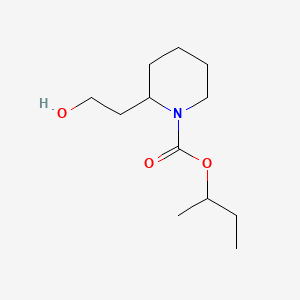
Icaridin
Butan-2-yl 2-(2-hydroxyethyl)piperidine-1-carboxylate is a member of piperidines and a carboxylic acid. — ChEBI
- IUPAC 名称
- butan-2-yl 2-(2-hydroxyethyl)piperidine-1-carboxylate
- 分子式
- C12H23NO3
- 分子量
- 229.32 g/mol
- 精确质量
- 229.16779360 Da
- XLogP3
- 2.0
- 拓扑极性表面积
- 49.8 Ų
- 氢键供体
- 1
- 氢键受体
- 3
- 共价单元
- 1
- 已定义的立体中心
- 0
又称
另有 16 个已报告名称
外部数据库标识符
- ChEBI:CHEBI:143733
- ChEMBL:CHEMBL2104314
- EPA DTXSID:DTXSID0034227
- PubMed:40403953
- PubMed:36077093
- PubMed:27535661
- PubMed:25522134
- PubMed:25349401
- PubMed:25332663
- PubMed:22216951
- PubMed:22030833
- PubMed:21436880
- PubMed:21301870
- PubMed:20695288
- PubMed:20128903
来自其他科学数据库的证据
NIH PubChem PUG-View
Attributed physical-property, hazard, environmental and use annotations.
- Boiling Point: 208 at 1013 hPa 来源: DrugBank
- Boiling Point: 296 °C 来源: Hazardous Substances Data Bank (HSDB)
- Boiling Point: BP: 208 °C at 1013 hPa 来源: Hazardous Substances Data Bank (HSDB)
- Color/Form: Colorless liquid 来源: Hazardous Substances Data Bank (HSDB)
- Density: 1.07 at 20 °C 来源: Hazardous Substances Data Bank (HSDB)
- LogP: log Kow = 2.11 at 20 °C (unbuffered); 2.23 (pH 4-9) at 20 °C 来源: Hazardous Substances Data Bank (HSDB)
- Melting Point: < -170 来源: DrugBank
- Melting Point: < -170 °C 来源: Hazardous Substances Data Bank (HSDB)
- Odor: Nearly odorless 来源: Hazardous Substances Data Bank (HSDB)
- Physical Description: Colorless liquid; [Merck Index] 来源: Haz-Map, Information on Hazardous Chemicals and Occupational Diseases
- Refractive Index: Index of refraction = 1.4717 at 20 °C/D 来源: Hazardous Substances Data Bank (HSDB)
- Solubility: Insoluble 来源: DrugBank
- Solubility: In water, 8.2 g/L (pH 4-9); 8.6 g/L (unbuffered), at 20 °C 来源: Hazardous Substances Data Bank (HSDB)
- Solubility: In water, 8.2X10+3 mg/L at 20 °C, pH 4-9 来源: Hazardous Substances Data Bank (HSDB)
- Solubility: In acetone, 7520 g/L at 20 °C 来源: Hazardous Substances Data Bank (HSDB)
- Vapor Pressure: 0.00044 [mmHg] 来源: Haz-Map, Information on Hazardous Chemicals and Occupational Diseases
- Vapor Pressure: VP: 3.4X10⁻⁴ hPa at 20 °C; 5.9X10⁻⁴ hPa at 25 °C; 7.1X10⁻³ hPa at 50 °C 来源: Hazardous Substances Data Bank (HSDB)
- Vapor Pressure: 4.43X10⁻⁴ mm Hg at 25 °C 来源: Hazardous Substances Data Bank (HSDB)
- Viscosity: 135.5 mPa.s at 20 °C 来源: Hazardous Substances Data Bank (HSDB)
- Carcinogen Classification: No indication of carcinogenicity to humans (not listed by IARC). 来源: Toxin and Toxin Target Database (T3DB)
- Signal: Warning 来源: European Chemicals Agency (ECHA)
- GHS Hazard Statements: H319 (100%): Causes serious eye irritation [Warning Serious eye damage/eye irritation] 来源: European Chemicals Agency (ECHA)
- Precautionary Statement Codes: P264+P265, P280, P305+P351+P338, and P337+P317 (click each P-code to see the statement) 来源: European Chemicals Agency (ECHA)
- ECHA C&L Notifications Summary: Aggregated GHS information provided per 50 reports by companies from 1 notifications to the ECHA C&L Inventory.; Information may vary between notifications depending on impurities, additives, and other factors. The percentage value in parenthesis indicates the notified classification ratio from companies that provide hazard codes. Only hazard codes with percentage values above 10% are shown. For more detailed information, please visit ECHA C&L website. 来源: European Chemicals Agency (ECHA)
- ECHA C&L Notifications Summary: Aggregated GHS information provided per 40 reports by companies from 2 notifications to the ECHA C&L Inventory.; Information may vary between notifications depending on impurities, additives, and other factors. The percentage value in parenthesis indicates the notified classification ratio from companies that provide hazard codes. Only hazard codes with percentage values above 10% are shown. For more detailed information, please visit ECHA C&L website. 来源: European Chemicals Agency (ECHA)
- Toxicity Summary: IDENTIFICATION AND USE: Picaridin is a colorless liquid. Picaridin is an insect repellent, for application to human or animal skin. In particular, it is used as mosquito repellent. HUMAN EXPOSURE AND TOXICITY: Allergic contact dermatitis has been reported in a human following routine application of picaridin and produced erythema and pruritis. It is not clear whether the solvent methyl glucose-dioleate had a causative or additive effect. However, insect repellents containing picaridin may be acceptable alternatives in patients who demonstrate sensitivity to products containing DEET. Primary symptoms across all insect repellent exposures included ocular irritation/pain, vomiting, red eye/conjunctivitis, and oral irritation. Unintentional ingestion of picaridin-containing and other insect repellents was associated only with minor toxicity. ANIMAL STUDIES: The skin of 50 rats/sex/group was treated with 0, 50, 100 or 200 mg/kg/day 5 days per week for 2 years (the two year cohort). Additionally, 20 animals/sex/group were treated with 0 or 200 mg/kg/kg and 10 animals/sex/group were treated with 50 or 100 mg/kg/day of the test material. These animals received the treatment for one year (o 来源: Hazardous Substances Data Bank (HSDB)
- Environmental Bioconcentration: An estimated BCF of 14 was calculated in fish for picaridin(SRC), using a log Kow of 2.23(1) and a regression-derived equation(2). According to a classification scheme(3), this BCF suggests the potential for bioconcentration in aquatic organisms is low(SRC). 来源: Hazardous Substances Data Bank (HSDB)
- Environmental Fate: TERRESTRIAL FATE: Based on a classification scheme(1), an estimated Koc value of 80(SRC), determined from a structure estimation method(2), indicates that picaridin is expected to have high mobility in soil(SRC). Volatilization of picaridin from moist soil surfaces is not expected to be an important fate process(SRC) given an estimated Henry's Law constant of 1.6X10⁻⁸ atm-cu m/mole(SRC), based upon its vapor pressure, 4.43X10⁻⁴ mm Hg(3), and water solubility, 8200 mg/L(3). Picaridin is not expected to volatilize from dry soil surfaces(SRC) based upon its vapor pressure(3). Biodegradation data in soil were not available(SRC, 2016). 来源: Hazardous Substances Data Bank (HSDB)
- Environmental Fate: AQUATIC FATE: Based on a classification scheme(1), an estimated Koc value of 80(SRC), determined from a structure estimation method(2), indicates that picaridin is not expected to adsorb to suspended solids and sediment(SRC). Volatilization from water surfaces is not expected(3) based upon an estimated Henry's Law constant of 1.6X10⁻⁸ atm-cu m/mole(SRC), derived from its vapor pressure, 4.43X10⁻⁴ mm Hg(4), and water solubility, 8200 mg/L(4). Picaridin did not undergo hydrolysis at pH 5, 7 and 9, 25 °C over 30 days(4). According to a classification scheme(5), an estimated BCF of 14(SRC), from its log Kow of 2.23(4) and a regression-derived equation(2), suggests the potential for bioconcentration in aquatic organisms is low(SRC). Biodegradation data in water were not available(SRC, 2016). 来源: Hazardous Substances Data Bank (HSDB)
- Environmental Fate: ATMOSPHERIC FATE: According to a model of gas/particle partitioning of semivolatile organic compounds in the atmosphere(1), picaridin, which has a vapor pressure of 4.43X10⁻⁴ mm Hg at 25 °C(2), is expected to exist solely as a vapor in the ambient atmosphere. Vapor-phase picaridin is degraded in the atmosphere by reaction with photochemically-produced hydroxyl radicals(SRC); the half-life for this reaction in air is estimated to be 7 hours(SRC), calculated from its rate constant of 5.6X10⁻¹¹ cu cm/molecule-sec at 25 °C(SRC) that was derived using a structure estimation method(3). Picaridin does not contain chromophores that absorb at wavelengths >290 nm(2) and, therefore, is not expected to be susceptible to direct photolysis by sunlight(SRC). 来源: Hazardous Substances Data Bank (HSDB)
- Sources/Uses: Used as insect repellent applied to skin against biting flies, mosquitoes, chiggers, ticks, and fleas; [Reference #1] 来源: Haz-Map, Information on Hazardous Chemicals and Occupational Diseases
- Uses: For picaridin (USEPA/OPP Pesticide Code: 070705) ACTIVE products with label matches. /SRP: Registered for use in the U.S. but approved pesticide uses may change periodically and so federal, state and local authorities must be consulted for currently approved uses./ 来源: Hazardous Substances Data Bank (HSDB)
- Uses: Mosquito repellent 来源: Hazardous Substances Data Bank (HSDB)
- Uses: Icaridin is an insect repellent, for application to human or animal skin. 来源: Hazardous Substances Data Bank (HSDB)
映射方: Existing checksum-valid CAS to unique PubChem CID match. 检索时间: 2026-08-31. 打开来源记录
科学分类和危害注释仅提供背景信息,不能取代上方所示针对具体市场的监管决定。
其他来源的覆盖范围和匹配状态
| 来源 | 结果 | 已检查 |
|---|---|---|
| NIH PubChem PUG-View | 精确匹配 | 2026-08-31 |
已记录的无匹配结果是该来源已被检查的有效证据;这并不表示该物质在别处不存在。
于 2026-08-31 通过校验和有效的 CAS 匹配从美国国立卫生研究院 (NIH) PubChem 检索。化学性质不能取代本页的监管决定。
欧盟官方成分名称证据
该成分名称与 2025 年欧盟官方通用成分名称词汇表完全匹配。
相关清单证据
配方功能重叠的成分
其他官方和科学来源
11 个可用于核查此身份的外部数据库
每个链接都会在该来源中搜索此身份。 各来源是什么及其法律效力
HYDROXYETHYL ISOBUTYL PIPERIDINE CARBOXYLATE 在 CosIng 清单中的呈现方式
CosIng 清单将 HYDROXYETHYL ISOBUTYL PIPERIDINE CARBOXYLATE 列为化妆品成分,本页将其关联到 0 条附件记录。清单条目记录名称和标识符,而附件记录显示该物质在欧盟化妆品法规中被禁用、限用或列入准用清单的情况。
在官方数据中,HYDROXYETHYL ISOBUTYL PIPERIDINE CARBOXYLATE 还被标记了 1 项化妆品功能。功能标识描述预期用途,但不能取代在配方或标签工作之前对关联附件记录的监管审查。