
HELIOTROPINE
1,3-Benzodioxole-5-carboxaldehyde
HELIOTROPINE 列于欧盟 CosIng 清单,但本页尚未关联任何直接的附件记录。
按市场划分的监管证据
此处跟踪的 13 个市场均未导入该成分的规则。
这描述的是本清单,而非法律。没有已导入的规则并不能证明某成分获准使用:规则可能以其他名称或标识符存在,或存在于尚未在此导入的数据集中。
HELIOTROPINE 的清单详情
INCI 名称
HELIOTROPINE
说明
1,3-Benzodioxole-5-carboxaldehyde
HELIOTROPINE 的附件记录
关键数据
- FRAGRANCE
Imparting an odour or taste. Creating a perceivable pleasant smell and/or masking a bad smell.
- PERFUMING
Used for perfume and aromatic raw materials.
- SKIN CONDITIONING
Maintaining the skin in good condition.
化学身份与性质
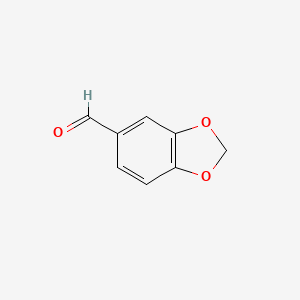
Piperonal
Piperonal is an arenecarbaldehyde that is 1,3-benzodioxole substituted by a formyl substituent at position 5. It has been isolated from Piper nigrum. It has a role as a fragrance, an insect repellent and a plant metabolite. It is an arenecarbaldehyde and a member of benzodioxoles. — ChEBI
- IUPAC 名称
- 1,3-benzodioxole-5-carbaldehyde
- 分子式
- C8H6O3
- 分子量
- 150.13 g/mol
- 精确质量
- 150.031694049 Da
- XLogP3
- 1.1
- 拓扑极性表面积
- 35.5 Ų
- 氢键供体
- 0
- 氢键受体
- 3
- 共价单元
- 1
- 已定义的立体中心
- 0
又称
另有 16 个已报告名称
外部数据库标识符
- ChEBI:CHEBI:8240
- ChEMBL:CHEMBL271663
- EPA DTXSID:DTXSID7025924
- PubMed:22589889
- PubMed:22412539
- PubMed:22347079
- PubMed:22259529
- PubMed:22220078
- PubMed:22219914
- PubMed:22219913
- PubMed:22219912
- PubMed:22091175
- PubMed:22064284
- PubMed:22059011
- PubMed:22058939
来自其他科学数据库的证据
NIH PubChem PUG-View
Attributed physical-property, hazard, environmental and use annotations.
- Boiling Point: 505 °F at 760 mmHg (NTP, 1992) 来源: CAMEO Chemicals
- Boiling Point: 263 °C 来源: Hazardous Substances Data Bank (HSDB)
- Boiling Point: BP: 88 °C at 0.5 mm Hg 来源: Hazardous Substances Data Bank (HSDB)
- Boiling Point: 263.00 to 265.00 °C. @ 760.00 mm Hg 来源: Human Metabolome Database (HMDB)
- Boiling Point: 263 °C 来源: Joint FAO/WHO Expert Committee on Food Additives (JECFA)
- Color/Form: Colorless, lustrous crystals 来源: Hazardous Substances Data Bank (HSDB)
- Color/Form: White or colorless crystals 来源: Hazardous Substances Data Bank (HSDB)
- Color/Form: Turns brown on exposure to light 来源: Hazardous Substances Data Bank (HSDB)
- Color/Form: Forms white crystals (MP 37 °C) 来源: Hazardous Substances Data Bank (HSDB)
- LogP: log Kow = 1.05 来源: Hazardous Substances Data Bank (HSDB)
- LogP: 1.05 来源: Human Metabolome Database (HMDB)
- Melting Point: 99 °F (NTP, 1992) 来源: CAMEO Chemicals
- Melting Point: 37 °C 来源: Hazardous Substances Data Bank (HSDB)
- Melting Point: MP: 35.5-37 °C 来源: Hazardous Substances Data Bank (HSDB)
- Melting Point: 37 °C 来源: Human Metabolome Database (HMDB)
- Odor: Heliotrope odor 来源: Hazardous Substances Data Bank (HSDB)
- Odor: Floral odor 来源: Hazardous Substances Data Bank (HSDB)
- Odor: Sweet, flowery odor reminiscent of heliotrope 来源: Hazardous Substances Data Bank (HSDB)
- Odor: Sweet-floral, slightly spicey, heliotrope-like odor 来源: Hazardous Substances Data Bank (HSDB)
- Physical Description: Piperonal appears as colorless lustrous crystals. (NTP, 1992) 来源: CAMEO Chemicals
- Physical Description: CBI; Large Crystals; Other Solid; Liquid 来源: EPA Chemical Data Reporting (CDR)
- Physical Description: Colorless lustrous solid; mp = 37 deg C; [Merck Index] White shining solid with a floral odor; Darkens to red-brown on light exposure; mp = 35.5-37 deg C; [Hawley] Colorless solid; mp = 36 deg C; [MSDSonline] 来源: Haz-Map, Information on Hazardous Chemicals and Occupational Diseases
- Physical Description: Solid 来源: Human Metabolome Database (HMDB)
- Physical Description: white or colourless crystals with a sweet, floral, spicy odour 来源: Joint FAO/WHO Expert Committee on Food Additives (JECFA)
- Solubility: Slightly soluble (NTP, 1992) 来源: CAMEO Chemicals
- Solubility: In water, 3.5X10+3 mg/L at 20 °C 来源: Hazardous Substances Data Bank (HSDB)
- Solubility: Soluble in 500 parts water 来源: Hazardous Substances Data Bank (HSDB)
- Solubility: Slightly soluble in water 来源: Hazardous Substances Data Bank (HSDB)
- Solubility: Very soluble in ethanol; miscible with ethyl ether; soluble in acetone, chloroform 来源: Hazardous Substances Data Bank (HSDB)
- Solubility: Slightly soluble in glycerol 来源: Hazardous Substances Data Bank (HSDB)
- Solubility: 3.5 mg/mL at 20 °C 来源: Human Metabolome Database (HMDB)
- Solubility: slightly soluble in water; soluble in organic solvents, oils 来源: Joint FAO/WHO Expert Committee on Food Additives (JECFA)
- Solubility: freely soluble (in ethanol) 来源: Joint FAO/WHO Expert Committee on Food Additives (JECFA)
- Vapor Pressure: 1 mmHg at 189 °F (NTP, 1992) 来源: CAMEO Chemicals
- Vapor Pressure: 0.01 [mmHg] 来源: Haz-Map, Information on Hazardous Chemicals and Occupational Diseases
- Vapor Pressure: 1X10⁻² mm Hg at 25 °C (extrapolated) 来源: Hazardous Substances Data Bank (HSDB)
- pH: Solution (1 to 10) acid to litmus 来源: Hazardous Substances Data Bank (HSDB)
- First Aid: EYES: First check the victim for contact lenses and remove if present. Flush victim's eyes with water or normal saline solution for 20 to 30 minutes while simultaneously calling a hospital or poison control center. Do not put any ointments, oils, or medication in the victim's eyes without specific instructions from a physician. IMMEDIATELY transport the victim after flushing eyes to a hospital even if no symptoms (such as redness or irritation) develop.; SKIN: IMMEDIATELY flood affected skin with water while removing and isolating all contaminated clothing. Gently wash all affected skin areas thoroughly with soap and water. If symptoms such as redness or irritation develop, IMMEDIATELY call a physician and be prepared to transport the victim to a hospital for treatment.; INHALATION: IMMEDIATELY leave the contaminated area; take deep breaths of fresh air. If symptoms (such as wheezing, coughing, shortness of breath, or burning in the mouth, throat, or chest) develop, call a physician and be prepared to transport the victim to a hospital. Provide proper respiratory protection to rescuers entering an unknown atmosphere. Whenever possible, Self-Contained Breathing Apparatus (SCBA) shou 来源: CAMEO Chemicals
- Note: This chemical does not meet GHS hazard criteria for 15.9% (329 of 2063) of reports. 来源: European Chemicals Agency (ECHA)
- Signal: Warning 来源: European Chemicals Agency (ECHA)
- GHS Hazard Statements: H317 (81.6%): May cause an allergic skin reaction [Warning Sensitization, Skin] 来源: European Chemicals Agency (ECHA)
- Precautionary Statement Codes: P261, P272, P280, P302+P352, P321, P333+P317, P362+P364, and P501 (click each P-code to see the statement) 来源: European Chemicals Agency (ECHA)
- ECHA C&L Notifications Summary: Aggregated GHS information provided per 2063 reports by companies from 14 notifications to the ECHA C&L Inventory.; Reported as not meeting GHS hazard criteria per 329 of 2063 reports by companies.; There are 12 notifications provided by 1734 of 2063 reports by companies with hazard statement code(s).; Information may vary between notifications depending on impurities, additives, and other factors. The percentage value in parenthesis indicates the notified classification ratio from companies that provide hazard codes. Only hazard codes with percentage values above 10% are shown. For more detailed information, please visit ECHA C&L website. 来源: European Chemicals Agency (ECHA)
- Signal: Danger 来源: NITE-CMC
- GHS Hazard Statements: H301: Toxic if swallowed [Danger Acute toxicity, oral]; H312: Harmful in contact with skin [Warning Acute toxicity, dermal]; H330: Fatal if inhaled [Danger Acute toxicity, inhalation]; H336: May cause drowsiness or dizziness [Warning Specific target organ toxicity, single exposure; Narcotic effects]; H351: Suspected of causing cancer [Warning Carcinogenicity]; H360: May damage fertility or the unborn child [Danger Reproductive toxicity]; H370: Causes damage to organs [Danger Specific target organ toxicity, single exposure]; H372: Causes damage to organs through prolonged or repeated exposure [Danger Specific target organ toxicity, repeated exposure] 来源: NITE-CMC
- Precautionary Statement Codes: P203, P260, P261, P264, P270, P271, P280, P284, P301+P316, P302+P352, P304+P340, P308+P316, P316, P317, P318, P319, P320, P321, P330, P362+P364, P403+P233, P405, and P501 (click each P-code to see the statement) 来源: NITE-CMC
- Signal: Warning 来源: Hazardous Substances Data Bank (HSDB)
- GHS Hazard Statements: H315: Causes skin irritation [Warning Skin corrosion/irritation]; H402: Harmful to aquatic life [Hazardous to the aquatic environment, acute hazard]; H412: Harmful to aquatic life with long lasting effects [Hazardous to the aquatic environment, long-term hazard] 来源: Hazardous Substances Data Bank (HSDB)
- Precautionary Statement Codes: P264, P273, P280, P302+P352, P321, P332+P317, P362+P364, and P501 (click each P-code to see the statement) 来源: Hazardous Substances Data Bank (HSDB)
- Toxicity Summary: IDENTIFICATION AND USE: Piperonal is a solid. It is used in perfumery, flavors, and organic syntheses. A constituent of vanilla and cherry flavors. It has also been used for the treatment of head lice. HUMAN STUDIES: Ten grams of piperonal were ingested by man without any adverse effect. ANIMAL STUDIES: When rats were given 13-115 mg piperonal perorally for 5-9 days, fatty infiltration of the liver parenchymal cells was noted. Intragastric administration of 900 mg/kg bw per day to 3 male and 3 female rats for 4 days produced slight gross liver damage in some animals. Groups of 20 male and 20 female rats were fed on diets containing 0, 0.1 and 0.5 % piperonal for 2 years without any specific adverse effect. Based of a feeding study in rats at 500 mg/kg bw per day for a period of 15 weeks NOAEL of 500 mg/kg bw was determined. Piperonal was positive in the Bacillus subtilis DNA-repair test (Rec assay) without metabolic activation, but it was negative when tested in the Ames Salmonella reversion assay or in the Escherichia coli WP2 uvrA reversion test. 来源: Hazardous Substances Data Bank (HSDB)
- Environmental Bioconcentration: An estimated BCF of 2.3 was calculated in fish for piperonal(SRC), using a log Kow of 1.05(1) and a regression-derived equation(1). According to a classification scheme(2), this BCF suggests the potential for bioconcentration in aquatic organisms is low(SRC). 来源: Hazardous Substances Data Bank (HSDB)
- Environmental Fate: TERRESTRIAL FATE: Based on a classification scheme(1), an estimated Koc value of 24(SRC), determined from a log Kow of 1.05(2) and a regression-derived equation(3), indicates that piperonal is expected to have very high mobility in soil(SRC). Volatilization of piperonal from moist soil surfaces is not expected to be an important fate process(SRC) given an estimated Henry's Law constant of 5.6X10⁻⁷ atm-cu m/mole(SRC), derived from its vapor pressure, 0.01 mm Hg(4), and water solubility, 3,500 mg/L(5). Piperonal has a vapor pressure of 0.01 mm Hg(4) and exudes a floral odor under environmental conditions: therefore, piperonal may volatilize from dry soil(SRC). Utilizing the Japanese MITI test, 88% of the Theoretical BOD was reached in 2 weeks(6) indicating that biodegradation is an important environmental fate process in soil(SRC). 来源: Hazardous Substances Data Bank (HSDB)
- Environmental Fate: AQUATIC FATE: Based on a classification scheme(1), an estimated Koc value of 24(SRC), determined from a log Kow of 1.05(2) and a regression-derived equation(3), indicates that piperonal is not expected to adsorb to suspended solids and sediment(SRC). Volatilization from water surfaces is not expected(4) based upon an estimated Henry's Law constant of 5.6X10⁻⁷ atm-cu m/mole(SRC), derived from its vapor pressure, 0.01 mm Hg(5), and water solubility, 3,500 mg/L(6). According to a classification scheme(7), an estimated BCF of 2.3(SRC), from its log Kow(2) and a regression-derived equation(3), suggests the potential for bioconcentration in aquatic organisms is low(SRC). Utilizing the Japanese MITI test, 88% of the Theoretical BOD was reached in 2 weeks(8) indicating that biodegradation is an important environmental fate process in water(SRC). 来源: Hazardous Substances Data Bank (HSDB)
- Environmental Fate: ATMOSPHERIC FATE: According to a model of gas/particle partitioning of semivolatile organic compounds in the atmosphere(1), piperonal, which has a vapor pressure of 0.01 mm Hg at 25 °C(2), is expected to exist solely as a vapor in the ambient atmosphere. Vapor-phase piperonal is degraded in the atmosphere by reaction with photochemically-produced hydroxyl radicals(SRC); the half-life for this reaction in air is estimated to be 14 hrs(SRC), calculated from its rate constant of 2.9X10⁻¹¹ cu cm/molecule-sec at 25 °C(SRC) that was derived using a structure estimation method(2). Piperonal contains chromophores that absorb at wavelengths >290 nm(3) and, therefore, may be susceptible to direct photolysis by sunlight(SRC). 来源: Hazardous Substances Data Bank (HSDB)
- Consumer Uses: Fragrance 来源: EPA Chemical Data Reporting (CDR)
- Industry Uses: Flavoring and nutrient; Fragrance 来源: EPA Chemical Data Reporting (CDR)
- Sources/Uses: Found in various essential oils; Used in fragrances, flavoring agents, and suntan preparations; Also used as a mosquito repellent, laboratory reagent, organic intermediate, and synergist for pyrethrum and rotenone; [HSDB] 来源: Haz-Map, Information on Hazardous Chemicals and Occupational Diseases
- Industrial Processes with risk of exposure: Farming (Pesticides) [Category: Industry] 来源: Haz-Map, Information on Hazardous Chemicals and Occupational Diseases
- Uses: Reported uses (ppm):; Table: Reported uses (ppm): (Flavor and Extract Manufacturers' Association, 1994) [Table#1679] 来源: Hazardous Substances Data Bank (HSDB)
- Uses: Has been used as pediculicide 来源: Hazardous Substances Data Bank (HSDB)
- Uses: Perfumery, suntan preparations, mosquito repellent, laboratory reagent, flavoring. 来源: Hazardous Substances Data Bank (HSDB)
- Uses: In perfumery, in cherry and vanilla flavors, in organic syntheses. 来源: Hazardous Substances Data Bank (HSDB)
- Uses: For more Uses (Complete) data for Piperonal (7 total), please visit the HSDB record page. 来源: Hazardous Substances Data Bank (HSDB)
映射方: Existing checksum-valid CAS to unique PubChem CID match. 检索时间: 2026-08-31. 打开来源记录
科学分类和危害注释仅提供背景信息,不能取代上方所示针对具体市场的监管决定。
其他来源的覆盖范围和匹配状态
| 来源 | 结果 | 已检查 |
|---|---|---|
| NIH PubChem PUG-View | 精确匹配 | 2026-08-31 |
已记录的无匹配结果是该来源已被检查的有效证据;这并不表示该物质在别处不存在。
于 2026-08-31 通过校验和有效的 CAS 匹配从美国国立卫生研究院 (NIH) PubChem 检索。化学性质不能取代本页的监管决定。
欧盟官方成分名称证据
该成分名称与 2025 年欧盟官方通用成分名称词汇表完全匹配。
相关清单证据
配方功能重叠的成分
其他官方和科学来源
11 个可用于核查此身份的外部数据库
每个链接都会在该来源中搜索此身份。 各来源是什么及其法律效力
HELIOTROPINE 在 CosIng 清单中的呈现方式
CosIng 清单将 HELIOTROPINE 列为化妆品成分,本页将其关联到 0 条附件记录。清单条目记录名称和标识符,而附件记录显示该物质在欧盟化妆品法规中被禁用、限用或列入准用清单的情况。
在官方数据中,HELIOTROPINE 还被标记了 3 项化妆品功能。功能标识描述预期用途,但不能取代在配方或标签工作之前对关联附件记录的监管审查。