
FERULIC ACID
4-Hydroxy-3-methoxycinnamic acid
FERULIC ACID 列于欧盟 CosIng 清单,但本页尚未关联任何直接的附件记录。
按市场划分的监管证据
此矩阵将已核实的成分规则与已映射但尚未导入的来源区分开。没有已导入的规则并不意味着该成分获准使用。
滑动或横向滚动以查看所有列。
| 市场 | 证据状态 | 记录 | 来源语言 |
|---|---|---|---|
| European Union | 来源已映射 Inventory entry; no linked annex rule | 0 | English and EU languages |
| Great Britain | 来源已映射 Official source mapped; ingredient rule not imported | 0 | English |
| Canada | 来源已映射 Official source mapped; ingredient rule not imported | 0 | English and French |
| New Zealand | 来源已映射 Official source mapped; ingredient rule not imported | 0 | English |
| ASEAN | 来源已映射 Official source mapped; ingredient rule not imported | 0 | English and national languages |
| China | 来源已映射 Official source mapped; ingredient rule not imported | 0 | Chinese with selected English material |
| Japan | 已关联证据 Restricted 打开此证据 | 1 | Japanese; official English translation available |
| South Korea | 来源已映射 Official source mapped; ingredient rule not imported | 0 | Korean with some English names |
| United States | 来源已映射 Official source mapped; ingredient rule not imported | 0 | English |
| Australia | 来源已映射 Official source mapped; ingredient rule not imported | 0 | English |
| Brazil | 来源已映射 Official source mapped; ingredient rule not imported | 0 | Portuguese with INCI crosswalks |
| India | 来源已映射 Official source mapped; ingredient rule not imported | 0 | English and Hindi |
| Saudi Arabia | 来源已映射 Official source mapped; ingredient rule not imported | 0 | Arabic and English |
FERULIC ACID 的清单详情
INCI 名称
FERULIC ACID
说明
4-Hydroxy-3-methoxycinnamic acid
FERULIC ACID 的附件记录
关键数据
- ANTIMICROBIAL
Preventing and/or slowing down microbial growth.
- ANTIOXIDANT
Inhibiting reactions promoted by oxygen, thus avoiding oxidation and rancidity.
化学身份与性质
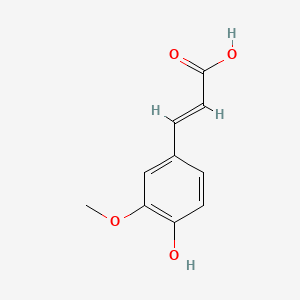
Ferulic Acid
Ferulic acid is a member of the class of ferulic acids that is cinnamic acid substituted by a methoxy and a hydroxy group at positions 3 and 4 of the phenyl ring. It has a role as an antioxidant, a neuroprotective agent and a plant metabolite. — ChEBI
- IUPAC 名称
- (E)-3-(4-hydroxy-3-methoxyphenyl)prop-2-enoic acid
- 分子式
- C10H10O4
- 分子量
- 194.18 g/mol
- 精确质量
- 194.05790880 Da
- XLogP3
- 1.5
- 拓扑极性表面积
- 66.8 Ų
- 氢键供体
- 2
- 氢键受体
- 4
- 共价单元
- 1
- 已定义的立体中心
- 0
又称
另有 16 个已报告名称
外部数据库标识符
- ChEBI:CHEBI:17620
- ChEBI:CHEBI:193350
- ChEMBL:CHEMBL32749
- EPA DTXSID:DTXSID70892035
- PubMed:24358168
- PubMed:23800587
- PubMed:21763500
- PubMed:18952420
- PubMed:15229801
- PubMed:12076751
- PubMed:9561563
来自其他科学数据库的证据
NIH PubChem PUG-View
Attributed physical-property, hazard, environmental and use annotations.
- Dissociation Constants: pKa = 4.58 来源: Hazardous Substances Data Bank (HSDB)
- LogP: log Kow = 1.51 来源: Hazardous Substances Data Bank (HSDB)
- LogP: 1.51 来源: Human Metabolome Database (HMDB)
- Melting Point: 168 - 171 °C 来源: Human Metabolome Database (HMDB)
- Physical Description: cis-Form is a yellow liquid; trans-Form is a solid; [Merck Index] trans-Isomer: Tan powder; [Alfa Aesar MSDS] 来源: Haz-Map, Information on Hazardous Chemicals and Occupational Diseases
- Physical Description: Tan powder; [Alfa Aesar MSDS] 来源: Haz-Map, Information on Hazardous Chemicals and Occupational Diseases
- Physical Description: Solid 来源: Human Metabolome Database (HMDB)
- Vapor Pressure: 0.00000269 [mmHg] 来源: Haz-Map, Information on Hazardous Chemicals and Occupational Diseases
- Note: This chemical does not meet GHS hazard criteria for 2.4% (8 of 329) of reports. 来源: European Chemicals Agency (ECHA)
- Signal: Warning 来源: European Chemicals Agency (ECHA)
- GHS Hazard Statements: H315 (97.6%): Causes skin irritation [Warning Skin corrosion/irritation]; H319 (97.6%): Causes serious eye irritation [Warning Serious eye damage/eye irritation]; H335 (97.6%): May cause respiratory irritation [Warning Specific target organ toxicity, single exposure; Respiratory tract irritation] 来源: European Chemicals Agency (ECHA)
- Precautionary Statement Codes: P261, P264, P264+P265, P271, P280, P302+P352, P304+P340, P305+P351+P338, P319, P321, P332+P317, P337+P317, P362+P364, P403+P233, P405, and P501 (click each P-code to see the statement) 来源: European Chemicals Agency (ECHA)
- ECHA C&L Notifications Summary: Aggregated GHS information provided per 329 reports by companies from 8 notifications to the ECHA C&L Inventory. Each notification may be associated with multiple companies.; Reported as not meeting GHS hazard criteria per 8 of 329 reports by companies.; There are 7 notifications provided by 321 of 329 reports by companies with hazard statement code(s).; Information may vary between notifications depending on impurities, additives, and other factors. The percentage value in parenthesis indicates the notified classification ratio from companies that provide hazard codes. Only hazard codes with percentage values above 10% are shown. For more detailed information, please visit ECHA C&L website. 来源: European Chemicals Agency (ECHA)
- Note: This chemical does not meet GHS hazard criteria for 1% (1 of 105) of reports. 来源: European Chemicals Agency (ECHA)
- GHS Hazard Statements: H315 (99%): Causes skin irritation [Warning Skin corrosion/irritation]; H319 (99%): Causes serious eye irritation [Warning Serious eye damage/eye irritation]; H335 (98.1%): May cause respiratory irritation [Warning Specific target organ toxicity, single exposure; Respiratory tract irritation] 来源: European Chemicals Agency (ECHA)
- ECHA C&L Notifications Summary: Aggregated GHS information provided per 105 reports by companies from 10 notifications to the ECHA C&L Inventory. Each notification may be associated with multiple companies.; Reported as not meeting GHS hazard criteria per 1 of 105 reports by companies.; There are 9 notifications provided by 104 of 105 reports by companies with hazard statement code(s).; Information may vary between notifications depending on impurities, additives, and other factors. The percentage value in parenthesis indicates the notified classification ratio from companies that provide hazard codes. Only hazard codes with percentage values above 10% are shown. For more detailed information, please visit ECHA C&L website. 来源: European Chemicals Agency (ECHA)
- GHS Hazard Statements: H317 (100%): May cause an allergic skin reaction [Warning Sensitization, Skin] 来源: European Chemicals Agency (ECHA)
- Precautionary Statement Codes: P261, P272, P280, P302+P352, P321, P333+P317, P362+P364, and P501 (click each P-code to see the statement) 来源: European Chemicals Agency (ECHA)
- ECHA C&L Notifications Summary: The GHS information provided by 1 company from 1 notification to the ECHA C&L Inventory. 来源: European Chemicals Agency (ECHA)
- Environmental Bioconcentration: An estimated BCF of 3.2 was calculated in fish for ferulic acid, using a measured log Kow of 1.51 (1) and a regression-derived equation (2). According to a classification scheme(3), this BCF suggests the potential for bioconcentration in aquatic organism is low(SRC), provided the compound is not metabolized by the organism(SRC). 来源: Hazardous Substances Data Bank (HSDB)
- Environmental Fate: TERRESTRIAL FATE: Based on a classification scheme(1), an estimated Koc value of 57(SRC), determined from a log Kow of 1.51(2) and a regression-derived equation(3), indicates that ferulic acid is expected to have high mobility in soil(SRC). The pKa of ferulic acid is 4.58(4), indicating that this compound will almost entirely exist in the anion form. In the environment, anions generally do not adsorb more strongly to soils containing organic carbon and clay than their neutral counterparts(5). Volatilization of ferulic acid from moist soil surfaces is not expected to be an important fate process(SRC) given the anionic nature of ferulic acid in the environment. Ferulic acid is not expected to volatilize from dry soil surfaces(SRC) based upon an estimated vapor pressure of 2.7X10⁻⁶ mm Hg(SRC), determined from a fragment constant method(6). Under neutral and acidic conditions in soil, ferulic acid is expected to undergo rapid aerobic biodegradation(7)(8). Under alkaline conditions in soil, ferulic acid is not expected to undergo rapid aerobic biodegradation(8). 来源: Hazardous Substances Data Bank (HSDB)
- Environmental Fate: AQUATIC FATE: Based on a classification scheme(1), an estimated Koc value of 57(SRC), determined from a log Kow of 1.51(2) and a regression-derived equation(3), indicates that ferulic acid is not expected to adsorb to suspended solids and sediment(SRC). A pKa of 4.58(4) indicates ferulic acid will exist almost entirely in the anion form at pH values of 5 to 9, and therefore volatilization from water surfaces/moist soil is not expected to be an important fate process(5). According to a classification scheme(6), an estimated BCF of 3.2(SRC), from its log Kow of 1.51(2) and a regression-derived equation(7), suggests the potential for bioconcentration in aquatic organisms is low(SRC). Ferulic acid is expected to biodegrade rapidly in water under anaerobic conditions(8). 来源: Hazardous Substances Data Bank (HSDB)
- Environmental Fate: ATMOSPHERIC FATE: According to a model of gas/particle partitioning of semivolatile organic compounds in the atmosphere(1), ferulic acid, which has a an estimated vapor pressure of 2.7X10⁻⁶ mm Hg at 25 °C(SRC), determined from a fragment constant method(2), will exist in both the vapor and particulate phases. Vapor-phase ferulic acid is degraded in the atmosphere by reaction with photochemically-produced hydroxyl radicals(SRC); the half-life for this reaction in air is estimated to be 8 hours(SRC), calculated from its rate constant of 4.8X10⁻¹¹ cu cm/molecule-sec at 25 °C(SRC), derived using a structure estimation method(3). Particulate-phase ferulic acid may be removed from the air by wet or dry deposition(SRC). Ferulic acid contains a chromophore that absorbs light at wavelengths >290 nm(4) and therefore may be susceptible to direct photolysis by sunlight(SRC). 来源: Hazardous Substances Data Bank (HSDB)
- Sources/Uses: Found in small amounts in many plants; Used as a food preservative; [Merck Index] 来源: Haz-Map, Information on Hazardous Chemicals and Occupational Diseases
- Sources/Uses: Widely distributed in plants; [Alfa Aesar MSDS] 来源: Haz-Map, Information on Hazardous Chemicals and Occupational Diseases
- Uses: Food preservative 来源: Hazardous Substances Data Bank (HSDB)
- Uses: /Ferulic acid was one of several compounds identified in/ ... a survey of 624 commercially available supplements targeted towards bodybuilding athletes... 来源: Hazardous Substances Data Bank (HSDB)
- Uses: Synthetic Polymer MALDI Matrix Compounds 来源: NIST Synthetic Polymer MALDI Recipes Database
映射方: Existing checksum-valid CAS to unique PubChem CID match. 检索时间: 2026-08-31. 打开来源记录
科学分类和危害注释仅提供背景信息,不能取代上方所示针对具体市场的监管决定。
其他来源的覆盖范围和匹配状态
| 来源 | 结果 | 已检查 |
|---|---|---|
| NIH PubChem PUG-View | 精确匹配 | 2026-08-31 |
已记录的无匹配结果是该来源已被检查的有效证据;这并不表示该物质在别处不存在。
于 2026-09-02 通过校验和有效的 CAS 匹配从美国国立卫生研究院 (NIH) PubChem 检索。化学性质不能取代本页的监管决定。
欧盟官方成分名称证据
该成分名称与 2025 年欧盟官方通用成分名称词汇表完全匹配。
相关清单证据
配方功能重叠的成分
其他官方和科学来源
11 个可用于核查此身份的外部数据库
每个链接都会在该来源中搜索此身份。 各来源是什么及其法律效力
FERULIC ACID 在 CosIng 清单中的呈现方式
CosIng 清单将 FERULIC ACID 列为化妆品成分,本页将其关联到 0 条附件记录。清单条目记录名称和标识符,而附件记录显示该物质在欧盟化妆品法规中被禁用、限用或列入准用清单的情况。
在官方数据中,FERULIC ACID 还被标记了 2 项化妆品功能。功能标识描述预期用途,但不能取代在配方或标签工作之前对关联附件记录的监管审查。