
AMMONIUM CHLORIDE
Ammonium chloride
AMMONIUM CHLORIDE 列于欧盟 CosIng 清单,但本页尚未关联任何直接的附件记录。
按市场划分的监管证据
此处跟踪的 13 个市场均未导入该成分的规则。
这描述的是本清单,而非法律。没有已导入的规则并不能证明某成分获准使用:规则可能以其他名称或标识符存在,或存在于尚未在此导入的数据集中。
AMMONIUM CHLORIDE 的清单详情
INCI 名称
AMMONIUM CHLORIDE
INN 名称
ammonium chloride
Ph. Eur. 名称
ammonii chloridum
说明
Ammonium chloride
AMMONIUM CHLORIDE 的附件记录
关键数据
- BUFFERING
Stabilising the pH of an aqueous medium in a narrow range even if an acid or base is added. Altering and/or maintaining a cosmetic product's pH at the desired level.
- FRAGRANCE
Imparting an odour or taste. Creating a perceivable pleasant smell and/or masking a bad smell.
- VISCOSITY CONTROLLING
Increasing or decreasing the viscosity (thickness) of cosmetics.
化学身份与性质
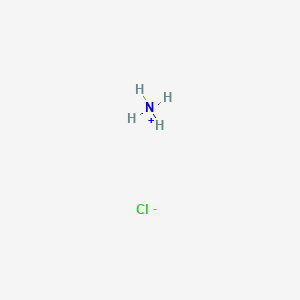
Ammonium Chloride
Ammonium chloride is an inorganic chloride having ammonium as the counterion. It has a role as a ferroptosis inhibitor. It is an inorganic chloride and an ammonium salt. — ChEBI
- IUPAC 名称
- azanium chloride
- 分子式
- ClH4N
- 分子量
- 53.49 g/mol
- 精确质量
- 53.0032268 Da
- 拓扑极性表面积
- 1.0 Ų
- 氢键供体
- 1
- 氢键受体
- 1
- 共价单元
- 2
- 已定义的立体中心
- 0
又称
另有 16 个已报告名称
外部数据库标识符
来自其他科学数据库的证据
NIH PubChem PUG-View
Attributed physical-property, hazard, environmental and use annotations.
- Boiling Point: Sublimes (NIOSH, 2024) 来源: CAMEO Chemicals
- Boiling Point: Sublimes 来源: DrugBank
- Boiling Point: 338 °C (sublimes) 来源: Hazardous Substances Data Bank (HSDB)
- Boiling Point: 520 °C 来源: ILO-WHO International Chemical Safety Cards (ICSCs)
- Boiling Point: sublimes 来源: Occupational Safety and Health Administration (OSHA)
- Boiling Point: Sublimes 来源: The National Institute for Occupational Safety and Health (NIOSH)
- Color/Form: Colorless crystals or crystalline masses, or white, granular powder 来源: Hazardous Substances Data Bank (HSDB)
- Color/Form: Colorless cubic crystals 来源: Hazardous Substances Data Bank (HSDB)
- Color/Form: A white, fine or coarse, crystalline powder 来源: Hazardous Substances Data Bank (HSDB)
- Color/Form: Finely divided, ... white particulate dispersed in air. /Ammonium chloride fume/ 来源: Hazardous Substances Data Bank (HSDB)
- Density: 1.53 at 68 °F (USCG, 1999) - Denser than water; will sink 来源: CAMEO Chemicals
- Density: 1.519 g/cu cm 来源: Hazardous Substances Data Bank (HSDB)
- Density: 1.5 g/cm³ 来源: ILO-WHO International Chemical Safety Cards (ICSCs)
- Density: 1.53 来源: Occupational Safety and Health Administration (OSHA)
- Density: 1.53 @25 °C 来源: PAC Chemical Database, U.S. Department of Energy
- Density: 1.53 来源: The National Institute for Occupational Safety and Health (NIOSH)
- Melting Point: 662 °F (Sublimes) (NIOSH, 2024) 来源: CAMEO Chemicals
- Melting Point: 350 ° C (Sublimes) 来源: DrugBank
- Melting Point: 520.1 (triple point; decomposes) 来源: Hazardous Substances Data Bank (HSDB)
- Melting Point: 662 °F (sublimes) 来源: Occupational Safety and Health Administration (OSHA)
- Melting Point: 338 °C 来源: PAC Chemical Database, U.S. Department of Energy
- Melting Point: 662 °F (Sublimes) 来源: The National Institute for Occupational Safety and Health (NIOSH)
- Odor: Odorless 来源: Hazardous Substances Data Bank (HSDB)
- Physical Description: Ammonium chloride is a white crystalline solid. It is soluble in water(37%). The primary hazard is the threat posed to the environment. Immediate steps should be taken to limit its spread to the environment. It is used to make other ammonium compounds, as a soldering flux, as a fertilizer, and for many other uses. 来源: CAMEO Chemicals
- Physical Description: Dry Powder; Liquid; Liquid; Other Solid; Dry Powder; CBI; Large Crystals 来源: EPA Chemical Data Reporting (CDR)
- Physical Description: Finely divided, odorless, white particulate dispersed in air; [NIOSH] 来源: Haz-Map, Information on Hazardous Chemicals and Occupational Diseases
- Physical Description: ODOURLESS COLOURLESS-TO-WHITE HYGROSCOPIC SOLID IN VARIOUS FORMS. 来源: ILO-WHO International Chemical Safety Cards (ICSCs)
- Physical Description: Finely divided, odorless, white particulate dispersed in air. 来源: Occupational Safety and Health Administration (OSHA)
- Physical Description: Finely divided, odorless, white particulate dispersed in air. 来源: The National Institute for Occupational Safety and Health (NIOSH)
- Refractive Index: Index of refraction: 1.642 来源: Hazardous Substances Data Bank (HSDB)
- Solubility: 37 % (NIOSH, 2024) 来源: CAMEO Chemicals
- Solubility: Strongly endothermic; sublimes without melting; somewhat hygroscopic; tendency to cake; hydrochloric acid and sodium chloride decrease solubility in water 来源: Hazardous Substances Data Bank (HSDB)
- Solubility: In water, 39.5 g/100 g water at 25 °C 来源: Hazardous Substances Data Bank (HSDB)
- Solubility: Almost insoluble in acetone, ether, ethyl acetate; soluble in alcohol 来源: Hazardous Substances Data Bank (HSDB)
- Solubility: 28.3% (wt/wt) in water at 25 °C 来源: Hazardous Substances Data Bank (HSDB)
- Solubility: Soluble in liquid ammonia 来源: Hazardous Substances Data Bank (HSDB)
- Solubility: For more Solubility (Complete) data for AMMONIUM CHLORIDE (10 total), please visit the HSDB record page. 来源: Hazardous Substances Data Bank (HSDB)
- Solubility: Solubility in water, g/100ml at 25 °C: 28.3 来源: ILO-WHO International Chemical Safety Cards (ICSCs)
- Solubility: 37% 来源: The National Institute for Occupational Safety and Health (NIOSH)
- Vapor Pressure: 1 mmHg at 321 °F (NIOSH, 2024) 来源: CAMEO Chemicals
- Vapor Pressure: 1 Pa at 91 °C (solid); 10 Pa at 121 °C (solid); 100 Pa at 159 °C (solid); 1kPa at 204.7 °C (solid); 10 kPa at 263.1 °C (solid); 100 kPa at 339.5 °C (solid) 来源: Hazardous Substances Data Bank (HSDB)
- Vapor Pressure: Vapor pressure, kPa at 160 °C: 0.13 来源: ILO-WHO International Chemical Safety Cards (ICSCs)
- Vapor Pressure: 1 mmHg at 321 °F 来源: Occupational Safety and Health Administration (OSHA)
- Vapor Pressure: (321 °F): 1 mmHg 来源: The National Institute for Occupational Safety and Health (NIOSH)
- pH: pH of aqueous solution (25 °C): 1% 5.5; 3% 5.1; 10% 5.0 来源: Hazardous Substances Data Bank (HSDB)
- Exposure Routes: The substance can be absorbed into the body by inhalation of dust or fume and by ingestion. 来源: ILO-WHO International Chemical Safety Cards (ICSCs)
- Exposure Routes: inhalation, skin and/or eye contact 来源: The National Institute for Occupational Safety and Health (NIOSH)
- First Aid: Excerpt from NIOSH Pocket Guide for Ammonium chloride fume:; Eye: IRRIGATE IMMEDIATELY - If this chemical contacts the eyes, immediately wash (irrigate) the eyes with large amounts of water, occasionally lifting the lower and upper lids. Get medical attention immediately.; Skin: SOAP WASH IMMEDIATELY - If this chemical contacts the skin, immediately wash the contaminated skin with soap and water. If this chemical penetrates the clothing, immediately remove the clothing, wash the skin with soap and water, and get medical attention promptly.; Breathing: RESPIRATORY SUPPORT - If a person breathes large amounts of this chemical, move the exposed person to fresh air at once. If breathing has stopped, perform artificial respiration. Keep the affected person warm and at rest. Get medical attention as soon as possible. (NIOSH, 2024) 来源: CAMEO Chemicals
- First Aid: (General first aid procedures); Eye: Irrigate immediately - If this chemical contacts the eyes, immediately wash (irrigate) the eyes with large amounts of water, occasionally lifting the lower and upper lids. Get medical attention immediately.; Skin: Soap wash immediately - If this chemical contacts the skin, immediately wash the contaminated skin with soap and water. If this chemical penetrates the clothing, immediately remove the clothing, wash the skin with soap and water, and get medical attention promptly.; Breathing: Respiratory support 来源: The National Institute for Occupational Safety and Health (NIOSH)
- Signal: Warning 来源: Regulation (EC) No 1272/2008 of the European Parliament and of the Council
- GHS Hazard Statements: H302: Harmful if swallowed [Warning Acute toxicity, oral]; H319: Causes serious eye irritation [Warning Serious eye damage/eye irritation] 来源: Regulation (EC) No 1272/2008 of the European Parliament and of the Council
- Precautionary Statement Codes: P264, P264+P265, P270, P280, P301+P317, P305+P351+P338, P330, P337+P317, and P501 (click each P-code to see the statement) 来源: Regulation (EC) No 1272/2008 of the European Parliament and of the Council
- Note: This chemical does not meet GHS hazard criteria for < 0.1% (2 of 3391) of reports. 来源: European Chemicals Agency (ECHA)
- Signal: Warning 来源: European Chemicals Agency (ECHA)
- GHS Hazard Statements: H302 (99.9%): Harmful if swallowed [Warning Acute toxicity, oral]; H319 (> 99.9%): Causes serious eye irritation [Warning Serious eye damage/eye irritation] 来源: European Chemicals Agency (ECHA)
- Precautionary Statement Codes: P264, P264+P265, P270, P280, P301+P317, P305+P351+P338, P330, P337+P317, and P501 (click each P-code to see the statement) 来源: European Chemicals Agency (ECHA)
- ECHA C&L Notifications Summary: Aggregated GHS information provided per 3391 reports by companies from 17 notifications to the ECHA C&L Inventory. Each notification may be associated with multiple companies.; Reported as not meeting GHS hazard criteria per 2 of 3391 reports by companies.; There are 16 notifications provided by 3389 of 3391 reports by companies with hazard statement code(s).; Information may vary between notifications depending on impurities, additives, and other factors. The percentage value in parenthesis indicates the notified classification ratio from companies that provide hazard codes. Only hazard codes with percentage values above 10% are shown. For more detailed information, please visit ECHA C&L website. 来源: European Chemicals Agency (ECHA)
- GHS Hazard Statements: H402: Harmful to aquatic life [Hazardous to the aquatic environment, acute hazard] 来源: NITE-CMC
- Precautionary Statement Codes: P273, and P501 (click each P-code to see the statement) 来源: NITE-CMC
- GHS Hazard Statements: Not Classified 来源: NITE-CMC
- Signal: Danger 来源: NITE-CMC
- Target Organs: Eyes, skin, respiratory system 来源: The National Institute for Occupational Safety and Health (NIOSH)
- Toxicity Summary: IDENTIFICATION AND USE: Ammonium chloride is a white, fine or coarse, crystalline powder. it is a good fertilizer for important crops in rainy climates, particularly for rice. It is not registered for current use in the U.S., but approved pesticide uses may change periodically and so federal, state and local authorities must be consulted for currently approved uses. Ammonium chloride is used also as a flux in zinc and tin plating; electroplating, electrolytic refining of zinc; etching solutions in manufacture of printed circuit boards; in dry and Leclanche batteries; manufacturing of explosives; flame suppressant; hardener for formaldehyde-based adhesives; mordant for dyes and printing. It is used as medication particularly in diuretics, expectorants. HUMAN EXPOSURE AND TOXICITY: Potential symptoms of overexposure to fumes are irritation of eyes, skin, and respiratory system; cough, dyspnea, pulmonary sensitization. Large doses of ammonium chloride may cause metabolic acidosis secondary to hyperchloremia, especially in patients with impaired renal function. Other adverse effects of excessive ammonium chloride dosage include rash, headache, hyperventilation, bradycardia, progressive 来源: Hazardous Substances Data Bank (HSDB)
- Consumer Uses: Processing aids, specific to petroleum production; Flux agent; Sealant (barrier); Not Known or Reasonably Ascertainable; Soil amendments (fertilizers); pH regulating agent; Other 来源: EPA Chemical Data Reporting (CDR)
- Industry Uses: Lubricating agent; Other; Processing aids not otherwise specified; Plating agent; Flux agent; Soil amendments (fertilizers); Ion exchange agent; Not Known or Reasonably Ascertainable; Intermediate; Anti-scaling agent; Processing aids, specific to petroleum production; Etching agent 来源: EPA Chemical Data Reporting (CDR)
- Sources/Uses: Used as a mordant in dyeing, a soldering flux, a fertilizer, and a pickling agent; also used in the dry battery, electroplating, plastics, food processing, and pharmaceutical industries; a large amount of fume may be generated in galvanizing operations; [ACGIH] 来源: Haz-Map, Information on Hazardous Chemicals and Occupational Diseases
- Industrial Processes with risk of exposure: Steel Producing [Category: Industry]; Electroplating [Category: Plate]; Soldering [Category: Heat or Machine] 来源: Haz-Map, Information on Hazardous Chemicals and Occupational Diseases
- Activities with risk of exposure: Applying metallic patinas [Category: Hobbies] 来源: Haz-Map, Information on Hazardous Chemicals and Occupational Diseases
- Uses: Mesh Heading: diuretics, expectorants 来源: Hazardous Substances Data Bank (HSDB)
- Uses: For ammonium chloride (USEPA/OPP Pesticide Code: 129014) there are 0 labels match. /SRP: Not registered for current use in the U.S., but approved pesticide uses may change periodically and so federal, state and local authorities must be consulted for currently approved uses./ 来源: Hazardous Substances Data Bank (HSDB)
- Uses: As a flux in zinc and tin plating; electroplating, electrolytic refining of zinc; etching solutions in manufacture of printed circuit boards; in dry and Leclanche batteries; as a nitrogen source for fertilization of rice and wheat, manufacturing of explosives; flame suppressant; hardener for formaldehyde-based adhesives; mordant for dyes and printing. 来源: Hazardous Substances Data Bank (HSDB)
- Uses: Dry batteries, mordant (dyeing and printing), soldering flux, manufacturing of various ammonia compounds, fertilizer, pickeling agent in zinc coating and tinning, electroplating, washing powders, melt-retarding snow treatment, production of urea-formaldehyde resins and adhesives, bakery products. 来源: Hazardous Substances Data Bank (HSDB)
- Uses: For more Uses (Complete) data for AMMONIUM CHLORIDE (23 total), please visit the HSDB record page. 来源: Hazardous Substances Data Bank (HSDB)
映射方: Existing checksum-valid CAS to unique PubChem CID match. 检索时间: 2026-08-31. 打开来源记录
科学分类和危害注释仅提供背景信息,不能取代上方所示针对具体市场的监管决定。
其他来源的覆盖范围和匹配状态
| 来源 | 结果 | 已检查 |
|---|---|---|
| NIH PubChem PUG-View | 精确匹配 | 2026-08-31 |
已记录的无匹配结果是该来源已被检查的有效证据;这并不表示该物质在别处不存在。
于 2026-08-31 通过校验和有效的 CAS 匹配从美国国立卫生研究院 (NIH) PubChem 检索。化学性质不能取代本页的监管决定。
欧盟官方成分名称证据
该成分名称与 2025 年欧盟官方通用成分名称词汇表完全匹配。
相关清单证据
配方功能重叠的成分
其他官方和科学来源
11 个可用于核查此身份的外部数据库
每个链接都会在该来源中搜索此身份。 各来源是什么及其法律效力
AMMONIUM CHLORIDE 在 CosIng 清单中的呈现方式
CosIng 清单将 AMMONIUM CHLORIDE 列为化妆品成分,本页将其关联到 0 条附件记录。清单条目记录名称和标识符,而附件记录显示该物质在欧盟化妆品法规中被禁用、限用或列入准用清单的情况。
在官方数据中,AMMONIUM CHLORIDE 还被标记了 3 项化妆品功能。功能标识描述预期用途,但不能取代在配方或标签工作之前对关联附件记录的监管审查。