
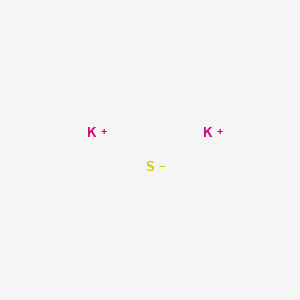
CAS 1312-73-8CAS 37248-34-3PubChem CID 162263
Potassium Sulfide
Potassium sulfide, hydrated, with not less than 30% water of crystallization appears as a red crystalline solid. Denser than water. Contact may severely irritate skin, eyes and mucous membranes. May be toxic by ingestion. — CAMEO Chemicals
- IUPAC 名称
- dipotassium;sulfide
- 分子式
- K2S
- 分子量
- 110.26 g/mol
- 精确质量
- 109.89948414 Da
- 拓扑极性表面积
- 1.0 Ų
- 氢键供体
- 0
- 氢键受体
- 1
- 共价单元
- 3
- 已定义的立体中心
- 0
又称
potassium sulphideDipotassium monosulfidePotassium sulfide (2:1)POTASSIUM MONOSULPHIDEDIPOTASSIUM MONOSULPHIDE31R0R7HD0NPOTASSIUM SULPHIDE (2:1)HEPAR SULFURIS
另有 16 个已报告名称
RefChem:57958POTASSIUM SULFURETKali Sulf. Bath EssencePOTASSIUM SULFIDE (K2S4)POTASSIUM SULPHIDE, ANHYDROUSPOTASSIUM POLYSULFIDE (K2S4)POTASSIUM SULFIDE, WITH LESS THAN 30% WATER OF CRYSTALLIZATIONPOTASSIUM SULPHIDE, WITH LESS THAN 30% WATER OF CRYSTALLIZATION215-197-0AI3-25350Dipotassium monosulfide (K2S)Dipotassium tetrasulfideEINECS 215-197-0HSDB 1204Potassium monosulfidePotassium sulfide (K2(S4))
外部数据库标识符
- EPA DTXSID:DTXSID70909738
来自其他科学数据库的证据
NIH PubChem PUG-View
标识符精确匹配162263
Attributed physical-property, hazard, environmental and use annotations.
- Color/Form: WHITE CUBIC CRYSTALS OR FUSED PLATES 来源: Hazardous Substances Data Bank (HSDB)
- Color/Form: RED OR YELLOW-RED CRYSTALLINE MASS OR FUSED SOLID 来源: Hazardous Substances Data Bank (HSDB)
- Density: Density = 1.74 g/cu cm 来源: Hazardous Substances Data Bank (HSDB)
- Density: Relative density (water = 1): 1.8 来源: ILO-WHO International Chemical Safety Cards (ICSCs)
- Melting Point: 912 °C 来源: Hazardous Substances Data Bank (HSDB)
- Melting Point: 840 °C 来源: ILO-WHO International Chemical Safety Cards (ICSCs)
- Physical Description: Potassium sulfide, anhydrous appears as a yellow-red to red crystalline mass or fused solid with an odor of rotten eggs. 来源: CAMEO Chemicals
- Physical Description: Potassium sulfide, hydrated, with not less than 30% water of crystallization appears as a red crystalline solid. Denser than water. Contact may severely irritate skin, eyes and mucous membranes. May be toxic by ingestion. 来源: CAMEO Chemicals
- Physical Description: White very hygroscopic solid; Discolored by air; [Merck Index] Red or yellow-red deliquescent solid; [Hawley] White to yellow powder with an odor of rotten eggs; [Strem MSDS] 来源: Haz-Map, Information on Hazardous Chemicals and Occupational Diseases
- Physical Description: HYGROSCOPIC WHITE CRYSTALS WITH CHARACTERISTIC ODOUR. TURNS RED OR BROWN ON EXPOSURE TO AIR. 来源: ILO-WHO International Chemical Safety Cards (ICSCs)
- Solubility: FREELY SOL IN WATER 来源: Hazardous Substances Data Bank (HSDB)
- Solubility: SOL IN ALCOHOL, GLYCERINE; INSOL IN ETHER 来源: Hazardous Substances Data Bank (HSDB)
- Solubility: Soluble in ethanol, insoluble in ether. 来源: Hazardous Substances Data Bank (HSDB)
- Solubility: Solubility in water: very good 来源: ILO-WHO International Chemical Safety Cards (ICSCs)
- pH: AQ SOL ARE STRONGLY ALKALINE 来源: Hazardous Substances Data Bank (HSDB)
- Exposure Routes: The substance can be absorbed into the body by inhalation and by ingestion. 来源: ILO-WHO International Chemical Safety Cards (ICSCs)
- First Aid: Excerpt from ERG Guide 135 [Substances - Spontaneously Combustible]:; Refer to the "General First Aid" section. (ERG, 2024) 来源: CAMEO Chemicals
- First Aid: Excerpt from ERG Guide 153 [Substances - Toxic and/or Corrosive (Combustible)]:; Refer to the "General First Aid" section. Specific First Aid: For corrosives, in case of contact, immediately flush skin or eyes with running water for at least 30 minutes. Additional flushing may be required. Removal of solidified molten material from skin requires medical assistance. (ERG, 2024) 来源: CAMEO Chemicals
- ERG2024, Guide 153 (Potassium sulfide, hydrated, with not less than 30% water of crystallization): General First Aid:; · Call 911 or emergency medical service.; · Ensure that medical personnel are aware of the material(s) involved, take precautions to protect themselves and avoid contamination.; · Move victim to fresh air if it can be done safely.; · Administer oxygen if breathing is difficult.; · If victim is not breathing:; -- DO NOT perform mouth-to-mouth resuscitation; the victim may have ingested or inhaled the substance.; -- If equipped and pulse detected, wash face and mouth, then give artificial respiration using a proper respiratory medical device (bag-valve mask, pocket mask equipped with a one-way valve or other device).; -- If no pulse detected or no respiratory medical device available, provide continuous compressions. Conduct a pulse check every two minutes or monitor for any signs of spontaneous respirations.; · Remove and isolate contaminated clothing and shoes.; · For minor skin contact, avoid spreading material on unaffected skin.; · In case of contact with substance, remove immediately by flushing skin or eyes with running water for at least 20 minutes.; · For severe burns, immediate medical attention is required.; · Effects of exposure (inhalation, ingestion, 来源: Emergency Response Guidebook (ERG)
- ERG2024, Guide 135 (Potassium sulfide, anhydrous; Potassium sulfide, with less than 30% water of crystallization): General First Aid:; · Call 911 or emergency medical service.; · Ensure that medical personnel are aware of the material(s) involved, take precautions to protect themselves and avoid contamination.; · Move victim to fresh air if it can be done safely.; · Administer oxygen if breathing is difficult.; · If victim is not breathing:; -- DO NOT perform mouth-to-mouth resuscitation; the victim may have ingested or inhaled the substance.; -- If equipped and pulse detected, wash face and mouth, then give artificial respiration using a proper respiratory medical device (bag-valve mask, pocket mask equipped with a one-way valve or other device).; -- If no pulse detected or no respiratory medical device available, provide continuous compressions. Conduct a pulse check every two minutes or monitor for any signs of spontaneous respirations.; · Remove and isolate contaminated clothing and shoes.; · For minor skin contact, avoid spreading material on unaffected skin.; · In case of contact with substance, remove immediately by flushing skin or eyes with running water for at least 20 minutes.; · For severe burns, immediate medical attention is required.; · Effects of exposure (inhalation, ingestion, 来源: Emergency Response Guidebook (ERG)
- Signal: Danger 来源: Regulation (EC) No 1272/2008 of the European Parliament and of the Council
- GHS Hazard Statements: H314: Causes severe skin burns and eye damage [Danger Skin corrosion/irritation]; H400: Very toxic to aquatic life [Warning Hazardous to the aquatic environment, acute hazard] 来源: Regulation (EC) No 1272/2008 of the European Parliament and of the Council
- Precautionary Statement Codes: P260, P264, P273, P280, P301+P330+P331, P302+P361+P354, P304+P340, P305+P354+P338, P316, P321, P363, P391, P405, and P501 (click each P-code to see the statement) 来源: Regulation (EC) No 1272/2008 of the European Parliament and of the Council
- Signal: Danger 来源: European Chemicals Agency (ECHA)
- GHS Hazard Statements: H251 (44.3%): Self-heating; may catch fire [Danger Self-heating substances and mixtures]; H314 (100%): Causes severe skin burns and eye damage [Danger Skin corrosion/irritation]; H400 (100%): Very toxic to aquatic life [Warning Hazardous to the aquatic environment, acute hazard] 来源: European Chemicals Agency (ECHA)
- Precautionary Statement Codes: P235, P260, P264, P273, P280, P301+P330+P331, P302+P361+P354, P304+P340, P305+P354+P338, P316, P321, P363, P391, P405, P407, P410, P413, P420, and P501 (click each P-code to see the statement) 来源: European Chemicals Agency (ECHA)
- ECHA C&L Notifications Summary: Aggregated GHS information provided per 88 reports by companies from 3 notifications to the ECHA C&L Inventory. Each notification may be associated with multiple companies.; Information may vary between notifications depending on impurities, additives, and other factors. The percentage value in parenthesis indicates the notified classification ratio from companies that provide hazard codes. Only hazard codes with percentage values above 10% are shown. For more detailed information, please visit ECHA C&L website. 来源: European Chemicals Agency (ECHA)
- Signal: Danger 来源: NITE-CMC
- GHS Hazard Statements: H251: Self-heating; may catch fire [Danger Self-heating substances and mixtures]; H300: Fatal if swallowed [Danger Acute toxicity, oral]; H314: Causes severe skin burns and eye damage [Danger Skin corrosion/irritation]; H318: Causes serious eye damage [Danger Serious eye damage/eye irritation]; H371: May cause damage to organs [Warning Specific target organ toxicity, single exposure] 来源: NITE-CMC
- Precautionary Statement Codes: P235, P260, P264, P264+P265, P270, P280, P301+P316, P301+P330+P331, P302+P361+P354, P304+P340, P305+P354+P338, P308+P316, P316, P317, P321, P330, P363, P405, P407, P410, P413, P420, and P501 (click each P-code to see the statement) 来源: NITE-CMC
- Signal: Danger 来源: Hazardous Chemical Information System (HCIS), Safe Work Australia
- GHS Hazard Statements: H301: Toxic if swallowed [Danger Acute toxicity, oral]; H312: Harmful in contact with skin [Warning Acute toxicity, dermal]; H314: Causes severe skin burns and eye damage [Danger Skin corrosion/irritation]; H400: Very toxic to aquatic life [Warning Hazardous to the aquatic environment, acute hazard] 来源: Hazardous Chemical Information System (HCIS), Safe Work Australia
- NFPA Health Rating: 3 - Materials that, under emergency conditions, can cause serious or permanent injury. 来源: Hazardous Substances Data Bank (HSDB)
- NFPA Fire Rating: 1 - Materials that must be preheated before ignition can occur. Materials require considerable preheating, under all ambient temperature conditions, before ignition and combustion can occur. 来源: Hazardous Substances Data Bank (HSDB)
- NFPA Instability Rating: 0 - Materials that in themselves are normally stable, even under fire conditions. 来源: Hazardous Substances Data Bank (HSDB)
- Sources/Uses: Used in photography (toner); [www.ci.tucson.az.us/arthazards/medium.html] Used as an analytical reagent, depilatory, and medicine; [Hawley] 来源: Haz-Map, Information on Hazardous Chemicals and Occupational Diseases
- Industrial Processes with risk of exposure: Photographic Processing [Category: Other] 来源: Haz-Map, Information on Hazardous Chemicals and Occupational Diseases
- Activities with risk of exposure: Applying metallic patinas [Category: Hobbies] 来源: Haz-Map, Information on Hazardous Chemicals and Occupational Diseases
- Uses: Reagent in analytical chemistry, depilatory, medicine. 来源: Hazardous Substances Data Bank (HSDB)
映射方: Existing checksum-valid CAS to unique PubChem CID match. 检索时间: 2026-08-31. 打开来源记录
科学分类和危害注释仅提供背景信息,不能取代上方所示针对具体市场的监管决定。
其他来源的覆盖范围和匹配状态
| 来源 | 结果 | 已检查 |
|---|---|---|
| NIH PubChem PUG-View | 精确匹配 | 2026-08-31 |
已记录的无匹配结果是该来源已被检查的有效证据;这并不表示该物质在别处不存在。
于 2026-09-02 通过校验和有效的 CAS 匹配从美国国立卫生研究院 (NIH) PubChem 检索。化学性质不能取代本页的监管决定。