
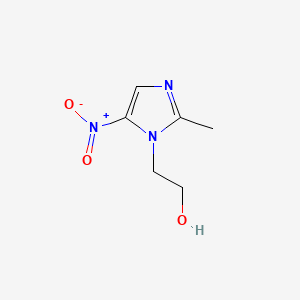
Metronidazole
Metronidazole is a member of the class of imidazoles substituted at C-1, -2 and -5 with 2-hydroxyethyl, nitro and methyl groups respectively. It has activity against anaerobic bacteria and protozoa, and has a radiosensitising effect on hypoxic tumour cells. It may be given by mouth in tablets, or as the benzoate in an oral suspension. The hydrochloride salt can be used in intravenous infusions. Metronidazole is a prodrug and is selective for anaerobic bacteria due to their ability to intracellularly reduce the nitro group of metronidazole to give nitroso-containing intermediates. These can covalently bind to DNA, disrupting its helical structure, inducing DNA strand breaks and inhibiting bacterial nucleic acid synthesis, ultimately resulting in bacterial cell death. It has a role as a radiosensitizing agent, an antiamoebic agent, an antimicrobial agent, an antiparasitic agent, a xenobiotic, an antibacterial drug, a prodrug, an antitrichomonal drug and an environmental contaminant. It is a primary alcohol, a member of imidazoles and a C-nitro compound. It is a conjugate base of a metronidazole(1+). — ChEBI
- IUPAC 名称
- 2-(2-methyl-5-nitroimidazol-1-yl)ethanol
- 分子式
- C6H9N3O3
- 分子量
- 171.15 g/mol
- 精确质量
- 171.06439116 Da
- XLogP3
- 0.0
- 拓扑极性表面积
- 83.9 Ų
- 氢键供体
- 1
- 氢键受体
- 4
- 共价单元
- 1
- 已定义的立体中心
- 0
又称
另有 16 个已报告名称
外部数据库标识符
于 2026-08-31 通过校验和有效的 CAS 匹配从美国国立卫生研究院 (NIH) PubChem 检索。化学性质不能取代本页的监管决定。