
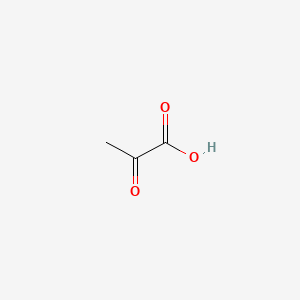
CAS 127-17-3PubChem CID 1060
Pyruvic Acid
Pyruvic acid is a 2-oxo monocarboxylic acid that is the 2-keto derivative of propionic acid. It is a metabolite obtained during glycolysis. It has a role as a cofactor and a fundamental metabolite. It is functionally related to a propionic acid. It is a conjugate acid of a pyruvate. — ChEBI
- IUPAC 名称
- 2-oxopropanoic acid
- 分子式
- C3H4O3
- 分子量
- 88.06 g/mol
- 精确质量
- 88.016043985 Da
- XLogP3
- -0.3
- 拓扑极性表面积
- 54.4 Ų
- 氢键供体
- 1
- 氢键受体
- 3
- 共价单元
- 1
- 已定义的立体中心
- 0
又称
acetylformic acidPyroracemic acid2-Oxopropionic acidPropanoic acid, 2-oxo-alpha-ketopropionic acid2-Ketopropionic acid2-Oxopropansaeure2-Oxopropionsaeure
另有 16 个已报告名称
alpha-Oxopropionsaeure2-oxo-propionic acidacide pyruviquea-Ketopropionic acidCH3COCOOHFEMA No. 2970BrenztraubensaeureNSC-1798558G7RUTRCHEBI:32816Acid, PyruvicRefChem:6190204-824-3Pyruvic acid (natural)alpha-keto propionic acid.alpha.-Ketopropionic acid
外部数据库标识符
- ChEBI:CHEBI:32816
- ChEMBL:CHEMBL1162144
- EPA DTXSID:DTXSID2021650
- PubMed:29968805
- PubMed:23112412
- PubMed:23109393
- PubMed:23107522
- PubMed:23106469
- PubMed:23105596
- PubMed:23105452
- PubMed:23105378
- PubMed:23098296
- PubMed:23094580
- PubMed:23093855
- PubMed:23091152
来自其他科学数据库的证据
NIH PubChem PUG-View
标识符精确匹配1060
Attributed physical-property, hazard, environmental and use annotations.
- Boiling Point: 54 °C at 1.00E+01 mm Hg 来源: DrugBank
- Boiling Point: 164 °C 来源: Joint FAO/WHO Expert Committee on Food Additives (JECFA)
- Density: 1.260-1.281 来源: Joint FAO/WHO Expert Committee on Food Additives (JECFA)
- pKa: 2.45 (at 25 °C) 来源: DrugBank
- LogP: -0.5 来源: DrugBank
- Melting Point: 13.8 °C 来源: DrugBank
- Melting Point: 13.8 °C 来源: Human Metabolome Database (HMDB)
- Physical Description: Liquid with an odor like acetic acid; mp = 11.8 deg C; [Merck Index] 来源: Haz-Map, Information on Hazardous Chemicals and Occupational Diseases
- Physical Description: Liquid 来源: Human Metabolome Database (HMDB)
- Physical Description: colourless to amber viscous liquid with a sour vinegar-like odour 来源: Joint FAO/WHO Expert Committee on Food Additives (JECFA)
- Refractive Index: 1.424-1.435 来源: Joint FAO/WHO Expert Committee on Food Additives (JECFA)
- Solubility: 1000000 mg/L (at 20 °C) 来源: DrugBank
- Solubility: 1000.0 mg/mL 来源: Human Metabolome Database (HMDB)
- Solubility: miscible with water; soluble in organic solvents, oils 来源: Joint FAO/WHO Expert Committee on Food Additives (JECFA)
- Solubility: miscible at room temperature (in ethanol) 来源: Joint FAO/WHO Expert Committee on Food Additives (JECFA)
- Vapor Pressure: 1.29 [mmHg] 来源: Haz-Map, Information on Hazardous Chemicals and Occupational Diseases
- Carcinogen Classification: No indication of carcinogenicity to humans (not listed by IARC). 来源: Toxin and Toxin Target Database (T3DB)
- Exposure Routes: Pyruvate is absorbed from the gastrointestinal tract from whence it is transported to the liver via the portal circulation. 来源: Toxin and Toxin Target Database (T3DB)
- Signal: Danger 来源: European Chemicals Agency (ECHA)
- GHS Hazard Statements: H314 (100%): Causes severe skin burns and eye damage [Danger Skin corrosion/irritation]; H318 (83.2%): Causes serious eye damage [Danger Serious eye damage/eye irritation] 来源: European Chemicals Agency (ECHA)
- Precautionary Statement Codes: P260, P264, P264+P265, P280, P301+P330+P331, P302+P361+P354, P304+P340, P305+P354+P338, P316, P317, P321, P363, P405, and P501 (click each P-code to see the statement) 来源: European Chemicals Agency (ECHA)
- ECHA C&L Notifications Summary: Aggregated GHS information provided per 1823 reports by companies from 11 notifications to the ECHA C&L Inventory. Each notification may be associated with multiple companies.; Information may vary between notifications depending on impurities, additives, and other factors. The percentage value in parenthesis indicates the notified classification ratio from companies that provide hazard codes. Only hazard codes with percentage values above 10% are shown. For more detailed information, please visit ECHA C&L website. 来源: European Chemicals Agency (ECHA)
- Toxicity Summary: Pyruvate serves as a biological fuel by being converted to acetyl coenzyme A, which enters the tricarboxylic acid or Krebs cycle where it is metabolized to produce ATP aerobically. Energy can also be obtained anaerobically from pyruvate via its conversion to lactate. Pyruvate injections or perfusions increase contractile function of hearts when metabolizing glucose or fatty acids. This inotropic effect is striking in hearts stunned by ischemia/reperfusion. The inotropic effect of pyruvate requires intracoronary infusion. Among possible mechanisms for this effect are increased generation of ATP and an increase in ATP phosphorylation potential. Another is activation of pyruvate dehydrogenase, promoting its own oxidation by inhibiting pyruvate dehydrogenase kinase. Pyruvate dehydrogenase is inactivated in ischemia myocardium. Yet another is reduction of cytosolic inorganic phosphate concentration. Pyruvate, as an antioxidant, is known to scavenge such reactive oxygen species as hydrogen peroxide and lipid peroxides. Indirectly, supraphysiological levels of pyruvate may increase cellular reduced glutathione. 来源: Toxin and Toxin Target Database (T3DB)
- Sources/Uses: Intermediate in sugar metabolism and alcoholic fermentation; [Merck Index] Used as flavoring agent or adjuvant; [FDA] 来源: Haz-Map, Information on Hazardous Chemicals and Occupational Diseases
- Uses: For nutritional supplementation, also for treating dietary shortage or imbalance 来源: Toxin and Toxin Target Database (T3DB)
映射方: Existing checksum-valid CAS to unique PubChem CID match. 检索时间: 2026-08-31. 打开来源记录
科学分类和危害注释仅提供背景信息,不能取代上方所示针对具体市场的监管决定。
其他来源的覆盖范围和匹配状态
| 来源 | 结果 | 已检查 |
|---|---|---|
| NIH PubChem PUG-View | 精确匹配 | 2026-08-31 |
已记录的无匹配结果是该来源已被检查的有效证据;这并不表示该物质在别处不存在。
于 2026-08-31 通过校验和有效的 CAS 匹配从美国国立卫生研究院 (NIH) PubChem 检索。化学性质不能取代本页的监管决定。