
CAS
1 条记录
CAS 125-71-3
CAS 125-71-3 与法规 1223/2009 附件 II–VI 中的 1 条欧盟附件记录相匹配。
CAS 125-71-3 的记录
1 共化学身份与性质
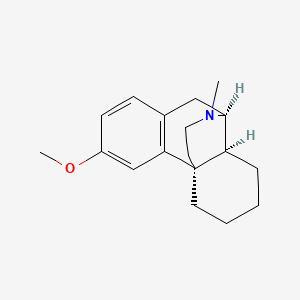
CAS 125-71-3PubChem CID 5360696
Dextromethorphan
Dextromethorphan is a 6-methoxy-11-methyl-1,3,4,9,10,10a-hexahydro-2H-10,4a-(epiminoethano)phenanthrene in which the sterocenters at positions 4a, 10 and 10a have S-configuration. It is a prodrug of dextrorphan and used as an antitussive drug for suppressing cough. It has a role as a oneirogen, a xenobiotic, a prodrug, a neurotoxin, an antitussive, a NMDA receptor antagonist and an environmental contaminant. It is functionally related to a dextrorphan. It is an enantiomer of a levomethorphan. — ChEBI
- IUPAC 名称
- (1S,9S,10S)-4-methoxy-17-methyl-17-azatetracyclo[7.5.3.01,10.02,7]heptadeca-2(7),3,5-triene
- 分子式
- C18H25NO
- 分子量
- 271.4 g/mol
- 精确质量
- 271.193614421 Da
- XLogP3
- 3.4
- 拓扑极性表面积
- 12.5 Ų
- 氢键供体
- 0
- 氢键受体
- 2
- 共价单元
- 1
- 已定义的立体中心
- 3
又称
d-Methorphandelta-MethorphanDextromorphanDextromethorfanDextrometorfanoDextromethorphaneAlbutussinDestrometerfano
另有 16 个已报告名称
DextromethorphanumBA 2666Balminil DM(+)-Dextromethorphan3-Methoxy-17-methyl-9alpha,13alpha,14alpha-morphinanMorphinan, 3-methoxy-17-methyl-, (9alpha,13alpha,14alpha)-DXM [Antitussive]BA-26667355X3ROTSCHEBI:4470(+)-3-Methoxy-N-methylmorphinonNSC-751452DXM (Antitussive)(+)-cis-1,3,4,9,10,10a-Hexahydro-6-methoxy-11-methyl-2H-10,4alpha-iminoethanophenanthren(+)-3-methoxy-17-methyl-9alpha,13alpha,14alpha-morphinanRoboTablets
外部数据库标识符
- ChEBI:CHEBI:4470
- ChEBI:CHEBI:92579
- ChEMBL:CHEMBL52440
- EPA DTXSID:DTXSID3022908
- PubMed:22608604
- PubMed:22073096
- PubMed:22066053
- PubMed:22044595
- PubMed:21973086
- PubMed:21867562
- PubMed:21614312
- PubMed:21445282
- PubMed:21436715
- PubMed:21266064
- PubMed:21244712
- PubMed:21175434
来自其他科学数据库的证据
NIH PubChem PUG-View
标识符精确匹配5360696
Attributed physical-property, hazard, environmental and use annotations.
- Color/Form: White to slightly yellow crystalline powder 来源: Hazardous Substances Data Bank (HSDB)
- Melting Point: 122-124 来源: DrugBank
- Melting Point: 109-111 °C 来源: Hazardous Substances Data Bank (HSDB)
- Odor: Odorless 来源: Hazardous Substances Data Bank (HSDB)
- Solubility: 1.5 g/100 mL 来源: DrugBank
- Solubility: Practically insoluble in water 来源: Hazardous Substances Data Bank (HSDB)
- Solubility: Freely soluble in chloroform 来源: Hazardous Substances Data Bank (HSDB)
- Carcinogen Classification: No indication of carcinogenicity to humans (not listed by IARC). 来源: Toxin and Toxin Target Database (T3DB)
- Exposure Routes: Oral, rapidly absorbed from the gastrointestinal tract. 来源: Toxin and Toxin Target Database (T3DB)
- Note: This chemical does not meet GHS hazard criteria for 46.8% (36 of 77) of reports. 来源: European Chemicals Agency (ECHA)
- Signal: Danger 来源: European Chemicals Agency (ECHA)
- GHS Hazard Statements: H301 (51.9%): Toxic if swallowed [Danger Acute toxicity, oral] 来源: European Chemicals Agency (ECHA)
- Precautionary Statement Codes: P264, P270, P301+P316, P321, P330, P405, and P501 (click each P-code to see the statement) 来源: European Chemicals Agency (ECHA)
- ECHA C&L Notifications Summary: Aggregated GHS information provided per 77 reports by companies from 4 notifications to the ECHA C&L Inventory.; Reported as not meeting GHS hazard criteria per 36 of 77 reports by companies.; There are 3 notifications provided by 41 of 77 reports by companies with hazard statement code(s).; Information may vary between notifications depending on impurities, additives, and other factors. The percentage value in parenthesis indicates the notified classification ratio from companies that provide hazard codes. Only hazard codes with percentage values above 10% are shown. For more detailed information, please visit ECHA C&L website. 来源: European Chemicals Agency (ECHA)
- Health Effects: Hypertension, shallow respiration. Dextromethorphan can cause other gastrointestinal disturbances. [Wikipedia] 来源: Toxin and Toxin Target Database (T3DB)
- Toxicity Summary: IDENTIFICATION AND USE: Dextromethorphan is a white odorless solid crystal or powder. It is an opium alkaloid derivative, which is found in cough and cold preparations. HUMAN STUDIES: Dextromethorphan is a drug of abuse. The main risks associated with dextromethorphan are ataxia, central nervous system (CNS) stimulation, dizziness, lethargy and psychotic behavior. Less frequently with large doses seizures and respiratory depression can occur. Nausea, vomiting, constipation and tachycardia may also occur. CNS effects include ataxia, drowsiness, vertigo and rarely coma. CNS stimulation may be observed. Restlessness, increased muscle tone with body rigidity have been reported. With extremely large ingestions respiratory depression can occur. Gastrointestinal effects include nausea, vomiting, constipation and dry mouth. Urinary retention may be seen. Dextromethorphan abuse has been described and produces euphoria, CNS stimulation, visual and/or auditory hallucinations. Dextromethorphan hydrobromide is the drug form, thus the possibility of bromide poisoning should be considered in the long term abuser. Dextromethorphan enhances serotonin activity by inhibiting the reuptake of serotonin 来源: Hazardous Substances Data Bank (HSDB)
- Toxicity Summary: Signs and Symptoms of Overdose; One significant concern regarding dextromethorphan toxicity is its OTC misuse, which has steadily increased since the early 2000s. This misuse is referred to by slang terms such as "going pharming," "robotripping," and "dexing." In 2006, three specific OTC product formulations accounted for 66% of reported dextromethorphan misuse cases in the United States, with Coricidin HBP Cough & Cold Tablets and Robitussin products being prominent. A life-threatening toxicity associated with dextromethorphan abuse is serotonin syndrome, resulting from its serotonin reuptake inhibition properties. When combined with SSRIs or MAOIs, the risk of serotonin syndrome increases significantly. Symptoms include agitation, confusion, dilated pupils, headache, tachycardia, hypotension, high fever, seizures, irregular heartbeat, and may progress to unconsciousness.; Despite the rise in misuse, public health efforts and legislative actions restricting the sale of dextromethorphan-containing products to minors have helped stabilize or reduce abuse rates in recent years. However, continued vigilance is essential to prevent misuse and associated toxicities, given dextromethorph 来源: StatPearls
- Toxicity Summary: Dextromethorphan is an opioid-like drug that binds to and acts as antagonist to the NMDA glutamatergic receptor, it is an agonist to the opioid sigma 1 and sigma 2 receptors, it is also an alpha3/beta4 nicotinic receptor antagonist and targets the serotonin reuptake pump. Dextromethorphan is rapidly absorbed from the gastrointestinal tract, where it enters the bloodstream and crosses the blood-brain barrier. The first-pass through the hepatic portal vein results in some of the drug being metabolized into an active metabolite of dextromethorphan, dextrorphan, the 3-hydroxy derivative of dextromethorphan. 来源: Toxin and Toxin Target Database (T3DB)
- Environmental Bioconcentration: The estimated pKa of dextromethorphan is 9.8(1), indicating that dextromethorphan will exist almost entirely in the cation form at pH values of 5 to 9 and, therefore, bioconcentration in fish is not expected to be an important fate process(SRC). 来源: Hazardous Substances Data Bank (HSDB)
- Environmental Fate: TERRESTRIAL FATE: Based on a classification scheme(1), an estimated Koc value of 23,000(SRC), determined from a structure estimation method(2), indicates that dextromethorphan is expected to be immobile in soil(SRC). The estimated pKa of dextromethorphan is 9.8(3), indicating that this compound will exist almost entirely in the cation form in the environment and cations generally adsorb more strongly to soils containing organic carbon and clay than their neutral counterparts(4). Volatilization of the cation from moist soil is not expected because cations do not volatilize(SRC). Dextromethorphan is not expected to volatilize from dry soil surfaces(SRC) based upon an estimated vapor pressure of 1.0X10⁻⁵ mm Hg at 25 °C(SRC), determined from a fragment constant method(2). Biodegradation data in soil were not available(SRC, 2017). 来源: Hazardous Substances Data Bank (HSDB)
- Environmental Fate: AQUATIC FATE: Based on a classification scheme(1), an estimated Koc value of 23,000(SRC), determined from a structure estimation method(2), indicates that dextromethorphan is expected to adsorb to suspended solids and sediment(SRC). An estimated pKa of 9.8(3) indicates dextromethorphan will exist almost entirely in the cation form at pH values of 5 to 9 and, therefore, volatilization from water surfaces and bioconcentration in aquatic organisms are not expected to be an important fate processes(SRC). Dextromethorphan is not expected to undergo hydrolysis in the environment due to the lack of functional groups that hydrolyze under environmental conditions(4). Biodegradation data in water were not available(SRC, 2017). 来源: Hazardous Substances Data Bank (HSDB)
- Environmental Fate: ATMOSPHERIC FATE: According to a model of gas/particle partitioning of semivolatile organic compounds in the atmosphere(1), dextromethorphan, which has an estimated vapor pressure of 1.0X10⁻⁵ mm Hg at 25 °C(SRC), determined from a fragment constant method(2), will exist in both the vapor and particulate phases in the ambient atmosphere. Vapor-phase dextromethorphan is degraded in the atmosphere by reaction with photochemically-produced hydroxyl radicals(SRC); the half-life for this reaction in air is estimated to be 3.3 hours(SRC), calculated from its rate constant of 1.2X10⁻¹⁰ cu cm/molecule-sec at 25 °C(SRC) that was derived using a structure estimation method(2). Particulate-phase dextromethorphan may be removed from the air by wet or dry deposition(SRC). Dextromethorphan contains chromophores that absorb at wavelengths >290 nm(3) and, therefore, is expected to be susceptible to direct photolysis by sunlight(SRC). 来源: Hazardous Substances Data Bank (HSDB)
- Uses: Antitussive Agents; Excitatory Amino Acid Antagonists 来源: Hazardous Substances Data Bank (HSDB)
- Uses: Probe to determine cytochrome 450 phenotype 来源: Hazardous Substances Data Bank (HSDB)
- Uses: MEDICATION 来源: Hazardous Substances Data Bank (HSDB)
- Uses: Dextromethorphan (DXM) is an over-the-counter (OTC) cough suppressant commonly found in cold medications. DXM is often abused in high doses by adolescents to generate euphoria and visual and auditory hallucinations. Illicit use of DXM is referred to on the street as "Robo-tripping" or "skittling." These terms are derived from the most commonly abused products, Robitussin and Coricidin. 来源: Hazardous Substances Data Bank (HSDB)
- Uses: Use (kg; approx.) in Germany (2009): >1000; Use (kg) in USA (2002): 38000; Consumption (g per capita; approx.) in Germany (2009): 0.0122; Consumption (g per capita) in the USA (2002): 0.135; Excretion rate: 0.25; Calculated removal (%): 45.3 来源: NORMAN Suspect List Exchange
- Uses: The primary use of dextromethorphan is as a cough suppressant, for the temporary relief of cough caused by minor throat and bronchial irritation (as commonly accompanies the common cold), as well as those resulting from inhaled irritants. In addition, a combination of dextromethorphan and quinidine has been shown to alleviate symptoms of easy laughing and crying (pseudobulbar affect) in patients with amyotrophic lateral sclerosis and multiple sclerosis. 来源: Toxin and Toxin Target Database (T3DB)
映射方: Existing checksum-valid CAS to unique PubChem CID match. 检索时间: 2026-08-31. 打开来源记录
科学分类和危害注释仅提供背景信息,不能取代上方所示针对具体市场的监管决定。
其他来源的覆盖范围和匹配状态
| 来源 | 结果 | 已检查 |
|---|---|---|
| NIH PubChem PUG-View | 精确匹配 | 2026-08-31 |
已记录的无匹配结果是该来源已被检查的有效证据;这并不表示该物质在别处不存在。
于 2026-08-31 通过校验和有效的 CAS 匹配从美国国立卫生研究院 (NIH) PubChem 检索。化学性质不能取代本页的监管决定。
本站如何使用 CAS 125-71-3
CAS 125-71-3 是化学文摘社 (Chemical Abstracts Service) 的标识符,用于将本页对应到特定物质。在当前数据集中,有 1 条欧盟附件记录共用该标识符,可帮助您交叉核对同一物质是出现在一种还是多种监管情境中。
当供应商规格书、SDS 或原料档案给出 CAS 125-71-3,而您需要在一处查看所有关联的附件 II–VI 记录时,请使用本页。上方的条目卡片是查看浓度限值、警示语、附件归属和产品类型条件的最快途径。
常见问题
以 CAS 125-71-3 标识的物质,如果在不同情境下适用不同条件,可能出现在欧盟化妆品法规的多个附件中。例如,某物质可能在附件 III 中按特定条件受到限制,同一 CAS 也可能在附件 IV 中作为准用着色剂按另行规定的条件出现。每个条目都必须单独审查。
将 CAS 编号与您的原料规格书和 CoA 文件进行交叉核对。当该 CAS 出现在附件 II 时,应核实其不存在。当其出现在附件 III 时,应核实您的配方满足浓度限值和产品类型条件。共用此 CAS 编号的所有附件条目均列于上方。
CAS 编号由美国化学文摘社 (Chemical Abstracts Service) 分配,全球通用。EC 编号是来自 EINECS、ELINCS 或 NLP 清单等名录的欧盟委员会标识符。两种标识符都可能出现在欧盟化妆品附件条目中。有些物质两者都有,有些只有其一,一些较旧的条目可能两者都没有。
INCI 检查器接受成分名称、CAS 编号和 EC 编号。可直接检查此 CAS 编号,然后对照供应商规格书和所有关联的附件条件核实结果。