
CAS
1 fiche
CAS 125-71-3
Le CAS 125-71-3 correspond à 1 fiche d’annexe de l’UE dans les annexes II à VI du règlement (CE) n° 1223/2009.
Fiches pour le CAS 125-71-3
1 au totalIdentité et propriétés chimiques
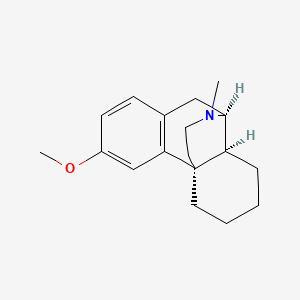
CAS 125-71-3PubChem CID 5360696
Dextromethorphan
Dextromethorphan is a 6-methoxy-11-methyl-1,3,4,9,10,10a-hexahydro-2H-10,4a-(epiminoethano)phenanthrene in which the sterocenters at positions 4a, 10 and 10a have S-configuration. It is a prodrug of dextrorphan and used as an antitussive drug for suppressing cough. It has a role as a oneirogen, a xenobiotic, a prodrug, a neurotoxin, an antitussive, a NMDA receptor antagonist and an environmental contaminant. It is functionally related to a dextrorphan. It is an enantiomer of a levomethorphan. — ChEBI
- Nom IUPAC
- (1S,9S,10S)-4-methoxy-17-methyl-17-azatetracyclo[7.5.3.01,10.02,7]heptadeca-2(7),3,5-triene
- Formule moléculaire
- C18H25NO
- Masse moléculaire
- 271.4 g/mol
- Masse exacte
- 271.193614421 Da
- XLogP3
- 3,4
- Surface polaire topologique
- 12,5 Ų
- Donneurs de liaisons hydrogène
- 0
- Accepteurs de liaisons hydrogène
- 2
- Unités covalentes
- 1
- Stéréocentres définis
- 3
Également connu sous le nom de
d-Methorphandelta-MethorphanDextromorphanDextromethorfanDextrometorfanoDextromethorphaneAlbutussinDestrometerfano
16 autres noms signalés
DextromethorphanumBA 2666Balminil DM(+)-Dextromethorphan3-Methoxy-17-methyl-9alpha,13alpha,14alpha-morphinanMorphinan, 3-methoxy-17-methyl-, (9alpha,13alpha,14alpha)-DXM [Antitussive]BA-26667355X3ROTSCHEBI:4470(+)-3-Methoxy-N-methylmorphinonNSC-751452DXM (Antitussive)(+)-cis-1,3,4,9,10,10a-Hexahydro-6-methoxy-11-methyl-2H-10,4alpha-iminoethanophenanthren(+)-3-methoxy-17-methyl-9alpha,13alpha,14alpha-morphinanRoboTablets
Identifiants de bases de données externes
- ChEBI:CHEBI:4470
- ChEBI:CHEBI:92579
- ChEMBL:CHEMBL52440
- EPA DTXSID:DTXSID3022908
- PubMed:22608604
- PubMed:22073096
- PubMed:22066053
- PubMed:22044595
- PubMed:21973086
- PubMed:21867562
- PubMed:21614312
- PubMed:21445282
- PubMed:21436715
- PubMed:21266064
- PubMed:21244712
- PubMed:21175434
Preuves issues de bases de données scientifiques complémentaires
NIH PubChem PUG-View
Correspondance exacte d’identifiant5360696
Attributed physical-property, hazard, environmental and use annotations.
- Color/Form: White to slightly yellow crystalline powder Source: Hazardous Substances Data Bank (HSDB)
- Melting Point: 122-124 Source: DrugBank
- Melting Point: 109-111 °C Source: Hazardous Substances Data Bank (HSDB)
- Odor: Odorless Source: Hazardous Substances Data Bank (HSDB)
- Solubility: 1.5 g/100 mL Source: DrugBank
- Solubility: Practically insoluble in water Source: Hazardous Substances Data Bank (HSDB)
- Solubility: Freely soluble in chloroform Source: Hazardous Substances Data Bank (HSDB)
- Carcinogen Classification: No indication of carcinogenicity to humans (not listed by IARC). Source: Toxin and Toxin Target Database (T3DB)
- Exposure Routes: Oral, rapidly absorbed from the gastrointestinal tract. Source: Toxin and Toxin Target Database (T3DB)
- Note: This chemical does not meet GHS hazard criteria for 46.8% (36 of 77) of reports. Source: European Chemicals Agency (ECHA)
- Signal: Danger Source: European Chemicals Agency (ECHA)
- GHS Hazard Statements: H301 (51.9%): Toxic if swallowed [Danger Acute toxicity, oral] Source: European Chemicals Agency (ECHA)
- Precautionary Statement Codes: P264, P270, P301+P316, P321, P330, P405, and P501 (click each P-code to see the statement) Source: European Chemicals Agency (ECHA)
- ECHA C&L Notifications Summary: Aggregated GHS information provided per 77 reports by companies from 4 notifications to the ECHA C&L Inventory.; Reported as not meeting GHS hazard criteria per 36 of 77 reports by companies.; There are 3 notifications provided by 41 of 77 reports by companies with hazard statement code(s).; Information may vary between notifications depending on impurities, additives, and other factors. The percentage value in parenthesis indicates the notified classification ratio from companies that provide hazard codes. Only hazard codes with percentage values above 10% are shown. For more detailed information, please visit ECHA C&L website. Source: European Chemicals Agency (ECHA)
- Health Effects: Hypertension, shallow respiration. Dextromethorphan can cause other gastrointestinal disturbances. [Wikipedia] Source: Toxin and Toxin Target Database (T3DB)
- Toxicity Summary: IDENTIFICATION AND USE: Dextromethorphan is a white odorless solid crystal or powder. It is an opium alkaloid derivative, which is found in cough and cold preparations. HUMAN STUDIES: Dextromethorphan is a drug of abuse. The main risks associated with dextromethorphan are ataxia, central nervous system (CNS) stimulation, dizziness, lethargy and psychotic behavior. Less frequently with large doses seizures and respiratory depression can occur. Nausea, vomiting, constipation and tachycardia may also occur. CNS effects include ataxia, drowsiness, vertigo and rarely coma. CNS stimulation may be observed. Restlessness, increased muscle tone with body rigidity have been reported. With extremely large ingestions respiratory depression can occur. Gastrointestinal effects include nausea, vomiting, constipation and dry mouth. Urinary retention may be seen. Dextromethorphan abuse has been described and produces euphoria, CNS stimulation, visual and/or auditory hallucinations. Dextromethorphan hydrobromide is the drug form, thus the possibility of bromide poisoning should be considered in the long term abuser. Dextromethorphan enhances serotonin activity by inhibiting the reuptake of serotonin Source: Hazardous Substances Data Bank (HSDB)
- Toxicity Summary: Signs and Symptoms of Overdose; One significant concern regarding dextromethorphan toxicity is its OTC misuse, which has steadily increased since the early 2000s. This misuse is referred to by slang terms such as "going pharming," "robotripping," and "dexing." In 2006, three specific OTC product formulations accounted for 66% of reported dextromethorphan misuse cases in the United States, with Coricidin HBP Cough & Cold Tablets and Robitussin products being prominent. A life-threatening toxicity associated with dextromethorphan abuse is serotonin syndrome, resulting from its serotonin reuptake inhibition properties. When combined with SSRIs or MAOIs, the risk of serotonin syndrome increases significantly. Symptoms include agitation, confusion, dilated pupils, headache, tachycardia, hypotension, high fever, seizures, irregular heartbeat, and may progress to unconsciousness.; Despite the rise in misuse, public health efforts and legislative actions restricting the sale of dextromethorphan-containing products to minors have helped stabilize or reduce abuse rates in recent years. However, continued vigilance is essential to prevent misuse and associated toxicities, given dextromethorph Source: StatPearls
- Toxicity Summary: Dextromethorphan is an opioid-like drug that binds to and acts as antagonist to the NMDA glutamatergic receptor, it is an agonist to the opioid sigma 1 and sigma 2 receptors, it is also an alpha3/beta4 nicotinic receptor antagonist and targets the serotonin reuptake pump. Dextromethorphan is rapidly absorbed from the gastrointestinal tract, where it enters the bloodstream and crosses the blood-brain barrier. The first-pass through the hepatic portal vein results in some of the drug being metabolized into an active metabolite of dextromethorphan, dextrorphan, the 3-hydroxy derivative of dextromethorphan. Source: Toxin and Toxin Target Database (T3DB)
- Environmental Bioconcentration: The estimated pKa of dextromethorphan is 9.8(1), indicating that dextromethorphan will exist almost entirely in the cation form at pH values of 5 to 9 and, therefore, bioconcentration in fish is not expected to be an important fate process(SRC). Source: Hazardous Substances Data Bank (HSDB)
- Environmental Fate: TERRESTRIAL FATE: Based on a classification scheme(1), an estimated Koc value of 23,000(SRC), determined from a structure estimation method(2), indicates that dextromethorphan is expected to be immobile in soil(SRC). The estimated pKa of dextromethorphan is 9.8(3), indicating that this compound will exist almost entirely in the cation form in the environment and cations generally adsorb more strongly to soils containing organic carbon and clay than their neutral counterparts(4). Volatilization of the cation from moist soil is not expected because cations do not volatilize(SRC). Dextromethorphan is not expected to volatilize from dry soil surfaces(SRC) based upon an estimated vapor pressure of 1.0X10⁻⁵ mm Hg at 25 °C(SRC), determined from a fragment constant method(2). Biodegradation data in soil were not available(SRC, 2017). Source: Hazardous Substances Data Bank (HSDB)
- Environmental Fate: AQUATIC FATE: Based on a classification scheme(1), an estimated Koc value of 23,000(SRC), determined from a structure estimation method(2), indicates that dextromethorphan is expected to adsorb to suspended solids and sediment(SRC). An estimated pKa of 9.8(3) indicates dextromethorphan will exist almost entirely in the cation form at pH values of 5 to 9 and, therefore, volatilization from water surfaces and bioconcentration in aquatic organisms are not expected to be an important fate processes(SRC). Dextromethorphan is not expected to undergo hydrolysis in the environment due to the lack of functional groups that hydrolyze under environmental conditions(4). Biodegradation data in water were not available(SRC, 2017). Source: Hazardous Substances Data Bank (HSDB)
- Environmental Fate: ATMOSPHERIC FATE: According to a model of gas/particle partitioning of semivolatile organic compounds in the atmosphere(1), dextromethorphan, which has an estimated vapor pressure of 1.0X10⁻⁵ mm Hg at 25 °C(SRC), determined from a fragment constant method(2), will exist in both the vapor and particulate phases in the ambient atmosphere. Vapor-phase dextromethorphan is degraded in the atmosphere by reaction with photochemically-produced hydroxyl radicals(SRC); the half-life for this reaction in air is estimated to be 3.3 hours(SRC), calculated from its rate constant of 1.2X10⁻¹⁰ cu cm/molecule-sec at 25 °C(SRC) that was derived using a structure estimation method(2). Particulate-phase dextromethorphan may be removed from the air by wet or dry deposition(SRC). Dextromethorphan contains chromophores that absorb at wavelengths >290 nm(3) and, therefore, is expected to be susceptible to direct photolysis by sunlight(SRC). Source: Hazardous Substances Data Bank (HSDB)
- Uses: Antitussive Agents; Excitatory Amino Acid Antagonists Source: Hazardous Substances Data Bank (HSDB)
- Uses: Probe to determine cytochrome 450 phenotype Source: Hazardous Substances Data Bank (HSDB)
- Uses: MEDICATION Source: Hazardous Substances Data Bank (HSDB)
- Uses: Dextromethorphan (DXM) is an over-the-counter (OTC) cough suppressant commonly found in cold medications. DXM is often abused in high doses by adolescents to generate euphoria and visual and auditory hallucinations. Illicit use of DXM is referred to on the street as "Robo-tripping" or "skittling." These terms are derived from the most commonly abused products, Robitussin and Coricidin. Source: Hazardous Substances Data Bank (HSDB)
- Uses: Use (kg; approx.) in Germany (2009): >1000; Use (kg) in USA (2002): 38000; Consumption (g per capita; approx.) in Germany (2009): 0.0122; Consumption (g per capita) in the USA (2002): 0.135; Excretion rate: 0.25; Calculated removal (%): 45.3 Source: NORMAN Suspect List Exchange
- Uses: The primary use of dextromethorphan is as a cough suppressant, for the temporary relief of cough caused by minor throat and bronchial irritation (as commonly accompanies the common cold), as well as those resulting from inhaled irritants. In addition, a combination of dextromethorphan and quinidine has been shown to alleviate symptoms of easy laughing and crying (pseudobulbar affect) in patients with amyotrophic lateral sclerosis and multiple sclerosis. Source: Toxin and Toxin Target Database (T3DB)
Mis en correspondance par: Existing checksum-valid CAS to unique PubChem CID match. Récupéré le: 2026-08-31. Ouvrir la fiche source
Les classifications scientifiques et les annotations de danger apportent du contexte et ne remplacent pas la décision réglementaire propre au marché indiquée ci-dessus.
Couverture des sources complémentaires et état des correspondances
| Source | Résultat | Vérifié |
|---|---|---|
| NIH PubChem PUG-View | Correspondance exacte | 2026-08-31 |
Une absence de correspondance enregistrée est une preuve utile que la source a été vérifiée ; ce n’est pas l’affirmation que la substance n’existe pas ailleurs.
Récupéré depuis NIH PubChem le 2026-08-31 par correspondance CAS à somme de contrôle valide. Les propriétés chimiques ne remplacent pas la décision réglementaire de cette page.
Comment le CAS 125-71-3 est utilisé sur ce site
Le CAS 125-71-3 est l’identifiant du Chemical Abstracts Service utilisé pour rattacher cette page à une substance précise. Dans le jeu de données actuel, 1 fiche d’annexe de l’UE partage cet identifiant, ce qui vous aide à vérifier si la même substance apparaît dans un seul contexte réglementaire ou dans plusieurs.
Utilisez cette page lorsqu’une spécification fournisseur, une FDS ou un dossier de matière première vous donne le CAS 125-71-3 et que vous devez voir au même endroit toutes les fiches liées des annexes II à VI. Les cartes d’entrées ci-dessus sont le moyen le plus rapide d’accéder aux limites de concentration, aux avertissements, à l’annexe concernée et aux conditions par type de produit.
Questions fréquentes
Une substance identifiée par le CAS 125-71-3 peut figurer dans plusieurs annexes du règlement de l’UE sur les cosmétiques lorsqu’elle est soumise à des conditions différentes selon les contextes. Par exemple, une substance peut être soumise à restrictions à l’annexe III avec des conditions précises, et le même CAS peut aussi figurer à l’annexe IV comme colorant autorisé, dans une entrée distincte avec ses propres conditions. Chaque entrée doit être examinée individuellement.
Recoupez le numéro CAS avec les fiches de spécification de vos matières premières et vos certificats d’analyse. Lorsqu’un CAS figure à l’annexe II, vérifiez son absence. Lorsqu’il figure à l’annexe III, vérifiez que les limites de concentration et les conditions de type de produit sont respectées dans votre formulation. Toutes les entrées d’annexe partageant ce numéro CAS sont énumérées ci-dessus.
Un numéro CAS est attribué par le Chemical Abstracts Service (États-Unis) et reconnu dans le monde entier. Un numéro CE est un identifiant de la Commission européenne issu d’inventaires tels que l’EINECS, l’ELINCS ou la liste NLP. Les deux identifiants peuvent figurer dans les entrées des annexes cosmétiques de l’UE. Certaines substances ont les deux, d’autres un seul, et certaines entrées plus anciennes peuvent n’en avoir aucun.
Le vérificateur INCI accepte les noms d’ingrédients, les numéros CAS et les numéros CE. Vérifiez directement ce numéro CAS, puis contrôlez le résultat auprès des fiches de spécification des fournisseurs et de toutes les conditions d’annexe associées.
Outils et étapes suivantes
Vérifiez votre formule
Analysez une liste INCI complète, puis utilisez le CAS 125-71-3 pour recouper les documents fournisseurs relatifs aux substances identifiées.
Vérificateur INCIParcourir les annexes
Parcourez toutes les annexes du règlement de l’UE sur les cosmétiques par catégorie.
Toutes les annexesRechercher par nom
Recherchez les noms INCI, alias ou identifiants associés qui figurent à côté du CAS 125-71-3 dans votre documentation.
Rechercher