
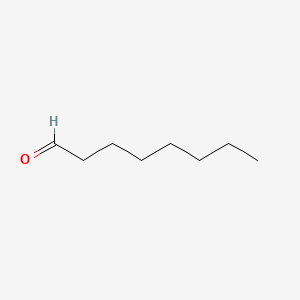
CAS 124-13-0PubChem CID 454
Octanal
Octanal is a saturated fatty aldehyde formally arising from reduction of the carboxy group of caprylic acid (octanoic acid). It has a role as a plant metabolite. It is a n-alkanal, a saturated fatty aldehyde and a medium-chain fatty aldehyde. — ChEBI
- IUPAC 名称
- octanal
- 分子式
- C8H16O
- 分子量
- 128.21 g/mol
- 精确质量
- 128.120115130 Da
- XLogP3
- 2.7
- 拓扑极性表面积
- 17.1 Ų
- 氢键供体
- 0
- 氢键受体
- 1
- 共价单元
- 1
- 已定义的立体中心
- 0
又称
CaprylaldehydeCaprylic aldehyden-Octanal1-octanaln-Octyl aldehyden-Caprylaldehyden-OctaldehydeOctanaldehyde
另有 16 个已报告名称
n-OctylalAldehyde C-8Octanoic aldehydeOctaldehydeC-8 aldehydeOCTYLALDEHYDE1-Octylaldehyde1-Octaldehyde1-CaprylaldehydeOctanal, tech.Octyl aldehydesFEMA No. 2797XGE9999H19NSC-1508NSC-8969CHEBI:17935
外部数据库标识符
- ChEBI:CHEBI:17935
- ChEMBL:CHEMBL18407
- EPA DTXSID:DTXSID3021643
- PubMed:30002397
- PubMed:25014914
- PubMed:23077570
- PubMed:23064773
- PubMed:23017416
- PubMed:23009099
- PubMed:22975052
- PubMed:22975051
- PubMed:22975050
- PubMed:22975046
- PubMed:22975045
- PubMed:22959517
来自其他科学数据库的证据
NIH PubChem PUG-View
标识符精确匹配454
Attributed physical-property, hazard, environmental and use annotations.
- Boiling Point: 171 °C 来源: Hazardous Substances Data Bank (HSDB)
- Boiling Point: 171 °C 来源: Joint FAO/WHO Expert Committee on Food Additives (JECFA)
- Boiling Point: 163.4 °C @760 [mm Hg] 来源: PAC Chemical Database, U.S. Department of Energy
- Color/Form: Colorless liquid 来源: Hazardous Substances Data Bank (HSDB)
- Color/Form: Colorless to light yellow liquid 来源: Hazardous Substances Data Bank (HSDB)
- Density: 0.82 to 0.83 (USCG, 1999) 来源: CAMEO Chemicals
- Density: 0.8211 g/cu cm at 20 °C 来源: Hazardous Substances Data Bank (HSDB)
- Density: Density: 0.820-0.830 来源: Hazardous Substances Data Bank (HSDB)
- Density: 0.810-0.830 来源: Joint FAO/WHO Expert Committee on Food Additives (JECFA)
- Density: 0.821 @ 20°C 来源: PAC Chemical Database, U.S. Department of Energy
- Flash Point: 125 °F (USCG, 1999) 来源: CAMEO Chemicals
- Flash Point: 125 °F (52 °C) 来源: Hazardous Substances Data Bank (HSDB)
- LogP: log Kow = 3.5 at pH 6.9 (by HPLC) 来源: Hazardous Substances Data Bank (HSDB)
- Melting Point: -23 °C 来源: Hazardous Substances Data Bank (HSDB)
- Melting Point: Liquid Molar Volume = 0.15704 cu m/kmol; IG Heat of Formation = -2.8464X10+8 J/kmol; Heat of Fusion at Melting Point = 2.613X10+7 J/kmol 来源: Hazardous Substances Data Bank (HSDB)
- Melting Point: -23 °C 来源: Human Metabolome Database (HMDB)
- Melting Point: -23 °C 来源: PAC Chemical Database, U.S. Department of Energy
- Odor: Strong, fruity odor 来源: Hazardous Substances Data Bank (HSDB)
- Odor: Fatty, citrus, honey odor on dilution 来源: Hazardous Substances Data Bank (HSDB)
- Odor: Pungent odor; citrus-like on dilution 来源: Hazardous Substances Data Bank (HSDB)
- Physical Description: N-octylaldehyde is a colorless liquids with a strong fruity odor. Less dense than water and insoluble in water. Flash points 125 °F. Used in making perfumes and flavorings. 来源: CAMEO Chemicals
- Physical Description: Liquid 来源: EPA Chemical Data Reporting (CDR)
- Physical Description: Colorless liquid with a fruity odor; [Hawley] 来源: Haz-Map, Information on Hazardous Chemicals and Occupational Diseases
- Physical Description: Liquid 来源: Human Metabolome Database (HMDB)
- Physical Description: colourless to light yellow liquid/fatty-orange odour 来源: Joint FAO/WHO Expert Committee on Food Additives (JECFA)
- Refractive Index: MAX ABSORPTION (HEXANE): 295 NM (LOG E= 1.11); INDEX OF REFRACTION: 1.4217 @ 20 °C/D 来源: Hazardous Substances Data Bank (HSDB)
- Refractive Index: Index of refraction: 1.4217 at 20 °C/D 来源: Hazardous Substances Data Bank (HSDB)
- Refractive Index: Index of refraction: 1.418-1.425 来源: Hazardous Substances Data Bank (HSDB)
- Refractive Index: 1.417-1.425 来源: Joint FAO/WHO Expert Committee on Food Additives (JECFA)
- Solubility: In water, 5.6X10+2 mg/L at 25 °C 来源: Hazardous Substances Data Bank (HSDB)
- Solubility: In water, <0.01 wt% at 20 °C 来源: Hazardous Substances Data Bank (HSDB)
- Solubility: Slightly soluble in water 来源: Hazardous Substances Data Bank (HSDB)
- Solubility: Miscible with alcohol, ether 来源: Hazardous Substances Data Bank (HSDB)
- Solubility: For more Solubility (Complete) data for Octylaldehyde (7 total), please visit the HSDB record page. 来源: Hazardous Substances Data Bank (HSDB)
- Solubility: 0.56 mg/mL 来源: Human Metabolome Database (HMDB)
- Solubility: soluble in alcohol, most fixed oils, propylene glycol; insoluble in glycerol 来源: Joint FAO/WHO Expert Committee on Food Additives (JECFA)
- Solubility: 1ml in 2ml of 70% alcohol (in ethanol) 来源: Joint FAO/WHO Expert Committee on Food Additives (JECFA)
- Vapor Pressure: 1.18 [mmHg] 来源: Haz-Map, Information on Hazardous Chemicals and Occupational Diseases
- Vapor Pressure: 0.6 mm Hg at 20 °C 来源: Hazardous Substances Data Bank (HSDB)
- Vapor Pressure: 1.18 [mm Hg] @25 °C 来源: PAC Chemical Database, U.S. Department of Energy
- First Aid: Call for medical aid.; INHALATION: Remove victim to fresh air; give oxygen if breathing is difficult.; EYES: Irrigate immediately for 15 min. with water, lifting lids occasionally.; SKIN: Flush with water; wash with soap and water. (USCG, 1999) 来源: CAMEO Chemicals
- ERG2024, Guide 129 (Octyl aldehydes): General First Aid:; · Call 911 or emergency medical service.; · Ensure that medical personnel are aware of the material(s) involved, take precautions to protect themselves and avoid contamination.; · Move victim to fresh air if it can be done safely.; · Administer oxygen if breathing is difficult.; · If victim is not breathing:; -- DO NOT perform mouth-to-mouth resuscitation; the victim may have ingested or inhaled the substance.; -- If equipped and pulse detected, wash face and mouth, then give artificial respiration using a proper respiratory medical device (bag-valve mask, pocket mask equipped with a one-way valve or other device).; -- If no pulse detected or no respiratory medical device available, provide continuous compressions. Conduct a pulse check every two minutes or monitor for any signs of spontaneous respirations.; · Remove and isolate contaminated clothing and shoes.; · For minor skin contact, avoid spreading material on unaffected skin.; · In case of contact with substance, remove immediately by flushing skin or eyes with running water for at least 20 minutes.; · For severe burns, immediate medical attention is required.; · Effects of exposure (inhalation, ingestion, 来源: Emergency Response Guidebook (ERG)
- Note: This chemical does not meet GHS hazard criteria for < 0.1% (1 of 1971) of reports. 来源: European Chemicals Agency (ECHA)
- Signal: Warning 来源: European Chemicals Agency (ECHA)
- GHS Hazard Statements: H226 (93.3%): Flammable liquid and vapor [Warning Flammable liquids]; H315 (97.4%): Causes skin irritation [Warning Skin corrosion/irritation]; H319 (97.3%): Causes serious eye irritation [Warning Serious eye damage/eye irritation]; H411 (77.1%): Toxic to aquatic life with long lasting effects [Hazardous to the aquatic environment, long-term hazard]; H412 (19.8%): Harmful to aquatic life with long lasting effects [Hazardous to the aquatic environment, long-term hazard] 来源: European Chemicals Agency (ECHA)
- Precautionary Statement Codes: P210, P233, P240, P241, P242, P243, P264, P264+P265, P273, P280, P302+P352, P303+P361+P353, P305+P351+P338, P321, P332+P317, P337+P317, P362+P364, P370+P378, P391, P403+P235, and P501 (click each P-code to see the statement) 来源: European Chemicals Agency (ECHA)
- ECHA C&L Notifications Summary: Aggregated GHS information provided per 1971 reports by companies from 23 notifications to the ECHA C&L Inventory. Each notification may be associated with multiple companies.; Reported as not meeting GHS hazard criteria per 1 of 1971 reports by companies.; There are 22 notifications provided by 1970 of 1971 reports by companies with hazard statement code(s).; Information may vary between notifications depending on impurities, additives, and other factors. The percentage value in parenthesis indicates the notified classification ratio from companies that provide hazard codes. Only hazard codes with percentage values above 10% are shown. For more detailed information, please visit ECHA C&L website. 来源: European Chemicals Agency (ECHA)
- Signal: Warning 来源: NITE-CMC
- GHS Hazard Statements: H226: Flammable liquid and vapor [Warning Flammable liquids] 来源: NITE-CMC
- Precautionary Statement Codes: P210, P233, P240, P241, P242, P243, P280, P303+P361+P353, P370+P378, P403+P235, and P501 (click each P-code to see the statement) 来源: NITE-CMC
- Signal: Warning 来源: Hazardous Substances Data Bank (HSDB)
- GHS Hazard Statements: H226: Flammable liquid and vapor [Warning Flammable liquids]; H315: Causes skin irritation [Warning Skin corrosion/irritation]; H319: Causes serious eye irritation [Warning Serious eye damage/eye irritation]; H401: Toxic to aquatic life [Hazardous to the aquatic environment, acute hazard]; H411: Toxic to aquatic life with long lasting effects [Hazardous to the aquatic environment, long-term hazard] 来源: Hazardous Substances Data Bank (HSDB)
- Precautionary Statement Codes: P210, P233, P240, P241, P242, P243, P264, P264+P265, P273, P280, P302+P352, P303+P361+P353, P305+P351+P338, P321, P332+P317, P337+P317, P362+P364, P370+P378, P391, P403+P235, and P501 (click each P-code to see the statement) 来源: Hazardous Substances Data Bank (HSDB)
- NFPA Health Rating: 0 - Materials that, under emergency conditions, would offer no hazard beyond that of ordinary combustible materials. 来源: Hazardous Substances Data Bank (HSDB)
- NFPA Fire Rating: 2 - Materials that must be moderately heated or exposed to relatively high ambient temperatures before ignition can occur. Materials would not under normal conditions form hazardous atmospheres with air, but under high ambient temperatures or under moderate heating could release vapor in sufficient quantities to produce hazardous atmospheres with air. 来源: Hazardous Substances Data Bank (HSDB)
- NFPA Instability Rating: 0 - Materials that in themselves are normally stable, even under fire conditions. 来源: Hazardous Substances Data Bank (HSDB)
- Toxicity Summary: IDENTIFICATION AND USE: Octylaldehyde (Octanal) is a colorless liquid. It is employed in the perfume industry for the preparation of synthetic citrus oils and for the synthesis of alpha-hexylcinnamaldehyde. HUMAN STUDIES: In vitro in human A549 cells octanal affects the expression of several chemokines and inflammatory cytokines and increases the levels of interleukin 6 (IL-6) and IL-8 released. Microarray analysis identified 15 miRNAs that were differentially expressed in octanal-exposed A549 human alveolar cells. ANIMAL STUDIES: It induced a significant decrease in the number of live pups in rats but only at a dose which causes maternal toxicity. Octanal was tested in Salmonella typhimurium TA98, TA100, TA1535 and TA1537 with and without metabolic activation. No cytotoxic or genotoxic effects were observed. ECOTOXICITY STUDIES: A membrane damage mechanism involving membrane peroxidation might contribute to the antifungal activity of octanal against P. digitatum spores. Aflatoxin production by the fungus Aspergillus parasiticus was stimulated by octanal. 来源: Hazardous Substances Data Bank (HSDB)
- Environmental Bioconcentration: An estimated BCF of 60 was calculated in fish for octylaldehyde(SRC), using a log Kow of 3.5(1) and a regression-derived equation(2). According to a classification scheme(3), this BCF suggests the potential for bioconcentration in aquatic organisms is moderate(SRC). 来源: Hazardous Substances Data Bank (HSDB)
- Environmental Fate: TERRESTRIAL FATE: Based on a classification scheme(1), an estimated Koc value of 290(SRC), determined from a log Kow of 3.5(2) and a regression-derived equation(3), indicates that octylaldehyde is expected to have moderate mobility in soil(SRC). Volatilization of octylaldehyde from moist soil surfaces is expected to be an important fate process(SRC) given a Henry's Law constant of 5.14X10⁻⁴ atm-cu m/mole(4). Octylaldehyde has a vapor pressure of 0.6 mm Hg(2) and exists as a liquid under environmental conditions; therefore, octylaldehyde may volatilize from dry soil. Utilizing the Zahn-Wellens test, 77% degradation was reached using an activated sludge inoculum after 28 days(5) which indicates this compound is expected to biodegrade under certain environmental conditions in soil(SRC). 来源: Hazardous Substances Data Bank (HSDB)
- Environmental Fate: AQUATIC FATE: Based on a classification scheme(1), an estimated Koc value of 290(SRC), determined from a log Kow of 3.5(2) and a regression-derived equation(3), indicates that octylaldehyde may adsorb to suspended solids and sediment(SRC). Volatilization from water surfaces is expected(4) based upon a estimated Henry's Law constant of 5.14X10⁻⁴ atm-cu m/mole(5). Using this Henry's Law constant and an estimation method(3), volatilization half-lives for a model river and model lake are 5 hours and 5 days, respectively(SRC). According to a classification scheme(6), an estimated BCF of 60(SRC), from its log Kow(2) and a regression-derived equation(3), suggests the potential for bioconcentration in aquatic organisms is moderate(SRC). Utilizing the Zahn-Wellens test, 77% degradation was reached using an activated sludge inoculum after 28 days(7) which indicates this compound is expected to biodegrade under certain environmental conditions in water(SRC). 来源: Hazardous Substances Data Bank (HSDB)
- Environmental Fate: ATMOSPHERIC FATE: According to a model of gas/particle partitioning of semivolatile organic compounds in the atmosphere(1), octylaldehyde, which has a vapor pressure of 0.6 mm Hg at 20 °C(2), will exist solely in the vapor phase in the ambient atmosphere. Vapor-phase octylaldehyde is degraded in the atmosphere by reaction with photochemically-produced hydroxyl radicals(SRC); the half-life for this reaction in air is estimated to be 12 hours(SRC), calculated from its rate constant of 3.2X10⁻¹¹ cu cm/molecule-sec at 25 °C(SRC) that was derived using a structure estimation method(3). Octylaldehyde does not contain chromophores that absorb at wavelengths >290 nm(4) and, therefore, is not expected to be susceptible to direct photolysis by sunlight(SRC). 来源: Hazardous Substances Data Bank (HSDB)
- Consumer Uses: Fragrance 来源: EPA Chemical Data Reporting (CDR)
- Industry Uses: Fragrance; Flavoring and nutrient 来源: EPA Chemical Data Reporting (CDR)
- Sources/Uses: Found in rose and orange oils; Used in perfumes, flavors, and fragrances; Used to make linear alcohols; [HSDB] 来源: Haz-Map, Information on Hazardous Chemicals and Occupational Diseases
- Uses: For octylaldehyde (USEPA/OPP Pesticide Code: 128948) there are 0 labels match. /SRP: Not registered for current use in the USA, but approved pesticide uses may change periodically and so federal, state and local authorities must be consulted for currently approved uses./ 来源: Hazardous Substances Data Bank (HSDB)
- Uses: Perfumery, flavors. 来源: Hazardous Substances Data Bank (HSDB)
- Uses: Octanal is employed in the perfume industry for the preparation of synthetic citrus oils and for the synthesis of alpha-hexylcinnamaldehyde. 来源: Hazardous Substances Data Bank (HSDB)
- Uses: ingredient in some air fresheners 来源: Hazardous Substances Data Bank (HSDB)
- Uses: For more Uses (Complete) data for Octylaldehyde (6 total), please visit the HSDB record page. 来源: Hazardous Substances Data Bank (HSDB)
映射方: Existing checksum-valid CAS to unique PubChem CID match. 检索时间: 2026-08-31. 打开来源记录
科学分类和危害注释仅提供背景信息,不能取代上方所示针对具体市场的监管决定。
其他来源的覆盖范围和匹配状态
| 来源 | 结果 | 已检查 |
|---|---|---|
| NIH PubChem PUG-View | 精确匹配 | 2026-08-31 |
已记录的无匹配结果是该来源已被检查的有效证据;这并不表示该物质在别处不存在。
于 2026-08-31 通过校验和有效的 CAS 匹配从美国国立卫生研究院 (NIH) PubChem 检索。化学性质不能取代本页的监管决定。