
CAS
1 条记录
CAS 12001-28-4
CAS 12001-28-4 与法规 1223/2009 附件 II–VI 中的 1 条欧盟附件记录相匹配。
CAS 12001-28-4 的记录
1 共化学身份与性质
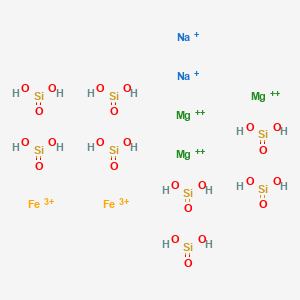
CAS 12001-28-4PubChem CID 86278622
Crocidolite Asbestos
Asbestos is a slender, fine, flaxy fiber. Long term occupational exposure to the dust can result in lung cancer. Asbestos is resistant to fire and most solvents. The primary hazard is the threat to the environment. Immediate steps should be taken to limit its spread to the environment. It is used as a heat resistant material, in cement, furnace bricks, and brake linings. — CAMEO Chemicals
- IUPAC 名称
- trimagnesium;disodium;octakis(dihydroxy(oxo)silane);bis(iron(3+))
- 分子式
- Fe2H16Mg3Na2O24Si8+14
- 分子量
- 855.38 g/mol
- 精确质量
- 853.623098 Da
- 拓扑极性表面积
- 460.0 Ų
- 氢键供体
- 16
- 氢键受体
- 24
- 共价单元
- 15
- 已定义的立体中心
- 0
又称
Blue AsbestosASBESTOS, CROCIDOLITECK28D16OLZAsbestos, BlueAsbestos-crocidoliteRefChem:51ASBESTOS, (BLUE)CHEBI:46666
另有 16 个已报告名称
CrocidoliteKrokydolithCrocidolite uiccMagnesioriebeckiteRiebeckite asbestosCrocidolite (9CI)Krokydolith [German]Magnesioriebackite asbestosCrocidolite [Asbestos]trimagnesium;disodium;dihydroxy(oxo)silane;iron(3+)CROCIDOLITEASBESTOSAsbestos, magnesioriebeckiteFibrous crocidolite asbestosAmorphous crocidolite asbestosCCRIS 362NCI C09007
来自其他科学数据库的证据
NIH PubChem PUG-View
标识符精确匹配86278622
Attributed physical-property, hazard, environmental and use annotations.
- Boiling Point: Decomposes (NIOSH, 2024) 来源: CAMEO Chemicals
- Boiling Point: decomposes 来源: Occupational Safety and Health Administration (OSHA)
- Density: Relative density (water = 1): 3.3-3.4 来源: ILO-WHO International Chemical Safety Cards (ICSCs)
- Melting Point: 1112 °F (Decomposes) (NIOSH, 2024) 来源: CAMEO Chemicals
- Melting Point: 1112 °F (decomposes) 来源: Occupational Safety and Health Administration (OSHA)
- Physical Description: Asbestos is a slender, fine, flaxy fiber. Long term occupational exposure to the dust can result in lung cancer. Asbestos is resistant to fire and most solvents. The primary hazard is the threat to the environment. Immediate steps should be taken to limit its spread to the environment. It is used as a heat resistant material, in cement, furnace bricks, and brake linings. 来源: CAMEO Chemicals
- Physical Description: LAVENDER, BLUE OR GREENISH FIBROUS SOLID. 来源: ILO-WHO International Chemical Safety Cards (ICSCs)
- Physical Description: Blue fibrous, odorless solid. 来源: Occupational Safety and Health Administration (OSHA)
- Solubility: Insoluble (NIOSH, 2024) 来源: CAMEO Chemicals
- Solubility: Solubility in water: none 来源: ILO-WHO International Chemical Safety Cards (ICSCs)
- Vapor Pressure: 0 mmHg (approx) (NIOSH, 2024) 来源: CAMEO Chemicals
- Vapor Pressure: 0 mmHg (approx) 来源: Occupational Safety and Health Administration (OSHA)
- Substance: Asbestos, crocidolite 来源: NTP Technical Reports
- NTP Technical Report: TR-280: Toxicology and Carcinogenesis Studies of Crocidolite Asbestos (CASRN 12001-28-4) In F344/N Rats (Feed Studies) (1988 ) 来源: NTP Technical Reports
- Peer Review Date: 02/28/83 来源: NTP Technical Reports
- Conclusion for Male Rat: No Evidence 来源: NTP Technical Reports
- Conclusion for Female Rat: No Evidence 来源: NTP Technical Reports
- Conclusion for Male Mice: Chemical Not Tested in Species/Sex 来源: NTP Technical Reports
- Conclusion for Female Mice: Chemical Not Tested in Species/Sex 来源: NTP Technical Reports
- Summary: Under the conditions of these feed studies, crocidolite asbestos was not overtly toxic and did not cause a carcinogenic response when ingested at a concentration of 1% in the diet by male and female F344/N rats for their lifetime. 来源: NTP Technical Reports
- Carcinogen Classification: 1, carcinogenic to humans. (L224) 来源: Toxin and Toxin Target Database (T3DB)
- Exposure Routes: Exposure mainly occurs via inhalation. 来源: ILO-WHO International Chemical Safety Cards (ICSCs)
- Exposure Routes: Inhalation (L222) ; injection (L222) 来源: Toxin and Toxin Target Database (T3DB)
- First Aid: Excerpt from NIOSH Pocket Guide for Asbestos:; Eye: IRRIGATE IMMEDIATELY - If this chemical contacts the eyes, immediately wash (irrigate) the eyes with large amounts of water, occasionally lifting the lower and upper lids. Get medical attention immediately.; Breathing: FRESH AIR - If a person breathes large amounts of this chemical, move the exposed person to fresh air at once. Other measures are usually unnecessary. (NIOSH, 2024) 来源: CAMEO Chemicals
- Signal: Danger 来源: Regulation (EC) No 1272/2008 of the European Parliament and of the Council
- GHS Hazard Statements: H350: May cause cancer [Danger Carcinogenicity]; H372 **: Causes damage to organs through prolonged or repeated exposure [Danger Specific target organ toxicity, repeated exposure] 来源: Regulation (EC) No 1272/2008 of the European Parliament and of the Council
- Precautionary Statement Codes: P203, P260, P264, P270, P280, P318, P319, P405, and P501 (click each P-code to see the statement) 来源: Regulation (EC) No 1272/2008 of the European Parliament and of the Council
- Signal: Danger 来源: NITE-CMC
- GHS Hazard Statements: H341: Suspected of causing genetic defects [Warning Germ cell mutagenicity]; H350: May cause cancer [Danger Carcinogenicity]; H370: Causes damage to organs [Danger Specific target organ toxicity, single exposure]; H372: Causes damage to organs through prolonged or repeated exposure [Danger Specific target organ toxicity, repeated exposure] 来源: NITE-CMC
- Precautionary Statement Codes: P203, P260, P264, P270, P280, P308+P316, P318, P319, P321, P405, and P501 (click each P-code to see the statement) 来源: NITE-CMC
- GHS Hazard Statements: H335: May cause respiratory irritation [Warning Specific target organ toxicity, single exposure; Respiratory tract irritation]; H341: Suspected of causing genetic defects [Warning Germ cell mutagenicity]; H350: May cause cancer [Danger Carcinogenicity]; H372: Causes damage to organs through prolonged or repeated exposure [Danger Specific target organ toxicity, repeated exposure] 来源: NITE-CMC
- Precautionary Statement Codes: P203, P260, P261, P264, P270, P271, P280, P304+P340, P318, P319, P403+P233, P405, and P501 (click each P-code to see the statement) 来源: NITE-CMC
- Signal: Danger 来源: Hazardous Chemical Information System (HCIS), Safe Work Australia
- GHS Hazard Statements: H350: May cause cancer [Danger Carcinogenicity]; H372: Causes damage to organs through prolonged or repeated exposure [Danger Specific target organ toxicity, repeated exposure] 来源: Hazardous Chemical Information System (HCIS), Safe Work Australia
- Precautionary Statement Codes: P203, P260, P264, P270, P280, P318, P319, P405, and P501 (click each P-code to see the statement) 来源: Hazardous Chemical Information System (HCIS), Safe Work Australia
- Health Effects: Infected people develop a slow buildup of scar-like tissue in the lungs and in the membrane that surrounds the lungs, so breathing becomes difficult. Blood flow to the lung may also be decreased, and this causes the heart to enlarge. This disease is called asbestosis. Infected people have increased chances of getting two principal types of cancer: cancer of the lung tissue itself and mesothelioma, a cancer of the thin membrane that surrounds the lung and other internal organs. The cellular immune system of the patient can be depressed. Also, deletions of chromosome segments have been noted in human mesothelioma cells or cell lines. (L222) 来源: Toxin and Toxin Target Database (T3DB)
- Toxicity Summary: When asbestos fibers are inhaled, many are deposited on the epithelial surface of the respiratory tree. Fibers that are retained in the lung or mesothelium for long periods of time are capable of producing chronic inflammation and fibrotic and tumorigenic effects. These effects may be mediated by direct interactions between the fiber and key cellular macromolecules, or they may be mediated by the production of reactive oxygen species and other cellular factors originating from alveolar macrophages. In addition, the physical-chemical nature of the fiber appears to be an important determinant of toxicity. It is generally agreed that exposure to amphibole fibers can produce mesothelioma, and that the potency of amphibole fibers to produce mesothelioma is greater than that of chrysotile. Asbestos fibers can adsorb to a variety of cellular macromolecules (e.g., proteins,membrane lipids, RNA, DNA). The coulombic forces between the asbestos fiber and some of these macromolecules may induce conformational changes, and these changes could affect protein function and chromosomal fidelity. Fibers found to be translocated near the nucleus can interact with the cytoskeleton and interfere with c 来源: Toxin and Toxin Target Database (T3DB)
- Uses: Asbestos are used in building materials (roofing shingles, ceiling and floor tiles, paper products, and asbestos cement products), friction products (automobile clutch, brake, and transmission parts), heat-resistant fabrics, packaging, gaskets, and coatings. Some vermiculite or talc products may contain asbestos. Exposure most likely by breathing air containing asbestos fibers or by drinking asbestos fibers that are present in water. (L222) 来源: Toxin and Toxin Target Database (T3DB)
映射方: Existing checksum-valid CAS to unique PubChem CID match. 检索时间: 2026-08-31. 打开来源记录
科学分类和危害注释仅提供背景信息,不能取代上方所示针对具体市场的监管决定。
其他来源的覆盖范围和匹配状态
| 来源 | 结果 | 已检查 |
|---|---|---|
| NIH PubChem PUG-View | 精确匹配 | 2026-08-31 |
已记录的无匹配结果是该来源已被检查的有效证据;这并不表示该物质在别处不存在。
于 2026-09-02 通过校验和有效的 CAS 匹配从美国国立卫生研究院 (NIH) PubChem 检索。化学性质不能取代本页的监管决定。
本站如何使用 CAS 12001-28-4
CAS 12001-28-4 是化学文摘社 (Chemical Abstracts Service) 的标识符,用于将本页对应到特定物质。在当前数据集中,有 1 条欧盟附件记录共用该标识符,可帮助您交叉核对同一物质是出现在一种还是多种监管情境中。
当供应商规格书、SDS 或原料档案给出 CAS 12001-28-4,而您需要在一处查看所有关联的附件 II–VI 记录时,请使用本页。上方的条目卡片是查看浓度限值、警示语、附件归属和产品类型条件的最快途径。
常见问题
以 CAS 12001-28-4 标识的物质,如果在不同情境下适用不同条件,可能出现在欧盟化妆品法规的多个附件中。例如,某物质可能在附件 III 中按特定条件受到限制,同一 CAS 也可能在附件 IV 中作为准用着色剂按另行规定的条件出现。每个条目都必须单独审查。
将 CAS 编号与您的原料规格书和 CoA 文件进行交叉核对。当该 CAS 出现在附件 II 时,应核实其不存在。当其出现在附件 III 时,应核实您的配方满足浓度限值和产品类型条件。共用此 CAS 编号的所有附件条目均列于上方。
CAS 编号由美国化学文摘社 (Chemical Abstracts Service) 分配,全球通用。EC 编号是来自 EINECS、ELINCS 或 NLP 清单等名录的欧盟委员会标识符。两种标识符都可能出现在欧盟化妆品附件条目中。有些物质两者都有,有些只有其一,一些较旧的条目可能两者都没有。
INCI 检查器接受成分名称、CAS 编号和 EC 编号。可直接检查此 CAS 编号,然后对照供应商规格书和所有关联的附件条件核实结果。