
CAS
1 Eintrag
CAS 12001-28-4
CAS 12001-28-4 entspricht 1 EU-Anhangseintrag in den Anhängen II–VI der Verordnung (EG) Nr. 1223/2009.
Einträge zu CAS 12001-28-4
1 insgesamtChemische Identität und Eigenschaften
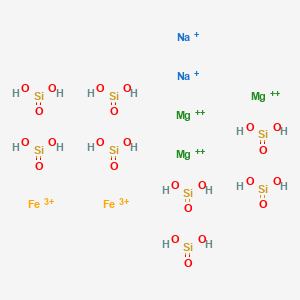
CAS 12001-28-4PubChem CID 86278622
Crocidolite Asbestos
Asbestos is a slender, fine, flaxy fiber. Long term occupational exposure to the dust can result in lung cancer. Asbestos is resistant to fire and most solvents. The primary hazard is the threat to the environment. Immediate steps should be taken to limit its spread to the environment. It is used as a heat resistant material, in cement, furnace bricks, and brake linings. — CAMEO Chemicals
- IUPAC-Name
- trimagnesium;disodium;octakis(dihydroxy(oxo)silane);bis(iron(3+))
- Summenformel
- Fe2H16Mg3Na2O24Si8+14
- Molekulargewicht
- 855.38 g/mol
- Exakte Masse
- 853.623098 Da
- Topologische polare Oberfläche
- 460,0 Ų
- Wasserstoffbrücken-Donoren
- 16
- Wasserstoffbrücken-Akzeptoren
- 24
- Kovalente Einheiten
- 15
- Definierte Stereozentren
- 0
Auch bekannt als
Blue AsbestosASBESTOS, CROCIDOLITECK28D16OLZAsbestos, BlueAsbestos-crocidoliteRefChem:51ASBESTOS, (BLUE)CHEBI:46666
16 weitere gemeldete Namen
CrocidoliteKrokydolithCrocidolite uiccMagnesioriebeckiteRiebeckite asbestosCrocidolite (9CI)Krokydolith [German]Magnesioriebackite asbestosCrocidolite [Asbestos]trimagnesium;disodium;dihydroxy(oxo)silane;iron(3+)CROCIDOLITEASBESTOSAsbestos, magnesioriebeckiteFibrous crocidolite asbestosAmorphous crocidolite asbestosCCRIS 362NCI C09007
Belege aus weiteren wissenschaftlichen Datenbanken
NIH PubChem PUG-View
Exakter Kennungstreffer86278622
Attributed physical-property, hazard, environmental and use annotations.
- Boiling Point: Decomposes (NIOSH, 2024) Quelle: CAMEO Chemicals
- Boiling Point: decomposes Quelle: Occupational Safety and Health Administration (OSHA)
- Density: Relative density (water = 1): 3.3-3.4 Quelle: ILO-WHO International Chemical Safety Cards (ICSCs)
- Melting Point: 1112 °F (Decomposes) (NIOSH, 2024) Quelle: CAMEO Chemicals
- Melting Point: 1112 °F (decomposes) Quelle: Occupational Safety and Health Administration (OSHA)
- Physical Description: Asbestos is a slender, fine, flaxy fiber. Long term occupational exposure to the dust can result in lung cancer. Asbestos is resistant to fire and most solvents. The primary hazard is the threat to the environment. Immediate steps should be taken to limit its spread to the environment. It is used as a heat resistant material, in cement, furnace bricks, and brake linings. Quelle: CAMEO Chemicals
- Physical Description: LAVENDER, BLUE OR GREENISH FIBROUS SOLID. Quelle: ILO-WHO International Chemical Safety Cards (ICSCs)
- Physical Description: Blue fibrous, odorless solid. Quelle: Occupational Safety and Health Administration (OSHA)
- Solubility: Insoluble (NIOSH, 2024) Quelle: CAMEO Chemicals
- Solubility: Solubility in water: none Quelle: ILO-WHO International Chemical Safety Cards (ICSCs)
- Vapor Pressure: 0 mmHg (approx) (NIOSH, 2024) Quelle: CAMEO Chemicals
- Vapor Pressure: 0 mmHg (approx) Quelle: Occupational Safety and Health Administration (OSHA)
- Substance: Asbestos, crocidolite Quelle: NTP Technical Reports
- NTP Technical Report: TR-280: Toxicology and Carcinogenesis Studies of Crocidolite Asbestos (CASRN 12001-28-4) In F344/N Rats (Feed Studies) (1988 ) Quelle: NTP Technical Reports
- Peer Review Date: 02/28/83 Quelle: NTP Technical Reports
- Conclusion for Male Rat: No Evidence Quelle: NTP Technical Reports
- Conclusion for Female Rat: No Evidence Quelle: NTP Technical Reports
- Conclusion for Male Mice: Chemical Not Tested in Species/Sex Quelle: NTP Technical Reports
- Conclusion for Female Mice: Chemical Not Tested in Species/Sex Quelle: NTP Technical Reports
- Summary: Under the conditions of these feed studies, crocidolite asbestos was not overtly toxic and did not cause a carcinogenic response when ingested at a concentration of 1% in the diet by male and female F344/N rats for their lifetime. Quelle: NTP Technical Reports
- Carcinogen Classification: 1, carcinogenic to humans. (L224) Quelle: Toxin and Toxin Target Database (T3DB)
- Exposure Routes: Exposure mainly occurs via inhalation. Quelle: ILO-WHO International Chemical Safety Cards (ICSCs)
- Exposure Routes: Inhalation (L222) ; injection (L222) Quelle: Toxin and Toxin Target Database (T3DB)
- First Aid: Excerpt from NIOSH Pocket Guide for Asbestos:; Eye: IRRIGATE IMMEDIATELY - If this chemical contacts the eyes, immediately wash (irrigate) the eyes with large amounts of water, occasionally lifting the lower and upper lids. Get medical attention immediately.; Breathing: FRESH AIR - If a person breathes large amounts of this chemical, move the exposed person to fresh air at once. Other measures are usually unnecessary. (NIOSH, 2024) Quelle: CAMEO Chemicals
- Signal: Danger Quelle: Regulation (EC) No 1272/2008 of the European Parliament and of the Council
- GHS Hazard Statements: H350: May cause cancer [Danger Carcinogenicity]; H372 **: Causes damage to organs through prolonged or repeated exposure [Danger Specific target organ toxicity, repeated exposure] Quelle: Regulation (EC) No 1272/2008 of the European Parliament and of the Council
- Precautionary Statement Codes: P203, P260, P264, P270, P280, P318, P319, P405, and P501 (click each P-code to see the statement) Quelle: Regulation (EC) No 1272/2008 of the European Parliament and of the Council
- Signal: Danger Quelle: NITE-CMC
- GHS Hazard Statements: H341: Suspected of causing genetic defects [Warning Germ cell mutagenicity]; H350: May cause cancer [Danger Carcinogenicity]; H370: Causes damage to organs [Danger Specific target organ toxicity, single exposure]; H372: Causes damage to organs through prolonged or repeated exposure [Danger Specific target organ toxicity, repeated exposure] Quelle: NITE-CMC
- Precautionary Statement Codes: P203, P260, P264, P270, P280, P308+P316, P318, P319, P321, P405, and P501 (click each P-code to see the statement) Quelle: NITE-CMC
- GHS Hazard Statements: H335: May cause respiratory irritation [Warning Specific target organ toxicity, single exposure; Respiratory tract irritation]; H341: Suspected of causing genetic defects [Warning Germ cell mutagenicity]; H350: May cause cancer [Danger Carcinogenicity]; H372: Causes damage to organs through prolonged or repeated exposure [Danger Specific target organ toxicity, repeated exposure] Quelle: NITE-CMC
- Precautionary Statement Codes: P203, P260, P261, P264, P270, P271, P280, P304+P340, P318, P319, P403+P233, P405, and P501 (click each P-code to see the statement) Quelle: NITE-CMC
- Signal: Danger Quelle: Hazardous Chemical Information System (HCIS), Safe Work Australia
- GHS Hazard Statements: H350: May cause cancer [Danger Carcinogenicity]; H372: Causes damage to organs through prolonged or repeated exposure [Danger Specific target organ toxicity, repeated exposure] Quelle: Hazardous Chemical Information System (HCIS), Safe Work Australia
- Precautionary Statement Codes: P203, P260, P264, P270, P280, P318, P319, P405, and P501 (click each P-code to see the statement) Quelle: Hazardous Chemical Information System (HCIS), Safe Work Australia
- Health Effects: Infected people develop a slow buildup of scar-like tissue in the lungs and in the membrane that surrounds the lungs, so breathing becomes difficult. Blood flow to the lung may also be decreased, and this causes the heart to enlarge. This disease is called asbestosis. Infected people have increased chances of getting two principal types of cancer: cancer of the lung tissue itself and mesothelioma, a cancer of the thin membrane that surrounds the lung and other internal organs. The cellular immune system of the patient can be depressed. Also, deletions of chromosome segments have been noted in human mesothelioma cells or cell lines. (L222) Quelle: Toxin and Toxin Target Database (T3DB)
- Toxicity Summary: When asbestos fibers are inhaled, many are deposited on the epithelial surface of the respiratory tree. Fibers that are retained in the lung or mesothelium for long periods of time are capable of producing chronic inflammation and fibrotic and tumorigenic effects. These effects may be mediated by direct interactions between the fiber and key cellular macromolecules, or they may be mediated by the production of reactive oxygen species and other cellular factors originating from alveolar macrophages. In addition, the physical-chemical nature of the fiber appears to be an important determinant of toxicity. It is generally agreed that exposure to amphibole fibers can produce mesothelioma, and that the potency of amphibole fibers to produce mesothelioma is greater than that of chrysotile. Asbestos fibers can adsorb to a variety of cellular macromolecules (e.g., proteins,membrane lipids, RNA, DNA). The coulombic forces between the asbestos fiber and some of these macromolecules may induce conformational changes, and these changes could affect protein function and chromosomal fidelity. Fibers found to be translocated near the nucleus can interact with the cytoskeleton and interfere with c Quelle: Toxin and Toxin Target Database (T3DB)
- Uses: Asbestos are used in building materials (roofing shingles, ceiling and floor tiles, paper products, and asbestos cement products), friction products (automobile clutch, brake, and transmission parts), heat-resistant fabrics, packaging, gaskets, and coatings. Some vermiculite or talc products may contain asbestos. Exposure most likely by breathing air containing asbestos fibers or by drinking asbestos fibers that are present in water. (L222) Quelle: Toxin and Toxin Target Database (T3DB)
Zugeordnet durch: Existing checksum-valid CAS to unique PubChem CID match. Abgerufen: 2026-08-31. Quelleneintrag öffnen
Wissenschaftliche Klassifizierungen und Gefahrenannotationen liefern Kontext und ersetzen nicht die oben gezeigte marktspezifische regulatorische Entscheidung.
Weitere Quellenabdeckung und Trefferstatus
| Quelle | Ergebnis | Geprüft |
|---|---|---|
| NIH PubChem PUG-View | Exakter Treffer | 2026-08-31 |
Ein erfasster Nicht-Treffer ist ein nützlicher Beleg dafür, dass die Quelle geprüft wurde; er ist keine Behauptung, dass der Stoff anderswo nicht existiert.
Am 2026-09-02 von NIH PubChem durch prüfsummengültigen CAS-Abgleich abgerufen. Chemische Eigenschaften ersetzen nicht die regulatorische Entscheidung auf dieser Seite.
Wie CAS 12001-28-4 auf dieser Website verwendet wird
CAS 12001-28-4 ist die Kennung des Chemical Abstracts Service, mit der diese Seite einem bestimmten Stoff zugeordnet wird. Im aktuellen Datenbestand hat 1 EU-Anhangseintrag diese Kennung; so können Sie gegenprüfen, ob derselbe Stoff in einem oder in mehreren regulatorischen Zusammenhängen auftaucht.
Nutzen Sie diese Seite, wenn eine Lieferantenspezifikation, ein Sicherheitsdatenblatt oder ein Rohstoffdossier CAS 12001-28-4 nennt und Sie alle verknüpften Einträge der Anhänge II–VI an einem Ort sehen möchten. Die Eintragskarten oben sind der schnellste Weg zu Konzentrationsgrenzen, Warnhinweisen, Anhangszuordnung und Produktartbedingungen.
Häufig gestellte Fragen
Ein durch CAS 12001-28-4 identifizierter Stoff kann in mehreren Anhängen der EU-Kosmetikverordnung vorkommen, wenn er in unterschiedlichen Zusammenhängen unterschiedlichen Bedingungen unterliegt. Ein Stoff kann beispielsweise nach Anhang III mit bestimmten Bedingungen beschränkt sein, und dieselbe CAS-Nummer kann auch in Anhang IV als zugelassener Farbstoff unter eigenen Eintragsbedingungen erscheinen. Jeder Eintrag muss einzeln geprüft werden.
Gleichen Sie die CAS-Nummer mit den Spezifikationsblättern und Analysenzertifikaten Ihrer Rohstoffe ab. Erscheint eine CAS-Nummer in Anhang II, prüfen Sie die Abwesenheit des Stoffs. Erscheint sie in Anhang III, prüfen Sie, ob Konzentrationsgrenzen und Produktartbedingungen in Ihrer Rezeptur eingehalten werden. Alle Anhangseinträge mit dieser CAS-Nummer sind oben aufgeführt.
Eine CAS-Nummer wird vom Chemical Abstracts Service (USA) vergeben und ist weltweit anerkannt. Eine EC-Nummer ist eine Kennung der Europäischen Kommission aus Verzeichnissen wie EINECS, ELINCS oder der NLP-Liste. Beide Kennungen können in Einträgen der EU-Kosmetikanhänge vorkommen. Manche Stoffe haben beide, manche nur eine, und einige ältere Einträge haben möglicherweise keine von beiden.
Der INCI-Checker akzeptiert Inhaltsstoffnamen, CAS-Nummern und EC-Nummern. Prüfen Sie diese CAS-Nummer direkt und gleichen Sie das Ergebnis anschließend mit den Spezifikationsblättern der Lieferanten und allen verknüpften Anhangsbedingungen ab.
Werkzeuge und nächste Schritte
Rezeptur prüfen
Eine vollständige INCI-Liste prüfen und anschließend mit CAS 12001-28-4 Lieferantendokumente zu den gefundenen Stoffen gegenprüfen.
INCI-CheckerNach Name suchen
Nach INCI-Namen, Aliasen oder verwandten Kennungen suchen, die in Ihrer Dokumentation neben CAS 12001-28-4 stehen.
Suche