
CAS 112-49-2
CAS 112-49-2 与法规 1223/2009 附件 II–VI 中的 1 条欧盟附件记录相匹配。
CAS 112-49-2 的记录
1 共化学身份与性质
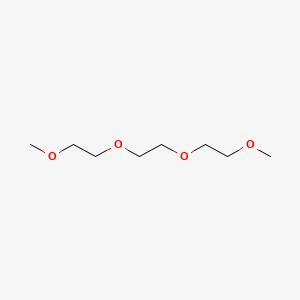
Triglyme
Triethylene glycol dimethyl ether is a clear colorless liquid with a mild ethereal odor. (NTP, 1992) — CAMEO Chemicals
- IUPAC 名称
- 1-methoxy-2-[2-(2-methoxyethoxy)ethoxy]ethane
- 分子式
- C8H18O4
- 分子量
- 178.23 g/mol
- 精确质量
- 178.12050905 Da
- XLogP3
- -0.5
- 拓扑极性表面积
- 36.9 Ų
- 氢键供体
- 0
- 氢键受体
- 4
- 共价单元
- 1
- 已定义的立体中心
- 0
又称
另有 16 个已报告名称
外部数据库标识符
- ChEBI:CHEBI:44842
- ChEMBL:CHEMBL1235255
- EPA DTXSID:DTXSID8026224
- PubMed:19562813
- PubMed:16854038
- PubMed:16805630
- PubMed:16701839
- PubMed:15252658
- PubMed:12492325
- PubMed:11430081
来自其他科学数据库的证据
NIH PubChem PUG-View
Attributed physical-property, hazard, environmental and use annotations.
- Autoignition Temperature: 1166 °F (NTP, 1992) 来源: CAMEO Chemicals
- Boiling Point: 421 °F at 760 mmHg (NTP, 1992) 来源: CAMEO Chemicals
- Boiling Point: 216 °C 来源: ILO-WHO International Chemical Safety Cards (ICSCs)
- Boiling Point: 216 °C @760 [mm Hg] 来源: PAC Chemical Database, U.S. Department of Energy
- Density: 0.99 at 68 °F (NTP, 1992) - Less dense than water; will float 来源: CAMEO Chemicals
- Density: Relative density (water = 1): 0.99 来源: ILO-WHO International Chemical Safety Cards (ICSCs)
- Density: 0.986 @25 °C 来源: PAC Chemical Database, U.S. Department of Energy
- Flash Point: 232 °F (NTP, 1992) 来源: CAMEO Chemicals
- Flash Point: 111 °C o.c. 来源: ILO-WHO International Chemical Safety Cards (ICSCs)
- LogP: -0.48 来源: ILO-WHO International Chemical Safety Cards (ICSCs)
- Melting Point: -49 °F (NTP, 1992) 来源: CAMEO Chemicals
- Melting Point: -45 °C 来源: ILO-WHO International Chemical Safety Cards (ICSCs)
- Physical Description: Triethylene glycol dimethyl ether is a clear colorless liquid with a mild ethereal odor. (NTP, 1992) 来源: CAMEO Chemicals
- Physical Description: Liquid; [Merck Index] Colorless liquid; [ICSC] Hygroscopic; [Alfa Aesar MSDS] 来源: Haz-Map, Information on Hazardous Chemicals and Occupational Diseases
- Physical Description: COLOURLESS LIQUID WITH CHARACTERISTIC ODOUR. 来源: ILO-WHO International Chemical Safety Cards (ICSCs)
- Solubility: greater than or equal to 100 mg/mL at 70 °F (NTP, 1992) 来源: CAMEO Chemicals
- Solubility: Solubility in water: miscible 来源: ILO-WHO International Chemical Safety Cards (ICSCs)
- Vapor Pressure: 0.9 mmHg at 68 °F (NTP, 1992) 来源: CAMEO Chemicals
- Vapor Pressure: 0.04 [mmHg] 来源: Haz-Map, Information on Hazardous Chemicals and Occupational Diseases
- Vapor Pressure: Vapor pressure, kPa at 20 °C: 0.12 来源: ILO-WHO International Chemical Safety Cards (ICSCs)
- Exposure Routes: The substance can be absorbed into the body by inhalation of its aerosol and by ingestion. 来源: ILO-WHO International Chemical Safety Cards (ICSCs)
- First Aid: EYES: First check the victim for contact lenses and remove if present. Flush victim's eyes with water or normal saline solution for 20 to 30 minutes while simultaneously calling a hospital or poison control center. Do not put any ointments, oils, or medication in the victim's eyes without specific instructions from a physician. IMMEDIATELY transport the victim after flushing eyes to a hospital even if no symptoms (such as redness or irritation) develop.; SKIN: IMMEDIATELY flood affected skin with water while removing and isolating all contaminated clothing. Gently wash all affected skin areas thoroughly with soap and water. If symptoms such as redness or irritation develop, IMMEDIATELY call a physician and be prepared to transport the victim to a hospital for treatment.; INHALATION: IMMEDIATELY leave the contaminated area; take deep breaths of fresh air. If symptoms (such as wheezing, coughing, shortness of breath, or burning in the mouth, throat, or chest) develop, call a physician and be prepared to transport the victim to a hospital. Provide proper respiratory protection to rescuers entering an unknown atmosphere. Whenever possible, Self-Contained Breathing Apparatus (SCBA) shou 来源: CAMEO Chemicals
- Signal: Danger 来源: Regulation (EC) No 1272/2008 of the European Parliament and of the Council
- GHS Hazard Statements: H360Df: May damage the unborn child; Suspected of damaging fertility [Danger Reproductive toxicity] 来源: Regulation (EC) No 1272/2008 of the European Parliament and of the Council
- Precautionary Statement Codes: P203, P280, P318, P405, and P501 (click each P-code to see the statement) 来源: Regulation (EC) No 1272/2008 of the European Parliament and of the Council
- Signal: Danger 来源: European Chemicals Agency (ECHA)
- GHS Hazard Statements: H319 (22.6%): Causes serious eye irritation [Warning Serious eye damage/eye irritation]; H360 (99%): May damage fertility or the unborn child [Danger Reproductive toxicity] 来源: European Chemicals Agency (ECHA)
- Precautionary Statement Codes: P203, P264+P265, P280, P305+P351+P338, P318, P337+P317, P405, and P501 (click each P-code to see the statement) 来源: European Chemicals Agency (ECHA)
- ECHA C&L Notifications Summary: Aggregated GHS information provided per 310 reports by companies from 11 notifications to the ECHA C&L Inventory. Each notification may be associated with multiple companies.; Information may vary between notifications depending on impurities, additives, and other factors. The percentage value in parenthesis indicates the notified classification ratio from companies that provide hazard codes. Only hazard codes with percentage values above 10% are shown. For more detailed information, please visit ECHA C&L website. 来源: European Chemicals Agency (ECHA)
- Signal: Warning 来源: NITE-CMC
- GHS Hazard Statements: H361: Suspected of damaging fertility or the unborn child [Warning Reproductive toxicity] 来源: NITE-CMC
- Precautionary Statement Codes: P203, P280, P318, P405, and P501 (click each P-code to see the statement) 来源: NITE-CMC
- Signal: Danger 来源: Hazardous Chemical Information System (HCIS), Safe Work Australia
- GHS Hazard Statements: H360Df: May damage the unborn child; Suspected of damaging fertility [Danger Reproductive toxicity] 来源: Hazardous Chemical Information System (HCIS), Safe Work Australia
- Sources/Uses: Used as a solvent; [Merck Index] Used as a solvent for gases and coupling immiscible liquid; [NTP] Not produced commercially in the EU; [Glycol Ethers Online] 来源: Haz-Map, Information on Hazardous Chemicals and Occupational Diseases
映射方: Existing checksum-valid CAS to unique PubChem CID match. 检索时间: 2026-08-31. 打开来源记录
科学分类和危害注释仅提供背景信息,不能取代上方所示针对具体市场的监管决定。
其他来源的覆盖范围和匹配状态
| 来源 | 结果 | 已检查 |
|---|---|---|
| NIH PubChem PUG-View | 精确匹配 | 2026-08-31 |
已记录的无匹配结果是该来源已被检查的有效证据;这并不表示该物质在别处不存在。
于 2026-09-02 通过校验和有效的 CAS 匹配从美国国立卫生研究院 (NIH) PubChem 检索。化学性质不能取代本页的监管决定。
本站如何使用 CAS 112-49-2
CAS 112-49-2 是化学文摘社 (Chemical Abstracts Service) 的标识符,用于将本页对应到特定物质。在当前数据集中,有 1 条欧盟附件记录共用该标识符,可帮助您交叉核对同一物质是出现在一种还是多种监管情境中。
当供应商规格书、SDS 或原料档案给出 CAS 112-49-2,而您需要在一处查看所有关联的附件 II–VI 记录时,请使用本页。上方的条目卡片是查看浓度限值、警示语、附件归属和产品类型条件的最快途径。