CAS 112-49-2
CAS 112-49-2 entspricht 1 EU-Anhangseintrag in den Anhängen II–VI der Verordnung (EG) Nr. 1223/2009.
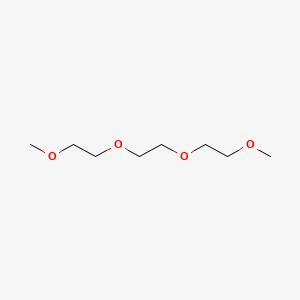
Einträge zu CAS 112-49-2
1 insgesamtChemische Identität und Eigenschaften

Triglyme
Triethylene glycol dimethyl ether is a clear colorless liquid with a mild ethereal odor. (NTP, 1992) — CAMEO Chemicals
- IUPAC-Name
- 1-methoxy-2-[2-(2-methoxyethoxy)ethoxy]ethane
- Summenformel
- C8H18O4
- Molekulargewicht
- 178.23 g/mol
- Exakte Masse
- 178.12050905 Da
- XLogP3
- -0,5
- Topologische polare Oberfläche
- 36,9 Ų
- Wasserstoffbrücken-Donoren
- 0
- Wasserstoffbrücken-Akzeptoren
- 4
- Kovalente Einheiten
- 1
- Definierte Stereozentren
- 0
Auch bekannt als
16 weitere gemeldete Namen
Kennungen in externen Datenbanken
- ChEBI:CHEBI:44842
- ChEMBL:CHEMBL1235255
- EPA DTXSID:DTXSID8026224
- PubMed:19562813
- PubMed:16854038
- PubMed:16805630
- PubMed:16701839
- PubMed:15252658
- PubMed:12492325
- PubMed:11430081
Belege aus weiteren wissenschaftlichen Datenbanken
NIH PubChem PUG-View
Attributed physical-property, hazard, environmental and use annotations.
- Autoignition Temperature: 1166 °F (NTP, 1992) Quelle: CAMEO Chemicals
- Boiling Point: 421 °F at 760 mmHg (NTP, 1992) Quelle: CAMEO Chemicals
- Boiling Point: 216 °C Quelle: ILO-WHO International Chemical Safety Cards (ICSCs)
- Boiling Point: 216 °C @760 [mm Hg] Quelle: PAC Chemical Database, U.S. Department of Energy
- Density: 0.99 at 68 °F (NTP, 1992) - Less dense than water; will float Quelle: CAMEO Chemicals
- Density: Relative density (water = 1): 0.99 Quelle: ILO-WHO International Chemical Safety Cards (ICSCs)
- Density: 0.986 @25 °C Quelle: PAC Chemical Database, U.S. Department of Energy
- Flash Point: 232 °F (NTP, 1992) Quelle: CAMEO Chemicals
- Flash Point: 111 °C o.c. Quelle: ILO-WHO International Chemical Safety Cards (ICSCs)
- LogP: -0.48 Quelle: ILO-WHO International Chemical Safety Cards (ICSCs)
- Melting Point: -49 °F (NTP, 1992) Quelle: CAMEO Chemicals
- Melting Point: -45 °C Quelle: ILO-WHO International Chemical Safety Cards (ICSCs)
- Physical Description: Triethylene glycol dimethyl ether is a clear colorless liquid with a mild ethereal odor. (NTP, 1992) Quelle: CAMEO Chemicals
- Physical Description: Liquid; [Merck Index] Colorless liquid; [ICSC] Hygroscopic; [Alfa Aesar MSDS] Quelle: Haz-Map, Information on Hazardous Chemicals and Occupational Diseases
- Physical Description: COLOURLESS LIQUID WITH CHARACTERISTIC ODOUR. Quelle: ILO-WHO International Chemical Safety Cards (ICSCs)
- Solubility: greater than or equal to 100 mg/mL at 70 °F (NTP, 1992) Quelle: CAMEO Chemicals
- Solubility: Solubility in water: miscible Quelle: ILO-WHO International Chemical Safety Cards (ICSCs)
- Vapor Pressure: 0.9 mmHg at 68 °F (NTP, 1992) Quelle: CAMEO Chemicals
- Vapor Pressure: 0.04 [mmHg] Quelle: Haz-Map, Information on Hazardous Chemicals and Occupational Diseases
- Vapor Pressure: Vapor pressure, kPa at 20 °C: 0.12 Quelle: ILO-WHO International Chemical Safety Cards (ICSCs)
- Exposure Routes: The substance can be absorbed into the body by inhalation of its aerosol and by ingestion. Quelle: ILO-WHO International Chemical Safety Cards (ICSCs)
- First Aid: EYES: First check the victim for contact lenses and remove if present. Flush victim's eyes with water or normal saline solution for 20 to 30 minutes while simultaneously calling a hospital or poison control center. Do not put any ointments, oils, or medication in the victim's eyes without specific instructions from a physician. IMMEDIATELY transport the victim after flushing eyes to a hospital even if no symptoms (such as redness or irritation) develop.; SKIN: IMMEDIATELY flood affected skin with water while removing and isolating all contaminated clothing. Gently wash all affected skin areas thoroughly with soap and water. If symptoms such as redness or irritation develop, IMMEDIATELY call a physician and be prepared to transport the victim to a hospital for treatment.; INHALATION: IMMEDIATELY leave the contaminated area; take deep breaths of fresh air. If symptoms (such as wheezing, coughing, shortness of breath, or burning in the mouth, throat, or chest) develop, call a physician and be prepared to transport the victim to a hospital. Provide proper respiratory protection to rescuers entering an unknown atmosphere. Whenever possible, Self-Contained Breathing Apparatus (SCBA) shou Quelle: CAMEO Chemicals
- Signal: Danger Quelle: Regulation (EC) No 1272/2008 of the European Parliament and of the Council
- GHS Hazard Statements: H360Df: May damage the unborn child; Suspected of damaging fertility [Danger Reproductive toxicity] Quelle: Regulation (EC) No 1272/2008 of the European Parliament and of the Council
- Precautionary Statement Codes: P203, P280, P318, P405, and P501 (click each P-code to see the statement) Quelle: Regulation (EC) No 1272/2008 of the European Parliament and of the Council
- Signal: Danger Quelle: European Chemicals Agency (ECHA)
- GHS Hazard Statements: H319 (22.6%): Causes serious eye irritation [Warning Serious eye damage/eye irritation]; H360 (99%): May damage fertility or the unborn child [Danger Reproductive toxicity] Quelle: European Chemicals Agency (ECHA)
- Precautionary Statement Codes: P203, P264+P265, P280, P305+P351+P338, P318, P337+P317, P405, and P501 (click each P-code to see the statement) Quelle: European Chemicals Agency (ECHA)
- ECHA C&L Notifications Summary: Aggregated GHS information provided per 310 reports by companies from 11 notifications to the ECHA C&L Inventory. Each notification may be associated with multiple companies.; Information may vary between notifications depending on impurities, additives, and other factors. The percentage value in parenthesis indicates the notified classification ratio from companies that provide hazard codes. Only hazard codes with percentage values above 10% are shown. For more detailed information, please visit ECHA C&L website. Quelle: European Chemicals Agency (ECHA)
- Signal: Warning Quelle: NITE-CMC
- GHS Hazard Statements: H361: Suspected of damaging fertility or the unborn child [Warning Reproductive toxicity] Quelle: NITE-CMC
- Precautionary Statement Codes: P203, P280, P318, P405, and P501 (click each P-code to see the statement) Quelle: NITE-CMC
- Signal: Danger Quelle: Hazardous Chemical Information System (HCIS), Safe Work Australia
- GHS Hazard Statements: H360Df: May damage the unborn child; Suspected of damaging fertility [Danger Reproductive toxicity] Quelle: Hazardous Chemical Information System (HCIS), Safe Work Australia
- Sources/Uses: Used as a solvent; [Merck Index] Used as a solvent for gases and coupling immiscible liquid; [NTP] Not produced commercially in the EU; [Glycol Ethers Online] Quelle: Haz-Map, Information on Hazardous Chemicals and Occupational Diseases
Zugeordnet durch: Existing checksum-valid CAS to unique PubChem CID match. Abgerufen: 2026-08-31. Quelleneintrag öffnen
Wissenschaftliche Klassifizierungen und Gefahrenannotationen liefern Kontext und ersetzen nicht die oben gezeigte marktspezifische regulatorische Entscheidung.
Weitere Quellenabdeckung und Trefferstatus
| Quelle | Ergebnis | Geprüft |
|---|---|---|
| NIH PubChem PUG-View | Exakter Treffer | 2026-08-31 |
Ein erfasster Nicht-Treffer ist ein nützlicher Beleg dafür, dass die Quelle geprüft wurde; er ist keine Behauptung, dass der Stoff anderswo nicht existiert.
Am 2026-09-02 von NIH PubChem durch prüfsummengültigen CAS-Abgleich abgerufen. Chemische Eigenschaften ersetzen nicht die regulatorische Entscheidung auf dieser Seite.
Wie CAS 112-49-2 auf dieser Website verwendet wird
CAS 112-49-2 ist die Kennung des Chemical Abstracts Service, mit der diese Seite einem bestimmten Stoff zugeordnet wird. Im aktuellen Datenbestand hat 1 EU-Anhangseintrag diese Kennung; so können Sie gegenprüfen, ob derselbe Stoff in einem oder in mehreren regulatorischen Zusammenhängen auftaucht.
Nutzen Sie diese Seite, wenn eine Lieferantenspezifikation, ein Sicherheitsdatenblatt oder ein Rohstoffdossier CAS 112-49-2 nennt und Sie alle verknüpften Einträge der Anhänge II–VI an einem Ort sehen möchten. Die Eintragskarten oben sind der schnellste Weg zu Konzentrationsgrenzen, Warnhinweisen, Anhangszuordnung und Produktartbedingungen.
Häufig gestellte Fragen
Werkzeuge und nächste Schritte
Rezeptur prüfen
Eine vollständige INCI-Liste prüfen und anschließend mit CAS 112-49-2 Lieferantendokumente zu den gefundenen Stoffen gegenprüfen.
INCI-CheckerNach Name suchen
Nach INCI-Namen, Aliasen oder verwandten Kennungen suchen, die in Ihrer Dokumentation neben CAS 112-49-2 stehen.
Suche