
CAS
1 条记录
CAS 108-05-4
CAS 108-05-4 与法规 1223/2009 附件 II–VI 中的 1 条欧盟附件记录相匹配。
CAS 108-05-4 的记录
1 共化学身份与性质
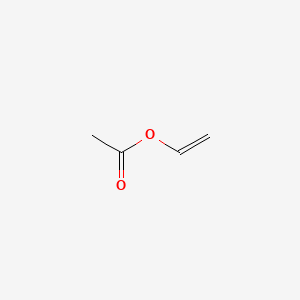
- IUPAC 名称
- ethenyl acetate
- 分子式
- C4H6O2
- 分子量
- 86.09 g/mol
- 精确质量
- 86.036779430 Da
- XLogP3
- 0.7
- 拓扑极性表面积
- 26.3 Ų
- 氢键供体
- 0
- 氢键受体
- 2
- 共价单元
- 1
- 已定义的立体中心
- 0
又称
Acetic acid ethenyl esterAcetic acid vinyl esterEthenyl ethanoateAcetoxyethyleneVinylacetateVinyl acetate monomerVinyl A monomerAcetoxyethene
另有 16 个已报告名称
1-AcetoxyethyleneVinyl ethanoateVinylacetatZeset TVinylacetaatAcetic acid, ethenyl esterOctan winyluAcetate de vinyleVinyl acetate H.Q.VyAcEthanoic acid, ethenyl esterVinile (acetato di)Vinyle (acetate de)Acetic acid, ethylene etherAcetic acid, vinyl esterVinylester kyseliny octove
外部数据库标识符
- ChEBI:CHEBI:46916
- ChEMBL:CHEMBL1470323
- EPA DTXSID:DTXSID3021431
- PubMed:24038327
- PubMed:23090233
- PubMed:23024778
- PubMed:22989650
- PubMed:22962730
- PubMed:22863701
- PubMed:22847187
- PubMed:22836214
- PubMed:22823453
- PubMed:22809240
- PubMed:22799490
- PubMed:22780868
来自其他科学数据库的证据
NIH PubChem PUG-View
标识符精确匹配7904
Attributed physical-property, hazard, environmental and use annotations.
- Autoignition Temperature: 756 °F (USCG, 1999) 来源: CAMEO Chemicals
- Autoignition Temperature: 402 °C, 756 °F 来源: Hazardous Substances Data Bank (HSDB)
- Autoignition Temperature: 385 °C 来源: ILO-WHO International Chemical Safety Cards (ICSCs)
- Boiling Point: 162 to 163 °F at 760 mmHg (EPA, 1998) 来源: CAMEO Chemicals
- Boiling Point: 72.8 °C 来源: Hazardous Substances Data Bank (HSDB)
- Boiling Point: 72.50 °C. @ 760.00 mm Hg 来源: Human Metabolome Database (HMDB)
- Boiling Point: 72.7 °C 来源: ILO-WHO International Chemical Safety Cards (ICSCs)
- Boiling Point: 162 °F 来源: Occupational Safety and Health Administration (OSHA)
- Boiling Point: 72.8 °C @760 [mm Hg] 来源: PAC Chemical Database, U.S. Department of Energy
- Boiling Point: 162 °F 来源: The National Institute for Occupational Safety and Health (NIOSH)
- Color/Form: COLORLESS, MOBILE LIQUID 来源: Hazardous Substances Data Bank (HSDB)
- Color/Form: Clear, colorless liquid 来源: Hazardous Substances Data Bank (HSDB)
- Density: 0.932 at 68 °F (EPA, 1998) - Less dense than water; will float 来源: CAMEO Chemicals
- Density: 0.932 at 20 °C/4 °C 来源: Hazardous Substances Data Bank (HSDB)
- Density: Relative density (water = 1): 0.93 来源: ILO-WHO International Chemical Safety Cards (ICSCs)
- Density: 0.93 来源: Occupational Safety and Health Administration (OSHA)
- Density: 0.9256 @25 °C 来源: PAC Chemical Database, U.S. Department of Energy
- Density: 0.93 来源: The National Institute for Occupational Safety and Health (NIOSH)
- Flash Point: 18 °F (EPA, 1998) 来源: CAMEO Chemicals
- Flash Point: -8 °C, closed cup 来源: Haz-Map, Information on Hazardous Chemicals and Occupational Diseases
- Flash Point: -8 °C, 18 °F (CLOSED CUP) 来源: Hazardous Substances Data Bank (HSDB)
- Flash Point: 0.5-0.9 °C (open cup) 来源: Hazardous Substances Data Bank (HSDB)
- Flash Point: -8 °C c.c. 来源: ILO-WHO International Chemical Safety Cards (ICSCs)
- Flash Point: 18 °F 来源: Occupational Safety and Health Administration (OSHA)
- Flash Point: 18 °F 来源: The National Institute for Occupational Safety and Health (NIOSH)
- LogP: log Kow = 0.73 来源: Hazardous Substances Data Bank (HSDB)
- LogP: 0.73 来源: Human Metabolome Database (HMDB)
- LogP: 0.73 来源: ILO-WHO International Chemical Safety Cards (ICSCs)
- Melting Point: -136 °F (EPA, 1998) 来源: CAMEO Chemicals
- Melting Point: -93.2 °C 来源: Hazardous Substances Data Bank (HSDB)
- Melting Point: -100 °C 来源: Human Metabolome Database (HMDB)
- Melting Point: -93.2 °C 来源: ILO-WHO International Chemical Safety Cards (ICSCs)
- Melting Point: -136 °F 来源: Occupational Safety and Health Administration (OSHA)
- Melting Point: -93.2 °C 来源: PAC Chemical Database, U.S. Department of Energy
- Melting Point: -136 °F 来源: The National Institute for Occupational Safety and Health (NIOSH)
- Odor: An initially pleasant odor which quickly becomes sharp and irritating ... Not unpleasant , sweetish smell in small quantities 来源: Hazardous Substances Data Bank (HSDB)
- Physical Description: Vinyl acetate appears as a clear colorless liquid. Flash point 18 °F. Density 7.8 lb / gal. Slightly soluble in water. Vapors are heavier than air. Vapors irritate the eyes and respiratory system. May polymerize if heated or contaminated. If polymerization occurs inside a container, the container may violently rupture. Used to make adhesives, paints, and plastics. 来源: CAMEO Chemicals
- Physical Description: Liquid; Other Solid; Liquid 来源: EPA Chemical Data Reporting (CDR)
- Physical Description: Colorless liquid with a pleasant, fruity odor. [Note: Raw material for many polyvinyl resins.]; [NIOSH] Polymerizes when exposed to light; [ACGIH] 来源: Haz-Map, Information on Hazardous Chemicals and Occupational Diseases
- Physical Description: Liquid 来源: Human Metabolome Database (HMDB)
- Physical Description: COLOURLESS LIQUID WITH CHARACTERISTIC ODOUR. 来源: ILO-WHO International Chemical Safety Cards (ICSCs)
- Physical Description: Colorless liquid with a pleasant, fruity odor. 来源: Occupational Safety and Health Administration (OSHA)
- Physical Description: Colorless liquid with a pleasant, fruity odor. [Note: Raw material for many polyvinyl resins.] 来源: The National Institute for Occupational Safety and Health (NIOSH)
- Refractive Index: Index of refraction: 1.3926 at 25 °C 来源: Hazardous Substances Data Bank (HSDB)
- Solubility: 2 % (NIOSH, 2024) 来源: CAMEO Chemicals
- Solubility: Sol in ethane, acetone, chloroform 来源: Hazardous Substances Data Bank (HSDB)
- Solubility: Soluble in organic liquids 来源: Hazardous Substances Data Bank (HSDB)
- Solubility: > 10% in ethyl ether; > 10% in ethanol; > 10% in benzene 来源: Hazardous Substances Data Bank (HSDB)
- Solubility: At 20 °C, a saturated solution of vinyl acetate in water contains 2.0-2.4 wt % vinyl acetate, whereas a saturated solution of water in vinyl acetate contains 0.9-1.0 wt % water; at 50 °C, the solubility of vinyl acetate in water is 0.1 wt % more than at 20 °C, but the solubility of water in vinyl acetate doubles to about 2 wt % 来源: Hazardous Substances Data Bank (HSDB)
- Solubility: For more Solubility (Complete) data for VINYL ACETATE (7 total), please visit the HSDB record page. 来源: Hazardous Substances Data Bank (HSDB)
- Solubility: 20 mg/mL at 20 °C 来源: Human Metabolome Database (HMDB)
- Solubility: Solubility in water, g/100ml at 20 °C: 2 (poor) 来源: ILO-WHO International Chemical Safety Cards (ICSCs)
- Solubility: 2% 来源: The National Institute for Occupational Safety and Health (NIOSH)
- Vapor Pressure: 83 to 140 mmHg at 68 to 86 °F (EPA, 1998) 来源: CAMEO Chemicals
- Vapor Pressure: 115.0 [mmHg] 来源: Haz-Map, Information on Hazardous Chemicals and Occupational Diseases
- Vapor Pressure: 90.2 mm Hg at 20 °C /extrapolated/ 来源: Hazardous Substances Data Bank (HSDB)
- Vapor Pressure: Vapor pressure, kPa at 20 °C: 11.7 来源: ILO-WHO International Chemical Safety Cards (ICSCs)
- Vapor Pressure: 83 mmHg 来源: Occupational Safety and Health Administration (OSHA)
- Vapor Pressure: 75 [mm Hg] @16.2 °C 来源: PAC Chemical Database, U.S. Department of Energy
- Vapor Pressure: 83 mmHg 来源: The National Institute for Occupational Safety and Health (NIOSH)
- Viscosity: 0.43 cPs at 20 °C 来源: Hazardous Substances Data Bank (HSDB)
- IARC Carcinogenic Agent: Vinyl acetate 来源: International Agency for Research on Cancer (IARC)
- IARC Carcinogenic Classes: Group 2B: Possibly carcinogenic to humans 来源: International Agency for Research on Cancer (IARC)
- IARC Monographs: Volume Sup 7: Overall Evaluations of Carcinogenicity: An Updating of IARC Monographs Volumes 1 to 42, 1987; 440 pages; ISBN 92-832-1411-0 (out of print); Volume 63: (1995) Dry Cleaning, Some Chlorinated Solvents and Other Industrial Chemicals 来源: International Agency for Research on Cancer (IARC)
- Publication Year: 1995 来源: International Agency for Research on Cancer (IARC)
- Evaluation Year: 1995 来源: International Agency for Research on Cancer (IARC)
- Carcinogen Classification: 3, not classifiable as to its carcinogenicity to humans. (L135) 来源: Toxin and Toxin Target Database (T3DB)
- Carcinogen Classification: 2B, possibly carcinogenic to humans. (L135) 来源: Toxin and Toxin Target Database (T3DB)
- Exposure Routes: The substance can be absorbed into the body by inhalation, through the skin and by ingestion. 来源: ILO-WHO International Chemical Safety Cards (ICSCs)
- Exposure Routes: inhalation, ingestion, skin and/or eye contact 来源: The National Institute for Occupational Safety and Health (NIOSH)
- Exposure Routes: Oral (L1304) ; Inhalation (L1304) ; Dermal (L1304) 来源: Toxin and Toxin Target Database (T3DB)
- Exposure Routes: Oral (L565) ; inhalation (L565) ; dermal (L565) 来源: Toxin and Toxin Target Database (T3DB)
- First Aid: Signs and Symptoms of Acute Vinyl Acetate Monomer Exposure: Vinyl acetate monomer may irritate the skin, eyes, and respiratory tract; blisters may form. Inhalation of vapors may result in dizziness or suffocation.; Emergency Life-Support Procedures: Acute exposure to vinyl acetate monomer may require decontamination and life support for the victims. Emergency personnel should wear protective clothing appropriate to the type and degree of contamination. Air-purifying or supplied-air respiratory equipment should also be worn, as necessary. Rescue vehicles should carry supplies such as plastic sheeting and disposable plastic bags to assist in preventing spread of contamination.; Inhalation Exposure:; 1. Move victims to fresh air. Emergency personnel should avoid self-exposure to vinyl acetate monomer.; 2. Evaluate vital signs including pulse and respiratory rate, and note any trauma. If no pulse is detected, provide CPR. If not breathing, provide artificial respiration. If breathing is labored, administer oxygen or other respiratory support.; 3. Obtain authorization and/or further instructions from the local hospital for administration of an antidote or performance of other invasive p 来源: CAMEO Chemicals
- ERG2024, Guide 129P (Vinyl acetate, stabilized): General First Aid:; · Call 911 or emergency medical service.; · Ensure that medical personnel are aware of the material(s) involved, take precautions to protect themselves and avoid contamination.; · Move victim to fresh air if it can be done safely.; · Administer oxygen if breathing is difficult.; · If victim is not breathing:; -- DO NOT perform mouth-to-mouth resuscitation; the victim may have ingested or inhaled the substance.; -- If equipped and pulse detected, wash face and mouth, then give artificial respiration using a proper respiratory medical device (bag-valve mask, pocket mask equipped with a one-way valve or other device).; -- If no pulse detected or no respiratory medical device available, provide continuous compressions. Conduct a pulse check every two minutes or monitor for any signs of spontaneous respirations.; · Remove and isolate contaminated clothing and shoes.; · For minor skin contact, avoid spreading material on unaffected skin.; · In case of contact with substance, remove immediately by flushing skin or eyes with running water for at least 20 minutes.; · For severe burns, immediate medical attention is required.; · Effects of exposure (inhalation, ingestion, 来源: Emergency Response Guidebook (ERG)
- First Aid: (General first aid procedures); Eye: Irrigate immediately - If this chemical contacts the eyes, immediately wash (irrigate) the eyes with large amounts of water, occasionally lifting the lower and upper lids. Get medical attention immediately.; Skin: Soap flush immediately - If this chemical contacts the skin, immediately flush the contaminated skin with soap and water. If this chemical penetrates the clothing, immediately remove the clothing and flush the skin with water. If irritation persists after washing, get medical attention.; Breathing: Respiratory support; Swallow: Medical attention immediately - If this chemical has been swallowed, get medical attention immediately. 来源: The National Institute for Occupational Safety and Health (NIOSH)
- Signal: Danger 来源: Regulation (EC) No 1272/2008 of the European Parliament and of the Council
- GHS Hazard Statements: H225: Highly Flammable liquid and vapor [Danger Flammable liquids]; H332: Harmful if inhaled [Warning Acute toxicity, inhalation]; H335: May cause respiratory irritation [Warning Specific target organ toxicity, single exposure; Respiratory tract irritation]; H351: Suspected of causing cancer [Warning Carcinogenicity] 来源: Regulation (EC) No 1272/2008 of the European Parliament and of the Council
- Precautionary Statement Codes: P203, P210, P233, P240, P241, P242, P243, P261, P271, P280, P303+P361+P353, P304+P340, P317, P318, P319, P370+P378, P403+P233, P403+P235, P405, and P501 (click each P-code to see the statement) 来源: Regulation (EC) No 1272/2008 of the European Parliament and of the Council
- Note: This chemical does not meet GHS hazard criteria for < 0.1% (1 of 2185) of reports. 来源: European Chemicals Agency (ECHA)
- Signal: Danger 来源: European Chemicals Agency (ECHA)
- GHS Hazard Statements: H225 (> 99.9%): Highly Flammable liquid and vapor [Danger Flammable liquids]; H332 (56.8%): Harmful if inhaled [Warning Acute toxicity, inhalation]; H335 (56.7%): May cause respiratory irritation [Warning Specific target organ toxicity, single exposure; Respiratory tract irritation]; H351 (57.8%): Suspected of causing cancer [Warning Carcinogenicity]; H412 (28.9%): Harmful to aquatic life with long lasting effects [Hazardous to the aquatic environment, long-term hazard] 来源: European Chemicals Agency (ECHA)
- Precautionary Statement Codes: P203, P210, P233, P240, P241, P242, P243, P261, P271, P273, P280, P303+P361+P353, P304+P340, P317, P318, P319, P370+P378, P403+P233, P403+P235, P405, and P501 (click each P-code to see the statement) 来源: European Chemicals Agency (ECHA)
- ECHA C&L Notifications Summary: Aggregated GHS information provided per 2185 reports by companies from 39 notifications to the ECHA C&L Inventory. Each notification may be associated with multiple companies.; Reported as not meeting GHS hazard criteria per 1 of 2185 reports by companies.; There are 38 notifications provided by 2184 of 2185 reports by companies with hazard statement code(s).; Information may vary between notifications depending on impurities, additives, and other factors. The percentage value in parenthesis indicates the notified classification ratio from companies that provide hazard codes. Only hazard codes with percentage values above 10% are shown. For more detailed information, please visit ECHA C&L website. 来源: European Chemicals Agency (ECHA)
- GHS Hazard Statements: Not Classified; Reported as not meeting GHS hazard criteria by 1 of 1 companies. For more detailed information, please visit ECHA C&L website. 来源: European Chemicals Agency (ECHA)
- Signal: Danger 来源: NITE-CMC
- GHS Hazard Statements: H225: Highly Flammable liquid and vapor [Danger Flammable liquids]; H315: Causes skin irritation [Warning Skin corrosion/irritation]; H319: Causes serious eye irritation [Warning Serious eye damage/eye irritation]; H332: Harmful if inhaled [Warning Acute toxicity, inhalation]; H335: May cause respiratory irritation [Warning Specific target organ toxicity, single exposure; Respiratory tract irritation]; H336: May cause drowsiness or dizziness [Warning Specific target organ toxicity, single exposure; Narcotic effects]; H341: Suspected of causing genetic defects [Warning Germ cell mutagenicity]; H350: May cause cancer [Danger Carcinogenicity]; H373: May causes damage to organs through prolonged or repeated exposure [Warning Specific target organ toxicity, repeated exposure]; H401: Toxic to aquatic life [Hazardous to the aquatic environment, acute hazard]; H412: Harmful to aquatic life with long lasting effects [Hazardous to the aquatic environment, long-term hazard] 来源: NITE-CMC
- Precautionary Statement Codes: P203, P210, P233, P240, P241, P242, P243, P260, P261, P264, P264+P265, P271, P273, P280, P302+P352, P303+P361+P353, P304+P340, P305+P351+P338, P317, P318, P319, P321, P332+P317, P337+P317, P362+P364, P370+P378, P403+P233, P403+P235, P405, and P501 (click each P-code to see the statement) 来源: NITE-CMC
- Health Effects: Vinyl acetate may affect the immune system. It may also be a carcinogen. (L1304) 来源: Toxin and Toxin Target Database (T3DB)
- NFPA Health Rating: 2 - Materials that, under emergency conditions, can cause temporary incapacitation or residual injury. 来源: Hazardous Substances Data Bank (HSDB)
- NFPA Fire Rating: 3 - Liquids and solids that can be ignited under almost all ambient temperature conditions. Materials produce hazardous atmospheres with air under almost all ambient temperatures or, though unaffected by ambient temperatures, are readily ignited under almost all conditions. 来源: Hazardous Substances Data Bank (HSDB)
- NFPA Instability Rating: 2 - Materials that readily undergo violent chemical changes at elevated temperatures and pressures. 来源: Hazardous Substances Data Bank (HSDB)
- NFPA Specific Notice: W - No water: Materials that react violently or explosively with water. 来源: Hazardous Substances Data Bank (HSDB)
- Target Organs: Respiratory (From the Nose to the Lungs) 来源: Agency for Toxic Substances and Disease Registry (ATSDR)
- Target Organs: Nervous; Respiratory 来源: EPA Integrated Risk Information System (IRIS)
- Target Organs: Eyes, skin, respiratory system 来源: The National Institute for Occupational Safety and Health (NIOSH)
- Toxicity Summary: Polyvinyl acetate usually contains trace amounts of its precursor, vinyl acetate. One of the metabolites of vinyl acetate, acetaldehyde, is a known animal carcinogen. Acetaldehyde can form adducts with DNA, causing damage such as cross-links. (L1304, A354) 来源: Toxin and Toxin Target Database (T3DB)
- Toxicity Summary: One of the metabolites of vinyl acetate, acetaldehyde, is a known animal carcinogen. Acetaldehyde can form adducts with DNA, causing damage such as cross-links. (L1304, A354) 来源: Toxin and Toxin Target Database (T3DB)
- Environmental Bioconcentration: An estimated BCF of 3.2 was calculated for vinyl acetate(SRC), using a log Kow of 0.73(1) and a regression-derived equation(2). According to a classification scheme(3), this BCF suggests the potential for bioconcentration in aquatic organisms is low(SRC). 来源: Hazardous Substances Data Bank (HSDB)
- Environmental Fate: TERRESTRIAL FATE: Based on a classification scheme(1), an estimated Koc value of 60(SRC), determined from a log Kow of 0.73(2) and a regression-derived equation(3), indicates that vinyl acetate is expected to have high mobility in soil(SRC). Volatilization of vinyl acetate from moist soil surfaces is expected to be an important fate process(SRC) given an estimated Henry's Law constant of 5.1X10⁻⁴ atm-cu m/mole(SRC), derived from its vapor pressure, 90.2 mm Hg(4), and water solubility, 20,000 mg/L(5). However, a hydrolysis half-life of 7.3 days (25 °C and pH 7)(6) indicates that hydrolysis may occur in moist soils and is expected to attenuate leaching in the soil column(SRC). Vinyl acetate is expected to volatilize from dry soil surfaces(SRC) based upon its vapor pressure(4). Vinyl acetate readily polymerizes; therefore, if vinyl acetate is released to the environment, polymerization may occur(SRC). Complete biodegradation of vinyl acetate occurred using a soil inoculum within 26 hours under both anaerobic and aerobic conditions; acetaldehyde and acetate were formed as reaction products under both oxygen conditions(7). This suggests that biodegradation may be an important environmen 来源: Hazardous Substances Data Bank (HSDB)
- Environmental Fate: AQUATIC FATE: Based on a classification scheme(1), an estimated Koc value of 60(SRC), determined from a log Kow of 0.73(2) and a regression-derived equation(3), indicates that vinyl acetate is not expected to adsorb to suspended solids and sediment(SRC). Volatilization from water surfaces is expected(3) based upon an estimated Henry's Law constant of 5.1X10⁻⁴ atm-cu m/mole(SRC), derived from its vapor pressure, 90.2 mm Hg(4), and water solubility, 20,000 mg/L(5). Using this Henry's Law constant and an estimation method(3), volatilization half-lives for a model river and model lake are 4 hours and 4 days, respectively(SRC). According to a classification scheme(6), an estimated BCF of 3.2(SRC), from its log Kow(2) and a regression-derived equation(7), suggests the potential for bioconcentration in aquatic organisms is low(SRC). Vinyl acetate is degraded in natural water by hydrolysis with an estimated hydrolysis half-life at 25 °C and pH 7 of 7.3 days(8); the hydrolysis rate increases as the pH increases(8). Reaction with hydroxyl radicals and singlet oxygen in natural water may proceed with half-lives of approximately 13 and 8 days, respectively, based on rates determined for olefin 来源: Hazardous Substances Data Bank (HSDB)
- Environmental Fate: ATMOSPHERIC FATE: According to a model of gas/particle partitioning of semivolatile organic compounds in the atmosphere(1), vinyl acetate, which has a vapor pressure of 90.2 mm Hg at 20 °C(2), is expected to exist solely as a vapor in the ambient atmosphere(SRC). Vapor-phase vinyl acetate is degraded in the atmosphere by reaction with photochemically-produced hydroxyl radicals(SRC); the half-life for this reaction in air is estimated to be 14 hours(SRC) calculated from its rate constant of 2.50X10⁻¹¹ cu cm/molecule-sec at 25 °C(3). Vapor-phase vinyl acetate may also be degraded in the atmosphere by reaction with ozone(4); the half-life for this reaction in air is estimated to be 3.9 days(SRC). 来源: Hazardous Substances Data Bank (HSDB)
- Consumer Uses: Adhesion/cohesion promoter; Intermediate; Not Known or Reasonably Ascertainable; Processing aids not otherwise specified; Monomers; Other 来源: EPA Chemical Data Reporting (CDR)
- Industry Uses: Adhesion/cohesion promoter; Intermediate; Not Known or Reasonably Ascertainable; Processing aids not otherwise specified; Monomers; Wrinkle resisting agent; Polymerization promoter; Other 来源: EPA Chemical Data Reporting (CDR)
- Uses: Vinyl acetate is primarily used as a monomer in the production of polyvinyl acetate and polyvinyl alcohol. 来源: EPA Hazardous Air Pollutants
- Sources/Uses: Used in the production of polyvinyl acetate emulsions, acrylic fiber, and polyvinyl alcohol; Occupational exposure occurs in production workers, painters, and floor layers; [ACGIH] 来源: Haz-Map, Information on Hazardous Chemicals and Occupational Diseases
- Industrial Processes with risk of exposure: Painting (Solvents) [Category: Paint] 来源: Haz-Map, Information on Hazardous Chemicals and Occupational Diseases
- Uses: In polymerized form for plastic masses, films, and lacquers; in plastic form for food packaging; as a modifier for food starch 来源: Hazardous Substances Data Bank (HSDB)
- Uses: CHEMICAL INTERMEDIATE IN SYNTH OF POLYVINYL ACETATE EMULSIONS, RESINS & POLYVINYL ALCOHOL; INTERMEDIATE IN SYNTH OF OTHER POLYMERS, RESINS, AND EMULSIONS. 来源: Hazardous Substances Data Bank (HSDB)
- Uses: Safety glass interlayers 来源: Hazardous Substances Data Bank (HSDB)
- Uses: Its chief use is as a monomer for making poly(vinyl acetate) and vinyl acetate copolymers, which are used as components in coatings, paints, and sealants, binders (adhesives, nonwovens, construction products, and carpet-backing) and in miscellaneous uses such as chewing gum and tablet coatings. Vinyl acetate is also copolymerized as the minor constituent with vinyl chloride and with ethylene to form commercial polymers and with acrylonitrile to form acrylic fibers. 来源: Hazardous Substances Data Bank (HSDB)
- Uses: For more Uses (Complete) data for VINYL ACETATE (9 total), please visit the HSDB record page. 来源: Hazardous Substances Data Bank (HSDB)
- Uses: Polyvinyl acetate is a component of glue and is used mainly as an adhesive for porous materials, particularly for wood, paper, and cloth. (L1301) 来源: Toxin and Toxin Target Database (T3DB)
- Uses: Vinyl acetate is used mainly for the production of other industrial chemicals, such as polyvinyl acetate, an important polymer for which it is the precursor. These chemicals are used mainly to make glues for the packaging and building industries. They are also used to make paints, textiles, and paper. Vinyl acetate is also used as a coating in plastic films for food packaging and as a modifier of food starch. (L1302, L1304) 来源: Toxin and Toxin Target Database (T3DB)
映射方: Existing checksum-valid CAS to unique PubChem CID match. 检索时间: 2026-08-31. 打开来源记录
科学分类和危害注释仅提供背景信息,不能取代上方所示针对具体市场的监管决定。
其他来源的覆盖范围和匹配状态
| 来源 | 结果 | 已检查 |
|---|---|---|
| NIH PubChem PUG-View | 精确匹配 | 2026-08-31 |
已记录的无匹配结果是该来源已被检查的有效证据;这并不表示该物质在别处不存在。
于 2026-08-31 通过校验和有效的 CAS 匹配从美国国立卫生研究院 (NIH) PubChem 检索。化学性质不能取代本页的监管决定。
本站如何使用 CAS 108-05-4
CAS 108-05-4 是化学文摘社 (Chemical Abstracts Service) 的标识符,用于将本页对应到特定物质。在当前数据集中,有 1 条欧盟附件记录共用该标识符,可帮助您交叉核对同一物质是出现在一种还是多种监管情境中。
当供应商规格书、SDS 或原料档案给出 CAS 108-05-4,而您需要在一处查看所有关联的附件 II–VI 记录时,请使用本页。上方的条目卡片是查看浓度限值、警示语、附件归属和产品类型条件的最快途径。
常见问题
以 CAS 108-05-4 标识的物质,如果在不同情境下适用不同条件,可能出现在欧盟化妆品法规的多个附件中。例如,某物质可能在附件 III 中按特定条件受到限制,同一 CAS 也可能在附件 IV 中作为准用着色剂按另行规定的条件出现。每个条目都必须单独审查。
将 CAS 编号与您的原料规格书和 CoA 文件进行交叉核对。当该 CAS 出现在附件 II 时,应核实其不存在。当其出现在附件 III 时,应核实您的配方满足浓度限值和产品类型条件。共用此 CAS 编号的所有附件条目均列于上方。
CAS 编号由美国化学文摘社 (Chemical Abstracts Service) 分配,全球通用。EC 编号是来自 EINECS、ELINCS 或 NLP 清单等名录的欧盟委员会标识符。两种标识符都可能出现在欧盟化妆品附件条目中。有些物质两者都有,有些只有其一,一些较旧的条目可能两者都没有。
INCI 检查器接受成分名称、CAS 编号和 EC 编号。可直接检查此 CAS 编号,然后对照供应商规格书和所有关联的附件条件核实结果。