
CAS
기록 1건
CAS 108-05-4
CAS 108-05-4은(는) 규정 1223/2009의 부속서 II–VI에 걸쳐 EU 부속서 기록 1건과 일치합니다.
CAS 108-05-4의 기록
1 총화학적 정체 및 특성
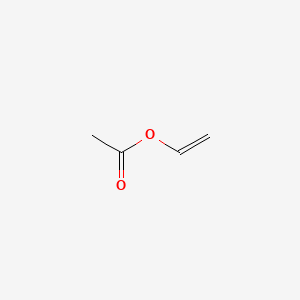
- IUPAC 명칭
- ethenyl acetate
- 분자식
- C4H6O2
- 분자량
- 86.09 g/mol
- 정확한 질량
- 86.036779430 Da
- XLogP3
- 0.7
- 위상 극성 표면적
- 26.3 Ų
- 수소 결합 공여체
- 0
- 수소 결합 수용체
- 2
- 공유결합 단위
- 1
- 정의된 입체중심
- 0
다른 이름
Acetic acid ethenyl esterAcetic acid vinyl esterEthenyl ethanoateAcetoxyethyleneVinylacetateVinyl acetate monomerVinyl A monomerAcetoxyethene
보고된 명칭 16개 더 보기
1-AcetoxyethyleneVinyl ethanoateVinylacetatZeset TVinylacetaatAcetic acid, ethenyl esterOctan winyluAcetate de vinyleVinyl acetate H.Q.VyAcEthanoic acid, ethenyl esterVinile (acetato di)Vinyle (acetate de)Acetic acid, ethylene etherAcetic acid, vinyl esterVinylester kyseliny octove
외부 데이터베이스 식별자
- ChEBI:CHEBI:46916
- ChEMBL:CHEMBL1470323
- EPA DTXSID:DTXSID3021431
- PubMed:24038327
- PubMed:23090233
- PubMed:23024778
- PubMed:22989650
- PubMed:22962730
- PubMed:22863701
- PubMed:22847187
- PubMed:22836214
- PubMed:22823453
- PubMed:22809240
- PubMed:22799490
- PubMed:22780868
추가 과학 데이터베이스의 근거
NIH PubChem PUG-View
식별자 정확히 일치7904
Attributed physical-property, hazard, environmental and use annotations.
- Autoignition Temperature: 756 °F (USCG, 1999) 출처: CAMEO Chemicals
- Autoignition Temperature: 402 °C, 756 °F 출처: Hazardous Substances Data Bank (HSDB)
- Autoignition Temperature: 385 °C 출처: ILO-WHO International Chemical Safety Cards (ICSCs)
- Boiling Point: 162 to 163 °F at 760 mmHg (EPA, 1998) 출처: CAMEO Chemicals
- Boiling Point: 72.8 °C 출처: Hazardous Substances Data Bank (HSDB)
- Boiling Point: 72.50 °C. @ 760.00 mm Hg 출처: Human Metabolome Database (HMDB)
- Boiling Point: 72.7 °C 출처: ILO-WHO International Chemical Safety Cards (ICSCs)
- Boiling Point: 162 °F 출처: Occupational Safety and Health Administration (OSHA)
- Boiling Point: 72.8 °C @760 [mm Hg] 출처: PAC Chemical Database, U.S. Department of Energy
- Boiling Point: 162 °F 출처: The National Institute for Occupational Safety and Health (NIOSH)
- Color/Form: COLORLESS, MOBILE LIQUID 출처: Hazardous Substances Data Bank (HSDB)
- Color/Form: Clear, colorless liquid 출처: Hazardous Substances Data Bank (HSDB)
- Density: 0.932 at 68 °F (EPA, 1998) - Less dense than water; will float 출처: CAMEO Chemicals
- Density: 0.932 at 20 °C/4 °C 출처: Hazardous Substances Data Bank (HSDB)
- Density: Relative density (water = 1): 0.93 출처: ILO-WHO International Chemical Safety Cards (ICSCs)
- Density: 0.93 출처: Occupational Safety and Health Administration (OSHA)
- Density: 0.9256 @25 °C 출처: PAC Chemical Database, U.S. Department of Energy
- Density: 0.93 출처: The National Institute for Occupational Safety and Health (NIOSH)
- Flash Point: 18 °F (EPA, 1998) 출처: CAMEO Chemicals
- Flash Point: -8 °C, closed cup 출처: Haz-Map, Information on Hazardous Chemicals and Occupational Diseases
- Flash Point: -8 °C, 18 °F (CLOSED CUP) 출처: Hazardous Substances Data Bank (HSDB)
- Flash Point: 0.5-0.9 °C (open cup) 출처: Hazardous Substances Data Bank (HSDB)
- Flash Point: -8 °C c.c. 출처: ILO-WHO International Chemical Safety Cards (ICSCs)
- Flash Point: 18 °F 출처: Occupational Safety and Health Administration (OSHA)
- Flash Point: 18 °F 출처: The National Institute for Occupational Safety and Health (NIOSH)
- LogP: log Kow = 0.73 출처: Hazardous Substances Data Bank (HSDB)
- LogP: 0.73 출처: Human Metabolome Database (HMDB)
- LogP: 0.73 출처: ILO-WHO International Chemical Safety Cards (ICSCs)
- Melting Point: -136 °F (EPA, 1998) 출처: CAMEO Chemicals
- Melting Point: -93.2 °C 출처: Hazardous Substances Data Bank (HSDB)
- Melting Point: -100 °C 출처: Human Metabolome Database (HMDB)
- Melting Point: -93.2 °C 출처: ILO-WHO International Chemical Safety Cards (ICSCs)
- Melting Point: -136 °F 출처: Occupational Safety and Health Administration (OSHA)
- Melting Point: -93.2 °C 출처: PAC Chemical Database, U.S. Department of Energy
- Melting Point: -136 °F 출처: The National Institute for Occupational Safety and Health (NIOSH)
- Odor: An initially pleasant odor which quickly becomes sharp and irritating ... Not unpleasant , sweetish smell in small quantities 출처: Hazardous Substances Data Bank (HSDB)
- Physical Description: Vinyl acetate appears as a clear colorless liquid. Flash point 18 °F. Density 7.8 lb / gal. Slightly soluble in water. Vapors are heavier than air. Vapors irritate the eyes and respiratory system. May polymerize if heated or contaminated. If polymerization occurs inside a container, the container may violently rupture. Used to make adhesives, paints, and plastics. 출처: CAMEO Chemicals
- Physical Description: Liquid; Other Solid; Liquid 출처: EPA Chemical Data Reporting (CDR)
- Physical Description: Colorless liquid with a pleasant, fruity odor. [Note: Raw material for many polyvinyl resins.]; [NIOSH] Polymerizes when exposed to light; [ACGIH] 출처: Haz-Map, Information on Hazardous Chemicals and Occupational Diseases
- Physical Description: Liquid 출처: Human Metabolome Database (HMDB)
- Physical Description: COLOURLESS LIQUID WITH CHARACTERISTIC ODOUR. 출처: ILO-WHO International Chemical Safety Cards (ICSCs)
- Physical Description: Colorless liquid with a pleasant, fruity odor. 출처: Occupational Safety and Health Administration (OSHA)
- Physical Description: Colorless liquid with a pleasant, fruity odor. [Note: Raw material for many polyvinyl resins.] 출처: The National Institute for Occupational Safety and Health (NIOSH)
- Refractive Index: Index of refraction: 1.3926 at 25 °C 출처: Hazardous Substances Data Bank (HSDB)
- Solubility: 2 % (NIOSH, 2024) 출처: CAMEO Chemicals
- Solubility: Sol in ethane, acetone, chloroform 출처: Hazardous Substances Data Bank (HSDB)
- Solubility: Soluble in organic liquids 출처: Hazardous Substances Data Bank (HSDB)
- Solubility: > 10% in ethyl ether; > 10% in ethanol; > 10% in benzene 출처: Hazardous Substances Data Bank (HSDB)
- Solubility: At 20 °C, a saturated solution of vinyl acetate in water contains 2.0-2.4 wt % vinyl acetate, whereas a saturated solution of water in vinyl acetate contains 0.9-1.0 wt % water; at 50 °C, the solubility of vinyl acetate in water is 0.1 wt % more than at 20 °C, but the solubility of water in vinyl acetate doubles to about 2 wt % 출처: Hazardous Substances Data Bank (HSDB)
- Solubility: For more Solubility (Complete) data for VINYL ACETATE (7 total), please visit the HSDB record page. 출처: Hazardous Substances Data Bank (HSDB)
- Solubility: 20 mg/mL at 20 °C 출처: Human Metabolome Database (HMDB)
- Solubility: Solubility in water, g/100ml at 20 °C: 2 (poor) 출처: ILO-WHO International Chemical Safety Cards (ICSCs)
- Solubility: 2% 출처: The National Institute for Occupational Safety and Health (NIOSH)
- Vapor Pressure: 83 to 140 mmHg at 68 to 86 °F (EPA, 1998) 출처: CAMEO Chemicals
- Vapor Pressure: 115.0 [mmHg] 출처: Haz-Map, Information on Hazardous Chemicals and Occupational Diseases
- Vapor Pressure: 90.2 mm Hg at 20 °C /extrapolated/ 출처: Hazardous Substances Data Bank (HSDB)
- Vapor Pressure: Vapor pressure, kPa at 20 °C: 11.7 출처: ILO-WHO International Chemical Safety Cards (ICSCs)
- Vapor Pressure: 83 mmHg 출처: Occupational Safety and Health Administration (OSHA)
- Vapor Pressure: 75 [mm Hg] @16.2 °C 출처: PAC Chemical Database, U.S. Department of Energy
- Vapor Pressure: 83 mmHg 출처: The National Institute for Occupational Safety and Health (NIOSH)
- Viscosity: 0.43 cPs at 20 °C 출처: Hazardous Substances Data Bank (HSDB)
- IARC Carcinogenic Agent: Vinyl acetate 출처: International Agency for Research on Cancer (IARC)
- IARC Carcinogenic Classes: Group 2B: Possibly carcinogenic to humans 출처: International Agency for Research on Cancer (IARC)
- IARC Monographs: Volume Sup 7: Overall Evaluations of Carcinogenicity: An Updating of IARC Monographs Volumes 1 to 42, 1987; 440 pages; ISBN 92-832-1411-0 (out of print); Volume 63: (1995) Dry Cleaning, Some Chlorinated Solvents and Other Industrial Chemicals 출처: International Agency for Research on Cancer (IARC)
- Publication Year: 1995 출처: International Agency for Research on Cancer (IARC)
- Evaluation Year: 1995 출처: International Agency for Research on Cancer (IARC)
- Carcinogen Classification: 3, not classifiable as to its carcinogenicity to humans. (L135) 출처: Toxin and Toxin Target Database (T3DB)
- Carcinogen Classification: 2B, possibly carcinogenic to humans. (L135) 출처: Toxin and Toxin Target Database (T3DB)
- Exposure Routes: The substance can be absorbed into the body by inhalation, through the skin and by ingestion. 출처: ILO-WHO International Chemical Safety Cards (ICSCs)
- Exposure Routes: inhalation, ingestion, skin and/or eye contact 출처: The National Institute for Occupational Safety and Health (NIOSH)
- Exposure Routes: Oral (L1304) ; Inhalation (L1304) ; Dermal (L1304) 출처: Toxin and Toxin Target Database (T3DB)
- Exposure Routes: Oral (L565) ; inhalation (L565) ; dermal (L565) 출처: Toxin and Toxin Target Database (T3DB)
- First Aid: Signs and Symptoms of Acute Vinyl Acetate Monomer Exposure: Vinyl acetate monomer may irritate the skin, eyes, and respiratory tract; blisters may form. Inhalation of vapors may result in dizziness or suffocation.; Emergency Life-Support Procedures: Acute exposure to vinyl acetate monomer may require decontamination and life support for the victims. Emergency personnel should wear protective clothing appropriate to the type and degree of contamination. Air-purifying or supplied-air respiratory equipment should also be worn, as necessary. Rescue vehicles should carry supplies such as plastic sheeting and disposable plastic bags to assist in preventing spread of contamination.; Inhalation Exposure:; 1. Move victims to fresh air. Emergency personnel should avoid self-exposure to vinyl acetate monomer.; 2. Evaluate vital signs including pulse and respiratory rate, and note any trauma. If no pulse is detected, provide CPR. If not breathing, provide artificial respiration. If breathing is labored, administer oxygen or other respiratory support.; 3. Obtain authorization and/or further instructions from the local hospital for administration of an antidote or performance of other invasive p 출처: CAMEO Chemicals
- ERG2024, Guide 129P (Vinyl acetate, stabilized): General First Aid:; · Call 911 or emergency medical service.; · Ensure that medical personnel are aware of the material(s) involved, take precautions to protect themselves and avoid contamination.; · Move victim to fresh air if it can be done safely.; · Administer oxygen if breathing is difficult.; · If victim is not breathing:; -- DO NOT perform mouth-to-mouth resuscitation; the victim may have ingested or inhaled the substance.; -- If equipped and pulse detected, wash face and mouth, then give artificial respiration using a proper respiratory medical device (bag-valve mask, pocket mask equipped with a one-way valve or other device).; -- If no pulse detected or no respiratory medical device available, provide continuous compressions. Conduct a pulse check every two minutes or monitor for any signs of spontaneous respirations.; · Remove and isolate contaminated clothing and shoes.; · For minor skin contact, avoid spreading material on unaffected skin.; · In case of contact with substance, remove immediately by flushing skin or eyes with running water for at least 20 minutes.; · For severe burns, immediate medical attention is required.; · Effects of exposure (inhalation, ingestion, 출처: Emergency Response Guidebook (ERG)
- First Aid: (General first aid procedures); Eye: Irrigate immediately - If this chemical contacts the eyes, immediately wash (irrigate) the eyes with large amounts of water, occasionally lifting the lower and upper lids. Get medical attention immediately.; Skin: Soap flush immediately - If this chemical contacts the skin, immediately flush the contaminated skin with soap and water. If this chemical penetrates the clothing, immediately remove the clothing and flush the skin with water. If irritation persists after washing, get medical attention.; Breathing: Respiratory support; Swallow: Medical attention immediately - If this chemical has been swallowed, get medical attention immediately. 출처: The National Institute for Occupational Safety and Health (NIOSH)
- Signal: Danger 출처: Regulation (EC) No 1272/2008 of the European Parliament and of the Council
- GHS Hazard Statements: H225: Highly Flammable liquid and vapor [Danger Flammable liquids]; H332: Harmful if inhaled [Warning Acute toxicity, inhalation]; H335: May cause respiratory irritation [Warning Specific target organ toxicity, single exposure; Respiratory tract irritation]; H351: Suspected of causing cancer [Warning Carcinogenicity] 출처: Regulation (EC) No 1272/2008 of the European Parliament and of the Council
- Precautionary Statement Codes: P203, P210, P233, P240, P241, P242, P243, P261, P271, P280, P303+P361+P353, P304+P340, P317, P318, P319, P370+P378, P403+P233, P403+P235, P405, and P501 (click each P-code to see the statement) 출처: Regulation (EC) No 1272/2008 of the European Parliament and of the Council
- Note: This chemical does not meet GHS hazard criteria for < 0.1% (1 of 2185) of reports. 출처: European Chemicals Agency (ECHA)
- Signal: Danger 출처: European Chemicals Agency (ECHA)
- GHS Hazard Statements: H225 (> 99.9%): Highly Flammable liquid and vapor [Danger Flammable liquids]; H332 (56.8%): Harmful if inhaled [Warning Acute toxicity, inhalation]; H335 (56.7%): May cause respiratory irritation [Warning Specific target organ toxicity, single exposure; Respiratory tract irritation]; H351 (57.8%): Suspected of causing cancer [Warning Carcinogenicity]; H412 (28.9%): Harmful to aquatic life with long lasting effects [Hazardous to the aquatic environment, long-term hazard] 출처: European Chemicals Agency (ECHA)
- Precautionary Statement Codes: P203, P210, P233, P240, P241, P242, P243, P261, P271, P273, P280, P303+P361+P353, P304+P340, P317, P318, P319, P370+P378, P403+P233, P403+P235, P405, and P501 (click each P-code to see the statement) 출처: European Chemicals Agency (ECHA)
- ECHA C&L Notifications Summary: Aggregated GHS information provided per 2185 reports by companies from 39 notifications to the ECHA C&L Inventory. Each notification may be associated with multiple companies.; Reported as not meeting GHS hazard criteria per 1 of 2185 reports by companies.; There are 38 notifications provided by 2184 of 2185 reports by companies with hazard statement code(s).; Information may vary between notifications depending on impurities, additives, and other factors. The percentage value in parenthesis indicates the notified classification ratio from companies that provide hazard codes. Only hazard codes with percentage values above 10% are shown. For more detailed information, please visit ECHA C&L website. 출처: European Chemicals Agency (ECHA)
- GHS Hazard Statements: Not Classified; Reported as not meeting GHS hazard criteria by 1 of 1 companies. For more detailed information, please visit ECHA C&L website. 출처: European Chemicals Agency (ECHA)
- Signal: Danger 출처: NITE-CMC
- GHS Hazard Statements: H225: Highly Flammable liquid and vapor [Danger Flammable liquids]; H315: Causes skin irritation [Warning Skin corrosion/irritation]; H319: Causes serious eye irritation [Warning Serious eye damage/eye irritation]; H332: Harmful if inhaled [Warning Acute toxicity, inhalation]; H335: May cause respiratory irritation [Warning Specific target organ toxicity, single exposure; Respiratory tract irritation]; H336: May cause drowsiness or dizziness [Warning Specific target organ toxicity, single exposure; Narcotic effects]; H341: Suspected of causing genetic defects [Warning Germ cell mutagenicity]; H350: May cause cancer [Danger Carcinogenicity]; H373: May causes damage to organs through prolonged or repeated exposure [Warning Specific target organ toxicity, repeated exposure]; H401: Toxic to aquatic life [Hazardous to the aquatic environment, acute hazard]; H412: Harmful to aquatic life with long lasting effects [Hazardous to the aquatic environment, long-term hazard] 출처: NITE-CMC
- Precautionary Statement Codes: P203, P210, P233, P240, P241, P242, P243, P260, P261, P264, P264+P265, P271, P273, P280, P302+P352, P303+P361+P353, P304+P340, P305+P351+P338, P317, P318, P319, P321, P332+P317, P337+P317, P362+P364, P370+P378, P403+P233, P403+P235, P405, and P501 (click each P-code to see the statement) 출처: NITE-CMC
- Health Effects: Vinyl acetate may affect the immune system. It may also be a carcinogen. (L1304) 출처: Toxin and Toxin Target Database (T3DB)
- NFPA Health Rating: 2 - Materials that, under emergency conditions, can cause temporary incapacitation or residual injury. 출처: Hazardous Substances Data Bank (HSDB)
- NFPA Fire Rating: 3 - Liquids and solids that can be ignited under almost all ambient temperature conditions. Materials produce hazardous atmospheres with air under almost all ambient temperatures or, though unaffected by ambient temperatures, are readily ignited under almost all conditions. 출처: Hazardous Substances Data Bank (HSDB)
- NFPA Instability Rating: 2 - Materials that readily undergo violent chemical changes at elevated temperatures and pressures. 출처: Hazardous Substances Data Bank (HSDB)
- NFPA Specific Notice: W - No water: Materials that react violently or explosively with water. 출처: Hazardous Substances Data Bank (HSDB)
- Target Organs: Respiratory (From the Nose to the Lungs) 출처: Agency for Toxic Substances and Disease Registry (ATSDR)
- Target Organs: Nervous; Respiratory 출처: EPA Integrated Risk Information System (IRIS)
- Target Organs: Eyes, skin, respiratory system 출처: The National Institute for Occupational Safety and Health (NIOSH)
- Toxicity Summary: Polyvinyl acetate usually contains trace amounts of its precursor, vinyl acetate. One of the metabolites of vinyl acetate, acetaldehyde, is a known animal carcinogen. Acetaldehyde can form adducts with DNA, causing damage such as cross-links. (L1304, A354) 출처: Toxin and Toxin Target Database (T3DB)
- Toxicity Summary: One of the metabolites of vinyl acetate, acetaldehyde, is a known animal carcinogen. Acetaldehyde can form adducts with DNA, causing damage such as cross-links. (L1304, A354) 출처: Toxin and Toxin Target Database (T3DB)
- Environmental Bioconcentration: An estimated BCF of 3.2 was calculated for vinyl acetate(SRC), using a log Kow of 0.73(1) and a regression-derived equation(2). According to a classification scheme(3), this BCF suggests the potential for bioconcentration in aquatic organisms is low(SRC). 출처: Hazardous Substances Data Bank (HSDB)
- Environmental Fate: TERRESTRIAL FATE: Based on a classification scheme(1), an estimated Koc value of 60(SRC), determined from a log Kow of 0.73(2) and a regression-derived equation(3), indicates that vinyl acetate is expected to have high mobility in soil(SRC). Volatilization of vinyl acetate from moist soil surfaces is expected to be an important fate process(SRC) given an estimated Henry's Law constant of 5.1X10⁻⁴ atm-cu m/mole(SRC), derived from its vapor pressure, 90.2 mm Hg(4), and water solubility, 20,000 mg/L(5). However, a hydrolysis half-life of 7.3 days (25 °C and pH 7)(6) indicates that hydrolysis may occur in moist soils and is expected to attenuate leaching in the soil column(SRC). Vinyl acetate is expected to volatilize from dry soil surfaces(SRC) based upon its vapor pressure(4). Vinyl acetate readily polymerizes; therefore, if vinyl acetate is released to the environment, polymerization may occur(SRC). Complete biodegradation of vinyl acetate occurred using a soil inoculum within 26 hours under both anaerobic and aerobic conditions; acetaldehyde and acetate were formed as reaction products under both oxygen conditions(7). This suggests that biodegradation may be an important environmen 출처: Hazardous Substances Data Bank (HSDB)
- Environmental Fate: AQUATIC FATE: Based on a classification scheme(1), an estimated Koc value of 60(SRC), determined from a log Kow of 0.73(2) and a regression-derived equation(3), indicates that vinyl acetate is not expected to adsorb to suspended solids and sediment(SRC). Volatilization from water surfaces is expected(3) based upon an estimated Henry's Law constant of 5.1X10⁻⁴ atm-cu m/mole(SRC), derived from its vapor pressure, 90.2 mm Hg(4), and water solubility, 20,000 mg/L(5). Using this Henry's Law constant and an estimation method(3), volatilization half-lives for a model river and model lake are 4 hours and 4 days, respectively(SRC). According to a classification scheme(6), an estimated BCF of 3.2(SRC), from its log Kow(2) and a regression-derived equation(7), suggests the potential for bioconcentration in aquatic organisms is low(SRC). Vinyl acetate is degraded in natural water by hydrolysis with an estimated hydrolysis half-life at 25 °C and pH 7 of 7.3 days(8); the hydrolysis rate increases as the pH increases(8). Reaction with hydroxyl radicals and singlet oxygen in natural water may proceed with half-lives of approximately 13 and 8 days, respectively, based on rates determined for olefin 출처: Hazardous Substances Data Bank (HSDB)
- Environmental Fate: ATMOSPHERIC FATE: According to a model of gas/particle partitioning of semivolatile organic compounds in the atmosphere(1), vinyl acetate, which has a vapor pressure of 90.2 mm Hg at 20 °C(2), is expected to exist solely as a vapor in the ambient atmosphere(SRC). Vapor-phase vinyl acetate is degraded in the atmosphere by reaction with photochemically-produced hydroxyl radicals(SRC); the half-life for this reaction in air is estimated to be 14 hours(SRC) calculated from its rate constant of 2.50X10⁻¹¹ cu cm/molecule-sec at 25 °C(3). Vapor-phase vinyl acetate may also be degraded in the atmosphere by reaction with ozone(4); the half-life for this reaction in air is estimated to be 3.9 days(SRC). 출처: Hazardous Substances Data Bank (HSDB)
- Consumer Uses: Adhesion/cohesion promoter; Intermediate; Not Known or Reasonably Ascertainable; Processing aids not otherwise specified; Monomers; Other 출처: EPA Chemical Data Reporting (CDR)
- Industry Uses: Adhesion/cohesion promoter; Intermediate; Not Known or Reasonably Ascertainable; Processing aids not otherwise specified; Monomers; Wrinkle resisting agent; Polymerization promoter; Other 출처: EPA Chemical Data Reporting (CDR)
- Uses: Vinyl acetate is primarily used as a monomer in the production of polyvinyl acetate and polyvinyl alcohol. 출처: EPA Hazardous Air Pollutants
- Sources/Uses: Used in the production of polyvinyl acetate emulsions, acrylic fiber, and polyvinyl alcohol; Occupational exposure occurs in production workers, painters, and floor layers; [ACGIH] 출처: Haz-Map, Information on Hazardous Chemicals and Occupational Diseases
- Industrial Processes with risk of exposure: Painting (Solvents) [Category: Paint] 출처: Haz-Map, Information on Hazardous Chemicals and Occupational Diseases
- Uses: In polymerized form for plastic masses, films, and lacquers; in plastic form for food packaging; as a modifier for food starch 출처: Hazardous Substances Data Bank (HSDB)
- Uses: CHEMICAL INTERMEDIATE IN SYNTH OF POLYVINYL ACETATE EMULSIONS, RESINS & POLYVINYL ALCOHOL; INTERMEDIATE IN SYNTH OF OTHER POLYMERS, RESINS, AND EMULSIONS. 출처: Hazardous Substances Data Bank (HSDB)
- Uses: Safety glass interlayers 출처: Hazardous Substances Data Bank (HSDB)
- Uses: Its chief use is as a monomer for making poly(vinyl acetate) and vinyl acetate copolymers, which are used as components in coatings, paints, and sealants, binders (adhesives, nonwovens, construction products, and carpet-backing) and in miscellaneous uses such as chewing gum and tablet coatings. Vinyl acetate is also copolymerized as the minor constituent with vinyl chloride and with ethylene to form commercial polymers and with acrylonitrile to form acrylic fibers. 출처: Hazardous Substances Data Bank (HSDB)
- Uses: For more Uses (Complete) data for VINYL ACETATE (9 total), please visit the HSDB record page. 출처: Hazardous Substances Data Bank (HSDB)
- Uses: Polyvinyl acetate is a component of glue and is used mainly as an adhesive for porous materials, particularly for wood, paper, and cloth. (L1301) 출처: Toxin and Toxin Target Database (T3DB)
- Uses: Vinyl acetate is used mainly for the production of other industrial chemicals, such as polyvinyl acetate, an important polymer for which it is the precursor. These chemicals are used mainly to make glues for the packaging and building industries. They are also used to make paints, textiles, and paper. Vinyl acetate is also used as a coating in plastic films for food packaging and as a modifier of food starch. (L1302, L1304) 출처: Toxin and Toxin Target Database (T3DB)
매핑 기준: Existing checksum-valid CAS to unique PubChem CID match. 가져온 시각: 2026-08-31. 출처 기록 열기
과학적 분류와 유해성 주석은 맥락을 제공할 뿐이며, 위에 표시된 시장별 규제 판단을 대체하지 않습니다.
추가 출처 적용 범위 및 일치 상태
| 출처 | 결과 | 확인됨 |
|---|---|---|
| NIH PubChem PUG-View | 정확히 일치 | 2026-08-31 |
기록된 불일치는 출처를 확인했다는 유용한 근거이며, 해당 물질이 다른 곳에 존재하지 않는다는 주장이 아닙니다.
체크섬이 유효한 CAS 일치를 통해 2026-08-31에 NIH PubChem에서 가져왔습니다. 화학적 특성은 이 페이지의 규제 판단을 대체하지 않습니다.
이 사이트에서 CAS 108-05-4을(를) 사용하는 방식
CAS 108-05-4은(는) 이 페이지를 특정 물질에 고정하는 데 사용하는 Chemical Abstracts Service 식별자입니다. 현재 데이터세트에서는 EU 부속서 기록 1건이 이 식별자를 공유하며, 같은 물질이 하나의 규제 맥락에 나타나는지 여러 맥락에 나타나는지 교차 확인하는 데 도움이 됩니다.
공급업체 규격서, SDS 또는 원료 문서에 CAS 108-05-4이(가) 제시되어 있고 연결된 모든 부속서 II–VI 기록을 한곳에서 확인해야 할 때 이 페이지를 이용하세요. 위의 항목 카드는 농도 한도, 경고 문구, 부속서 위치 및 제품 유형 조건을 가장 빠르게 확인하는 방법입니다.
자주 묻는 질문
CAS 108-05-4로 식별되는 물질은 맥락에 따라 다른 조건이 적용되는 경우 EU 화장품 규정의 여러 부속서에 나타날 수 있습니다. 예를 들어 어떤 물질이 부속서 III에서 특정 조건으로 사용제한될 수 있고, 같은 CAS가 부속서 IV에서 별도의 항목 조건에 따라 허용 색소로 나타날 수도 있습니다. 각 항목은 개별적으로 검토해야 합니다.
CAS 번호를 원료 규격서 및 CoA 문서와 대조하세요. CAS가 부속서 II에 있으면 해당 물질이 없는지 확인하세요. 부속서 III에 있으면 처방에서 농도 한도와 제품 유형 조건이 충족되는지 확인하세요. 이 CAS 번호를 공유하는 모든 부속서 항목이 위에 나열되어 있습니다.
CAS 번호는 미국의 Chemical Abstracts Service가 부여하며 전 세계적으로 통용됩니다. EC 번호는 EINECS, ELINCS 또는 NLP 목록 같은 목록에 수록된 유럽연합 집행위원회 식별자입니다. 두 식별자 모두 EU 화장품 부속서 항목에 나타날 수 있습니다. 두 가지를 모두 가진 물질도 있고, 하나만 가진 물질도 있으며, 일부 오래된 항목은 둘 다 없을 수도 있습니다.
INCI 검사기는 원료명, CAS 번호 및 EC 번호를 받습니다. 이 CAS 번호를 직접 확인한 다음, 결과를 공급업체 규격서 및 연결된 모든 부속서 조건과 대조하세요.