
CAS
1 条记录
CAS 107-49-3
CAS 107-49-3 与法规 1223/2009 附件 II–VI 中的 1 条欧盟附件记录相匹配。
CAS 107-49-3 的记录
1 共化学身份与性质
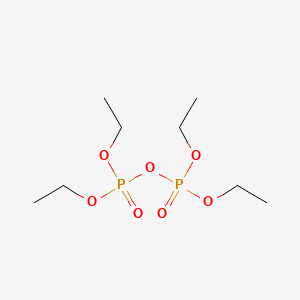
- IUPAC 名称
- diethoxyphosphoryl diethyl phosphate
- 分子式
- C8H20O7P2
- 分子量
- 290.19 g/mol
- 精确质量
- 290.06842697 Da
- XLogP3
- 0.4
- 拓扑极性表面积
- 80.3 Ų
- 氢键供体
- 0
- 氢键受体
- 7
- 共价单元
- 1
- 已定义的立体中心
- 0
又称
TEPPTetraethyl diphosphateVapotoneBladanTetronMortopalTetrastigmineHepthexamite
另有 16 个已报告名称
FosvexGrisolKillaxLirohexNifostNifosKilmite 40HexamiteKillexLethalaire G-52Tetron-100Nifos TDiphosphoric acid, tetraethyl esterEthyl pyrophosphate, tetra-Rcra waste number P111Ethyl pyrophosphate (Et4P2O7)
外部数据库标识符
- ChEBI:CHEBI:82149
- ChEMBL:CHEMBL293787
- EPA DTXSID:DTXSID3034957
- PubMed:22163587
- PubMed:20872688
- PubMed:20391100
- PubMed:20095145
- PubMed:19435147
- PubMed:19379510
- PubMed:18468398
- PubMed:16720085
- PubMed:16481169
- PubMed:15908205
- PubMed:11926204
来自其他科学数据库的证据
EMBL-EBI ChEBI
标识符精确匹配CHEBI:82149
TEPP
- 配方
- C8H20O7P2
- 平均质量
- 290.189 g/mol
- 单同位素质量
- 290.06843 Da
- 形式电荷
- 0
- organic diphosphate — is a (CHEBI:62889)
- organic diphosphate — is a (CHEBI:62889)
- 12383012 来源: PubMed
其他整理的名称
ethyl pyrophosphateEthyl pyrophosphateNSC-14707Tetraethyl pyrophosphate
来自此来源的交叉引用
映射方: Exact CAS cross-reference in the ChEBI compound record. 检索时间: 2026-08-31. 打开来源记录
NIH PubChem PUG-View
标识符精确匹配7873
Attributed physical-property, hazard, environmental and use annotations.
- Boiling Point: 280 °F at 2.3 mmHg (EPA, 1998) 来源: CAMEO Chemicals
- Boiling Point: 82 °C @ 0.05 mm Hg; 124 °C @ 1.1 mm Hg; 138 °C @ 2.3 mm Hg 来源: Hazardous Substances Data Bank (HSDB)
- Boiling Point: 280 °F at 2.3 mmHg 来源: Occupational Safety and Health Administration (OSHA)
- Boiling Point: 310 °C @760 [mm Hg] 来源: PAC Chemical Database, U.S. Department of Energy
- Boiling Point: Decomposes 来源: The National Institute for Occupational Safety and Health (NIOSH)
- Color/Form: Mobile liquid 来源: Hazardous Substances Data Bank (HSDB)
- Color/Form: Colorless to amber liquid (Note: A solid below 32 degrees F). 来源: Hazardous Substances Data Bank (HSDB)
- Density: 1.185 at 68 °F (EPA, 1998) - Denser than water; will sink 来源: CAMEO Chemicals
- Density: 1.185 @ 20 °C/4 °C 来源: Hazardous Substances Data Bank (HSDB)
- Density: Density: about 1.2 @ 25 °C; dark amber-colored mobile liquid /Technical product/ 来源: Hazardous Substances Data Bank (HSDB)
- Density: 1.18 g/cm³ 来源: ILO-WHO International Chemical Safety Cards (ICSCs)
- Density: Relative density of the vapour/air-mixture at 20 °C (air = 1): 1.00 来源: ILO-WHO International Chemical Safety Cards (ICSCs)
- Density: 1.185 来源: Occupational Safety and Health Administration (OSHA)
- Density: 1.2 @25 °C 来源: PAC Chemical Database, U.S. Department of Energy
- Density: 1.19 来源: The National Institute for Occupational Safety and Health (NIOSH)
- Flash Point: >110 °C c.c. 来源: ILO-WHO International Chemical Safety Cards (ICSCs)
- LogP: 2.94 来源: ILO-WHO International Chemical Safety Cards (ICSCs)
- Melting Point: 32 °F (EPA, 1998) 来源: CAMEO Chemicals
- Melting Point: Solid below 32 °F 来源: Hazardous Substances Data Bank (HSDB)
- Melting Point: 32 °F 来源: Occupational Safety and Health Administration (OSHA)
- Melting Point: 32 °F 来源: The National Institute for Occupational Safety and Health (NIOSH)
- Odor: Agreeable odor 来源: Hazardous Substances Data Bank (HSDB)
- Odor: AROMATIC 来源: Hazardous Substances Data Bank (HSDB)
- Odor: Faint, fruity odor 来源: Hazardous Substances Data Bank (HSDB)
- Physical Description: Tetraethyl pyrophosphate is an organic phosphate pesticide which acts as an inhibitor of cholinesterase, and as such it is highly toxic by all routes of exposure. It is a water-white to amber liquid, depending on purity. Tetraethyl pyrophosphate is soluble in water and is slowly decomposed by water. It is toxic by inhalation and by skin absorption. It may be found as a liquid or as a dry mixture where the liquid is absorbed onto a dry carrier. 来源: CAMEO Chemicals
- Physical Description: Colorless to amber liquid with a faint, fruity odor. [insecticide] [Note: A solid below 32 degrees F.]; [NIOSH] 来源: Haz-Map, Information on Hazardous Chemicals and Occupational Diseases
- Physical Description: COLOURLESS HYGROSCOPIC LIQUID. 来源: ILO-WHO International Chemical Safety Cards (ICSCs)
- Physical Description: Colorless to amber liquid with a faint, fruity odor. 来源: Occupational Safety and Health Administration (OSHA)
- Physical Description: Colorless to amber liquid with a faint, fruity odor. [insecticide] [Note: A solid below 32 °F.] 来源: The National Institute for Occupational Safety and Health (NIOSH)
- Refractive Index: Index of refraction: 1.4196 @ 20 deg C/D 来源: Hazardous Substances Data Bank (HSDB)
- Solubility: Miscible (decomposes) (NTP, 1992) 来源: CAMEO Chemicals
- Solubility: Miscible with glycerol, ethylene glycol, toluene, propylene glycol, acetone, methanol, benzene, carbon tetrachloride, xylene, ethanol, chloroform 来源: Hazardous Substances Data Bank (HSDB)
- Solubility: Miscible in water 来源: Hazardous Substances Data Bank (HSDB)
- Solubility: Solubility in water: good 来源: ILO-WHO International Chemical Safety Cards (ICSCs)
- Solubility: Miscible 来源: The National Institute for Occupational Safety and Health (NIOSH)
- Vapor Pressure: 0.00047 mmHg at 86 °F (EPA, 1998) 来源: CAMEO Chemicals
- Vapor Pressure: 0.00015 [mmHg] 来源: Haz-Map, Information on Hazardous Chemicals and Occupational Diseases
- Vapor Pressure: 2.60X10⁻⁴ mm Hg at 25 °C (extrapolated from 4.7X10⁻⁴ mm Hg at 30 °C) 来源: Hazardous Substances Data Bank (HSDB)
- Vapor Pressure: Vapor pressure, Pa at 20 °C: 2 来源: ILO-WHO International Chemical Safety Cards (ICSCs)
- Vapor Pressure: 0.0002 mmHg 来源: Occupational Safety and Health Administration (OSHA)
- Vapor Pressure: 0.00047 [mm Hg] @25 °C 来源: PAC Chemical Database, U.S. Department of Energy
- Vapor Pressure: 0.0002 mmHg 来源: The National Institute for Occupational Safety and Health (NIOSH)
- Exposure Routes: The substance can be absorbed into the body by inhalation, through the skin and by ingestion. 来源: ILO-WHO International Chemical Safety Cards (ICSCs)
- Exposure Routes: inhalation, skin absorption, ingestion, skin and/or eye contact 来源: The National Institute for Occupational Safety and Health (NIOSH)
- First Aid: Warning: Effects may be delayed up to 12 hours. Caution is advised.; Note: TEPP is a cholinesterase inhibitor.; Signs and Symptoms of TEPP Exposure: Acute exposure to TEPP may produce the following signs and symptoms: sweating, pinpoint pupils, blurred vision, headache, dizziness, profound weakness, muscle spasms, seizures, and coma. Mental confusion and psychosis may occur. Excessive salivation, nausea, vomiting, anorexia, diarrhea, and abdominal pain may also occur. The heart rate may decrease following oral exposure or increase following dermal exposure. Chest pain may be noted. Hypotension (low blood pressure) may be observed, although hypertension (high blood pressure) is not uncommon. Respiratory symptoms include dyspnea (shortness of breath), pulmonary edema, respiratory depression, and respiratory paralysis.; Emergency Life-Support Procedures: Acute exposure to TEPP may require decontamination and life support for the victims. Emergency personnel should wear protective clothing appropriate to the type and degree of contamination. Air purifying or supplied-air respiratory equipment should also be worn, as necessary. Rescue vehicles should carry supplies such as plastic sheet 来源: CAMEO Chemicals
- First Aid: (General first aid procedures); Eye: Irrigate immediately - If this chemical contacts the eyes, immediately wash (irrigate) the eyes with large amounts of water, occasionally lifting the lower and upper lids. Get medical attention immediately.; Skin: Water flush immediately - If this chemical contacts the skin, immediately flush the contaminated skin with water. If this chemical penetrates the clothing, immediately remove the clothing and flush the skin with water. Get medical attention promptly.; Breathing: Respiratory support; Swallow: Medical attention immediately - If this chemical has been swallowed, get medical attention immediately. 来源: The National Institute for Occupational Safety and Health (NIOSH)
- Signal: Danger 来源: Regulation (EC) No 1272/2008 of the European Parliament and of the Council
- GHS Hazard Statements: H300: Fatal if swallowed [Danger Acute toxicity, oral]; H310: Fatal in contact with skin [Danger Acute toxicity, dermal]; H400: Very toxic to aquatic life [Warning Hazardous to the aquatic environment, acute hazard] 来源: Regulation (EC) No 1272/2008 of the European Parliament and of the Council
- Precautionary Statement Codes: P262, P264, P270, P273, P280, P301+P316, P302+P352, P316, P321, P330, P361+P364, P391, P405, and P501 (click each P-code to see the statement) 来源: Regulation (EC) No 1272/2008 of the European Parliament and of the Council
- Signal: Danger 来源: European Chemicals Agency (ECHA)
- GHS Hazard Statements: H300 (100%): Fatal if swallowed [Danger Acute toxicity, oral]; H310 (100%): Fatal in contact with skin [Danger Acute toxicity, dermal]; H400 (100%): Very toxic to aquatic life [Warning Hazardous to the aquatic environment, acute hazard] 来源: European Chemicals Agency (ECHA)
- Precautionary Statement Codes: P262, P264, P270, P273, P280, P301+P316, P302+P352, P316, P321, P330, P361+P364, P391, P405, and P501 (click each P-code to see the statement) 来源: European Chemicals Agency (ECHA)
- ECHA C&L Notifications Summary: Aggregated GHS information provided per 42 reports by companies from 2 notifications to the ECHA C&L Inventory. Each notification may be associated with multiple companies.; Information may vary between notifications depending on impurities, additives, and other factors. The percentage value in parenthesis indicates the notified classification ratio from companies that provide hazard codes. Only hazard codes with percentage values above 10% are shown. For more detailed information, please visit ECHA C&L website. 来源: European Chemicals Agency (ECHA)
- Signal: Danger 来源: NITE-CMC
- GHS Hazard Statements: H300: Fatal if swallowed [Danger Acute toxicity, oral]; H310: Fatal in contact with skin [Danger Acute toxicity, dermal]; H315: Causes skin irritation [Warning Skin corrosion/irritation]; H319: Causes serious eye irritation [Warning Serious eye damage/eye irritation]; H330: Fatal if inhaled [Danger Acute toxicity, inhalation]; H370: Causes damage to organs [Danger Specific target organ toxicity, single exposure]; H372: Causes damage to organs through prolonged or repeated exposure [Danger Specific target organ toxicity, repeated exposure] 来源: NITE-CMC
- Precautionary Statement Codes: P260, P262, P264, P264+P265, P270, P271, P280, P284, P301+P316, P302+P352, P304+P340, P305+P351+P338, P308+P316, P316, P319, P320, P321, P330, P332+P317, P337+P317, P361+P364, P362+P364, P403+P233, P405, and P501 (click each P-code to see the statement) 来源: NITE-CMC
- GHS Hazard Statements: H300: Fatal if swallowed [Danger Acute toxicity, oral]; H310: Fatal in contact with skin [Danger Acute toxicity, dermal]; H315: Causes skin irritation [Warning Skin corrosion/irritation]; H319: Causes serious eye irritation [Warning Serious eye damage/eye irritation]; H330: Fatal if inhaled [Danger Acute toxicity, inhalation]; H370: Causes damage to organs [Danger Specific target organ toxicity, single exposure]; H373: May causes damage to organs through prolonged or repeated exposure [Warning Specific target organ toxicity, repeated exposure] 来源: NITE-CMC
- Signal: Danger 来源: Hazardous Chemical Information System (HCIS), Safe Work Australia
- Target Organs: Eyes, respiratory system, central nervous system, cardiovascular system, gastrointestinal tract, blood cholinesterase 来源: The National Institute for Occupational Safety and Health (NIOSH)
- Environmental Bioconcentration: An estimated BCF of 3.2 was calculated for tetraethyl pyrophosphate(SRC), using an estimated log Kow of 0.45(1) and a regression-derived equation(2). According to a classification scheme(3), this BCF suggests the potential for bioconcentration in aquatic organisms is low(SRC), provided the compound is not altered physically or chemically once released into the environment. 来源: Hazardous Substances Data Bank (HSDB)
- Environmental Fate: TERRESTRIAL FATE: Based on a classification scheme(1), an estimated Koc value of 2.2(SRC), determined from a water solubility of 1.00X10+6 mg/L(2) and a regression-derived equation(3), indicates that tetraethyl pyrophosphate is expected to have very high mobility in soil(SRC). Volatilization of tetraethyl pyrophosphate from moist soil surfaces is not expected to be an important fate process(SRC) given an estimated Henry's Law constant of 2.2X10⁻¹⁰ atm-cu m/mole(SRC) derived from its vapor pressure, 2.60X10⁻⁴ mm Hg at 25 °C(2), and water solubility(2). Tetraethyl pyrophosphate is not expected to volatilize from dry soil surfaces(SRC) based upon its vapor pressure(2). Biodegradation data for this substance were not located in the literature. 来源: Hazardous Substances Data Bank (HSDB)
- Environmental Fate: AQUATIC FATE: Based on a classification scheme(1), an estimated Koc value of 2.2(SRC), determined from a water solubility of 1.00X10+6 mg/L(2) and a regression-derived equation(3), indicates that tetraethyl pyrophosphate is not expected to adsorb to suspended solids and sediment(SRC). Volatilization from water surfaces is not expected(3) based upon an estimated Henry's Law constant of 2.2X10⁻¹⁰ atm-cu m/mole(SRC), derived from its vapor pressure, 2.60X10⁻⁴ mm Hg at 25 °C(2), and water solubility(2). Using this Henry's Law constant and an estimation method(3). According to a classification scheme(4), an estimated BCF of 3.2(SRC), from an estimated log Kow(5) and a regression-derived equation(6), suggests the potential for bioconcentration in aquatic organisms is low(SRC). Biodegradation data for this substance were not located in the literature. 来源: Hazardous Substances Data Bank (HSDB)
- Environmental Fate: ATMOSPHERIC FATE: According to a model of gas/particle partitioning of semivolatile organic compounds in the atmosphere(1), tetraethyl pyrophosphate, which has a vapor pressure of 2.60X10⁻⁴ mm Hg at 25 °C(2), is expected to exist solely as a vapor in the ambient atmosphere. Vapor-phase tetraethyl pyrophosphate is degraded in the atmosphere by reaction with photochemically-produced hydroxyl radicals(SRC); the half-life for this reaction in air is estimated to be 5.0 hours(SRC), calculated from its rate constant of 7.7X10⁻¹¹ cu cm/molecule-sec at 25 °C(SRC) that was derived using a structure estimation method(3). 来源: Hazardous Substances Data Bank (HSDB)
- Environmental Fate: Aquatic or Terrestrial Fate: ... Rapidly hydrolyzed in the presence of moisture. 来源: Hazardous Substances Data Bank (HSDB)
- Sources/Uses: Commercially available as dust, concentrate, or solution in methyl chloride to kill aphids, spiders, mites, mealy bugs, leafhoppers, and thrips; [ACGIH] Used on vegetable and fruit crops, it is one of the first organophosphate insecticide developed and has been largely replaced by newer products. [HSDB] 来源: Haz-Map, Information on Hazardous Chemicals and Occupational Diseases
- Industrial Processes with risk of exposure: Farming (Pesticides) [Category: Industry] 来源: Haz-Map, Information on Hazardous Chemicals and Occupational Diseases
- Uses: For tetraethyl pyrophosphate (USEPA/OPP Pesticide Code: 079601) there are 0 labels match. /SRP: Not registered for current use in the U.S., but approved pesticide uses may change periodically and so federal, state and local authorities must be consulted for currently approved uses./ 来源: Hazardous Substances Data Bank (HSDB)
- Uses: Insecticide-acaricide; used on three vegetable crops and three fruit crops; one of first organic phosphate insecticides in the US (1946); largely replaced by other products. 来源: Hazardous Substances Data Bank (HSDB)
- Uses: ... /It is/ used in the control of some aphids, spider mites, mealybugs, and leafhoppers and thrips. 来源: Hazardous Substances Data Bank (HSDB)
- Uses: Contact poison ... very effective against active stages of mites and other soft bodied insects. 来源: Hazardous Substances Data Bank (HSDB)
映射方: Existing checksum-valid CAS to unique PubChem CID match. 检索时间: 2026-08-31. 打开来源记录
科学分类和危害注释仅提供背景信息,不能取代上方所示针对具体市场的监管决定。
其他来源的覆盖范围和匹配状态
| 来源 | 结果 | 已检查 |
|---|---|---|
| EMBL-EBI ChEBI | 精确匹配 | 2026-08-31 |
| NIH PubChem PUG-View | 精确匹配 | 2026-08-31 |
已记录的无匹配结果是该来源已被检查的有效证据;这并不表示该物质在别处不存在。
于 2026-08-31 通过校验和有效的 CAS 匹配从美国国立卫生研究院 (NIH) PubChem 检索。化学性质不能取代本页的监管决定。
本站如何使用 CAS 107-49-3
CAS 107-49-3 是化学文摘社 (Chemical Abstracts Service) 的标识符,用于将本页对应到特定物质。在当前数据集中,有 1 条欧盟附件记录共用该标识符,可帮助您交叉核对同一物质是出现在一种还是多种监管情境中。
当供应商规格书、SDS 或原料档案给出 CAS 107-49-3,而您需要在一处查看所有关联的附件 II–VI 记录时,请使用本页。上方的条目卡片是查看浓度限值、警示语、附件归属和产品类型条件的最快途径。
常见问题
以 CAS 107-49-3 标识的物质,如果在不同情境下适用不同条件,可能出现在欧盟化妆品法规的多个附件中。例如,某物质可能在附件 III 中按特定条件受到限制,同一 CAS 也可能在附件 IV 中作为准用着色剂按另行规定的条件出现。每个条目都必须单独审查。
将 CAS 编号与您的原料规格书和 CoA 文件进行交叉核对。当该 CAS 出现在附件 II 时,应核实其不存在。当其出现在附件 III 时,应核实您的配方满足浓度限值和产品类型条件。共用此 CAS 编号的所有附件条目均列于上方。
CAS 编号由美国化学文摘社 (Chemical Abstracts Service) 分配,全球通用。EC 编号是来自 EINECS、ELINCS 或 NLP 清单等名录的欧盟委员会标识符。两种标识符都可能出现在欧盟化妆品附件条目中。有些物质两者都有,有些只有其一,一些较旧的条目可能两者都没有。
INCI 检查器接受成分名称、CAS 编号和 EC 编号。可直接检查此 CAS 编号,然后对照供应商规格书和所有关联的附件条件核实结果。