
CAS
1 条记录
CAS 106-46-7
CAS 106-46-7 与法规 1223/2009 附件 II–VI 中的 1 条欧盟附件记录相匹配。
CAS 106-46-7 的记录
1 共化学身份与性质
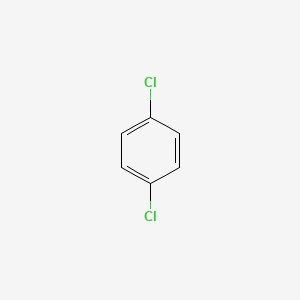
CAS 106-46-7PubChem CID 4685
1,4-Dichlorobenzene
P-dichlorobenzene appears as a white colored liquid with the odor of moth balls. Denser than water and insoluble in water. Flash point below 200 °F. Used as a moth repellent, to make other chemicals, as a fumigant, and for many other uses. — CAMEO Chemicals
- IUPAC 名称
- 1,4-dichlorobenzene
- 分子式
- C6H4Cl2
- 分子量
- 147.00 g/mol
- 精确质量
- 145.9690055 Da
- XLogP3
- 3.4
- 拓扑极性表面积
- 0.0 Ų
- 氢键供体
- 0
- 氢键受体
- 0
- 共价单元
- 1
- 已定义的立体中心
- 0
又称
p-DichlorobenzeneparadichlorobenzeneParacideParamothParadowParanuggetsSantochlorEvola
另有 16 个已报告名称
Persia-perazolp-Dichlorobenzolp-Chlorophenyl chlorideBenzene, 1,4-dichloro-GlobolParadip-DichlorbenzolDi-chloricidePara crystalsParadichlorbenzolpara-DichlorobenzeneDichlorocidePDCBp-Diclorobenzenep-DichloorbenzeenParadichlorobenzol
外部数据库标识符
- ChEBI:CHEBI:28618
- ChEMBL:CHEMBL190982
- EPA DTXSID:DTXSID1020431
- PubMed:23065949
- PubMed:23019821
- PubMed:22981285
- PubMed:22969546
- PubMed:22798848
- PubMed:22783624
- PubMed:22749900
- PubMed:22629932
- PubMed:22629641
- PubMed:22590382
- PubMed:22512181
- PubMed:22473014
来自其他科学数据库的证据
EMBL-EBI ChEBI
标识符精确匹配CHEBI:28618
1,4-dichlorobenzene
A dichlorobenzene carrying chloro groups at positions 1 and 4.
- 配方
- C6H4Cl2
- 平均质量
- 147.004 g/mol
- 单同位素质量
- 145.96901 Da
- 形式电荷
- 0
- dichlorobenzene — is a (CHEBI:23697)
- insecticide — has role (CHEBI:24852)
- insecticide — has role (CHEBI:24852)
- dichlorobenzene — is a (CHEBI:23697)
其他整理的名称
1,4-dichlorobenzene1,4-Dichlorobenzenep-chlorophenyl chloridep-DichlorbenzolPARAParadichlorbenzolparadichlorobenzenePDCBp-Dichlorobenzene
来自此来源的交叉引用
- CAS: 106-46-7 — ChemIDplus
- CAS: 106-46-7 — NIST Chemistry WebBook
- CAS: 106-46-7 — KEGG COMPOUND
- MANUAL_X_REF: 1,4-Dichlorobenzene — Wikipedia
- MANUAL_X_REF: c0593 — UM-BBD
- MANUAL_X_REF: C07092 — KEGG COMPOUND
- MANUAL_X_REF: HMDB0041971 — HMDB
- MANUAL_X_REF: WO2010122925 — Patent
- REGISTRY_NUMBER: 1680023 — Reaxys
- REGISTRY_NUMBER: 49722 — Gmelin
映射方: Exact CAS cross-reference in the ChEBI compound record. 来源更新: 2015-10-23. 检索时间: 2026-08-31. 打开来源记录
NIH PubChem PUG-View
标识符精确匹配4685
Attributed physical-property, hazard, environmental and use annotations.
- Autoignition Temperature: No autoflammability up to 500 °C. 来源: Hazardous Substances Data Bank (HSDB)
- Autoignition Temperature: 640 °C 来源: ILO-WHO International Chemical Safety Cards (ICSCs)
- Boiling Point: 345 °F at 760 mmHg (NTP, 1992) 来源: CAMEO Chemicals
- Boiling Point: 173.9 °C 来源: Hazardous Substances Data Bank (HSDB)
- Boiling Point: 174 °C 来源: ILO-WHO International Chemical Safety Cards (ICSCs)
- Boiling Point: 345 °F 来源: Occupational Safety and Health Administration (OSHA)
- Boiling Point: 174 °C @760 [mm Hg] 来源: PAC Chemical Database, U.S. Department of Energy
- Boiling Point: 345 °F 来源: The National Institute for Occupational Safety and Health (NIOSH)
- Color/Form: White crystals 来源: Hazardous Substances Data Bank (HSDB)
- Color/Form: Volatile crystals 来源: Hazardous Substances Data Bank (HSDB)
- Color/Form: White crystals or leaflets 来源: Hazardous Substances Data Bank (HSDB)
- Color/Form: Colorless or white crystalline solid 来源: Hazardous Substances Data Bank (HSDB)
- Density: 1.458 at 68 °F (USCG, 1999) - Denser than water; will sink 来源: CAMEO Chemicals
- Density: 1.2475 g/cu cm at 25 °C 来源: Hazardous Substances Data Bank (HSDB)
- Density: Density: 1.4581 at 20.5 °C/4 °C 来源: Hazardous Substances Data Bank (HSDB)
- Density: 1.2 g/cm³ 来源: ILO-WHO International Chemical Safety Cards (ICSCs)
- Density: Relative density of the vapour/air-mixture at 20 °C (air = 1): 1.01 来源: ILO-WHO International Chemical Safety Cards (ICSCs)
- Density: 1.458 来源: Occupational Safety and Health Administration (OSHA)
- Density: 1.2475 @ 55°C 来源: PAC Chemical Database, U.S. Department of Energy
- Density: 1.25 来源: The National Institute for Occupational Safety and Health (NIOSH)
- Flash Point: 150 °F (NTP, 1992) 来源: CAMEO Chemicals
- Flash Point: 66.0 °C (150.8 °F) - closed cup 来源: Hazardous Substances Data Bank (HSDB)
- Flash Point: 150 °F (66 °C) (closed cup) 来源: Hazardous Substances Data Bank (HSDB)
- Flash Point: 66 °C c.c. 来源: ILO-WHO International Chemical Safety Cards (ICSCs)
- Flash Point: 150 °F 来源: Occupational Safety and Health Administration (OSHA)
- Flash Point: 150 °F 来源: The National Institute for Occupational Safety and Health (NIOSH)
- LogP: log Kow = 3.44 来源: Hazardous Substances Data Bank (HSDB)
- LogP: 3.44 来源: Human Metabolome Database (HMDB)
- LogP: 3.37 来源: ILO-WHO International Chemical Safety Cards (ICSCs)
- Melting Point: 127 °F (NTP, 1992) 来源: CAMEO Chemicals
- Melting Point: 53 °C 来源: Haz-Map, Information on Hazardous Chemicals and Occupational Diseases
- Melting Point: 53.1 °C 来源: Hazardous Substances Data Bank (HSDB)
- Melting Point: 52.7 °C 来源: Human Metabolome Database (HMDB)
- Melting Point: 53 °C 来源: ILO-WHO International Chemical Safety Cards (ICSCs)
- Melting Point: 128 °F 来源: Occupational Safety and Health Administration (OSHA)
- Melting Point: 53.09 °C 来源: PAC Chemical Database, U.S. Department of Energy
- Melting Point: 128 °F 来源: The National Institute for Occupational Safety and Health (NIOSH)
- Odor: Distinctive aromatic odor ... becomes very strong at concentrations between 30 and 60 ppm 来源: Hazardous Substances Data Bank (HSDB)
- Odor: Strong penetrating odor 来源: Hazardous Substances Data Bank (HSDB)
- Odor: Mothball-like odor 来源: Hazardous Substances Data Bank (HSDB)
- Physical Description: P-dichlorobenzene appears as a white colored liquid with the odor of moth balls. Denser than water and insoluble in water. Flash point below 200 °F. Used as a moth repellent, to make other chemicals, as a fumigant, and for many other uses. 来源: CAMEO Chemicals
- Physical Description: Other Solid; Large Crystals 来源: EPA Chemical Data Reporting (CDR)
- Physical Description: Colorless or white crystalline solid with a mothball-like odor. [insecticide]; [NIOSH] 来源: Haz-Map, Information on Hazardous Chemicals and Occupational Diseases
- Physical Description: Solid 来源: Human Metabolome Database (HMDB)
- Physical Description: COLOURLESS-TO-WHITE CRYSTALS WITH CHARACTERISTIC ODOUR. 来源: ILO-WHO International Chemical Safety Cards (ICSCs)
- Physical Description: Colorless or white crystalline solid with a mothball-like odor. 来源: Occupational Safety and Health Administration (OSHA)
- Physical Description: Colorless or white crystalline solid with a mothball-like odor. [insecticide] 来源: The National Institute for Occupational Safety and Health (NIOSH)
- Solubility: less than 1 mg/mL at 73 °F (NTP, 1992) 来源: CAMEO Chemicals
- Solubility: In water, 81.3 mg/L at 25 °C 来源: Hazardous Substances Data Bank (HSDB)
- Solubility: Practically insoluble in water 来源: Hazardous Substances Data Bank (HSDB)
- Solubility: Soluble in chloroform, carbon disulfide, benzene, ether, alcohol 来源: Hazardous Substances Data Bank (HSDB)
- Solubility: Miscible with ethanol, acetone, benzene; soluble in ethyl ether, chloroform 来源: Hazardous Substances Data Bank (HSDB)
- Solubility: 0.0813 mg/mL at 25 °C 来源: Human Metabolome Database (HMDB)
- Solubility: Solubility in water, mg/l at 20 °C: 49 (practically insoluble) 来源: ILO-WHO International Chemical Safety Cards (ICSCs)
- Solubility: 0.008% 来源: The National Institute for Occupational Safety and Health (NIOSH)
- Vapor Pressure: 0.6 mmHg at 68 °F ; 1.8 mmHg at 86 °F (NTP, 1992) 来源: CAMEO Chemicals
- Vapor Pressure: 1.74 [mmHg] 来源: Haz-Map, Information on Hazardous Chemicals and Occupational Diseases
- Vapor Pressure: 1.74 mm Hg at 25 °C 来源: Hazardous Substances Data Bank (HSDB)
- Vapor Pressure: Vapor pressure, Pa at 20 °C: 170 来源: ILO-WHO International Chemical Safety Cards (ICSCs)
- Vapor Pressure: 1.3 mmHg 来源: Occupational Safety and Health Administration (OSHA)
- Vapor Pressure: 0.75 [mm Hg] @8 °C 来源: PAC Chemical Database, U.S. Department of Energy
- Vapor Pressure: 1.3 mmHg 来源: The National Institute for Occupational Safety and Health (NIOSH)
- Viscosity: 0.839 mPa.s at 55 °C; 0.668 mPa.s at 79 °C 来源: Hazardous Substances Data Bank (HSDB)
- Viscosity: 0.73 mPa*s at 70 °C 来源: ILO-WHO International Chemical Safety Cards (ICSCs)
- IARC Carcinogenic Agent: para-Dichlorobenzene 来源: International Agency for Research on Cancer (IARC)
- IARC Carcinogenic Classes: Group 2B: Possibly carcinogenic to humans 来源: International Agency for Research on Cancer (IARC)
- IARC Monographs: Volume Sup 7: Overall Evaluations of Carcinogenicity: An Updating of IARC Monographs Volumes 1 to 42, 1987; 440 pages; ISBN 92-832-1411-0 (out of print); Volume 73: (1999) Some Chemicals that Cause Tumours of the Kidney or Urinary Bladder in Rodents and Some Other Substances 来源: International Agency for Research on Cancer (IARC)
- Publication Year: 1999 来源: International Agency for Research on Cancer (IARC)
- Evaluation Year: 1998 来源: International Agency for Research on Cancer (IARC)
- Substance: 1,4-Dichlorobenzene (p-Dichlorobenzene) 来源: NTP Technical Reports
- NTP Technical Report: TR-319: Toxicology and Carcinogenesis Studies of 1,4-Dichlorobenzene (CASRN 106-46-7) in F344/N Rats and B6C3F1 Mice (Gavage Studies) (1987 ) 来源: NTP Technical Reports
- Peer Review Date: 03/26/86 来源: NTP Technical Reports
- Conclusion for Male Rat: Clear Evidence 来源: NTP Technical Reports
- Conclusion for Female Rat: No Evidence 来源: NTP Technical Reports
- Conclusion for Male Mice: Clear Evidence 来源: NTP Technical Reports
- Conclusion for Female Mice: Clear Evidence 来源: NTP Technical Reports
- Exposure Routes: The substance can be absorbed into the body by inhalation and by ingestion. 来源: ILO-WHO International Chemical Safety Cards (ICSCs)
- Exposure Routes: inhalation, skin absorption, ingestion, skin and/or eye contact 来源: The National Institute for Occupational Safety and Health (NIOSH)
- Exposure Routes: Inhalation (L397) ; oral (L397) ; dermal (L397) ; eye contact (L397) 来源: Toxin and Toxin Target Database (T3DB)
- First Aid: EYES: First check the victim for contact lenses and remove if present. Flush victim's eyes with water or normal saline solution for 20 to 30 minutes while simultaneously calling a hospital or poison control center. Do not put any ointments, oils, or medication in the victim's eyes without specific instructions from a physician. IMMEDIATELY transport the victim after flushing eyes to a hospital even if no symptoms (such as redness or irritation) develop.; SKIN: IMMEDIATELY flood affected skin with water while removing and isolating all contaminated clothing. Gently wash all affected skin areas thoroughly with soap and water. If symptoms such as redness or irritation develop, IMMEDIATELY call a physician and be prepared to transport the victim to a hospital for treatment.; INHALATION: IMMEDIATELY leave the contaminated area; take deep breaths of fresh air. IMMEDIATELY call a physician and be prepared to transport the victim to a hospital even if no symptoms (such as wheezing, coughing, shortness of breath, or burning in the mouth, throat, or chest) develop. Provide proper respiratory protection to rescuers entering an unknown atmosphere. Whenever possible, Self-Contained Breathing Ap 来源: CAMEO Chemicals
- First Aid: (General first aid procedures); Eye: Irrigate immediately - If this chemical contacts the eyes, immediately wash (irrigate) the eyes with large amounts of water, occasionally lifting the lower and upper lids. Get medical attention immediately.; Skin: Soap wash - If this chemical contacts the skin, wash the contaminated skin with soap and water.; Breathing: Respiratory support; Swallow: Medical attention immediately - If this chemical has been swallowed, get medical attention immediately. 来源: The National Institute for Occupational Safety and Health (NIOSH)
- Signal: Warning 来源: Regulation (EC) No 1272/2008 of the European Parliament and of the Council
- GHS Hazard Statements: H319: Causes serious eye irritation [Warning Serious eye damage/eye irritation]; H351: Suspected of causing cancer [Warning Carcinogenicity]; H400: Very toxic to aquatic life [Warning Hazardous to the aquatic environment, acute hazard]; H410: Very toxic to aquatic life with long lasting effects [Warning Hazardous to the aquatic environment, long-term hazard] 来源: Regulation (EC) No 1272/2008 of the European Parliament and of the Council
- Precautionary Statement Codes: P203, P264+P265, P273, P280, P305+P351+P338, P318, P337+P317, P391, P405, and P501 (click each P-code to see the statement) 来源: Regulation (EC) No 1272/2008 of the European Parliament and of the Council
- Signal: Warning 来源: European Chemicals Agency (ECHA)
- GHS Hazard Statements: H319 (100%): Causes serious eye irritation [Warning Serious eye damage/eye irritation]; H351 (100%): Suspected of causing cancer [Warning Carcinogenicity]; H400 (91%): Very toxic to aquatic life [Warning Hazardous to the aquatic environment, acute hazard]; H410 (100%): Very toxic to aquatic life with long lasting effects [Warning Hazardous to the aquatic environment, long-term hazard] 来源: European Chemicals Agency (ECHA)
- Precautionary Statement Codes: P203, P264+P265, P273, P280, P305+P351+P338, P318, P337+P317, P391, P405, and P501 (click each P-code to see the statement) 来源: European Chemicals Agency (ECHA)
- ECHA C&L Notifications Summary: Aggregated GHS information provided per 402 reports by companies from 11 notifications to the ECHA C&L Inventory. Each notification may be associated with multiple companies.; Information may vary between notifications depending on impurities, additives, and other factors. The percentage value in parenthesis indicates the notified classification ratio from companies that provide hazard codes. Only hazard codes with percentage values above 10% are shown. For more detailed information, please visit ECHA C&L website. 来源: European Chemicals Agency (ECHA)
- Signal: Danger 来源: NITE-CMC
- GHS Hazard Statements: H317: May cause an allergic skin reaction [Warning Sensitization, Skin]; H319: Causes serious eye irritation [Warning Serious eye damage/eye irritation]; H335: May cause respiratory irritation [Warning Specific target organ toxicity, single exposure; Respiratory tract irritation]; H351: Suspected of causing cancer [Warning Carcinogenicity]; H361: Suspected of damaging fertility or the unborn child [Warning Reproductive toxicity]; H370: Causes damage to organs [Danger Specific target organ toxicity, single exposure]; H372: Causes damage to organs through prolonged or repeated exposure [Danger Specific target organ toxicity, repeated exposure]; H373: May causes damage to organs through prolonged or repeated exposure [Warning Specific target organ toxicity, repeated exposure]; H400: Very toxic to aquatic life [Warning Hazardous to the aquatic environment, acute hazard]; H410: Very toxic to aquatic life with long lasting effects [Warning Hazardous to the aquatic environment, long-term hazard] 来源: NITE-CMC
- Precautionary Statement Codes: P203, P260, P261, P264, P264+P265, P270, P271, P272, P273, P280, P302+P352, P304+P340, P305+P351+P338, P308+P316, P318, P319, P321, P333+P317, P337+P317, P362+P364, P391, P403+P233, P405, and P501 (click each P-code to see the statement) 来源: NITE-CMC
- GHS Hazard Statements: H317: May cause an allergic skin reaction [Warning Sensitization, Skin]; H319: Causes serious eye irritation [Warning Serious eye damage/eye irritation]; H335: May cause respiratory irritation [Warning Specific target organ toxicity, single exposure; Respiratory tract irritation]; H351: Suspected of causing cancer [Warning Carcinogenicity]; H360: May damage fertility or the unborn child [Danger Reproductive toxicity]; H370: Causes damage to organs [Danger Specific target organ toxicity, single exposure]; H372: Causes damage to organs through prolonged or repeated exposure [Danger Specific target organ toxicity, repeated exposure]; H373: May causes damage to organs through prolonged or repeated exposure [Warning Specific target organ toxicity, repeated exposure] 来源: NITE-CMC
- Precautionary Statement Codes: P203, P260, P261, P264, P264+P265, P270, P271, P272, P280, P302+P352, P304+P340, P305+P351+P338, P308+P316, P318, P319, P321, P333+P317, P337+P317, P362+P364, P403+P233, P405, and P501 (click each P-code to see the statement) 来源: NITE-CMC
- Health Effects: Prolonged exposure to high concentration of 1,4-DCB may cause weakness, dizziness, loss of weight, liver injury. Chronic (months to years) ingestion of 1,4-DCB products can provoque skin blotches and problems with red blood cells, such as anemia. There is an indication that 1,4-DCB can affect the development of the nervous system after birth. 1,4-DCB is possibly a human carcinogen. (L395, T63) 来源: Toxin and Toxin Target Database (T3DB)
- NFPA Health Rating: 2 - Materials that, under emergency conditions, can cause temporary incapacitation or residual injury. 来源: Hazardous Substances Data Bank (HSDB)
- NFPA Fire Rating: 2 - Materials that must be moderately heated or exposed to relatively high ambient temperatures before ignition can occur. Materials would not under normal conditions form hazardous atmospheres with air, but under high ambient temperatures or under moderate heating could release vapor in sufficient quantities to produce hazardous atmospheres with air. 来源: Hazardous Substances Data Bank (HSDB)
- NFPA Instability Rating: 0 - Materials that in themselves are normally stable, even under fire conditions. 来源: Hazardous Substances Data Bank (HSDB)
- Target Organs: Hepatic 来源: EPA Integrated Risk Information System (IRIS)
- Target Organs: Liver, respiratory system, eyes, kidneys, skin 来源: The National Institute for Occupational Safety and Health (NIOSH)
- Toxicity Summary: IDENTIFICATION AND USE: 1,4-Dichlorobenzene (p-DCB) is a solid. It is used as moth repellent, general insecticide, germicide, space odorant, in manufacture of 2,5-dichloroaniline, dyes, intermediates, pharmacy, agriculture (fumigating soil). HUMAN STUDIES: Fumes from the surface of hot p-DCB may irritate skin slightly when contact is repeated or prolonged. Leukoencephalopathy has been described following ingestion of p-DCB mothballs. Hemolytic anemia and methemoglobinemia is more rarely reported in such cases. p-DCB increased the frequency of sister chromatid exchange in human peripheral blood lymphocytes in the absence of metabolic activation. ANIMAL STUDIES: p-DCB induces renal tumors specifically in male rats through an alpha2u-globulin-associated response. p-DCB failed to exhibit genotoxic effects in vivo, exhibiting negative responses in unscheduled DNA synthesis, in the chromosome aberration assay, in the dominant lethal assay, and in the in vivo micronucleus assay. It was reported as positive in one DNA strand breakage assay and in one in vivo micronucleus assay. p-DCB bound to DNA in the liver, lung, and kidney of mice but not in that of male rats. It also induced DNA damag 来源: Hazardous Substances Data Bank (HSDB)
- Toxicity Summary: The hepatotoxicity and nephrotoxicity observed in laboratory animals are likely due to the formation of toxic intermediates formed while converting 1,4-DCB to 2,5-dichlorophenol by cytochrome P-450, or by depletion of GSH at higher doses of 1,4-DCB, or both. (L395) 来源: Toxin and Toxin Target Database (T3DB)
- Environmental Bioconcentration: A mean BCF value of 78 was measured in mosquito fish exposed to 57-233 ug/L of 1,4-dichlorobenzene during 1 to 4 day incubation periods(1). Mean BCF values of 370 to 720 were experimentally determined for rainbow trout exposed to unspecified concentrations of 1,4-dichlorobenzene up to 119 days in laboratory aquariums(2). A whole body BCF of 60 was determined for bluegill sunfish exposed to 1,4-dichlorobenzene over a 28-day period in a continuous flow system(3). BCF values of 33 to 73 were measured in carp exposed to 2 ug/L of 1,4-dichlorobenzene during an 35 day incubation period and BCF values of 47 to 190 were measured in carp exposed to 0.2 ug/L of 1,4-dichlorobenzene during a 35 day incubation period(4). According to a classification scheme(5), these BCF values suggest that bioconcentration in aquatic organisms is moderate to high(SRC). 来源: Hazardous Substances Data Bank (HSDB)
- Environmental Fate: TERRESTRIAL FATE: Based on a classification scheme(1), Koc values of 273(2) and 390(3) indicate that 1,4-dichlorobenzene is expected to have moderate mobility in soil(SRC). Volatilization of 1,4-dichlorobenzene from moist soil surfaces is expected to be an important fate process(SRC) given a Henry's Law constant of 2.41X10⁻³ atm-cu m/mole(4). 1,4-Dichlorobenzene is expected to volatilize from dry soil surfaces(SRC) based upon a vapor pressure of 1.74 mm Hg at 25 °C(5). Utilizing the Japanese MITI test, 0% of the Theoretical BOD was reached in 4 weeks(6) indicating that biodegradation is not an important environmental fate process in soil(SRC). 来源: Hazardous Substances Data Bank (HSDB)
- Environmental Fate: AQUATIC FATE: Based on a classification scheme(1), Koc values of 273(2) and 290(3) indicate that 1,4-dichlorobenzene is expected to adsorb to suspended solids and sediment(SRC). Volatilization from water surfaces is expected(4) based upon a Henry's Law constant of 2.41X10⁻³ atm-cu m/mole(5). Using this Henry's Law constant and an estimation method(3), volatilization half-lives for a model river and model lake are 4 hours and 5 days, respectively(SRC). According to a classification scheme(6), BCF values ranging from 33-720(7-10) suggest the potential for bioconcentration in aquatic organisms is moderate to high(SRC). Utilizing the Japanese MITI test, 0% of the Theoretical BOD was reached in 4 weeks(10) indicating that biodegradation is not an important environmental fate process in water(SRC). 来源: Hazardous Substances Data Bank (HSDB)
- Environmental Fate: ATMOSPHERIC FATE: According to a model of gas/particle partitioning of semivolatile organic compounds in the atmosphere(1), 1,4-dichlorobenzene, which has a vapor pressure of 1.7 mm Hg at 25 °C(2), is expected to exist solely in the vapor phase in the ambient atmosphere. Vapor-phase 1,4-dichlorobenzene is degraded in the atmosphere by reaction with photochemically-produced hydroxyl radicals(SRC); the half-life for this reaction in air is estimated to be 40 days(SRC), calculated from its rate constant of 3.2X10⁻¹³ cu cm/molecule-sec at 25 deg(3). 1,4-Dichlorobenzene does not contain chromophores that absorb at wavelengths >290 nm and, therefore, is not expected to undergo direct photolysis by sunlight(4). 来源: Hazardous Substances Data Bank (HSDB)
- Consumer Uses: Deodorizer 来源: EPA Chemical Data Reporting (CDR)
- Industry Uses: Monomers; Deodorizer; Polymerization promoter 来源: EPA Chemical Data Reporting (CDR)
- Uses: 1,4-Dichlorobenzene is used mainly as a fumigant for the control of moths, molds, and mildews, and as a space deodorant for toilets and refuse containers. 来源: EPA Hazardous Air Pollutants
- Sources/Uses: Used as an insecticide and fumigant; [ACGIH] Used as a deodorizer for toilets and garbage cans; Also used as a moth repellent and chemical intermediate; [CHEMINFO] 来源: Haz-Map, Information on Hazardous Chemicals and Occupational Diseases
- Industrial Processes with risk of exposure: Farming (Pesticides) [Category: Industry] 来源: Haz-Map, Information on Hazardous Chemicals and Occupational Diseases
- Uses: For 1,4-dichlorobenzene (USEPA/OPP Pesticide Code: 061501) ACTIVE products with label matches. /SRP: Registered for use in the U.S. but approved pesticide uses may change periodically and so federal, state and local authorities must be consulted for currently approved uses./ 来源: Hazardous Substances Data Bank (HSDB)
- Uses: Insecticidal fumigant. For domestic use against clothes moths; as space deodorant in room deodorizers, toilet bowl blocks and diaper pail deodorizers. Intermediate in production of plastics for electronic components. 来源: Hazardous Substances Data Bank (HSDB)
- Uses: Para-Dichlorobenzene is limited to indoor use only. It is used as a moth and beetle repellant in products which are applied to commercial and residential use sites such as closets and storage containers, and to repel lice and mites from bird cages. It is also used in empty bee supers (stored indoors), to repel wax moths. When formulated into varpal rope, it is used in attics to repel snakes, mice, rats, squirrels, and bats. 来源: Hazardous Substances Data Bank (HSDB)
- Uses: Moth repellent, general insecticide, germicide, space odorant, manufacture of 2,5-dichloroaniline, dyes, intermediates, pharmacy, agriculture (fumigating soil). 来源: Hazardous Substances Data Bank (HSDB)
- Uses: For more Uses (Complete) data for 1,4-Dichlorobenzene (6 total), please visit the HSDB record page. 来源: Hazardous Substances Data Bank (HSDB)
- Uses: 1,4-DCB is used a pesticide and a deodorant, most famously in mothballs in which it is a replacement for the more traditional naphthalene. 1,4-DCB is also used as a precursor in the production of the polymer poly(p-phenylene sulfide). 1,4-DCB also is used to make deodorant blocks used in garbage cans and restrooms, and to help control odors in animal-holding facilities. 1,4-DCB has been used as an insecticide on fruit and as an agent to control mold and mildew growth on tobacco seeds, leather, and some fabrics. Recently, using 1,4-DCB to make resins has become very important. Exposure may result from breathing vapors from 1,4-DCB products, drinking contaminated water or eating contaminated food (However, the levels of p-DCB in foods are generally low), and eye exposure. (L393, L395, L397) 来源: Toxin and Toxin Target Database (T3DB)
映射方: Existing checksum-valid CAS to unique PubChem CID match. 检索时间: 2026-08-31. 打开来源记录
科学分类和危害注释仅提供背景信息,不能取代上方所示针对具体市场的监管决定。
其他来源的覆盖范围和匹配状态
| 来源 | 结果 | 已检查 |
|---|---|---|
| EMBL-EBI ChEBI | 精确匹配 | 2026-08-31 |
| NIH PubChem PUG-View | 精确匹配 | 2026-08-31 |
已记录的无匹配结果是该来源已被检查的有效证据;这并不表示该物质在别处不存在。
于 2026-09-02 通过校验和有效的 CAS 匹配从美国国立卫生研究院 (NIH) PubChem 检索。化学性质不能取代本页的监管决定。
本站如何使用 CAS 106-46-7
CAS 106-46-7 是化学文摘社 (Chemical Abstracts Service) 的标识符,用于将本页对应到特定物质。在当前数据集中,有 1 条欧盟附件记录共用该标识符,可帮助您交叉核对同一物质是出现在一种还是多种监管情境中。
当供应商规格书、SDS 或原料档案给出 CAS 106-46-7,而您需要在一处查看所有关联的附件 II–VI 记录时,请使用本页。上方的条目卡片是查看浓度限值、警示语、附件归属和产品类型条件的最快途径。
常见问题
以 CAS 106-46-7 标识的物质,如果在不同情境下适用不同条件,可能出现在欧盟化妆品法规的多个附件中。例如,某物质可能在附件 III 中按特定条件受到限制,同一 CAS 也可能在附件 IV 中作为准用着色剂按另行规定的条件出现。每个条目都必须单独审查。
将 CAS 编号与您的原料规格书和 CoA 文件进行交叉核对。当该 CAS 出现在附件 II 时,应核实其不存在。当其出现在附件 III 时,应核实您的配方满足浓度限值和产品类型条件。共用此 CAS 编号的所有附件条目均列于上方。
CAS 编号由美国化学文摘社 (Chemical Abstracts Service) 分配,全球通用。EC 编号是来自 EINECS、ELINCS 或 NLP 清单等名录的欧盟委员会标识符。两种标识符都可能出现在欧盟化妆品附件条目中。有些物质两者都有,有些只有其一,一些较旧的条目可能两者都没有。
INCI 检查器接受成分名称、CAS 编号和 EC 编号。可直接检查此 CAS 编号,然后对照供应商规格书和所有关联的附件条件核实结果。