
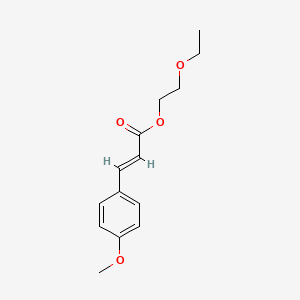
CAS 104-28-9PubChem CID 5373773
Cinoxate
2-ethoxyethyl-p-methoxycinnamate is a viscous clear to pale yellow liquid. Insoluble in water. (NTP, 1992) — CAMEO Chemicals
- IUPAC 名称
- 2-ethoxyethyl (E)-3-(4-methoxyphenyl)prop-2-enoate
- 分子式
- C14H18O4
- 分子量
- 250.29 g/mol
- 精确质量
- 250.12050905 Da
- XLogP3
- 2.4
- 拓扑极性表面积
- 44.8 Ų
- 氢键供体
- 0
- 氢键受体
- 4
- 共价单元
- 1
- 已定义的立体中心
- 0
又称
PhiasolSundareGive-TanCinoxatoGiv Tan F2-ETHOXYETHYL P-METHOXYCINNAMATECinoxatum2-Propenoic acid, 3-(4-methoxyphenyl)-, 2-ethoxyethyl ester
另有 16 个已报告名称
2-Ethoxyethyl-p-methoxycinnamate3-(4-Methoxyphenyl)-2-propenoic acid 2-ethoxyethyl ester5437O7N5BHCinnamic acid, p-methoxy-, 2-ethoxyethyl ester2-ethoxyethyl (2E)-3-(4-methoxyphenyl)prop-2-enoateRefChem:577241203-191-0Giv-tan F2-ethoxyethyl 3-(4-methoxyphenyl)prop-2-enoatePropenoic acid, 3-(4-methoxyphenyl)-, 2-ethoxyethyl esterGiv TanfCaswell No. 427ECinoxatum [INN-Latin]Cinoxato [INN-Spanish]CCRIS 4813HSDB 7424
外部数据库标识符
- ChEMBL:CHEMBL2104045
- EPA DTXSID:DTXSID101167513
来自其他科学数据库的证据
NIH PubChem PUG-View
标识符精确匹配5373773
Attributed physical-property, hazard, environmental and use annotations.
- Boiling Point: 388 °C at 760 mm Hg /Extrapolated from 185 °C at 2 mm Hg/ 来源: Hazardous Substances Data Bank (HSDB)
- Boiling Point: BP: 185 °C at 2 mm Hg 来源: Hazardous Substances Data Bank (HSDB)
- Color/Form: Viscous liquid, may have slight yellow tinge 来源: Hazardous Substances Data Bank (HSDB)
- Density: 1.1000 to 1.1035 at 77 °F (NTP, 1992) 来源: CAMEO Chemicals
- Density: 1.102 g/cu cm at 25 °C 来源: Hazardous Substances Data Bank (HSDB)
- Flash Point: greater than 212 °F (NTP, 1992) 来源: CAMEO Chemicals
- Melting Point: Solidifies below -25 °C 来源: Hazardous Substances Data Bank (HSDB)
- Odor: Practically odorless 来源: Hazardous Substances Data Bank (HSDB)
- Physical Description: 2-ethoxyethyl-p-methoxycinnamate is a viscous clear to pale yellow liquid. Insoluble in water. (NTP, 1992) 来源: CAMEO Chemicals
- Physical Description: Viscous liquid; May be slightly yellow; [Merck Index] 来源: Haz-Map, Information on Hazardous Chemicals and Occupational Diseases
- Refractive Index: Index of refraction: 1.567 at 20 °C 来源: Hazardous Substances Data Bank (HSDB)
- Solubility: Insoluble (NTP, 1992) 来源: CAMEO Chemicals
- Solubility: Practically insoluble in water with a solubility of approximately 0.05%. 来源: Hazardous Substances Data Bank (HSDB)
- Solubility: Soluble in glycerol 0.5%, propolyene glycol 5%; miscible with alcohols and vegetable oils 来源: Hazardous Substances Data Bank (HSDB)
- Vapor Pressure: 0.00034 [mmHg] 来源: Haz-Map, Information on Hazardous Chemicals and Occupational Diseases
- First Aid: EYES: First check the victim for contact lenses and remove if present. Flush victim's eyes with water or normal saline solution for 20 to 30 minutes while simultaneously calling a hospital or poison control center. Do not put any ointments, oils, or medication in the victim's eyes without specific instructions from a physician. IMMEDIATELY transport the victim after flushing eyes to a hospital even if no symptoms (such as redness or irritation) develop.; SKIN: IMMEDIATELY flood affected skin with water while removing and isolating all contaminated clothing. Gently wash all affected skin areas thoroughly with soap and water. If symptoms such as redness or irritation develop, IMMEDIATELY call a physician and be prepared to transport the victim to a hospital for treatment.; INHALATION: IMMEDIATELY leave the contaminated area; take deep breaths of fresh air. If symptoms (such as wheezing, coughing, shortness of breath, or burning in the mouth, throat, or chest) develop, call a physician and be prepared to transport the victim to a hospital. Provide proper respiratory protection to rescuers entering an unknown atmosphere. Whenever possible, Self-Contained Breathing Apparatus (SCBA) shou 来源: CAMEO Chemicals
- Environmental Bioconcentration: An estimated BCF of 26 was calculated for cinoxate in fish(SRC), using an estimated log Kow of 2.65(1) and a regression-derived equation(1). According to a classification scheme(2), this BCF suggests the potential for bioconcentration in aquatic organisms is low(SRC). 来源: Hazardous Substances Data Bank (HSDB)
- Environmental Fate: TERRESTRIAL FATE: Based on a classification scheme(1), an estimated Koc value of 208(SRC), determined from a structure estimation method(2), indicates that cinoxate is expected to have moderate mobility in soil(SRC). Volatilization of cinoxate from moist soil surfaces is not expected to be an important fate process(SRC) given an estimated Henry's Law constant of 5.1X10⁻⁹ atm-cu m/mole(SRC), using a fragment constant estimation method(2). Cinoxate is not expected to volatilize from dry soil surfaces(SRC) based upon an estimated vapor pressure of 1.6X10⁻⁵ mm Hg(SRC), determined from a fragment constant method(2). Cinoxate absorbs UV light in the sunlight spectrum(3) and, therefore, may be susceptible to direct photolysis on soil surfaces exposed to sunlight(SRC). No relevant data were available to assess the importance of biodegradation in the environment(SRC). 来源: Hazardous Substances Data Bank (HSDB)
- Environmental Fate: AQUATIC FATE: Based on a classification scheme(1), an estimated Koc value of 208(SRC), determined from a structure estimation method(2), indicates that cinoxate may have some moderate adsorption to suspended solids and sediment(SRC). Volatilization from water surfaces is not expected(3) based upon an estimated Henry's Law constant of 5.1X10⁻⁹ atm-cu m/mole(SRC), developed using a fragment constant estimation method(1). According to a classification scheme(4), an estimated BCF of 26(SRC), from an estimated log Kow of 2.65(2) and a regression-derived equation(2), suggests the potential for bioconcentration in aquatic organisms is low (SRC). A base-catalyzed second-order hydrolysis rate constant of 2.5X10⁻² L/mole-sec(SRC) was estimated using a structure estimation method(2); this corresponds to half-lives of 8.9 and 0.89 years at pH values of 7 and 8, respectively(2). Cinoxate absorbs UV light in the sunlight spectrum(5) and, therefore, may be susceptible to direct photolysis on water surfaces exposed to sunlight(SRC). No relevant data were available to assess the importance of biodegradation in the environment(SRC). 来源: Hazardous Substances Data Bank (HSDB)
- Environmental Fate: ATMOSPHERIC FATE: According to a model of gas/particle partitioning of semivolatile organic compounds in the atmosphere(1), cinoxate, which has an estimated vapor pressure of 1.6X10⁻⁵ mm Hg at 25 °C(SRC), determined from a fragment constant method(2), will exist in both the vapor and particulate phases in the ambient atmosphere. Vapor-phase cinoxate is degraded in the atmosphere by reaction with photochemically-produced hydroxyl radicals(SRC); the half-life for this reaction in air is estimated to be 6.7 hours(SRC), calculated from its rate constant of 5.7X10⁻¹¹ cu cm/molecule-sec at 25 °C(SRC) that was derived using a structure estimation method(2). Vapor-phase cinoxate is also degraded in the atmosphere by reaction with ozone (SRC); the half-life for this reaction in air is estimated to be about 19 hours(SRC), calculated from its rate constant of 1.6X10⁻¹⁷ cu cm/molecule-sec at 25 °C(SRC) that was derived using a structure estimation method(2). Particulate-phase cinoxate may be removed from the air by wet and dry deposition(SRC). Cinoxate absorbs UV light in the sunlight spectrum(3) and, therefore, may be susceptible to direct photolysis by sunlight(SRC). 来源: Hazardous Substances Data Bank (HSDB)
- Sources/Uses: Used as ultraviolet screen; [Merck Index] The cinnamates are a group of chemically related substances that are used as fragrances and flavorings and less frequently as sunscreens. [Marks, p. 219] 来源: Haz-Map, Information on Hazardous Chemicals and Occupational Diseases
- Uses: For cinoxate (USEPA/OPP Pesticide Code: 076604) there are 0 labels match. /SRP: Not registered for current use in the U.S., but approved pesticide uses may change periodically and so federal, state and local authorities must be consulted for currently approved uses./ 来源: Hazardous Substances Data Bank (HSDB)
- Uses: The active ingredient is no longer contained in any registered products ... "cancelled." 来源: Hazardous Substances Data Bank (HSDB)
- Uses: Ultraviolet screen 来源: Hazardous Substances Data Bank (HSDB)
- Uses: Sunscreening Agents 来源: Hazardous Substances Data Bank (HSDB)
映射方: Existing checksum-valid CAS to unique PubChem CID match. 检索时间: 2026-08-31. 打开来源记录
科学分类和危害注释仅提供背景信息,不能取代上方所示针对具体市场的监管决定。
其他来源的覆盖范围和匹配状态
| 来源 | 结果 | 已检查 |
|---|---|---|
| EMBL-EBI ChEBI | 无精确记录 | 2026-08-31 |
| NIH PubChem PUG-View | 精确匹配 | 2026-08-31 |
已记录的无匹配结果是该来源已被检查的有效证据;这并不表示该物质在别处不存在。
于 2026-09-02 通过校验和有效的 CAS 匹配从美国国立卫生研究院 (NIH) PubChem 检索。化学性质不能取代本页的监管决定。