
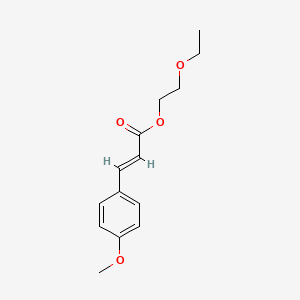
Cinoxate
2-ethoxyethyl-p-methoxycinnamate is a viscous clear to pale yellow liquid. Insoluble in water. (NTP, 1992) — CAMEO Chemicals
- Nom IUPAC
- 2-ethoxyethyl (E)-3-(4-methoxyphenyl)prop-2-enoate
- Formule moléculaire
- C14H18O4
- Masse moléculaire
- 250.29 g/mol
- Masse exacte
- 250.12050905 Da
- XLogP3
- 2,4
- Surface polaire topologique
- 44,8 Ų
- Donneurs de liaisons hydrogène
- 0
- Accepteurs de liaisons hydrogène
- 4
- Unités covalentes
- 1
- Stéréocentres définis
- 0
Également connu sous le nom de
16 autres noms signalés
Identifiants de bases de données externes
- ChEMBL:CHEMBL2104045
- EPA DTXSID:DTXSID101167513
Preuves issues de bases de données scientifiques complémentaires
NIH PubChem PUG-View
Attributed physical-property, hazard, environmental and use annotations.
- Boiling Point: 388 °C at 760 mm Hg /Extrapolated from 185 °C at 2 mm Hg/ Source: Hazardous Substances Data Bank (HSDB)
- Boiling Point: BP: 185 °C at 2 mm Hg Source: Hazardous Substances Data Bank (HSDB)
- Color/Form: Viscous liquid, may have slight yellow tinge Source: Hazardous Substances Data Bank (HSDB)
- Density: 1.1000 to 1.1035 at 77 °F (NTP, 1992) Source: CAMEO Chemicals
- Density: 1.102 g/cu cm at 25 °C Source: Hazardous Substances Data Bank (HSDB)
- Flash Point: greater than 212 °F (NTP, 1992) Source: CAMEO Chemicals
- Melting Point: Solidifies below -25 °C Source: Hazardous Substances Data Bank (HSDB)
- Odor: Practically odorless Source: Hazardous Substances Data Bank (HSDB)
- Physical Description: 2-ethoxyethyl-p-methoxycinnamate is a viscous clear to pale yellow liquid. Insoluble in water. (NTP, 1992) Source: CAMEO Chemicals
- Physical Description: Viscous liquid; May be slightly yellow; [Merck Index] Source: Haz-Map, Information on Hazardous Chemicals and Occupational Diseases
- Refractive Index: Index of refraction: 1.567 at 20 °C Source: Hazardous Substances Data Bank (HSDB)
- Solubility: Insoluble (NTP, 1992) Source: CAMEO Chemicals
- Solubility: Practically insoluble in water with a solubility of approximately 0.05%. Source: Hazardous Substances Data Bank (HSDB)
- Solubility: Soluble in glycerol 0.5%, propolyene glycol 5%; miscible with alcohols and vegetable oils Source: Hazardous Substances Data Bank (HSDB)
- Vapor Pressure: 0.00034 [mmHg] Source: Haz-Map, Information on Hazardous Chemicals and Occupational Diseases
- First Aid: EYES: First check the victim for contact lenses and remove if present. Flush victim's eyes with water or normal saline solution for 20 to 30 minutes while simultaneously calling a hospital or poison control center. Do not put any ointments, oils, or medication in the victim's eyes without specific instructions from a physician. IMMEDIATELY transport the victim after flushing eyes to a hospital even if no symptoms (such as redness or irritation) develop.; SKIN: IMMEDIATELY flood affected skin with water while removing and isolating all contaminated clothing. Gently wash all affected skin areas thoroughly with soap and water. If symptoms such as redness or irritation develop, IMMEDIATELY call a physician and be prepared to transport the victim to a hospital for treatment.; INHALATION: IMMEDIATELY leave the contaminated area; take deep breaths of fresh air. If symptoms (such as wheezing, coughing, shortness of breath, or burning in the mouth, throat, or chest) develop, call a physician and be prepared to transport the victim to a hospital. Provide proper respiratory protection to rescuers entering an unknown atmosphere. Whenever possible, Self-Contained Breathing Apparatus (SCBA) shou Source: CAMEO Chemicals
- Environmental Bioconcentration: An estimated BCF of 26 was calculated for cinoxate in fish(SRC), using an estimated log Kow of 2.65(1) and a regression-derived equation(1). According to a classification scheme(2), this BCF suggests the potential for bioconcentration in aquatic organisms is low(SRC). Source: Hazardous Substances Data Bank (HSDB)
- Environmental Fate: TERRESTRIAL FATE: Based on a classification scheme(1), an estimated Koc value of 208(SRC), determined from a structure estimation method(2), indicates that cinoxate is expected to have moderate mobility in soil(SRC). Volatilization of cinoxate from moist soil surfaces is not expected to be an important fate process(SRC) given an estimated Henry's Law constant of 5.1X10⁻⁹ atm-cu m/mole(SRC), using a fragment constant estimation method(2). Cinoxate is not expected to volatilize from dry soil surfaces(SRC) based upon an estimated vapor pressure of 1.6X10⁻⁵ mm Hg(SRC), determined from a fragment constant method(2). Cinoxate absorbs UV light in the sunlight spectrum(3) and, therefore, may be susceptible to direct photolysis on soil surfaces exposed to sunlight(SRC). No relevant data were available to assess the importance of biodegradation in the environment(SRC). Source: Hazardous Substances Data Bank (HSDB)
- Environmental Fate: AQUATIC FATE: Based on a classification scheme(1), an estimated Koc value of 208(SRC), determined from a structure estimation method(2), indicates that cinoxate may have some moderate adsorption to suspended solids and sediment(SRC). Volatilization from water surfaces is not expected(3) based upon an estimated Henry's Law constant of 5.1X10⁻⁹ atm-cu m/mole(SRC), developed using a fragment constant estimation method(1). According to a classification scheme(4), an estimated BCF of 26(SRC), from an estimated log Kow of 2.65(2) and a regression-derived equation(2), suggests the potential for bioconcentration in aquatic organisms is low (SRC). A base-catalyzed second-order hydrolysis rate constant of 2.5X10⁻² L/mole-sec(SRC) was estimated using a structure estimation method(2); this corresponds to half-lives of 8.9 and 0.89 years at pH values of 7 and 8, respectively(2). Cinoxate absorbs UV light in the sunlight spectrum(5) and, therefore, may be susceptible to direct photolysis on water surfaces exposed to sunlight(SRC). No relevant data were available to assess the importance of biodegradation in the environment(SRC). Source: Hazardous Substances Data Bank (HSDB)
- Environmental Fate: ATMOSPHERIC FATE: According to a model of gas/particle partitioning of semivolatile organic compounds in the atmosphere(1), cinoxate, which has an estimated vapor pressure of 1.6X10⁻⁵ mm Hg at 25 °C(SRC), determined from a fragment constant method(2), will exist in both the vapor and particulate phases in the ambient atmosphere. Vapor-phase cinoxate is degraded in the atmosphere by reaction with photochemically-produced hydroxyl radicals(SRC); the half-life for this reaction in air is estimated to be 6.7 hours(SRC), calculated from its rate constant of 5.7X10⁻¹¹ cu cm/molecule-sec at 25 °C(SRC) that was derived using a structure estimation method(2). Vapor-phase cinoxate is also degraded in the atmosphere by reaction with ozone (SRC); the half-life for this reaction in air is estimated to be about 19 hours(SRC), calculated from its rate constant of 1.6X10⁻¹⁷ cu cm/molecule-sec at 25 °C(SRC) that was derived using a structure estimation method(2). Particulate-phase cinoxate may be removed from the air by wet and dry deposition(SRC). Cinoxate absorbs UV light in the sunlight spectrum(3) and, therefore, may be susceptible to direct photolysis by sunlight(SRC). Source: Hazardous Substances Data Bank (HSDB)
- Sources/Uses: Used as ultraviolet screen; [Merck Index] The cinnamates are a group of chemically related substances that are used as fragrances and flavorings and less frequently as sunscreens. [Marks, p. 219] Source: Haz-Map, Information on Hazardous Chemicals and Occupational Diseases
- Uses: For cinoxate (USEPA/OPP Pesticide Code: 076604) there are 0 labels match. /SRP: Not registered for current use in the U.S., but approved pesticide uses may change periodically and so federal, state and local authorities must be consulted for currently approved uses./ Source: Hazardous Substances Data Bank (HSDB)
- Uses: The active ingredient is no longer contained in any registered products ... "cancelled." Source: Hazardous Substances Data Bank (HSDB)
- Uses: Ultraviolet screen Source: Hazardous Substances Data Bank (HSDB)
- Uses: Sunscreening Agents Source: Hazardous Substances Data Bank (HSDB)
Mis en correspondance par: Existing checksum-valid CAS to unique PubChem CID match. Récupéré le: 2026-08-31. Ouvrir la fiche source
Les classifications scientifiques et les annotations de danger apportent du contexte et ne remplacent pas la décision réglementaire propre au marché indiquée ci-dessus.
Couverture des sources complémentaires et état des correspondances
| Source | Résultat | Vérifié |
|---|---|---|
| EMBL-EBI ChEBI | Aucune fiche exacte | 2026-08-31 |
| NIH PubChem PUG-View | Correspondance exacte | 2026-08-31 |
Une absence de correspondance enregistrée est une preuve utile que la source a été vérifiée ; ce n’est pas l’affirmation que la substance n’existe pas ailleurs.
Récupéré depuis NIH PubChem le 2026-09-02 par correspondance CAS à somme de contrôle valide. Les propriétés chimiques ne remplacent pas la décision réglementaire de cette page.